Why UK Data Centres Are Now a Water Permitting Hot Topic in 2026
UK Environment Agency guidance treats cooling-tower blowdown as a regulated discharge under the Environmental Permitting (England and Wales) Regulations 2016 (EPR 2016). Operators self-supplying more than 100 m³/day must hold an abstraction licence; below that threshold, a registration may suffice, but new groundwater availability maps issued by Severn Trent and Thames Water regions in early 2026 have closed the de-minimis route for most hyperscale sites in the south-east and Midlands. The choice between a bespoke installation permit and a standard-rules permit turns on whether the treatment works exceeds the activity thresholds in the standard rules set (SR-2014 No. 2 and successors) — anything outside those limits falls into a bespoke application, which adds 13–18 weeks to programme. Board-level attention is sharpened by public commitments from major cloud providers to water-positive status by 2030, which now appears in UK enterprise procurement specifications as a WUE ceiling of 0.5–1.0 L/kWh for new build. On-site treatment decisions matter disproportionately: the IEA estimates data centre water use as 40% direct and 60% indirect (at power plants), so cutting direct abstraction has a faster line-of-sight in any EA submission than grid-carbon arguments (per IEA, as cited in CRS R49057).
Environment Agency Permits and Consents You Must Map First
Four UK consent pathways touch a typical cooling-water system, and the engineer must map each one before specifying equipment. Understanding these regulatory requirements is essential for maintaining compliance throughout the site lifecycle.
The first is the abstraction licence from the EA if the site self-supplies from a river, reservoir or borehole; for a 10 MW IT load running at 1.0 L/kWh, annual draw is roughly 87,600 m³ — comfortably above the 100 m³/day threshold that triggers a full licence rather than registration. The second is the EPR 2016 installation or standard-rules permit covering the on-site treatment train itself: screening, softening, membrane duty, chemical dosing, blowdown holding and any side-stream DAF. The third is the water discharge consent (WDC) under the Water Resources Act 1991, required for any direct outfall to surface water or a controlled surface-water drain; cooling-tower blowdown to a sewer does not normally require a WDC but does require consent four. That fourth pathway is the trade effluent consent with the local Water Company under Section 53 of the Water Industry Act 1991, which sets mass and concentration limits on temperature, pH, suspended solids, zinc (typically <1 mg/L where galvanic protection is in the loop), molybdate-based corrosion inhibitors and free chlorine (<0.5 mg/L) before discharge to the public sewer. PFAS screening is now a standing trigger: the Water UK Position Statement on PFAS (referenced in Project Finance Law, 2025-07) is being folded into 2026 consent templates, and operators with legacy PFAS-containing water-mist suppressants should expect specific effluent monitoring conditions. For chiller-side excursions, the regulatory treatment is different: closed-loop LSI breaches are an on-site asset-protection event, not a permit event, because the volume is batch and contained. Co-locating with a municipal WwTW is treated in the UK as a Section 55 bulk supply agreement with the Water Company rather than a new abstraction, paralleling the reclaimed-water model used by Loudoun Water in Virginia (Project Finance Law, 2025-07), and the engineering specification of the pre-treatment train changes accordingly.
WUE, Blowdown Chemistry and the Numbers Your Plant Must Hit
WUE is total annual site water (litres) divided by IT energy (kWh). A 10 MW IT load at 1.0 L/kWh draws about 87,600 m³/year, produces roughly 26,000 m³ of evaporation at 30% of makeup, and generates a blowdown stream sized by the cycles-of-concentration equation B = E × Cyc / (Cyc − 1). At 4 cycles, blowdown is one-third of evaporation; at 6 cycles, it is one-fifth, which is the practical ceiling before silica and calcium sulphate scaling dominate. Hyperscaler procurement specifications are now landing at WUE ≤ 0.5 L/kWh for new UK sites, which forces either closed-loop liquid cooling with reclaimed makeup or aggressive cycles paired with sidestream softening. The chemistry targets an operator puts on a P&ID are: TDS <500 mg/L on the basin at 4 cycles when makeup TDS is ~100 mg/L; calcium hardness <200 mg/L as CaCO₃; silica <150 mg/L; and a Langelier Saturation Index held in the −0.5 to +0.5 corridor to avoid simultaneous scale and corrosion (HydropureWater field data, 2026). Conductivity-controlled automatic blowdown at 1,500–2,500 µS/cm is the cheapest single lever for staying inside that band.
| Parameter | Open tower makeup target | Blowdown limit before sewer discharge | Closed-loop / liquid-cooling target |
|---|---|---|---|
| WUE (L/kWh) | ≤ 1.0 (UK baseline) | n/a | ≤ 0.5 (hyperscaler spec) |
| Cycles of concentration | 4–6 | setpoint-driven | 6–10 with sidestream softening |
| TDS (mg/L) | < 500 | < 1,500 | < 50 (post-RO) |
| Calcium hardness as CaCO₃ (mg/L) | < 200 | < 600 | < 5 (post-softener) |
| Silica (mg/L) | < 150 | < 200 | < 10 |
| LSI | −0.3 to +0.3 | −0.5 to +0.5 | −0.5 to +0.0 |
| Free chlorine residual (mg/L) | 0.5–1.0 (basin) | < 0.5 (consent) | < 0.1 (LOOP) |
Less than 5% of UK data centre water comes from non-municipal alternative sources (Project Finance Law, 2025-07), so the engineering work is to grow that share through reclaimed-water contracts and on-site reuse, not to abandon the municipal baseline.
Treatment Train Options for Cooling Makeup and Blowdown
Four trains cover the vast majority of UK data centre cases, and the engineer should pick by source water and end-use, not by product brochure. Selecting the correct configuration ensures operational efficiency and regulatory compliance.
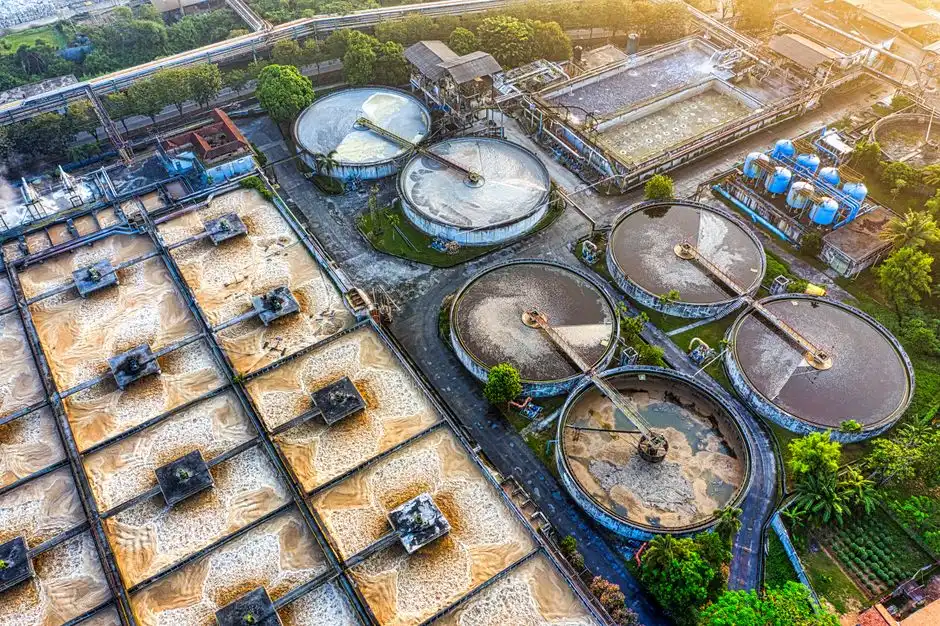
Train 1, for sites on municipal potable water with open cooling towers only, is a twin-tank industrial water softener feeding a PLC-controlled antiscalant and biocide dosing skid, with conductivity-controlled automatic blowdown. Train 2, for reclaimed water, greywater or hyperscaler liquid-cooling sites, inserts a 0.03 µm PVDF ultrafiltration system ahead of a closed-loop cooling makeup RO system — the UF holds the Silt Density Index below 3, which is the operating envelope that keeps RO membrane flux stable and extends cleaning-in-place intervals from monthly to quarterly. Train 3, for surface-water intakes or run-off harvesting, layers micro-bubble DAF for side-stream TSS ahead of multimedia filtration, UF, antiscalant dosing and RO. Train 4 is blowdown polishing: DAF or lamella clarifier, sand filter, pH correction and dechlorination ahead of sewer discharge to satisfy the trade effluent consent.
| Train | Source water | End use | Key equipment | Typical recovery / removal |
|---|---|---|---|---|
| 1 — Softener + dosing | Municipal potable | Open cooling tower | Softener, dosing skid, blowdown conductivity controller | Hardness <5 mg/L CaCO₃ |
| 2 — UF + RO + dosing | Reclaimed / greywater | Closed-loop, direct-to-chip liquid cooling | UF (0.03 µm), antiscalant, RO 75–85% | TDS rejection >99%, resistivity >15 MΩ·cm (2-pass) |
| 3 — DAF + MMF + UF + RO | Surface water / harvested | Open tower + closed-loop | DAF, multimedia, UF, RO | TSS <2 mg/L post-UF, recovery 70–80% |
| 4 — Blowdown polishing | Cooling-tower blowdown | Sewer discharge | DAF/lamella, sand filter, pH correction, dechlorination | Free Cl <0.5 mg/L, TSS <30 mg/L |
UF air-scour backwash every 20–40 minutes is the standard cycle that protects flux and reduces chemical cleaning. RO recovery in the 75–85% band is realistic with an energy-recovery device on the brine stream; two-pass RO is reserved for direct-to-chip liquid cooling where resistivity must exceed 15 MΩ·cm.
Engineering Decision Framework: Which Equipment for Which Site

Four procurement-ready rules let the engineer shortlist a train in a single meeting.
Rule 1. If the data centre is on municipal potable and runs open cooling towers only, specify softener, chemical dosing skid and conductivity-controlled automatic blowdown. Skip UF and RO — they are not justified by the feed-water quality and add permit scope under EPR 2016 that the site does not need.
Rule 2. If the operator has a reclaimed-water agreement with the local Water Company or a Section 55 bulk supply, specify a 0.03 µm PVDF ultrafiltration system feeding antiscalant dosing and a closed-loop cooling makeup RO system at 75–85% recovery. This is the same train used by hyperscaler liquid-cooling sites.
Rule 3. If blowdown goes to a sewer with a tight trade effluent consent (zinc <1 mg/L, free Cl <0.5 mg/L), add a micro-bubble DAF for side-stream TSS and a dechlorination step before discharge — see the UK package wastewater treatment plants engineering guide for sizing.
Rule 4. If the site targets WUE < 0.5 L/kWh, plan for RO-concentrate and blowdown blending for non-critical reuse (e.g., toilet flushing, landscape irrigation) before specifying further treatment. Reuse of these streams is the cheapest WUE lever available and the cleanest narrative for an EA permit application. The Helsinki data centre cooling blowdown guide and the Warsaw data centre cooling blowdown guide give worked examples of similar blowdown-blending strategies in cold-climate sites.
Frequently Asked Questions
Do UK data centres need an Environment Agency permit for cooling-tower blowdown?
Yes, in most cases. Cooling-tower blowdown that is treated on-site is regulated under the Environmental Permitting (England and Wales) Regulations 2016 as a standard-rules or bespoke installation permit, depending on throughput. Blowdown discharged to a sewer additionally needs a trade effluent consent from the local Water Company under Section 53 of the Water Industry Act 1991, with concentration limits on free chlorine (<0.5 mg/L), zinc and pH.
What WUE should a new UK data centre target in 2026?
Enterprise procurement specifications for new UK build are landing at WUE ≤ 0.5 L/kWh for hyperscaler liquid-cooling sites and ≤ 1.0 L/kWh for conventional open-tower sites. A
Frequently Asked Questions
Do UK data centres need an Environment Agency permit for cooling tower blowdown?
Yes, if the cooling tower blowdown is discharged directly into surface water or groundwater, you require an environmental permit from the Environment Agency. This is regulated under the Environmental Permitting (England and Wales) Regulations 2016 to ensure that chemicals, biocides, and temperature profiles do not adversely affect the receiving water body’s chemical or ecological status.
If the blowdown is discharged into the public foul sewer, it does not require an environmental permit from the Agency. Instead, it requires a trade effluent consent from your local sewerage undertaker, who will set limits on volume, pH, temperature, and specific chemical concentrations to ensure the waste does not damage the sewer network or interfere with wastewater treatment processes.
What WUE should a UK data centre target in 2026?
For 2026, industry best practice for new-build hyperscale and enterprise data centres in the UK is to target a Water Usage Effectiveness (WUE) of 0.20 L/kWh or lower. While the global average remains higher, UK facilities are increasingly adopting closed-loop systems and high-efficiency adiabatic cooling to drive performance toward this benchmark.
In water-stressed regions of the UK, such as the South East, local planning authorities and the Environment Agency may mandate lower WUE targets as a condition of planning permission. Facilities should monitor their WUE against the ASHRAE TC 9.9 standards, which provide the framework for balancing water consumption with energy efficiency and IT equipment reliability.
Can a data centre in the UK use reclaimed water for cooling?
Yes, using reclaimed or recycled water, such as treated effluent from a nearby wastewater treatment plant (often called 'purple pipe' water), is an increasingly viable strategy for UK data centres. This approach significantly reduces the demand on potable mains water supplies, which is a key metric for demonstrating environmental sustainability under updated Environment Agency guidance.
However, the use of reclaimed water requires advanced on-site treatment systems, including side-stream filtration, additional biocide dosing, and rigorous monitoring for Legionella and other pathogens. The water quality must be compatible with the cooling loop metallurgy to prevent scaling, corrosion, and fouling, which could otherwise lead to higher energy consumption and reduced equipment lifespan.
What is the difference between a trade effluent consent and a water discharge consent?
A trade effluent consent is an agreement with your local water utility company for the discharge of wastewater into the public sewer system. It focuses on protecting the integrity of the sewerage infrastructure and ensuring that the treatment plant can process the waste without violating its own environmental permits.
A water discharge consent (now typically an environmental permit) is issued by the Environment Agency for the discharge of wastewater directly into the environment, such as a river, stream, or soakaway. This permit is significantly more stringent, as it mandates specific concentration limits for pollutants to protect the direct ecological health of the receiving water body.
When does a data centre abstraction licence trigger in England?
An abstraction licence is required if a data centre intends to take more than 20 cubic metres (20,000 litres) of water per day from a single source, such as a river, stream, canal, or underground aquifer. This threshold is strictly enforced under the Water Resources Act 1991 to prevent the depletion of water bodies and protect local ecosystems.
If your facility intends to abstract water for cooling purposes, you must apply to the Environment Agency for a full abstraction licence. The application process involves a technical assessment of the proposed volume, the impact on the local water balance, and the potential effect on other water users. Exemptions exist for certain emergency activities, but these are generally not applicable to the continuous operational requirements of data centre cooling.