The ArcelorMittal Texas Precedent: What Permit WQ0005097000 Reveals
ArcelorMittal Texas HBI LLC's facility at 2800 Kay Bailey Hutchison Road, Portland, TX 78374 operates under TPDES Permit WQ0005097000 (EPA I.D. TX0134911) for direct-reduced iron and hot-briquetting iron production, and TCEQ's current major amendment to remove Outfall 201 demonstrates that outfall-level changes at a DRI/HBI site trigger full technical review, not an administrative transfer. Per the TCEQ Notice of Receipt of Application, ArcelorMittal sought authority to eliminate Outfall 201 and all associated references in the permit — a single outfall removal that nonetheless required public notice, antidegradation review, and re-evaluation against 40 CFR 420 Subpart F (DRI) and Subpart G (HBI) technology-based limits. The practical implication for an acquirer: any deal that changes process flow, production rate, cooling water routing, or outfall configuration at a Texas DRI/HBI plant inherits this same major-amendment pathway, not a simple paperwork change. The Portland facility discharges to Corpus Christi Bay (TCEQ Segment 2481), so the amendment also triggered Texas Surface Water Quality Standards review and bay-side mixing zone considerations. For engineers sizing a compliance budget, TCEQ will not rubber-stamp process-side changes at a steel/DRI site, even when the change is a reduction in discharge points.
Acquisition Trigger Assessment: Three Regulatory Pathways
Three TPDES pathways cover every Texas DRI/HBI acquisition scenario, and the choice depends entirely on whether the deal changes operations, not on deal structure. Pathway A is an administrative ownership transfer: the acquirer files TCEQ Form 10055 within 30 days of closing, the permit is reissued in identical terms, and the typical processing window is 30 days with no technical review. Pathway B is a major amendment under 30 TAC §305.62(c) — required when the acquisition changes production rate, adds DRI/HBI lines, modifies cooling water systems, alters outfall locations, or introduces new pollutant sources. TCEQ performs a complete technical review, issues public notice (30-day comment period), re-evaluates 40 CFR 420 limits, and the realistic timeline is 90-120 days; this is the pathway ArcelorMittal's own Outfall 201 amendment is traveling. Pathway C is a new TPDES permit for facilities with new discharge points, new outfalls, or no prior permit history — submission of Forms 10055 and 10053, technical review, possible contested case hearing, and 180+ day processing under 30 TAC §305.61. Understanding these distinctions allows firms to plan their operational integration timelines accordingly.
| Decision Factor | Pathway A (Form 10055 Only) | Pathway B (Major Amendment) | Pathway C (New TPDES) |
|---|---|---|---|
| Trigger condition | Ownership change, no process modification | Process change, outfall modification, new pollutants | New discharge, new outfall, no existing permit |
| Forms required | TCEQ-10055 | TCEQ-10055 + 10053 + tech memo | TCEQ-10055 + 10053 (full application) |
| Technical review | None (administrative) | Full 40 CFR 420 re-evaluation | Full new-source review |
| Public notice | No | Yes (30 days) | Yes (30 days) + possible hearing |
| Typical timeline | ~30 days | 90-120 days | 180+ days |
| Permit continuity during review | N/A | Operate under existing permit | Admin continuation under 30 TAC §305.62 |
Decision rule: if the answer to any of these is "yes" — production rate change, new DRI/HBI line, cooling water modification, outfall relocation, new waste stream — the deal moves out of Pathway A into B or C.
40 CFR Effluent Limits for DRI and HBI Operations
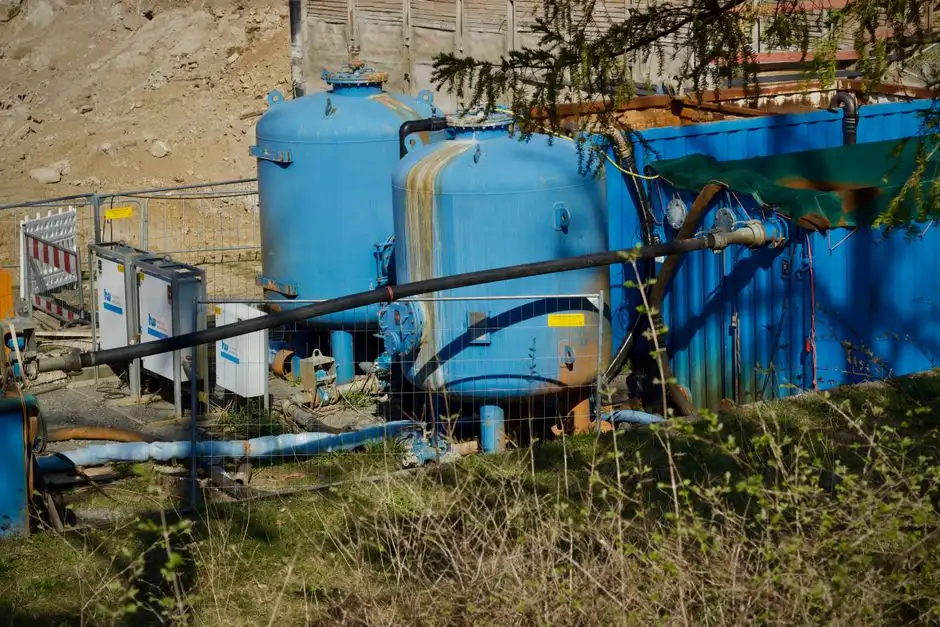
DRI/HBI facilities discharging under TPDES must meet 40 CFR 420 Subpart F (DRI) and Subpart G (HBI) technology-based effluent limits, codified at 40 CFR §420.60 through §420.77. Subpart F sets Best Practicable Control Technology (BPT) and Best Available Technology (BAT) limits at TSS 30 mg/L daily max and 20 mg/L 30-day average, Oil & Grease 10 mg/L daily max, pH 6.0-9.0, and a temperature rise no greater than 2.8°C above intake water. Subpart G (HBI) adds three metals/nitrogen parameters that drive most of the treatment design: Total Iron 3.0 mg/L daily max, Total Zinc 1.0 mg/L daily max, and Ammonia as N 30 mg/L daily max. New Source Performance Standards (NSPS) under §420.65 apply tighter limits to DRI/HBI lines constructed after 1984: TSS 20 mg/L daily max (10 mg/L 30-day avg), O&G 5 mg/L daily max (2.5 mg/L 30-day avg) — so any acquisition that constructs new DRI or HBI capacity inherits the NSPS floor, not the older BPT/BAT ceiling. These baseline requirements dictate the technical parameters for all subsequent facility upgrades.
| Parameter | Subpart F (DRI) BPT/BAT Daily Max | Subpart F 30-Day Avg | Subpart G (HBI) Daily Max | NSPS (Post-1984 New Source) |
|---|---|---|---|---|
| TSS (mg/L) | 30 | 20 | 30 | 20 (10 avg) |
| Oil & Grease (mg/L) | 10 | — | 10 | 5 (2.5 avg) |
| Total Iron (mg/L) | — | — | 3.0 | 3.0 |
| Total Zinc (mg/L) | — | — | 1.0 | 1.0 |
| Ammonia as N (mg/L) | — | — | 30 | 30 |
| pH (SU) | 6.0-9.0 | 6.0-9.0 | 6.0-9.0 | 6.0-9.0 |
| Temperature rise (°C) | ≤ 2.8 above intake | — | ≤ 2.8 above intake | ≤ 2.8 above intake |
Raw DRI/HBI wastewater characteristics that drive the design basis: flow 1-3 m³ per ton of product, pH 9-11 from lime addition in the reduction furnace gas scrubbing, temperature 40-60°C, suspended solids 200-500 mg/L from scrubber blowdown, oils 50-150 mg/L from rolling and briquetting lubrication, and soluble Fe/Zn from pickling and quench operations. For cross-referencing the full federal limits framework across categories, the complete 40 CFR effluent guidelines reference is the standard engineer-side lookup.
Treatment Train Design for DRI/HBI Wastewater Compliance
A compliant DRI/HBI treatment train is a four-stage system sized to the raw wastewater characteristics above and the Subpart F/G limits. Primary stage is dissolved air flotation targeting 90% O&G removal and 80% TSS removal — a properly designed DAF system for primary O&G and TSS removal handles 50-150 mg/L O&G and 200-500 mg/L TSS influent while skimming float for separate handling. Secondary stage is a lamella clarifier for metallics precipitation operated at 20-40 m/h surface loading with chemical precipitation of Fe and Zn at pH 8.5-9.5, followed by PLC-controlled dosing for pH and coagulant control to hold the metals within the 3.0/1.0 mg/L Subpart G envelope. Tertiary stage is pH adjustment (CO₂ or sulfuric acid) to bring 9-11 influent into the 6-9 discharge window, paired with a cooling tower or plate heat exchanger to knock 40-60°C effluent below the 2.8°C rise limit relative to intake. Polishing stage is multimedia filtration (anthracite/sand/garnet) for final TSS under 10 mg/L, with optional activated carbon for residual organics from lubricants. Sludge handling closes the loop: a plate-and-frame filter press dewatering DAF float and clarifier underflow to 15-25% dry solids, after which the solids typically classify as D008 (metals-bearing) under RCRA and require licensed disposal. For metals-bearing process water reuse, the engineering tradeoffs between membrane bioreactor and moving-bed biofilm reactor are detailed in the MBR vs MBBR comparison for metals wastewater reuse field study.
Pretreatment and Local Limits: Municipal vs. Direct Discharge
Plants discharging to a publicly owned treatment works (POTW) face 40 CFR 403 General Pretreatment Standards plus local POTW limits, which are often tighter than 40 CFR 420 for metals and oils. Texas POTWs handling industrial loads typically set local limits at Fe below 5 mg/L, Zn below 2 mg/L, O&G below 100 mg/L, and pH 6-10 — values that require pretreatment polishing beyond what 40 CFR 420 alone would demand. Categorical pretreatment standards under 40 CFR 420 apply to indirect discharges, but most Texas POTWs also impose mass-based limits that force flow equalization ahead of the discharge point. The ArcelorMittal Portland facility discharges directly to Corpus Christi Bay under TPDES, which sidesteps POTW variability but requires full 40 CFR 420 compliance with no municipal buffer. Acquisition teams should run a parallel local limits check at any receiving POTW before sizing the treatment train. For context on how Texas industrial pretreatment is enforced in adjacent sectors, the Mexico-US food and beverage pretreatment compliance guide walks through the enforcement mechanics that also govern steel/POTW interfaces.
Timeline and Integration: Aligning Permit Strategy with Acquisition Close
Pre-close due diligence requires the seller's TPDES permit, Discharge Monitoring Reports (DMRs) for the trailing 36 months, compliance history, and any pending TCEQ enforcement actions. File Form 10055 within 30 days of closing regardless of pathway — this preserves permit continuity even if a major amendment is queued behind it. If process changes are identified, submit the major amendment application (Form 10055 + Form 10053 + technical memo) by day 30-90, including updated process flow diagrams, pollutant load calculations, and the treatment design basis. TCEQ technical review and 30-day public notice consume days 90-180, with a realistic 120-day total for Pathway B. For Pathway C (new permit), the acquired facility operates under administrative continuation of the prior permit during the 180+ day processing window, but production cannot exceed prior permitted limits until the new TPDES is issued. Acquisition teams evaluating parallel semiconductor or advanced-manufacturing sites should compare the regulatory clock against the Intel Texas acquisition wastewater compliance guide to identify cross-sector permit leverage points.
Frequently Asked Questions
Does a stock purchase vs. asset purchase change TPDES transfer requirements?
No. TCEQ Form 1
Frequently Asked Questions
Does ArcelorMittal acquiring a Texas plant require a new TPDES permit or just a transfer?
Under Texas Commission on Environmental Quality (TCEQ) rules, an acquisition typically qualifies for an administrative transfer of the Texas Pollutant Discharge Elimination System (TPDES) permit. This process involves filing an Ownership Change Form, provided there are no planned changes to the facility's operations, discharge locations, or waste streams that would necessitate a major permit modification.
If ArcelorMittal intends to modify the existing production capacity or introduce new processes post-acquisition, a major amendment application may be required. In such cases, the TCEQ will evaluate whether the current permit limits remain protective of the receiving water body under the updated facility configuration.
What are the 40 CFR 420 effluent limits for direct reduced iron (DRI) wastewater?
Direct Reduced Iron (DRI) production is regulated under 40 CFR Part 420, Subpart G. For existing sources using the gaseous reduction process, effluent limitations focus on Total Suspended Solids (TSS) and Oil and Grease (O&G). Daily maximum limits are set at 50 mg/L for TSS and 15 mg/L for O&G, with 30-day average limitations of 25 mg/L and 10 mg/L respectively.
Facilities must also ensure that the pH of the discharge remains within the range of 6.0 to 9.0 standard units at all times. Depending on the specific site's water quality standards, the TPDES permit may impose more stringent water-quality-based effluent limits (WQBELs) that supersede these federal categorical standards.
How long does a major TPDES amendment take in Texas for a steel plant?
A major TPDES amendment for a steel facility in Texas typically takes between 12 to 18 months from the date of administrative completeness to final permit issuance. This timeline includes the technical review by TCEQ staff, public notice periods, the opportunity for public comment, and potential contested case hearings if significant public interest is expressed.
The duration can extend beyond this range if the facility requires an anti-degradation review for discharges into sensitive water bodies or if the U.S. Environmental Protection Agency (EPA) exercises its authority to review the draft permit for compliance with the Clean Water Act.
What pretreatment equipment is needed for DRI/HBI wastewater to meet TPDES limits?
To meet 40 CFR 420 standards, DRI/HBI wastewater treatment systems typically require a multi-stage approach starting with primary clarification or sedimentation to remove heavy suspended solids. This is often followed by oil-water separators or dissolved air flotation (DAF) units to achieve the required O&G concentrations.
Advanced facilities often incorporate secondary treatment, such as multimedia filtration or membrane bioreactors (MBR), to manage fine particulate matter and potential dissolved pollutants. Furthermore, automated pH adjustment systems using sulfuric acid or caustic soda injection are essential to maintain compliance with the required 6.0–9.0 pH discharge window.
Can an acquired plant keep operating under the seller's permit during transfer?
Yes, under Texas Administrative Code Title 30, Section 305.65, a facility may continue to operate under the existing TPDES permit following an acquisition, provided that a completed Ownership Change Form is submitted to the TCEQ within 30 days of the change in ownership. The facility must continue to adhere to all existing monitoring, reporting, and effluent limitations stipulated in the seller's permit during the transition.
Operations must remain consistent with the operational parameters defined in the original permit. If the acquisition involves a change in the nature or volume of the discharge, the facility must submit a formal amendment application and receive authorization before implementing those specific operational changes.