Arizona's Wastewater Rule Stack When TSMC Closes on a Plant
When TSMC acquires a plant in Arizona in 2026, the new owner must re-issue the ADEQ Aquifer Protection Permit (APP) and the AZPDES multi-sector industrial stormwater permit within 60 working days of closing, register the facility under A.R.S. Title 49, meet 40 CFR Part 433 metal-finishing and Part 411 semiconductor effluent guidelines, and clear TSMC's own Key Supplier audit (3 risk indicators, 85.7% improvement benchmark, 7 themes). Plan an NLD train from day one.
Four regulators will demand a document from the new owner within 90 days of closing. The Arizona Department of Environmental Quality (ADEQ) controls the Aquifer Protection Permit under A.R.S. § 49-255 and the multi-sector AZPDES industrial stormwater permit under AAC R-18-9-A301; both instruments are issued to a specific legal entity and lapse on a change of control, forcing full re-application rather than an amendment. The county environmental health department (Maricopa County Environmental Services for Phoenix/Chandler sites, Pinal County Public Health for Casa Grande/Eloy sites) handles on-site sewage and industrial waste handling, while the receiving water authority (City of Phoenix Water Services for the 91st Avenue system, EPCOR for the Anthem/south Scottsdale system, or the Town of Queen Creek for the Higley segment) controls the sewer-use ordinance that sits on top of the AZPDES pretreatment requirements. Layered on top of all three sits TSMC corporate's Supply Online 360 platform, which treats a wholly-owned fab as a key supplier from day one.
The WRI water-risk assessment classifies TSMC Arizona as a high-risk site (per TSMC 2025 Sustainability Report), and that designation will carry into the APP record for any acquired plant in the same operating watershed. The calendar risk is immediate: ADEQ rules give the buyer 60 working days from close to file the APP re-issuance application, while TSMC corporate's aviso paralelo (the change-of-control notice in the Supply Online 360 portal) is due within 30 days. A 10-day miss on the ADEQ clock is the most common reason an acquired fab's first TSMC on-site audit opens with a finding rather than a baseline.
Aquifer Protection Permit vs AZPDES: Which One Drives Design
The APP regulates discharges to the vadose zone and to surface impoundments; AZPDES regulates surface-water discharge under the federal Clean Water Act NPDES delegation. Most Phoenix- and Chandler-located fabs route to a municipal sewer (POTW) and trigger the AZPDES pretreatment path, while a Pinal County site with on-site evaporation ponds triggers the APP path — the two instruments rarely co-exist on the same outfall, but they co-exist on the same site. The 40 CFR Part 411 (semiconductor) effluent guideline ceilings set the federal floor for fluoride, ammonia, total phosphorus and metals, while the APP aquifer water quality standards at AAC R-18-11 impose site-specific groundwater protection limits that are almost always tighter than the federal floor. The design has to clear both.
The corporate stretch target that controls the front-end of the train is TSMC's 3 ppm total phosphorus benchmark, roughly one-tenth of the 30 mg/L daily-average limit in many AZPDES pretreatment ordinances (per TSMC 2025 Sustainability Report). The APP's site-specific TP ceiling will frequently be set in the 0.5-2 mg/L range at the vadose-zone monitoring point, which means the equalization and chemical precipitation stages have to be specified against the tighter of the two numbers, not the looser. A surface loading of 20-40 m/h on a lamella clarifier typically reduces equalization volume by 30-40% and is the standard front-end solids stage before fluoride precipitation with calcium chloride and TP polishing with ferric chloride or polyaluminum chloride.
| Parameter / Decision Point | APP (AAC R-18-11, vadose zone) | AZPDES Pretreatment (40 CFR Part 411) | Design Driver |
|---|---|---|---|
| Regulated medium | Soil/groundwater via surface impoundment or irrigation | POTW sewer → receiving treatment plant | Outfall type dictates which permit binds |
| Total phosphorus ceiling | Site-specific, typically 0.5-2 mg/L at monitoring well | Local ordinance, often 30 mg/L daily avg; TSMC corporate 3 mg/L stretch | Tighter of APP vs. corporate — design for ~1 mg/L |
| Fluoride (F⁻) | Site-specific, commonly 4-8 mg/L groundwater protection | Part 411 subcategory, varies by process | HF scrubber segregation + Ca precipitation |
| Ammonia-nitrogen (NH₃-N) | Site-specific, 5-10 mg/L at monitoring point | Local ordinance 10-20 mg/L | Biological nitrification stage |
| Effluent flow target | Mass-loading cap at vadose zone | POTW hydraulic loading | Defines equalization tank size |
| Sampling frequency | Quarterly groundwater monitoring + monthly effluent | Monthly self-monitoring, 24-h composite | Drives sampling manhole and auto-sampler design |
The single most common M&A-side error is to file the AZPDES transfer and assume the APP will ride along. The two agencies do not share databases, and a Pinal site that files only the AZPDES paperwork will receive a Notice of Violation within 90 days for operating an unpermitted surface impoundment.
Maricopa vs Pinal: Receiving-Water Reality Check
The county a fab sits in controls the receiving-water classification, and that classification in turn controls the fluoride, ammonia and conductivity limits stamped into the permit. Maricopa County fabs typically discharge to the 91st Avenue wastewater system under a regional pretreatment agreement administered jointly by the cities of Phoenix, Glendale, Mesa, Scottsdale and Tempe; the Salt and Gila River watersheds drive the receiving-water classification and set ammonia-nitrogen limits in the 10-15 mg/L range with fluoride typically 4-8 mg/L. Pinal County fabs sit over the same alluvial aquifer that supplies Eloy and Casa Grande, and the APP limits here are noticeably tighter — ammonia-nitrogen at the groundwater monitoring point is commonly set at 3-5 mg/L, fluoride at 2-4 mg/L, and NLD becomes a permit expectation rather than a stretch goal.
TSMC Arizona is planning Verde River restoration work to compensate for seepage and evaporation losses along its operating watershed, with completion anticipated in 2026 (per TSMC 2025 Sustainability Report). The data room for an acquisition should reference this project because the WRI high-risk rating flags compensatory watershed work as permit-relevant and ADEQ routinely cites it as a precedent when setting the water-stewardship conditions on a new APP. The 18% reclaimed water substitution rate achieved across TSMC's Taiwan fabs in 2025 is the benchmark any new Arizona fab will be measured against in the first APP revision, and a Pinal site that cannot demonstrate a credible path to that substitution rate will see a five-year permit with restrictive interim milestones.
TSMC's Key Supplier Audit: The Parallel Clock
TSMC's Key Supplier Wastewater Discharge Supervision Enhancement Program screened 425 critical raw-material suppliers using three risk indicators — whether wastewater is discharged to a natural water body, daily discharge volume, and presence of specific pollutants — and pulled 15 high-risk suppliers for on-site audits (per TSMC ESG, July 2026). 140 improvement recommendations were logged into the Supply Online 360 platform; the completion rate reached 85.7% as of July 2026. A wholly-owned Arizona fab is treated as a key supplier from day one and is measured against the same 85.7% benchmark, which is why the corporate audit runs in parallel with the ADEQ filings rather than after them.
The audit instrument is the TSMC Wastewater Management Audit Checklist, organized into seven themes. Theme 1 covers compliance with the Water Pollution Control Measures Plan and permits; Theme 2 covers the competence and execution of designated staff; Theme 3 covers reporting and water balance diagrams; Theme 4 covers on-site facilities and treatment process units; Theme 5 covers wastewater quality monitoring and measurement; Theme 6 covers emergency preparedness and response drills; Theme 7 covers special drainage applications and the maintenance of sampling wells and discharge-outfall signage. Two indicators consistently trip newly acquired sites: Theme 2, where the Arizona operator must hold a state-registered analogue to the responsable técnico credential and the role-mapping has to be explained proactively, and Theme 4, where real-time pH and flow monitoring is required by both ADEQ and TSMC but the data archival formats differ — ADEQ accepts a state-format report while Supply Online 360 ingests CSV with a specific schema.
| Audit Theme | Critical Indicator | Common M&A-Side Gap |
|---|---|---|
| 1. Permits & WPCMP | On-site facilities match the water use plan; regulated-substance disclosure | APP/AZPDES transfer not yet filed at audit time |
| 2. Designated staff competence | Qualified EHS personnel, regular training, documented duty fulfillment | State credential mapping not documented |
| 3. Reporting & water balance | Water balance diagram, recycling rate, wastewater testing reports | No baseline water balance for new fab |
| 4. On-site facilities | Real-time pH and flow, calibration, pipework labeling, bypass prevention | Data format mismatch with Supply Online 360 schema |
| 5. Monitoring & measurement | Discharge quality vs. standards, spill-risk assessment, containment | Fluoride monitoring not segregated from general outfall |
| 6. Emergency response | Drill familiarity, notification procedures, spill drill records | Drill records missing for new owner |
| 7. Sampling wells & signage | Special drainage, outfall signage, sampling-well maintenance | Signage still in predecessor name |
TSMC launches the Supplier Sustainability Academy course Common Deficiencies and Corrective/Preventive Measures in Supplier Wastewater System Management in September 2026, hosted on the same Supply Online 360 platform. Registration is through the supplier portal at no cost; the EHS manager at the new Arizona entity should enroll the team before the first TSMC on-site visit to align terminology.
NLD Design and the 60/40 Capex Split
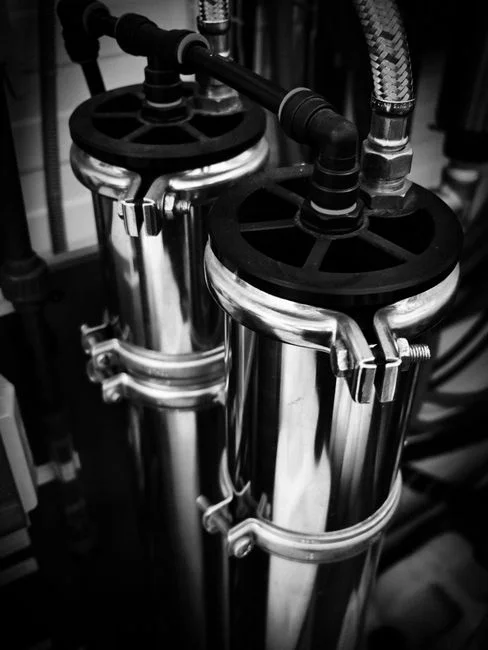
TSMC Arizona began construction of a reclaimed water facility in 2025 that adopts near-zero liquid discharge (NLD) technology — a multi-effect evaporator feeding a reverse osmosis polish stage and a crystallizer for the brine sidestream (per TSMC 2025 Sustainability Report). For a 100,000 m³/yr fab, the NLD train typically occupies 2,500-3,500 m² of covered process area and draws 2.0-2.5 MWh per m³ of treated water in electrical load, which is the design envelope a Pinal site should anchor its first APP around. Published semiconductor NLD installations operate in the 95-99% recovery range, well above the 18% reclaimed water substitution rate that is the current TSMC corporate benchmark.
The capital decision is split cleanly: TSMC corporate funds the NLD-specific equipment (evaporator-crystallizer skid, RO polish stage, integration engineering), while the host site funds civil works, electrical infrastructure, and the upstream biological pretreatment. The split runs roughly 60/40 in favor of corporate for the NLD-specific equipment, which is the same model used for the Mexico fab described in the parallel Lonza Malaysia plant acquisition compliance map. An MBR biological stage for organics removal paired with an RO polish stage sized to the design criteria in the 2026 RO design criteria for 2026 reference keeps total phosphorus below 3 mg/L on the way into the evaporator, which is the corporate stretch limit. A conventional biological + RO train without the evaporator would need roughly 1.5x the footprint once equalization, MBR, two-pass RO, and concentrate disposal are stacked, and would not achieve the reuse rate that the WRI high-risk designation now requires. The same semiconductor phosphorus wastewater treatment guide that drives the front-end design also drives the polish-stage chemical program.
Closing-Day Checklist and the First 90 Days
The single most useful artifact for an M&A integration team is a day-by-day action list, because the regulatory clock starts at the deed-inscription date and does not pause for document corrections. The Wastewater Management Plan written in the first 60 days of new ownership should be reused for every subsequent ADEQ and Supply Online 360 filing — the same single document that the parallel Mexico compliance map identifies as the artifact that satisfies two regulators at once.
| Day / Window | Action | Statute or Reference | Owner |
|---|---|---|---|
| Day 0 (close) | Notify ADEQ in writing of change of control; file TSMC Supply Online 360 cambio de control notice | A.R.S. § 49-255; Supply Online 360 | General counsel + EHS |
| Day 0-30 | Submit APP re-issuance application; identify responsible EHS lead and map to Theme 2 credential | AAC R-18-9-A301; TSMC Audit Theme 2 | EHS manager |
| Day 0-30 | Issue stand-by contract for temporary fluoride removal via calcium precipitation on segregated HF scrubber blowdown | 40 CFR Part 411 | Procurement + EHS |
| Day 30-60 | File AZPDES permit transfer; submit county pretreatment paperwork; complete Supply Online 360 entity registration | AAC R-18-9-A301; county ordinance | EHS + external counsel |
| Day 0-60 | Write the Wastewater Management Plan (Plan de Manejo equivalent); build the water balance diagram | TSMC Audit Themes 1, 3 | EHS + process engineering |
| Day 60-90 | Enroll EHS team in Supplier Sustainability Academy; commission PLC-controlled chemical dosing for TP and F⁻ | TSMC Supplier Academy (Sept 2026 launch) | EHS manager |
Frequently Asked Questions
How long does the ADEQ permit re-issuance take after a TSMC closes on an Arizona plant?
The new owner has 60 working days from the deed-inscription date to file the APP re-issuance application under A.R.S. § 49-255 and the AZPDES permit transfer under AAC R-18-9-A301. TSMC corporate's Supply Online 360 change-of-control notice is due within 30 days, so the first 30 days should be treated as the bottleneck window.
Does the new fab have to pass TSMC's Key Supplier audit as well as ADEQ?
Yes. A wholly-owned Arizona fab is treated as a key supplier from day one, scored against the same three risk indicators (natural-water-body discharge, daily volume, specific pollutants) and seven audit themes used for the 425 suppliers screened as of July 2026. The 85.7% recommendation-closure benchmark is the operating standard.
What is the capital split between TSMC corporate and the host site for the NLD train?
TSMC corporate funds the NLD-specific equipment (evaporator-crystallizer, RO polish, integration engineering), while the host site funds civil works, electrical infrastructure, and upstream biological pretreatment. The split runs roughly 60/40 in favor of corporate for the NLD-specific equipment, which is the same model applied to the Mexico fab.
Do Maricopa and Pinal County fabs face the same fluoride and ammonia limits?
No. Pinal County APP limits are tighter than Maricopa County AZPDES pretreatment limits because the Pinal site sits over the alluvial aquifer supplying Eloy and Casa Grande; ammonia-nitrogen at the groundwater monitoring point is commonly set at 3-5 mg/L versus 10-15 mg/L in the Maricopa POTW path, and fluoride is typically 2-4 mg/L versus 4-8 mg/L.