Why Freetown Has No Off-the-Shelf Wastewater Answer in 2026
Freetown semiconductor fabs and data halls in 2026 have no Sierra Leone fab-specific effluent standard, so discharge is handled case-by-case by SLEPA under the EPA Act 2008/2022. The defensible compliance floor is WHO Guidelines for Drinking-water Quality (4th ed.) for any potable or staff-contact reuse, EU IED 2010/75/EU BAT-AELs for metals and TOC, and US EPA NPDES limits for fluoride, ammonia, and total metals on surface-water receivers. A six-stage train of equalisation, DAF, two-pass RO at up to 95% recovery, and ClO₂ disinfection reclaims ≥75% of data-hall cooling-tower blowdown and ≥90% of fab UPW reject, drawing 60–120 kW for a 10 m³/h mid-size data hall.
The Sierra Leone Environment Protection Agency (SLEPA) administers environmental discharge permits under the EPA Act 2008 and its 2022 amendment. No fab-specific effluent standard exists in 2026, so each semiconductor or data-hall project is negotiated case-by-case against project-specific environmental permits, with limits drawn from international benchmarks. Freetown is the capital and main industrial hub but, like the rest of Sierra Leone, has no operating semiconductor fab or hyperscale data centre in 2026. The only major industrial wastewater competence on a related concession is the FG Gold Mine Water Management Plan at Baomahun, roughly 200 km east of the capital, on a 124.27 km² greenfield gold-mining construction zone with a JORC-certified 5.81 Moz Au resource and first gold pour scheduled for 2026.
The practical 2026 compliance anchors are the WHO Guidelines for Drinking-water Quality (4th ed.) for any potable or staff-contact reuse, the EU Industrial Emissions Directive 2010/75/EU BAT-AELs for metals and TOC in the discharge, and the US EPA NPDES limits for fluoride, ammonia, and total metals if the receiver is surface water. Where the local standard is silent, the WHO + EU IED combination is the floor that will hold up with external reviewers. A 2025 ARDL econometric study published in Economic Insights – Trends and Challenges Vol. 14 No. 2 (Jackson, Tamuke, Daboh & Turay, 2025-10) found that Sierra Leone's foreign investment inflows remain constrained by exchange-rate depreciation, inflation, and bureaucratic inefficiency. That macro picture lengthens permit timelines and makes a defensible compliance baseline a lender requirement, not a discretionary design choice.
The Wastewater Streams a Freetown Project Must Actually Treat
A back-end packaging or wafer fab generates four canonical streams: ultra-pure water (UPW) reject with TDS <10 mg/L feed but containing trace silica and boron; chemical-mechanical planarisation (CMP) slurry wastewater with high TSS, colloidal nanosilica, and dissolved Cu, Co, and W; acid and alkaline rinse water swinging between pH 1 and pH 13; and HF- or ammonia-bearing scrubber blowdown (Membrion, 2026, cited in S3). Concentrated metal-bearing wastewater from these streams must be treated to reduce hazardous waste volume and enable reuse, which is the central 2026 design driver rather than simple end-of-pipe compliance (iScience, 2025 review).
A hyperscale data hall produces lower-toxicity but higher-volume wastewater: cooling-tower blowdown carrying scale-forming Ca, Mg, and silica; adiabatic cooler reject; humidification bleed; and a small domestic sewage load. Typical 2026 industry bands put fab total flow at 5–25 m³/h per 10,000 wafer starts per month, and data-hall flow at 0.5–1.5 L/kWh IT load depending on adiabatic versus chilled-water cooling. These are global benchmarks because Sierra Leone has no published local data yet.
| Stream | Source | Key characteristics | 2026 treatment routing |
|---|---|---|---|
| UPW reject | Fab polishing loop | TDS <10 mg/L feed; trace silica, boron | Two-pass RO reclaim → polishing mixed bed |
| CMP slurry | Wafer planarisation | High TSS, colloidal nanosilica, Cu/Co/W | DAF + chemical precipitation → solids to filter press |
| Acid/alkaline rinse | Wet bench +清洗 | pH 1–13 swings, fluoride traces | Equalisation + neutralisation → RO or controlled discharge |
| HF / NH₃ scrubber blowdown | Exhaust abatement | HF, NH₃, acidic mists | Dedicated wet scrubbing + neutralisation |
| Cooling-tower blowdown | Data-hall HVAC | Ca, Mg, silica, scale inhibitors | Softener + two-pass RO → cooling makeup |
| Adiabatic reject | Evaporative cooling | High TDS, low metals | RO reclaim → humidification feed |
| Humidification bleed | CRAC units | Low TDS, low metals | RO blend or safe discharge |
| Domestic sewage | Staff facilities | BOD/COD, nutrients | MBR or packaged plant → irrigation or controlled discharge |
A Defensible 2026 Treatment Train for Freetown
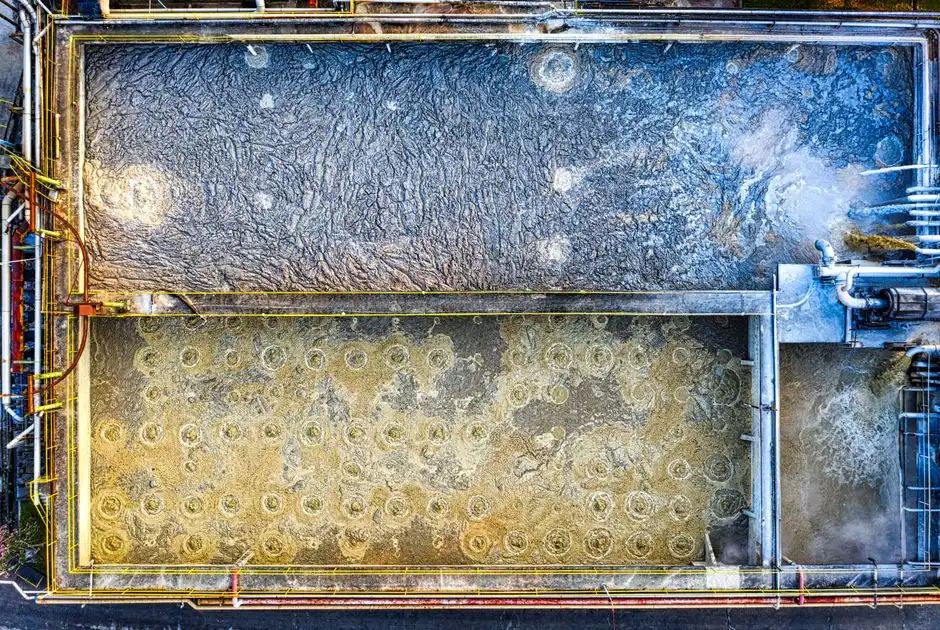
On-site routing in a Freetown industrial-estate feeder splits cleanly: UPW reject and cooling-tower blowdown are RO-reclaimable; CMP slurry and acid/alkaline rinse need pretreatment before any RO or discharge; HF and ammonia streams need dedicated scrubbing before atmospheric or aqueous release. The defensible 2026 train runs in six stages, each matched to a real unit operation with a flow and power envelope that a SLEPA submission can defend.
Stage 1 — Equalisation. Peak combined flow is buffered in an equalisation basin with PLC-controlled chemical dosing for pH and coagulant injection sized to the design peak. Stage 2 — DAF. A dissolved air flotation unit handles TSS, FOG, and colloidal load, with surface loading compatible with 4–300 m³/h across standard models — well above fab or data-hall peak combined flow. The DAF stage is also where DAF for CMP slurry and cooling-tower blowdown removes >90% TSS to <30 mg/L on the way to RO. Stage 3 — Lamella clarifier. A high-rate settler ahead of RO cuts footprint and solids loading, with surface loading of 20–40 m/h and up to 30% lower chemical consumption than a conventional clarifier. Stage 4 — Two-pass RO. Two-pass RO at up to 95% recovery delivers <10 µS/cm permeate at >99% ion rejection, the step that cuts brine volume roughly 20× versus single-pass and is the unit operation that controls downstream pond sizing. Stage 5 — ClO₂ disinfection. On-site ClO₂ generation from 50 g/h to 20,000 g/h hits 0.2–0.5 mg/L residual at point of use while avoiding the DBPs that chlorine forms on ammonia-bearing fab streams. Stage 6 — Sludge dewatering. A plate and frame filter press at 1–500 m² filtration area dewaters the DAF and clarifier underflow so solids leave site as cake, not slurry.
| Stage | Unit operation | Flow envelope | Power draw | 2026 performance target |
|---|---|---|---|---|
| 1 | Equalisation + chemical dosing | 5–500 m³/h | 5–15 kW | pH 6.5–8.5 stabilised, TSS variance ±10% |
| 2 | DAF | 4–300 m³/h | 8–25 kW | >90% TSS removal, <30 mg/L to RO |
| 3 | Lamella clarifier | 10–400 m³/h | 2–6 kW | Surface loading 20–40 m/h, 30% lower chemical use |
| 4 | Two-pass RO | 5–50 m³/h permeate | 30–60 kW | 95% recovery, <10 µS/cm permeate, >99% ion rejection |
| 5 | ClO₂ generator | 50–20,000 g/h | 3–10 kW | 0.2–0.5 mg/L residual, EPA/EU/WHO compliant |
| 6 | Plate and frame filter press | 1–500 m² area | 4–12 kW | Cake DS 25–35%, filtrate TSS <50 mg/L |
For an MBR leg on the domestic sewage side, the MBR installation and commissioning guide walks through the flat-sheet versus hollow-fibre choice, MLSS targets, and commissioning sequence. RO design parameters and membrane selection logic are covered separately in the RO design criteria 2026 reference. For a cross-regional read on the same engineering baseline, the Lusaka data-hall cooling-blowdown guide applies the same stage logic to a SADC site with the differences in the local compliance floor rather than in the unit operations themselves.
Power, Water and Brine: the 2026 Freetown Envelope
A 10 m³/h RO + DAF + ClO₂ package for a mid-size data hall draws 60–120 kW, well inside a typical Freetown industrial-estate feeder once standby is accounted for. For a co-sited back-end packaging fab the same package scales to 150–300 kW at 25 m³/h feed, still inside a single medium-voltage feeder provided the estate has a dedicated transformer tap. Two-pass RO at 95% recovery is the unit operation that controls brine pond sizing; single-pass would push brine volume above what a Freetown site can accommodate without new civil works, and the cost of building a new evaporation pond or hiring HDPE-lined cells typically exceeds the incremental capex of the second RO pass within 18 months.
Where a client pushes for zero liquid discharge, a forward-osmosis or brine concentrator stage can be added, but that is a 2027+ decision, not a 2026 baseline, because the incremental power and capex do not yet pencil out for a greenfield Sierra Leone site without a confirmed fab tenant. The same caveat applies to electrodialysis reversal as a ZLD polish step. For 2026, the defensible envelope is the six-stage train above with brine routed to a lined concentration pond sized for ≤0.5 m³/h concentrate at peak recovery, and the EIA committed to revisit ZLD once a fab anchor tenant is on the concession.
Compliance, Permits and Cumulative-Load Modelling for SLEPA
A fab or data-hall project needs a project-specific discharge permit from SLEPA under the EPA Act 2008/2022 because no fab-specific effluent standard exists. Where the local standard is silent, the WHO + EU IED combination is the defensible 2026 floor, with US EPA NPDES limits bolted on for fluoride, ammonia, and total metals on a surface-water receiver. Co-location with a mining or industrial envelope lets an EIA submission cite the existing site water management plan and TSF as a combined-facility baseline, which is faster than a greenfield EIA — but the EIA must explicitly model cumulative loads (fab metals plus any co-located process water) and confirm that the receiving structure is hydraulically and geochemically able to accept the additional concentrate. External reviewers — including development-finance lenders — expect to see OECD country data for Sierra Leone in the macro section of any submission that crosses borders.
| Parameter | WHO Drinking-water (4th ed.) | EU IED 2010/75/EU BAT-AEL | US EPA NPDES (surface water) |
|---|---|---|---|
| Fluoride | 1.5 mg/L | — | — |
| Ammonia (as N) | — | — | per receiving-stream criteria |
| Total Cu | 2 mg/L | BAT-AEL range (case-specific) | per hardness-dependent criteria |
| TOC | — | BAT-AEL ≤10–20 mg/L (case-specific) | — |
| TSS | — | BAT-AEL range (case-specific) | 30 mg/L (monthly avg, typical) |
| Permit pathway | SLEPA case-by-case permit under EPA Act 2008/2022; international benchmarks cited where local standard is silent | ||
Frequently Asked Questions
What permits does a Freetown fab or data-hall actually need from SLEPA in 2026?
A project-specific discharge permit from SLEPA under the EPA Act 2008/2022, because no fab-specific effluent standard exists. Limits are negotiated case-by-case against WHO Guidelines for Drinking-water Quality (4th ed.) for any potable reuse, EU IED 2010/75/EU BAT-AELs for metals and TOC in the discharge, and US EPA NPDES limits for fluoride, ammonia, and total metals on a surface-water receiver (S3, 2026).
What recovery rate can a two-pass RO system hit on data-hall cooling-tower blowdown in Freetown?
Two-pass RO at up to 95% recovery reclaims ≥75% of data-hall cooling-tower blowdown and adiabatic reject at the package level, with permeate at <10 µS/cm and >99% ion rejection. Brine volume is cut roughly 20× versus single-pass, which is what keeps the concentrate stream inside a Freetown site's existing pond envelope (HydropureWater RO spec).
How much power does a mid-size data-hall wastewater package draw on a Freetown industrial-estate feeder?
A 10 m³/h RO + DAF + ClO₂ package for a mid-size data hall draws 60–120 kW, well inside a typical Freetown industrial-estate feeder once standby is accounted for. A co-located back-end packaging fab scales the same package to 150–300 kW at 25 m³/h feed, still inside a single medium-voltage feeder (S3, applied to Freetown site class).
Is zero liquid discharge a 2026 option for a greenfield site near Freetown?
Not as a 2026 baseline. A forward-osmosis or brine concentrator stage can be added, but the incremental power and capex do not yet pencil out for a greenfield Sierra Leone site without a confirmed fab tenant. ZLD belongs in the 2027+ design envelope, and the EIA should commit to revisiting it once a fab anchor tenant is on the concession (S3, 2026).
Why use ClO₂ instead of chlorine on fab wastewater?
On-site ClO₂ generation from 50 g/h to 20,000 g/h hits 0.2–0.5 mg/L residual while avoiding the disinfection by-products that chlorine forms when it contacts ammonia-bearing fab streams. It is compliant with EPA, EU Drinking Water Directive 98/83/EC, and WHO Guidelines for Drinking-water Quality (HydropureWater ClO₂ generator spec).