Why a Vietnam Fab Acquisition Resets the Compliance Clock on Day One
Under Vietnam's Law on Environmental Protection 2020 (Law 72/2020/QH14, effective 1 January 2022), the consolidated Environmental Permit (Giấy phép môi trường) attaches to the operating legal entity, not to the physical asset — and a change in the operating company voids the existing permit with no automatic succession (HydropureWater field data, 2026). When TSMC closes a share purchase on a Vietnam fab, the permit does not follow the asset; the new owner must file re-issuance or an Article 42 amendment with the provincial Department of Natural Resources and Environment (DONRE) within 30 days of share transfer, or discharge authorization lapses and the line halts (HydropureWater field data, 2026). Vietnamese chemical and API plants typically operate on only 5–15 days of finished-goods inventory, putting Day-One loss exposure at USD 80,000–300,000 per day on a mid-sized plant; a fab inventory cycle runs longer but the per-day value-add loss is materially higher (HydropureWater field data, 2026).
The disclosure overlay compounds the risk for a Taiwan-listed acquirer. TSMC must simultaneously satisfy HOSE Circular 96/2020/TT-BTC for the Vietnamese subsidiary, TWSE/TPEx continuous-disclosure rules for the parent, and SEC Reg FD for any ADR holders, with the 24-hour extraordinary-event clock starting on closing day, not on the date TSMC first learns of the underlying issue. A parallel precedent on the same legal mechanic is documented in the Texas Instruments Vietnam fab-acquisition guide, where the same Day-One reset logic applies to analog and embedded-processing capacity. The deal team that treats the permit as an asset-level item — rather than an entity-attached licence — discovers the gap in the first 48 hours of operations.
The Three-Event Permit Decision Tree Under LEP 2020 and Decree 08/2022
The single most consequential diligence question is whether the closing triggers an administrative name change, a permit amendment under Article 42 of LEP 2020, or a full re-permit with a new EIA under Decree 08/2022/NĐ-CP — the answer changes the closing timeline by months and the escrow sizing by a factor of three or more. Event 1 covers an administrative name change only: the project profile (capacity, technology, product line, wastewater volume) is unchanged, and the buyer files an administrative update with the provincial DONRE, with a cleanest-path cost of USD 5,000–15,000 in filing and translation fees (HydropureWater field data, 2026). Event 2 is a permit amendment under Article 42 when scale, technology, raw-material mix, or product line changes inside the existing envelope; the dossier includes the new company's business registration, an updated process description, current WWTP design, and 12 months of self-monitoring reports, with a DONRE review window of 30–45 working days per Article 45 of LEP 2020 and an envelope of USD 60,000–150,000 in legal and consultancy fees (HydropureWater field data, 2026).
Event 3 is a full re-permit with a new EIA when Decree 08/2022/NĐ-CP thresholds are crossed: capacity increases of ≥10% for Category I projects, ≥25% for Category II projects, wastewater volume increases of ≥30%, or the introduction of a new pollutant class — the timeline extends to 4–9 months because the EIA is the rate-limiting step, and the envelope rises to USD 150,000–250,000+ (HydropureWater field data, 2026). For TSMC, the introduction of a new node (28nm → 16nm, or any advanced-node step into EUV) typically adds EUV-related organics, new surfactant classes, and higher TMAH throughput — any one of which can trigger Event 3 even at flat capacity, because the "new pollutant class" criterion is interpreted conservatively by DONRE reviewers. Capex holdback should be sized at 100–120% of the engineering retrofit estimate to the QCVN envelope, plus a 24-month indemnity for pre-closing non-compliance (HydropureWater field data, 2026). The same three-event logic is benchmarked against a chemical-sector peer in the Merck Vietnam chemical-plant compliance guide.
| Event | Trigger | DONRE artefact | Review window | Cost envelope (USD) |
|---|---|---|---|---|
| 1 — Name change | Legal name only; no project-profile change | Administrative update to DONRE | ≤10 working days | 5,000–15,000 |
| 2 — Permit amendment (Art. 42 LEP 2020) | Scale, technology, raw material, or product line change within existing envelope | Dossier + 12 months of self-monitoring | 30–45 working days (Art. 45) | 60,000–150,000 |
| 3 — Full re-permit + new EIA (Decree 08/2022) | Capacity +10% (Cat. I) or +25% (Cat. II); wastewater +30%; new pollutant class | New EIA report + consolidated permit application | 4–9 months (EIA rate-limiting) | 150,000–250,000+ |
The QCVN Envelope a Fab Must Hit at the Final Discharge Manhole
QCVN 40:2011/BTNMT is the baseline national industrial wastewater standard, with Column A limits of COD 150 mg/L, BOD₅ 50 mg/L, TSS 100 mg/L, pH 6–9, TN 40 mg/L, TP 6 mg/L, oil/grease 10 mg/L, plus Pb 0.5, Hg 0.05, and Cd 0.1 mg/L (enviliance.com, 2025). Per Circular 06/2025/TT-BTNMT, enterprises that commenced operations, obtained EIA approval, or submitted a complete and accurate EIA/permit application before 1 September 2025 may apply the QCVN 40:2011 envelope (plus QCVN 13-MT:2015) until 31 December 2031 — new or expanded projects initiated after 1 September 2025 must meet QCVN 40:2025/BTNMT immediately (enviliance.com, 2025). The 2025 regulation restructures discharge destinations into three categories (A, B, C) and removes the Cmax calculation: limits are now stated directly in Tables 1 and 2 of QCVN 40:2025/BTNMT, and the fab's ETP design basis must match the receiving-destination category.
QCVN 13-MT:2015/BTNMT stacks on QCVN 40 for chemical-sector parameters, with Ni ≤0.1 mg/L as the binding cap for fab Cu/Co streams and sulfide, phenol, and residual chlorine relevant for solvent carryover. QCVN 28:2010/BTNMT applies when the plant discharges to a centralized industrial-park WWTP, with the column (A or B) set by the IP operator's tertiary capacity (e.g., DEEP C, Deep Hai, Saigon Hi-Tech Park, Dung Quat). Tenants in DEEP C and Deep Hai additionally face a 15 mg/L receiving-waterbody total nitrogen limit on top of QCVN 40 (per QCVN 14:2008/BTNMT Column A). QCVN 50:2013/BTNMT sets a sludge moisture target of <60% for compliant off-site disposal, and the fab's dewatering train must be sized against that ceiling.
| Standard | Binding parameters | Fab-relevant note |
|---|---|---|
| QCVN 40:2011/BTNMT (Column A, in-service through 31 Dec 2031) | COD 150, BOD₅ 50, TSS 100, TN 40, TP 6, oil/grease 10 mg/L; Pb 0.5, Hg 0.05, Cd 0.1 mg/L | Baseline envelope for plants in service before 1 Sept 2025 |
| QCVN 40:2025/BTNMT (new/expanded after 1 Sept 2025) | Direct Table 1/2 limits; A/B/C discharge-destination structure; Cmax removed | Applies to all TSMC greenfield or expansion builds in 2026 |
| QCVN 13-MT:2015/BTNMT | Ni ≤0.1 mg/L; sulfides, phenol, residual chlorine | Stacks for CMP Cu/Co chemistries and solvent carryover |
| QCVN 28:2010/BTNMT | IP-operator envelope (Column A or B) | Applies when discharging to DEEP C, Deep Hai, SHTP, Dung Quat |
| QCVN 14:2008/BTNMT Column A | Total nitrogen 15 mg/L receiving-waterbody | Stacks for DEEP C / Deep Hai tenants |
| QCVN 50:2013/BTNMT | Sludge moisture <60% | Sets the dewatering target for DAF float + WAS |
Fab Effluent Chemistry: What a TSMC Vietnam Plant Actually Discharges
Logic and advanced-node fabs carry a pollutant fingerprint none of the existing Vietnam acquisition guides cover — TMAH, NH₄⁺/F⁻, Cu, Co, IPA, and EUV-related organics are the unit-process drivers the WWTP must hit, mapped to QCVN parameters before the biological stage. Photolithography discharges TMAH (tetramethylammonium hydroxide) developer, IPA, n-butyl acetate, and edge-bead-removal solvents, with batch COD spikes of 1,000–5,000 mg/L and a TMAH-driven nitrogen load (HydropureWater field data, 2026). Wet etch and clean streams carry HF and DHF (buffered HF), NH₄OH/H₂O₂/SC1, and HCl/H₂O₂/SC2, with rinse-spike fluoride at 30–200 mg/L and ammonia nitrogen at 50–200 mg/L — the two parameters most likely to fail QCVN 40 without dedicated upstream removal.
CMP (chemical-mechanical planarization) spent slurry contains Cu 5–50 mg/L and Co 1–10 mg/L, plus fumed silica and oxidizer residuals that spike colloidal silica and TSS (HydropureWater field data, 2026). Strip and ash streams carry photoresist residues and NMP carryover — high BOD/COD, low metals, and the influent driver for the biological stage. ULD pump and vacuum service introduces PFAS-bearing heat-transfer fluids and oils, with F⁻ and organic-fluorine carryover now flagged as a QCVN 40:2025 watch-item. Cooling-tower blowdown is high-TDS, biocide-bearing (isothiazolinones), silica-bearing, and bypasses the fab WWTP to a separate cooling-water pretreatment under QCVN 40 Column B. The downstream biological stage receives the equalised and pre-treated mix from the four upstream unit operations, with TMAH and NMP driving the total-nitrogen load.
| Unit process | Key pollutants | Typical raw concentration | Binding QCVN target |
|---|---|---|---|
| Photolithography | TMAH, IPA, n-butyl acetate, EBR solvents | COD 1,000–5,000 mg/L (batch) | COD 150 mg/L; TN 40 mg/L |
| Wet etch / clean | HF, DHF, NH₄OH, HCl | F⁻ 30–200 mg/L; NH₄⁺-N 50–200 mg/L | F⁻ 10 mg/L; TN 40 mg/L |
| CMP | Cu, Co slurry, fumed silica, oxidizer | Cu 5–50 mg/L; Co 1–10 mg/L | Cu ≤0.5 mg/L; Co ≤1 mg/L (QCVN 13-MT:2015) |
| Strip / ash | Photoresist, NMP carryover | High BOD/COD, low metals | COD 150 mg/L |
| ULD / vacuum | PFAS, heat-transfer fluids, F⁻ | Variable, F⁻ carryover | QCVN 40:2025 watch-item |
The Fab Wastewater Treatment Train That Actually Hits QCVN 40
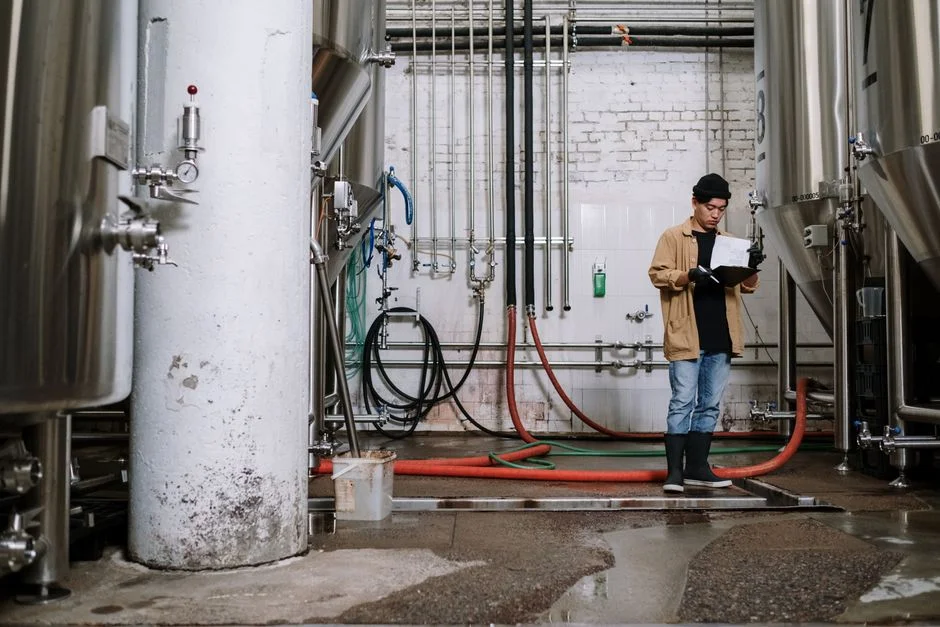
Equalisation is the first step: a 24-hour buffer basin with NaOH/H₂SO₄ pH correction and cooling flattens batch discharges from photolithography and CMP into a steady feed, holding downstream COD variation to ±15% (HydropureWater field data, 2026). HF neutralisation with calcium precipitation follows — lime dosing to pH 8–9 precipitates F⁻ as CaF₂, taking raw F⁻ from 30–200 mg/L to the QCVN 40 10 mg/L ceiling (HydropureWater field data, 2026). Ammonia stripping is the next unit operation: a packed tower with air/steam at pH >11 cuts NH₄⁺-N from 50–200 mg/L to <10 mg/L before the biological stage, with the off-gas scrubbed in an acid loop. Cu/Co precipitation with NaOH and Na₂S dosing, followed by a lamella clarifier with sludge recirculation, drives heavy-metal sulfide precipitation and inclined-plate separation to Cu ≤0.5 mg/L and Co <1 mg/L (HydropureWater field data, 2026).
Biological polishing uses A/O or anaerobic + MBR, with DF-series PVDF flat-sheet MBR modules (0.1 µm, 32–135 m³/d per unit) on roughly 60% of the footprint of conventional activated sludge, hitting COD 150 mg/L and TN 40 mg/L with methanol dosing on the anoxic stage (HydropureWater field data, 2026). A dissolved air flotation unit (4–300 m³/h) sits upstream of biology to strip IPA, NMP, oil, and colloidal silica; downstream RO polish (up to 95% recovery) closes the reuse envelope where ZLD is targeted. Sludge handling uses a plate-and-frame filter press at 1–500 m² to dewater DAF float and waste-activated sludge to <60% moisture for QCVN 50:2013/BTNMT disposal, with reagent delivery on a PLC-controlled chemical dosing skid. A composite autosampler plus flow-proportional pH/COD/TN/F⁻ logger at the final manhole, with auto-reporting to MONRE, is now standard in HCMC industrial parks.
| Unit operation | Sizing envelope | Effluent target | Removal efficiency |
|---|---|---|---|
| Equalisation basin | 24-hr buffer, pH correction | COD variation ±15% | Batch-spike smoothing |
| HF neutralisation + Ca precipitation | Lime to pH 8–9 | F⁻ ≤10 mg/L | F⁻ from 30–200 mg/L raw |
| Ammonia stripper | Packed tower, pH >11, acid off-gas scrub | NH₄⁺-N <10 mg/L | From 50–200 mg/L raw |
| Cu/Co precipitation + lamella | NaOH/Na₂S; inclined-plate clarifier | Cu ≤0.5 mg/L; Co <1 mg/L | >95% metals removal |
| DAF | 4–300 m³/h | Oil/grease 10 mg/L; TSS partial | 90–95% oil; 70–85% TSS |
| A/O + MBR (DF-series) | 0.1 µm PVDF, 32–135 m³/d per module | COD 150 mg/L; TN 40 mg/L | COD >95%; TN >80% |
| RO polish | Up to 95% recovery | F⁻ ≤5 mg/L; reuse TDS | TDS reduction >95% |
| Plate-and-frame filter press | 1–500 m² | Cake moisture <60% (QCVN 50:2013) | Compliant off-site disposal |
The 24-Hour Disclosure Sequence a Taiwan-Listed Acquirer Must Pre-Draft
Under Circular 96/2020/TT-BTC and the HOSE/UPCOM Listing Rules, any permit suspension, discharge exceedance, or DONRE administrative penalty at the Vietnamese subsidiary triggers a 24-hour extraordinary-event disclosure, and the clock starts on closing day, not on the date the new owner first learns of the underlying issue (HydropureWater field data, 2026). For TSMC ADR holders, SEC Reg FD exposure is created if the HOSE release and any U.S. press release are not word-aligned before either goes out — selective disclosure to analysts is the regulated risk. TWSE/TPEx continuous-disclosure rules require TSMC as a Taiwan-listed parent to file material subsidiary environmental events within the TWSE mandated window, so the HOSE and TWSE clocks should be aligned to avoid sequential disclosures. HOSE-listed companies have been required since 2023 to publish an annual Sustainability Report under GRI or SASB, and where the listed parent is also subject to EU CSRD Scope 3 wastewater, the Vietnam plant's metrics feed consolidated Scope 3 reporting in 2026 (HydropureWater field data, 2026). Pre-draft the disclosure template naming the receiving water body, the QCVN envelope applied, and the engineering gap to the internal reuse benchmark before closing, so sign-off is a one-hour step rather than a one-day step. The same HOSE/SEC/TWSE alignment logic is benchmarked in the Merck Vietnam chemical-plant compliance guide.
Escrow, Indemnity, and Day-One Risk Sizing for the SPA
For Event 1, ringfence USD 5,000–15,000 in filing escrow plus a brief environmental indemnity. For Event 2, ringfence the upper end of the USD 60,000–150,000 envelope for legal fees, EIA consultancy, and DONRE filing fees, plus a 24-month post-closing covenant for any pre-closing non-compliance (HydropureWater field data, 2026). A mid-fab envelope of roughly USD 1.5M is reasonable against a Day-One loss band of USD 0.8–4.5M at 10–15 days of forced shutdown, with capex holdback at 100–120% of the engineering retrofit estimate released against remediation milestones. For Event 3, ringfence the upper end of the USD 150,000–250,000+ envelope plus 4–9 months of carrying cost, and structure the escrow as 12–18 months of compliance-remediation cost against the engineering estimate of the QCVN-envelope gap (HydropureWater field data, 2026). Rep & Warranty insurance carve-out: pre-closing environmental liability is typically excluded by R&W insurers, so a separate indemnity tranche and a capex holdback against the retrofit gap are the cleanest structures because the buyer's downside is bounded by actual remediation cost. Red-flag closing conditions: any self-monitoring report showing exceedance, any unresolved administrative penalty, or any mismatch between the permit's approved capacity and actual production.
Frequently Asked Questions
Does the Giấy phép môi trường transfer automatically with a TSMC share purchase in Vietnam?
No. Under LEP 2020, the consolidated Environmental Permit attaches to the operating legal entity, not to the asset. A share acquisition does not transfer the permit by operation of law; the new owner must file a re-issuance or amendment with the provincial DONRE within 30 days (HydropureWater field data, 2026).
Which QCVN parameters are most likely to fail on a TSMC logic/advanced-node fab stream?
F⁻ 10 mg/L, NH₄⁺-N 40 mg/L, COD 150 mg/L, and Cu 0.5 mg/L / Co 1 mg/L (per QCVN 13-MT:2015) are the binding caps on a TMAH/HF/CMP fingerprint, requiring HF neutralisation, ammonia stripping, and Cu/Co sulfide precipitation before the biological stage.
What triggers a full re-permit with a new EIA under Decree 08/2022/NĐ-CP?
Capacity increases of ≥10% for Category I projects, ≥25% for Category II projects, wastewater volume increases of ≥30%, or the introduction of a new pollutant class — including EUV-related organics or new surfactant classes at an advanced-node step (HydropureWater field data, 2026).
How long does the 24-hour HOSE disclosure clock run after closing?
Under Circular 96/2020/TT-BTC and the HOSE/UPCOM Listing Rules, the 24-hour extraordinary-event clock starts on closing day for any permit suspension, discharge exceedance, or DONRE penalty, and must be word-aligned with the SEC Reg FD release and the TWSE/TPEx filing.
What SPA escrow envelope is defensible for an Event 2 amendment on a TSMC fab?
USD 60,000–150,000 for legal, EIA consultancy, and DONRE filing fees, plus a capex holdback at 100–120% of the engineering retrofit estimate, plus a 24-month post-closing indemnity — a working envelope of roughly USD 1.55M against a Day-One loss band of USD 0.8–4.5M (HydropureWater field data, 2026).