Why the TI–Silicon Labs deal resets the question for fabs
On 4 February 2026, Texas Instruments and Silicon Labs announced a definitive agreement under which TI will acquire Silicon Labs for $231.00 per share in an all-cash transaction, representing a total enterprise value of approximately $7.5 billion; the deal is expected to be accretive to TI's earnings per share, excluding transaction-related costs, in the first full year post-close (per the 4 February 2026 PR Newswire release). What makes this transaction a reset for the compliance question is that the inherited footprint is analog and embedded processing fab capacity — internally owned manufacturing, not foundry work for an outside customer — so the wastewater envelope the acquirer is buying is fab influent, not battery cathode rinsewater. The second structural point is that Vietnam's enforcement intensity has stepped up: Ho Chi Minh City is commissioning a 1.1 million m³/day MBBR plant in Thu Duc at a capital cost of USD 524 million (per U.S. Department of Commerce / trade.gov, 2024), and provincial inspection frequency on industrial-zone tenants has risen correspondingly through 2024–2026. The single-sentence reframe is that the buyer inherits a QCVN envelope, a provincial DONRE permit, and a fab effluent chemistry that none of the existing battery- or chemical-sector Vietnam acquisition guides cover — a gap this playbook is built to close.
The Vietnam regulatory stack: QCVN 40, QCVN 14, and QCVN 28 layered on a fab
QCVN 40:2011/BTNMT is the baseline national industrial wastewater standard. For facilities discharging to a source used for domestic water supply downstream, Column B applies, with the most common limits being BOD₅ ≤ 50 mg/L, COD ≤ 150 mg/L, TSS ≤ 100 mg/L, total nitrogen ≤ 40 mg/L, total phosphorus ≤ 6 mg/L, and pH 5.5–9.0 (HydropureWater regulatory review, 2026). Most fabs sit on this branch because even tenants in an industrial park typically have an on-site equalization system that discharges intermittently to a receiving drain with downstream intake. QCVN 14:2008/BTNMT is named for the battery and accumulator sector but in practice the heavy-metal ceilings — Pb ≤ 0.1 mg/L, Cd ≤ 0.05 mg/L, Ni ≤ 0.1 mg/L, Zn ≤ 1.0 mg/L — map directly onto a fab's Cu/Ni/Co process lines, and a provincial DONRE will read the metal list across to a fab by analogy. The QCVN 40 fluoride cap of F⁻ ≤ 10 mg/L is the non-negotiable for fabs because HF, buffered oxide etch (BOE), and any PFAS-bearing etchant generate F⁻ far above this floor, which is why calcium precipitation is forced into the train rather than being optional. QCVN 28:2010/BTNMT applies when the plant discharges to a centralized industrial-park WWTP; the column applied (A or B) depends on the IP operator's tertiary capacity, and the IP operator's permit — not the tenant's — sets the ultimate ceiling (e.g., Dung Quat, Cai Mep, Phu My 2). QCVN 13-MT:2015/BTNMT for nickel-bearing effluents can be cross-applied where on-site nickel or cobalt chemistries are used in BEOL or MEMS lines, with Ni ≤ 0.1 mg/L and sulfate limits. The envelope the deal team must lock in before signing is summarized below.
| Standard | Scope | Key parameters |
|---|---|---|
| QCVN 40:2011/BTNMT (Column B) | National industrial wastewater; receiving water with downstream domestic intake | COD ≤ 150; BOD₅ ≤ 50; TSS ≤ 100; TN ≤ 40; TP ≤ 6 mg/L; pH 5.5–9.0 |
| QCVN 40:2011/BTNMT — fluoride | Cross-sector cap on F⁻ in discharged wastewater | F⁻ ≤ 10 mg/L |
| QCVN 14:2008/BTNMT | Heavy metals (battery/accumulator standard, applied to fab Cu/Ni/Co by analogy) | Pb ≤ 0.1; Cd ≤ 0.05; Ni ≤ 0.1; Zn ≤ 1.0 mg/L; pH 6.0–9.0 |
| QCVN 28:2010/BTNMT (Column A or B) | Tenant discharge into a centralized industrial-park WWTP | Column set by IP operator's tertiary capacity; IP operator's permit is the ceiling |
| QCVN 13-MT:2015/BTNMT | Nickel-bearing effluents (BEOL/MEMS chemistries) | Ni ≤ 0.1 mg/L; sulfate limits apply |
Permit mechanics under LEP 2020 and Decree 08/2022
The Law on Environmental Protection 2020 (Law 72/2020/QH14, effective 1 January 2022) consolidated the wastewater, hazardous-waste, and air permits into one Environmental Permit (Giấy phép môi trường) with a 5-year validity under Decree 08/2022/NĐ-CP. The single most consequential due-diligence question is which of three events applies at closing, because the answer changes the closing timeline by months. Event 1 is a name-change only: if the target's legal name is the only change and the project profile (capacity, technology, product line, wastewater volume) is unchanged, the buyer files an administrative update with the provincial DONRE — the cleanest path. Event 2 is a permit amendment under Article 42 of LEP 2020: required when the new owner intends to change the project's scale, technology, raw material mix, or product line within the existing permit envelope; the dossier includes the new company's business registration certificate, updated process description, current WWTP design, and the last 12 months of self-monitoring reports, and DONRE review runs 30–45 working days per Article 45 of LEP 2020. Event 3 is a full re-permit with a new EIA when Decree 08/2022 thresholds are crossed: capacity increase ≥ 10% for Category I projects, ≥ 25% for Category II projects, any change that raises wastewater volume by ≥ 30%, or any introduction of a new pollutant class. The new-EIA path is the slow one — typically 4–9 months because the EIA itself is the rate-limiting step. Operation under the old permit is permitted during the DONRE review window. The risk flag is a pre-2020 permit whose project profile no longer matches: that permit is invalid ab initio and triggers a 90-day temporary discharge exemption that often forces rushed EIA scoping.
Fab wastewater chemistry: what TI is actually inheriting
Wet-etch and clean streams generate HF and BOE; F⁻ post-hydrolysis routinely lands at 50–500 mg/L, which is 5–50× the QCVN 40 cap, so fluoride removal is a forced unit operation rather than a polish step. TMAH-based developers contribute high NH3-N — often 200–1,000 mg/L — that pushes the biological stage into an A/O or MBR with dedicated nitrification; free ammonia is also toxic to downstream biology at > 100 mg/L, which is why TMAH waste must be segregated rather than commingled. IPA, NMP, acetone, and other solvents from coating, stripping, and resist steps drive COD into the 2,000–8,000 mg/L range on dump events, and NMP in particular is only partially biodegradable and inhibitory to biomass at the concentrations a fab produces. CMP slurries and electroless plating contribute colloidal and dissolved Cu, Ni, and Co at tens of mg/L each, so metals precipitation is a parallel train rather than a polishing add-on. Ultra-pure rinsewater (UPW reject) and cooling-tower blowdown dilute the streams but are high-volume; the 30-day sampling program must catch these because the mass load is dominated by flow, not concentration, and a 24-hour composite will under-represent a fab's true daily metals load.
Treatment train design for an acquired fab in 2026
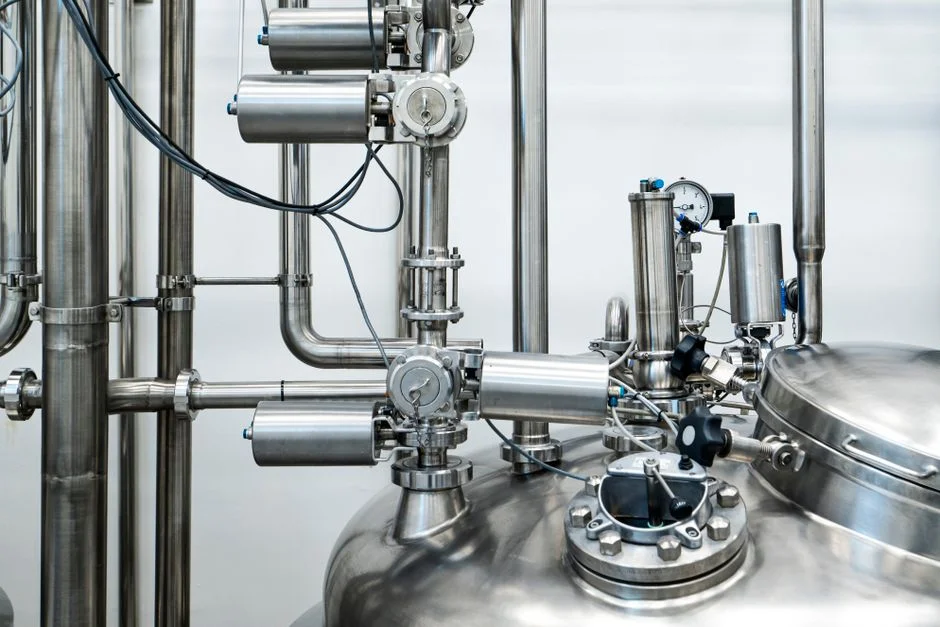
The defensible train for an acquired fab in 2026 segregates at source, treats each segregated stream with a unit process sized for its peak load, and converges the cleaned streams onto an RO-based reuse loop that maps onto the parent's ESG posture. Stage 1 is source segregation and equalization: HF-bearing acid waste, TMAH-bearing developer waste, and Cu/Ni-bearing CMP waste stay in separate sumps, with the equalization tank sized for 8–12 hours of hydraulic retention to dampen batch spikes. Stage 2 is coagulation, flocculation, and a DAF unit for colloidal CMP slurry, IPA, and resist residue; surface loading 5–10 m/h and air-to-solids 0.03–0.06 are the operating envelope, and DAF is preferred over primary clarification because the colloidal fraction has a low settling velocity and tends to form a scum layer that DAF can skim cleanly. Stage 3 is calcium precipitation for fluoride with CaCl₂ or lime, with molar Ca:F ≥ 1.5 to drive CaF₂ formation, followed by sedimentation to remove the fluoride sludge before it reaches biology. Stage 4 is an A/O or MBR biological step for residual COD and NH3-N; an MBR with PVDF flat-sheet or hollow-fiber membranes delivers sub-1 μm filtrate, protects the RO, and typically cuts the biological footprint ~ 60% versus conventional activated sludge at the same load. Stage 5 is two-pass RO for water reuse: the first pass targets conductivity < 50 µS/cm and TDS reductions sufficient for UPW pretreatment make-up; the second pass polishes for the highest-purity loops. Sludge from DAF, biological, and fluoride stages is conditioned and dewatered with a plate-and-frame filter press to ≥ 65% dry solids, supporting a Zero Waste to Landfill pathway that the parent group can map onto its existing ESG targets. Reference designs for the biological step, the pre-treatment step, and the reuse step are catalogued as an MBR system, a DAF system, and an industrial RO system. For a parallel playbook on a chemical-sector acquisition, see the listed-company Vietnam chemical-plant compliance guide; for a battery-sector analogue, see the Samsung SDI Vietnam compliance guide; and for a legacy-audit checklist applicable to any Vietnam manufacturing M&A, see the Samsung factory ETP due diligence checklist. The unit-process sizing envelope is summarized below.
| Stage | Unit process | Design parameter | Target / outcome |
|---|---|---|---|
| 1 — Source segregation & equalization | Separate sumps for HF, TMAH, Cu/Ni streams | HRT 8–12 h; pH 6.5–8.5 to biology | Dampens batch spikes; protects downstream biology |
| 2 — Coagulation / DAF | DAF for colloidal CMP, IPA, resist residue | Surface loading 5–10 m/h; A/S 0.03–0.06 | TSS ≤ 30 mg/L; oil & grease ≤ 5 mg/L |
| 3 — Ca²⁺ precipitation (fluoride) | CaCl₂ or lime dosing + sedimentation | Molar Ca:F ≥ 1.5 | F⁻ ≤ 10 mg/L; CaF₂ sludge to separate dewatering |
| 4 — Biological (A/O or MBR) | Nitrification/denitrification with MBR | MBR filtrate < 1 μm; footprint ~ 60% smaller than CAS | Residual COD stripped; NH3-N to QCVN 40 envelope |
| 5 — Two-pass RO (reuse) | RO system polishing | Pass 1 conductivity < 50 µS/cm | UPW pretreatment make-up; supports 80% reuse target |
| Sludge | Plate-and-frame filter press | Cake dryness ≥ 65% DS | Supports Zero Waste to Landfill pathway |
Due diligence: a 30-day, five-workstream audit
Convert the regulatory and technical analysis into a checklist the deal team can run in parallel with financial diligence. Workstream 1 — permit and compliance audit: pull the EIA approval, the consolidated Environmental Permit, every historical non-compliance notice, and all DONRE/MONRE correspondence; flag any open finding as a closing condition. Workstream 2 — independent sampling: run a 30-day, three-shift sampling campaign across each segregated waste stream using an independent lab, and reject the deal if COD, F⁻, Cu, or NH3-N deviates more than ~ 20% from the seller's design basis. Workstream 3 — asset condition: log age, nameplate capacity vs. current load, membrane and filter replacement history, and the last 12 months of discharge monitoring data; units > 5 years old with no replacement log operating at > 90% nameplate are a rebuild signal, not a maintenance item. Workstream 4 — chemical management gap: compare the plant's chemical inventory against Decree 08/2022/NĐ-CP and the parent's PRTR-style reporting list; HF, TMAH, NMP, Cu, Ni, and Co must each have a current SDS and a reportable-substance entry before closing. Workstream 5 — ESG alignment: compare the plant's current reuse rate against the parent group's long-dated benchmark; if the gap is wider than 10 points, quantify the capex to close it before signing so the delta is in the SPA, not on the post-close P&L.
Day-One integration: disclosure, escrow, and the 24-hour clock

Under Circular 96/2020/TT-BTC and the HOSE/UPCOM Listing Rules, any permit suspension, discharge exceedance, or MONRE/DONRE administrative penalty is a 24-hour extraordinary-event disclosure; the clock starts at closing, not at discovery, and a missed filing is itself a disclosure event. Insert an environmental indemnity and a 24-month post-closing covenant into the SPA covering any pre-closing non-compliance, with an escrow sized to 12–18 months of compliance remediation cost, benchmarked against the engineering gap between the target's actual discharge quality and the QCVN envelope plus an EIA re-assessment contingency. Ringfence USD 60,000–150,000 for legal fees, EIA consultancy, and DONRE filing fees for a clean transfer; if a fresh EIA is triggered, add USD 150,000–250,000 and 4–9 months of timeline. The Bac Ninh 2010–2013 finding that a major Korean-affiliated plant operated "without a proper toxic wastewater treatment system" is the cautionary precedent every acquirer should price into the deal — pre-draft the disclosure template and the internal sign-off chain before closing so the first 24 hours are spent confirming facts, not routing approvals.
Frequently Asked Questions
Which QCVN applies to a fab that discharges into a centralized industrial-park WWTP?
Plants discharging into a centralized industrial-park WWTP follow QCVN 28:2010/BTNMT (Column A or B depending on the IP operator's tertiary capacity), and the IP operator's permit — not the tenant's — sets the ultimate ceiling. Next step: pull the IP operator's discharge permit during DD before sizing the on-side train.
Does a TI acquisition of a Vietnam fab automatically trigger a new EIA?
No. A new EIA is required only when Decree 08/2022/NĐ-CP thresholds are crossed: capacity increases of ≥ 10% for Category I projects, ≥ 25% for Category II projects, wastewater volume increases of ≥ 30%, or the introduction of a new pollutant class; below those triggers, an Article 42 amendment under LEP 2020 is sufficient. Next step: model the post-acquisition production plan against the thresholds before signing.
What is the listed-company disclosure exposure if the fab exceeds QCVN 40 within 30 days of close?
Under Circular 96/2020/TT-BTC and the HOSE/UPCOM Listing Rules, a permit suspension, a discharge exceedance, or a MONRE/DONRE administrative penalty is a 24-hour extraordinary-event disclosure, and the clock starts on closing day. Next step: pre-draft the disclosure template and the internal sign-off chain before closing so the 24 hours are spent confirming facts, not routing approvals.
How should the SPA escrow be sized for a fab with pre-closing fluoride non-compliance?
Size the escrow to 12–18 months of compliance remediation cost, benchmarked against the engineering gap between actual discharge quality and the QCVN 40 F⁻ ≤ 10 mg/L envelope, plus an EIA re-assessment contingency of USD 150,000–250,000 if a fresh EIA is triggered. Next step: ringfence USD 60,000–150,000 for legal fees, EIA consultancy, and DONRE filing fees for a clean transfer, separate from the remediation escrow.