Why Pharmaceutical Effluent Forces a Modular STP Design
Pharmaceutical effluent spans BOD of 100–3,000 mg/L, COD of 200–10,000 mg/L, and trace APIs at 0.01–500 mg/L — a 100× spread driven by the difference between batch API synthesis (high-strength, intermittent) and continuous formulation (low-strength, surfactant-rich) (source: ClearFox pharmaceutical wastewater data, 2026). A conventional activated-sludge plant sized for 500 mg/L BOD collapses when an API campaign drops a reactor wash into the equalization tank at 8,000 mg/L COD; that shock load is the single most common cause of permit excursions in formulation plants. Modular MBR design solves this by front-loading a 24–48 h equalization buffer and a submerged PVDF biological stage that absorbs 5–10× peak shock without biomass washout, with a downstream integrated MBR membrane bioreactor system polishing to sub-1 μm effluent.
Delivery economics reinforce the case. A skid- or container-built package plant compresses site work to 4–8 weeks; an equivalent concrete STP needs 9–15 months, with civil and concrete alone running 30–45% of total CAPEX (HydropureWater field data, 2026). Capacity expansions are also a single parallel-skid drop rather than a basin retrofit. Under the 2026 EU Industrial Emissions Directive (2010/75/EU) BAT-AEL and US EPA 40 CFR Part 439 categorical pretreatment standards, both tightened in 2025, even a single excursion can trigger a consent review — making predictable, factory-tested modular performance the safer compliance bet.
Influent Characterization: What Goes Into the Modular Train
Characterization must precede any module count. Map your plant to one of four sub-streams before sampling: API production (BOD 500–3,000, COD 1,000–10,000, APIs 0.1–500 mg/L), formulation (BOD 200–1,000, COD 500–5,000, APIs 0.1–100 mg/L), fermentation (BOD 100–1,000, COD 200–3,000, APIs 0.01–50 mg/L), or cosmetic/cosmeceutical (BOD 100–500, COD 200–2,500, APIs 0.01–50 mg/L) (ClearFox, 2026). The spread tells you whether your MBR feed will look like a high-strength API stream or a surfactant-laden formulation stream — and whether you need RO polishing for trace APIs downstream.
Most scoping studies miss three secondary streams. Solvents (methanol, acetone, isopropanol) arrive in API campaign dumps at 0.1–2% v/v and can strip dissolved oxygen in the biological stage if not captured in equalization. Ion-exchange regenerant pushes TDS to 5,000–15,000 mg/L and fouls RO membranes if it bypasses softening. CIP alkali surges hit pH 11–13 during cleaning cycles and must be neutralized before the MBR or nitrification collapses. Total suspended solids typically run 200–800 mg/L and need DAF or lamella pre-treatment to protect the membrane.
Sampling protocol: run a 24-hour composite auto-sampler for three representative days plus 4-hour grab samples during at least one full API campaign. The grab is non-negotiable — it is the only way to capture the campaign peak that drives equalization sizing.
| Sub-stream | BOD (mg/L) | COD (mg/L) | APIs (mg/L) | Key secondary pollutants |
|---|---|---|---|---|
| API production | 500–3,000 | 1,000–10,000 | 0.1–500 | Solvents, heavy metals |
| Formulation | 200–1,000 | 500–5,000 | 0.1–100 | Surfactants, TSS |
| Fermentation | 100–1,000 | 200–3,000 | 0.01–50 | Inorganic salts, microbes |
| Cosmetic/cosmeceutical | 100–500 | 200–2,500 | 0.01–50 | Surfactants, fragrances |
The 2026 Modular Treatment Train: Block by Block
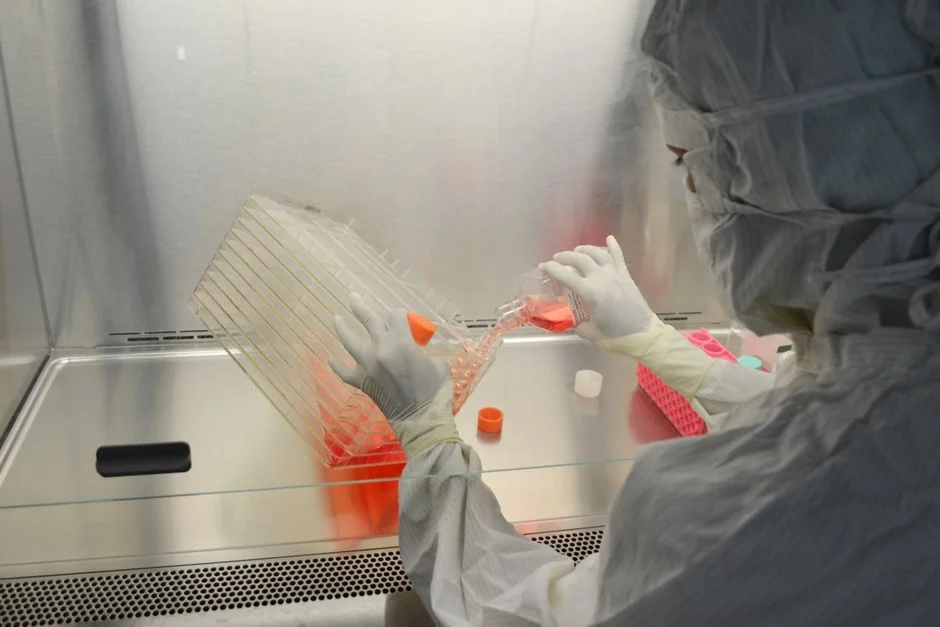
A 2026 modular train is six blocks. Each block is a factory-built skid with a defined inlet/outlet spec; substitution is allowed at the equalization and polishing stages, but the core equalization → primary → MBR → disinfection sequence is fixed by the regulatory performance contract.
- Equalization & pH correction. 24–48 h HRT buffer tank sized to the largest single API campaign volume; automatic chemical dosing on a separate automatic chemical dosing skid for pH adjustment (target 6.5–7.5) and coagulant feed. Without this buffer, the MBR cannot absorb a 5–10× shock load.
- Primary solids/FOG removal. A dissolved air flotation system (4–300 m³/h, micro-bubble flotation) or a lamella clarifier targets 80–95% TSS removal and FOG below 30 mg/L. DAF is the better fit when surfactant loads are high because it floats emulsified FOG rather than letting it bleed into the MBR.
- Biological stage. A submerged PVDF integrated MBR membrane bioreactor system (10–2,000 m³/day, <1 μm effluent) removes >95% BOD and runs partial nitrification in a single tank. For plants under 200 m³/day, DF-series PVDF flat sheet MBR modules (32–135 m³/day per 80–225 m² rack) drop into a container without civil basins.
- Tertiary polishing. Optional. If you need closed-loop reuse or API trace removal below 0.1 μg/L, add a hydrochar adsorption column (MDPI 2025 HTC review) or a brackish-water RO pass. If sewer discharge is the endpoint, skip this block.
- Disinfection. A pipeline UV sterilizer (chemical-free, 40 mJ/cm² dose) is the default. Where a chlorine residual is required by the downstream POTW, a chlorine dioxide generator on site avoids the bulk hypochlorite handling risk.
- Sludge handling. A plate and frame filter press (1–500 m² filtration area) dewaters wasted biological sludge to 25–35% DS cake — dry enough for off-site incineration or co-processing in a cement kiln.
| Block | Module / spec | Capacity range | Effluent target |
|---|---|---|---|
| Equalization + dosing | Buffer tank + dosing skid | 24–48 h HRT | pH 6.5–7.5 |
| Primary | DAF or lamella | 4–300 m³/h | TSS −80–95%, FOG <30 mg/L |
| Biological | PVDF MBR (integrated or DF rack) | 10–2,000 m³/day | BOD >95% removal, <1 μm |
| Polishing (optional) | Hydrochar column or RO | Site-specific | APIs <0.1 μg/L (reuse) |
| Disinfection | UV or ClO₂ | Match MBR flow | Pathogen log-reduction per EPA/EU |
| Sludge | Plate & frame filter press | 1–500 m² area | 25–35% DS cake |
Sizing the Modular Package: Flow, Footprint, and Module Count
Sizing starts with peak flow, not average. The rule of thumb: peak daily flow × 1.2 safety factor ÷ 24 h = average hourly MBR feed; round to the next standard skid rating. For a plant with 250 m³/day average and 400 m³/day peak: 400 × 1.2 / 24 = 20 m³/h, which maps to two DF-series PVDF flat sheet MBR modules at 80–225 m² each, one containerized DAF, and one containerized UV rack — total footprint ≈ 90 m² including 1 m access aisles (HydropureWater field data, 2026).
Three footprint archetypes cover the 2026 market. The WSZ underground package sewage treatment plant (1–80 m³/h) sits below grade with 0 m² surface footprint, ideal for land-constrained formulation plants. Containerized MBR trains (~12 m × 2.4 m per 100 m³/day) sit above grade and can be craned into position. Open-skid MBRs over a concrete basin give the largest hydraulic flexibility but recapture the civil cost you were trying to avoid.
Two site constraints kill projects late: ceiling height (containerized modules are 2.6 m tall) and door/road clearance (2.4 m wide × 12 m long ISO footprint). Verify both before signing the PO.
| Option | Capacity | Surface footprint | Civil work | Best fit |
|---|---|---|---|---|
| WSZ underground | 1–80 m³/h | 0 m² | Excavation only | Land-constrained, <80 m³/h |
| Containerized MBR | 10–2,000 m³/day | ~12 m × 2.4 m per 100 m³/day | Fast-track, no basin | |
| Open-skid + basin | Site-specific | Largest | Full civil | High hydraulic flexibility |
2026 Compliance and Discharge Targets
The performance bar is contractual, not aspirational. Under EU IED 2010/75/EU BAT-AEL for the API oxidation reference document, the binding ceilings for discharge are COD <50 mg/L, TOC <20 mg/L, and total nitrogen 10–25 mg/L depending on receiving-water sensitivity (per EU IED BAT-AEL, 2025 update). Under US EPA 40 CFR Part 439, the pharmaceutical manufacturing category sets daily-maximum BOD₅ and TSS at roughly 15–50 mg/L, with category-specific limits for cyanide, total chromium, and phenols. Indian CPCB norms for the API sector (COD ≤250 mg/L, BOD ≤30 mg/L, TSS ≤100 mg/L) drive the design baseline for projects such as the 2026 India plant acquisitions covered in our 2026 wastewater compliance guide for India plant acquisitions.
Modular MBR effluent lands at COD 30–80 mg/L, BOD <5 mg/L, TSS <2 mg/L — comfortably inside both EU and US limits. The remaining gap is API trace removal: if your consent order specifies APIs <0.1 μg/L, you need an RO polish or a hydrochar adsorption column, not the MBR alone. This is the single most common compliance miss in 2026 scoping studies.
Modular vs Conventional Concrete STP: 2026 Cost and Schedule
For a 250 m³/day plant, 2026 CAPEX for a modular containerized MBR is $350,000–$600,000 versus $900,000–$1,500,000 for an equivalent concrete activated-sludge plant (HydropureWater market data, 2026). Civil and concrete alone is 30–45% of the conventional price. OPEX differs less than procurement leads expect: MBR energy runs 0.8–1.2 kWh/m³, dominated by membrane aeration, but chemical OPEX is 15–25% lower than CAS because the MBR's higher SRT cuts sludge yield by roughly the same margin. The decisive number is schedule — 12–20 weeks delivery plus 2–4 weeks commissioning for modular, versus 40–70 weeks for a concrete build.
One trade-off worth flagging: modular MBRs handle peak flow only to about 150% of design. Above that, add a parallel train rather than expand a basin. If your plant has 3× diurnal swings from batch API campaigns, size the equalization to absorb the swing and keep the MBR at design flow.
| Parameter (250 m³/day, 2026) | Modular MBR | Conventional concrete STP |
|---|---|---|
| CAPEX (USD) | $350,000–$600,000 | $900,000–$1,500,000 |
| Civil share | <10% | 30–45% |
| Energy (kWh/m³) | 0.8–1.2 | 0.5–0.8 |
| Chemical OPEX vs CAS | 15–25% lower | Baseline |
| Delivery + commission | 14–24 weeks | 40–70 weeks |
| Hydraulic flexibility | ~150% of design | Higher, with basin volume |
Frequently Asked Questions
What flow range can a modular MBR sewage treatment package handle for a pharmaceutical plant?
Modular MBR packages are factory-rated from 10 m³/day (single DF rack) to 2,000 m³/day (parallel containerized trains). The HydropureWater integrated MBR membrane bioreactor system scales by adding containers in parallel, so a 250 m³/day plant uses two DF-series racks inside one ISO container without civil basins (HydropureWater product data, 2026).
How does a modular pharmaceutical effluent treatment plant handle API batch shock loads?
Equalization is sized at 24–48 h HRT — long enough to absorb a 5–10× peak COD spike from an API campaign dump. The submerged PVDF MBR then buffers the load biologically through its high mixed-liquor suspended solids (8,000–12,000 mg/L), preventing biomass washout that would knock out a conventional activated-sludge basin.
Do I need RO polishing after the MBR to meet EU IED or 40 CFR 439 discharge limits?
For COD, BOD, and TSS, the MBR alone meets both EU IED BAT-AEL and US EPA 40 CFR Part 439 limits. For trace APIs below 0.1 μg/L — common in consent orders with API-manufacturing sites — add a downstream RO pass or hydrochar adsorption column; the MBR alone does not guarantee API trace removal.
What is the CAPEX difference between a containerized STP and a concrete STP for a 250 m³/day pharma plant in 2026?
Modular containerized MBR runs $350,000–$600,000 in 2026 versus $900,000–$1,500,000 for an equivalent concrete activated-sludge plant (HydropureWater market data, 2026). The gap is driven by civil and concrete at 30–45% of the conventional price.
Can a modular sewage treatment package be installed underground on a constrained pharmaceutical site?
Yes. The WSZ underground package sewage treatment plant (1–80 m³/h) is a buried A/O contact-oxidation unit with 0 m² surface footprint, suitable for formulation plants with no above-grade space. For flows above 80 m³/h, containerized above-grade MBR modules are the alternative.