Why a Port Harcourt hotel stream is not a generic municipal stream
The NIJOTECH 2025 Port Harcourt hotel dataset (Vol. 35 No. 2) is the only defensible local anchor for a packaged sewage treatment plant specification in Rivers State, and it shows raw influent at COD 45 mg/L, BOD 20.05 mg/L, TSS 35 mg/L, NH3 27.65 mg/L, sulphate 450.08 mg/L, TDS 1,800 mg/L, and salinity 508.06 mg/L. That TDS and salinity pair is the headline: an inland-hotel stream typically runs 500–800 mg/L TDS, so a Port Harcourt stream is roughly twice as saline, and any design that copies a Lagos or Abuja influent table into a Rivers State specification will fail commissioning on chloride-correlated parameters even when conventional BOD and COD numbers look compliant. Three drivers explain the salt load: coastal groundwater infiltration into the collection network, sodium-based laundry detergents, and the Niger Delta salinity baseline already present in municipal supply (HydropureWater field data, 2026). The operational consequence is direct — a 2026 packaged STP must be specified for elevated TDS, salinity, and FOG, not just for BOD removal, or it will pass the first biological checks and fail the metals and salinity sweep at handover. For a parallel framing on the same selection problem, see this Lagos hotel packaged MBR selection guide.
Sizing the packaged MBR STP at 0.25–0.5 m³ per guest-night
Capacity for a Rivers State hotel is driven by room count, average occupancy, and a peaking factor for banquet and conference nights. The working rule is 0.25–0.5 m³ per guest-night at ~60% annual occupancy, the same envelope the NIJOTECH 500 m³/d Port Harcourt case sits in. A 50-room boutique needs 30–45 m³/day average, a 150-room resort needs 45–75 m³/day, and a 200-room full-service hotel lands at 150–220 m³/day average, with peaks of 220–440 m³/day when a 1.5–2.0× peaking factor is applied for banquets and conference blocks. The 500 m³/d NIJOTECH case is the upper envelope for a 200-room property with heavy conference or banquet load and is the right size to cite when a hotel has a large ballroom and event catering. Peak flow, not the daily biology load, drives equalization-tank and hydraulic-grade sizing — a sizing error that confuses average with peak is the single most common reason packaged MBR skids overflow on the first conference weekend. The table below maps the standard room counts to average and peak design flow at 60% occupancy.
| Property size | Average flow at 60% occupancy (m³/day) | Peak flow with 1.5–2.0× factor (m³/day) | Typical packaged STP class |
|---|---|---|---|
| 50-room boutique | 30–45 | 45–90 | WSZ A/O package or compact MBR |
| 100-room midscale | 75–110 | 115–220 | Submerged MBR or WSZ A/O |
| 150-room resort | 45–75 (low occupancy) to 110–165 (high) | 170–330 | Submerged MBR with 8 hr EQ |
| 200-room full-service | 150–220 | 220–440 | Submerged MBR with 8 hr EQ and DAF pretreatment |
| 200-room with heavy banquet / conference load | 220–500 (NIJOTECH envelope) | 330–750 | Submerged MBR + equalization sized for 8 hr at peak |
MBR, A/O package, or SBR — matching packaged STP to the site
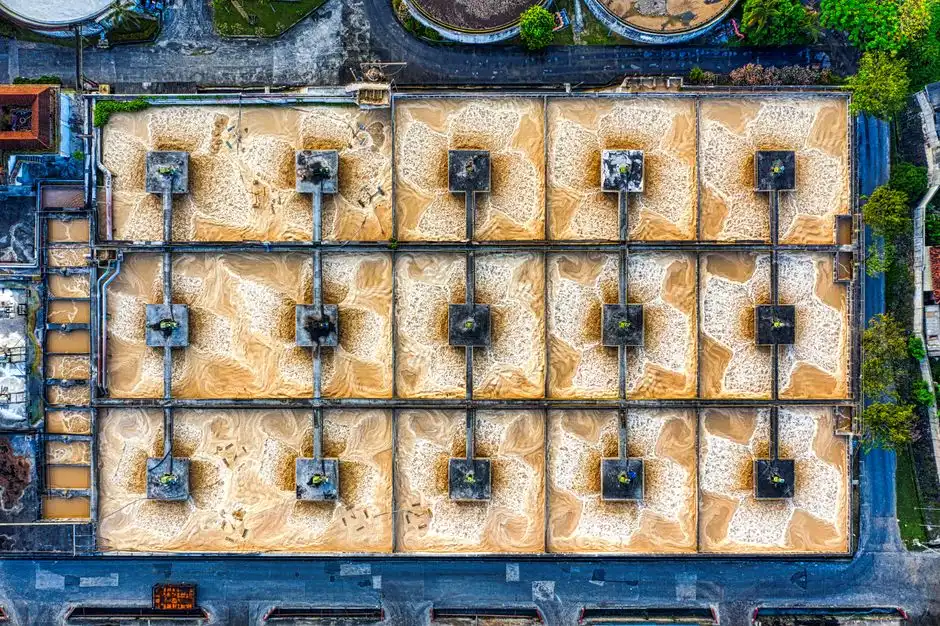
Three packaged options compete for a 50–500 m³/d Port Harcourt hotel: a WSZ underground A/O package plant, a submerged PVDF MBR system, and a sequencing batch reactor (SBR). The WSZ unit combines anoxic contact, aerobic oxidation, sedimentation, and disinfection in one buried skid, runs fully automatic on 1–80 m³/h, needs no dedicated operator, and fits the buried-mass buoyancy profile of a clay site like the NIJOTECH location. Its effluent is sewer-discharge grade, not reuse grade, so a polishing step is still needed for landscape irrigation. The submerged PVDF MBR system with 0.1 μm PVDF flat sheet MBR modules adds ultrafiltration inside the aeration tank, eliminates the secondary clarifier, shrinks the footprint by ~60% versus a conventional layout, and delivers near-reuse effluent. Its penalties are membrane fouling risk from FOG (forces a strict grease interceptor upstream) and energy at 1.2–1.8 kWh/m³ versus 0.8–1.2 kWh/m³ for A/O. SBR remains the fallback where packaged skids cannot be delivered or where seasonal occupancy swings are severe, but it needs a larger concrete tank and more attentive operation than either packaged option. The selection rule for 2026 is straightforward: if grid backup is below ~6 hours/day, install an 8-hour equalization buffer ahead of the MBR; if the grid is stable and reuse is not in the plan, a WSZ A/O package is the lowest-CAPEX defensible choice; if occupancy swings seasonally (Niger Delta conference season vs low summer), SBR with equalization is the most forgiving option. For broader aeration-stage troubleshooting, see this aeration diffuser fouling troubleshooting field guide. The matrix below scores each option against the three 2026 decision axes.
| Decision axis | WSZ A/O package | Submerged MBR | SBR |
|---|---|---|---|
| Flow size fit (50–500 m³/d) | Strong (1–80 m³/h) | Strong (200–500 m³/d sweet spot) | Strong but needs custom tankage |
| Grid resilience (<6 hr/day backup) | Tolerates short outages | Needs 8 hr EQ + blower genset | Most forgiving under swing load |
| Reuse intent (landscape / toilet flush) | Requires polishing | Reuse-grade direct from membrane | Requires polishing |
| Effluent BOD / TSS | BOD ≤30 / TSS ≤30 mg/L | BOD ≤5 / TSS ≤5 mg/L | BOD ≤20 / TSS ≤20 mg/L |
| Energy (kWh/m³) | 0.8–1.2 | 1.2–1.8 | 0.9–1.4 |
| Operator skill | Low (automatic) | Medium (membrane CIP) | High (cycle tuning) |
| Footprint vs conventional | ~30% smaller | ~60% smaller | ~20% smaller |
Permit stack — FMENV, DPR, Rivers State, and host-community by-laws
Two regulators govern hotel sewage discharge in Rivers State. The Federal Ministry of Environment (FMENV) enforces the National Environmental (Surface and Groundwater Quality) Regulations and is the primary permit holder for most Port Harcourt hotels. The Department of Petroleum Resources (DPR) sets effluent limits for oil-and-gas-adjacent facilities and applies to any hotel co-located with a fuel farm, generator station, or oil-sector catering contract. A 2026 specification must target the stricter FMENV limits — BOD 30 mg/L, TSS 10 mg/L, plus NH3, TDS, salinity, lead, and chromium — rather than the looser DPR thresholds, because the NIJOTECH study found that lead and chromium were the only parameters exceeding FMENV even when they passed DPR (NIJOTECH, 2025). On top of FMENV, any hotel discharging into the municipal sewer pays a Rivers State Ministry of Environment oversight fee and must satisfy host-community by-laws, which can add surprise clauses on sludge disposal routes. If the resort plans reuse on landscaping or toilet flushing, the design must add effluent polishing — a chlorine dioxide generator sized to deliver < 10 faecal coliform / 100 mL — because a biological reactor alone is not enough for reuse in 2026. Procurement teams that file the DPR form first and the FMENV form second typically rework the spec twice; file FMENV numbers from the start.
Pretreatment and polishing that decide whether the plant passes commissioning
The biological reactor is only the centre of the train, and the equipment on either side of it is what determines whether a 2026 Port Harcourt hotel passes its first commissioning round. Start with a rotary mechanical bar screen at the headworks to remove rags, plastics, and kitchen debris before they foul membranes or clog aerator diffusers — non-negotiable upstream of any MBR. Immediately downstream, a dissolved air flotation (DAF) unit sized as a grease interceptor removes fats, oils, and grease from hotel kitchens, which is the primary cause of MBR fouling and aeration-diffuser blockage; a 2026 spec that omits this step guarantees a six-month fouling problem. Disinfection is the third leg: a chlorine dioxide generator sized from 50 g/h for boutique properties up to multi-kg/h for full-service hotels handles the < 10 faecal coliform / 100 mL reuse target without the bulk-chlorine storage risk of sodium hypochlorite on a hotel site. Finally, an automatic chemical dosing system for coagulant and pH correction is the piece that closes the gap on FMENV's stricter 10 mg/L TSS threshold — and on lead and chromium, the only parameters that exceeded FMENV after biological treatment in the NIJOTECH case, originating almost entirely in laundry effluent and kitchen grease-trap sludge. A 2026 spec should pair the dosing skid with source segregation on the kitchen and laundry streams, since polishing heavy metals biologically is more expensive than not letting them into the reactor.
Grid resilience and sludge handling for the Niger Delta site
Grid resilience is the operational constraint that drives most permit violations in Port Harcourt, not equipment failure. An 8-hour equalization buffer ahead of the biological stage is non-negotiable on a Port Harcourt site — it lets the plant ride through grid outages without dumping raw sewage into the surrounding drain. Genset sizing follows a different rule than municipal practice: a blower-only backup, not full-plant backup. A 15–25 kVA genset for a 200 m³/day MBR covers the aeration blower, versus 80+ kVA for whole-plant backup, and that 60–70% reduction in fuel load is the difference between a generator that runs nightly and one the hotel can actually fuel. For sludge, a plate and frame filter press sized for the expected biosolids volume is the standard choice for 50–500 m³/day hotels, and a retrofit to an existing high-efficiency sedimentation tank (lamella clarifier) is often the cheapest way to lift cake dryness to the 22–25% range that FMENV sludge guidelines expect. Clay-site conditions like the NIJOTECH location require buoyancy-resistant tank design and anti-floatation anchoring for any buried unit, because the seasonal water table in Rivers State can rise within a metre of grade — a packaged STP that floats during the September–November wet season is a documented failure mode in clay-lagoon terrain.
Five-year cost case — why MBR wins on TCO even when A/O wins on sticker price
A WSZ A/O package CAPEX is lower but the effluent is sewer-discharge grade only; an MBR CAPEX is higher but it delivers reuse-grade water directly. At 70% reuse for landscape irrigation and toilet flushing, a 200 m³/day plant offsets 50–60% of municipal water purchases, which is significant in a market where tanker-delivered water is a major line item. Packaged A/O plants typically run 0.8–1.2 kWh/m³ with minimal chemical cost; MBRs run 1.2–1.8 kWh/m³ but eliminate the secondary clarifier and deliver reuse-grade water. The 2026 decision should be framed on five-year total cost of ownership — CAPEX + energy at 0.8–1.8 kWh/m³ + sludge disposal fees + reuse savings + downtime penalties — rather than purchase order, because the cheapest CAPEX is rarely the lowest five-year cost once reuse savings and downtime are added. For a hospitality project in another African grid-instability market, see the Abuja hotel packaged MBR selection guide for a comparable cost benchmark.
Frequently Asked Questions
What flow rate should I use to size a packaged MBR STP for a 200-room Port Harcourt hotel?
Use 0.25–0.5 m³ per guest-night at ~60% annual occupancy. For a 200-room full-service property that lands at 150–220 m³/day average, with peaks of 220–440 m³/day at a 1.5–2.0× peaking factor, the same envelope the NIJOTECH 2025 Port Harcourt case study covers at its 500 m³/d upper bound (NIJOTECH, Vol. 35 No. 2, 2025).
Which effluent limits should my hotel target — FMENV or DPR?
Target FMENV. The National Environmental (Surface and Groundwater Quality) Regulations set BOD 30 mg/L, TSS 10 mg/L, plus limits on NH3, TDS, salinity, lead, and chromium — and the NIJOTECH 2025 Port Harcourt study found lead and chromium were the only two parameters exceeding FMENV even when they passed DPR.
What genset size do I need to keep a 200 m³/day MBR running through Port Harcourt power outages?
Size the genset for the aeration blower only, not the full plant. A 15–25 kVA blower-only genset covers a 200 m³/day submerged MBR through typical grid outages and avoids the 80+ kVA fuel load of full-plant backup.
Is hotel wastewater from Port Harcourt reusable for landscape irrigation?
Yes, with a submerged MBR followed by chlorine dioxide polishing. The biological stage delivers reuse-grade BOD and TSS, and the disinfection stage hits the < 10 faecal coliform / 100 mL target that landscaping reuse requires in 2026 (NIJOTECH, 2025).
Why does my STP fail commissioning on metals even when BOD and COD look fine?
Because lead and chromium concentrate in laundry effluent and kitchen grease-trap sludge, and the NIJOTECH study reported them as the only parameters exceeding FMENV after biological treatment. A 2026 spec needs source segregation on kitchen and laundry streams, or a dedicated metals-polishing step ahead of the final disinfection.