
Why Wichita Chemical Plants Are Rethinking CAS in 2026
For a Wichita chemicals plant in 2026, the activated-sludge versus membrane-bioreactor decision is no longer a pure technology shootout. KDHE is mid-cycle on 2025–2026 industrial permit reissuance for organic and specialty chemical facilities along the Wichita industrial corridor, tightening whole-effluent toxicity (WET) limits and adding PFAS precursor scan monitoring consistent with the Central US regulatory pattern documented in 2025-2026 (HydropureWater field data, 2026). Permits are also folding in 40 CFR Part 414 organics-chemicals category language, which is the federal anchor for any Kansas-discharge argument built on oil-and-grease, COD, and toxic-pollutant scan tracking.
Wichita's industrial corridor — specialty chemicals, refining adjacencies, and aerospace chemical formulators on the "air capital" stretch — generates influent swings of 800–4,000 mg/L COD, surfactant and solvent slugs, and elevated chloride that routinely crash CAS clarifiers above SVI 150 mL/g. Reuse demand is rising in parallel because Wichita sits over the High Plains aquifer with declining allocations: cooling-tower makeup and scrubber dilution at $1.50–3.00/m³ of purchased water turn effluent quality into a revenue line, not a compliance checkbox. A 2026 capex memo that defaults to a 2015-era CAS train misses both the KDHE envelope and the reuse offset. For a deeper walkthrough of MBR architecture and the operating conditions where it pays back, see the MBR Wastewater Treatment System Explained: How It Works, Costs & When to Choose It (2026 Data).
Two definitions anchor the rest of the comparison. CAS uses a settling clarifier downstream of an aeration basin; settleability is its failure mode. MBR replaces the clarifier with a submerged 0.1–0.4 μm PVDF membrane operating at mixed-liquor suspended solids (MLSS) 8,000–15,000 mg/L and solids retention time (SRT) 20–60 days.
How MBR and CAS Treat the Same Chemicals Stream Differently
CAS and MBR share the same biological stage — an aerated bacterial–protozoan consortium oxidizing COD and ammonia — but the solid/liquid separation step is fundamentally different. In CAS, biomass aggregates into floc and settles in a downstream clarifier; performance collapses when SVI climbs above 150 mL/g, which is exactly what happens during the surfactant and solvent slug events common in specialty-chemicals production. In MBR, the same biology runs at SRT 20–60 days (versus CAS's 5–15 days) and separation is performed by a submerged 0.1–0.4 μm PVDF flat-sheet or hollow-fiber module at flux 10–25 LMH with continuous scouring aeration at 0.1–0.3 m/s crossflow (HydropureWater field data, 2026; Mannina et al., 2019).
The longer SRT in MBR retains slow-growing nitrifiers and PAH/SVOC-degrading specialists that wash out of a clarifier-based train. MBR observed yield runs 0.10–0.25 kg VSS/kg COD versus 0.30–0.45 for CAS, which translates to 20–40% less waste-activated sludge to haul offsite — a meaningful number for a Wichita plant shipping cake 100+ km to a Class B site. MBR also runs at MLSS 8,000–15,000 mg/L versus CAS's 2,000–4,000 mg/L, which compresses the aeration basin and eliminates the secondary clarifier. The two trains therefore occupy very different volumes on a brownfield footprint, which is usually the binding constraint on the Wichita corridor.
| Parameter | CAS | MBR |
|---|---|---|
| SRT (days) | 5–15 | 20–60 |
| MLSS (mg/L) | 2,000–4,000 | 8,000–15,000 |
| Observed yield (kg VSS/kg COD) | 0.30–0.45 | 0.10–0.25 |
| Membrane pore size / flux | n/a (clarifier) | 0.1–0.4 μm PVDF, 10–25 LMH |
| Scouring aeration | process air only | 0.1–0.3 m/s crossflow continuous |
| Footprint factor (vs CAS = 1.0) | 1.0 | ~0.4 (≈60% smaller) |
Effluent Quality, Footprint, and Cold-Weather Resilience in Wichita
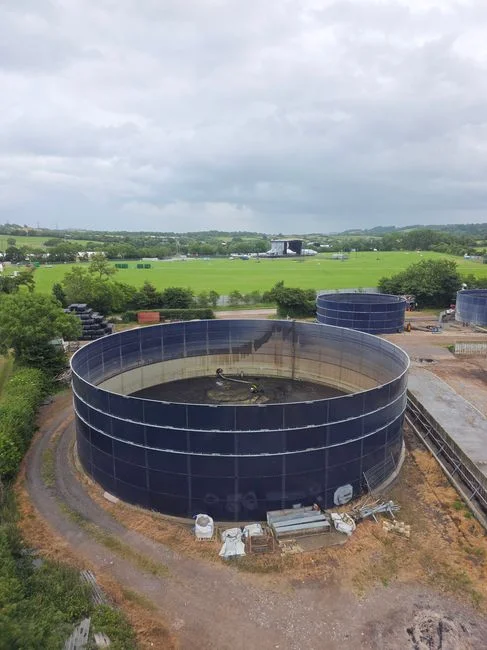
MBR effluent is set by a physical membrane barrier; CAS effluent is set by a settling process. MBR routinely delivers TSS <5 mg/L and turbidity <1 NTU regardless of upstream hydraulics, while a well-run CAS train sits at 10–30 mg/L TSS best case and degrades sharply when SVI climbs above 150 mL/g (HydropureWater field data, 2026). For Wichita chemicals reuse targets — cooling-tower makeup, scrubber dilution, and RO-polished boiler feed — MBR permeate is significantly closer to reuse-grade, and CAS effluent typically needs a tertiary polish step (sand filter, disc filter, or DAF, as covered in the parallel DAF vs clarifier for chemicals wastewater guide) to qualify.
The roughly 60% smaller MBR footprint is often the difference between a feasible retrofit and a major civil expansion on a constrained Wichita brownfield (HydropureWater field data, 2026; Mannina et al., 2019). Cold-weather survivability is the second operational lever. January mixed-liquor temperatures on the Wichita industrial corridor drop to 8–12 °C during polar events, and nitrification rates roughly halve per 10 °C drop. A 30-day SRT MBR at 10 °C sustains full nitrification, while a 10-day SRT CAS train at the same temperature typically does not. The MBR's enclosed membrane tank also reduces wind-chill exposure on sites with no windbreak — a common layout on the corridor.
Microplastics are an emerging talking point because KDHE has begun answering constituent inquiries on the topic. MBR permeate contains roughly 0.4 microplastics per liter versus 1 MP/L for CAS effluent (Lares et al., 2018, via Mannina et al., 2019). The numbers are small in absolute terms, but they are the kind of trace-contaminant datapoints that show up in scan-monitoring discussions with regulators and downstream POTWs.
| Outcome metric (1,000 m³/d chemicals stream) | CAS | MBR |
|---|---|---|
| Effluent TSS (mg/L, best case) | 10–30 | <5 |
| Effluent turbidity (NTU) | 2–10 (SVI-dependent) | <1 |
| Footprint factor | 1.0 | ~0.4 |
| Microplastics in effluent (MP/L) | ~1.0 | ~0.4 |
| Nitrification at 10 °C mixed liquor | Partial at 10-day SRT | Full at 30-day SRT |
| Reuse-grade without tertiary polish | No (typical) | Yes (typical) |
OPEX, CAPEX, and Reuse-Economics Crossover for a 1,000 m³/d Wichita Plant
On a 1,000 m³/d chemicals train, MBR carries roughly 1.4–1.8× the CAPEX of a comparable CAS train and 1.2–1.5× the OPEX per cubic meter treated (HydropureWater field data, 2026; Karim and Mark, 2017). CAS OPEX benchmarks $0.15–0.30/m³ versus MBR $0.25–0.50/m³ depending on flux and the fouling-control regime. The MBR structural OPEX delta is fouling management: 0.3–0.6 kWh/m³ of scouring aeration above the CAS baseline, weekly NaOCl 500–1,000 mg/L maintenance cleans, and semi-annual citric-acid or NaOH recovery cleans. The DF-series flat-sheet cassette is built to tolerate surfactant and solvent slugs that would foul a hollow-fiber train faster, which is why most Wichita chemicals skids ship with flat sheet.
Biosolids hauling is the second cost vector. Wichita-to-landfill and to Class B sites typically runs 100+ km, with 2026 hauling at $35–55/wet ton for dewatered cake (HydropureWater field data, 2026). MBR's 20–40% lower waste-activated-sludge yield compounds across a 20-year horizon into six figures of OPEX avoided at a 1,000 m³/d plant. Plant-wide direct GHG emissions land at 0.85 kgCO₂eq/m³ for CAS versus 0.91 kgCO₂eq/m³ for MBR — a small MBR penalty that reverses once reuse displaces purchased water (Mannina et al., 2019). Without reuse, the literature's long-horizon MBR-favored case only flips in MBR's favor at roughly 67 years (Karim and Mark, 2017). With reuse at $1.50–3.00/m³ of purchased water displaced, the MBR OPEX crossover compresses to roughly 3–7 years on a Wichita 1,000 m³/d chemicals stream. For an integrated MBR skid for chemical-plant retrofit sized to that envelope, the capital package typically packages the bioreactor, membrane cassette, scour-blower room, and CIP skid on a single deliverable.
| Cost axis (1,000 m³/d, 2026 directional) | CAS | MBR |
|---|---|---|
| CAPEX multiplier | 1.0× | 1.4–1.8× |
| OPEX ($/m³ treated) | 0.15–0.30 | 0.25–0.50 |
| Membrane scouring aeration | n/a | 0.3–0.6 kWh/m³ above CAS |
| Membrane replacement (% CAPEX/yr) | 0 | ~3–5% |
| Sludge hauling ($/yr, >100 km haul) | Baseline | 20–40% lower (yield-driven) |
| Direct GHG (kgCO₂eq/m³) | 0.85 | 0.91 |
| Reuse-driven OPEX crossover | n/a | ~3–7 years at $1.50–3.00/m³ reuse credit |
2026 Decision Matrix for a Wichita Chemicals Plant
Score the five rows below on a per-site basis. If three of five land in the MBR column, the procurement package should be written around an MBR or a hybrid MBR-retrofit train that keeps the existing aeration basin and adds a membrane cassette downstream — typically the lowest-risk upgrade path on a constrained Wichita brownfield.
| Decision row | Choose CAS (or stay with CAS) | Choose MBR (or retrofit) |
|---|---|---|
| 1. Discharge destination | POTW or surface water with permit headroom | Reuse (cooling, scrubber, boiler feed after RO/IX) |
| 2. Influent profile | Readily biodegradable, low recalcitrant load | Recalcitrant SVOCs, high salinity, pH swings, slug events |
| 3. Permit trend (2025–2026 KDHE reissuance) | Stable limits, no PFAS/microplastic scan | Tightening WET, PFAS precursor scan, microplastic monitoring |
| 4. Biosolids haul distance | Short haul (<50 km), landfill or land application | Long haul (>100 km), hauling cost significant |
| 5. Available footprint | Greenfield with land, civil expansion feasible | Tight brownfield, civil expansion constrained |
For a Wichita brownfield with reuse targets, an MBR-retrofit hybrid — keeping the existing aeration basin and clarifier in service while adding a DF-series flat-sheet MBR cassette downstream — is usually the lowest-risk path. For greenfield Wichita sites with abundant land, stable permit limits, and no reuse driver, CAS remains defensible, but the 2026 capex memo should still record the 20-year permit and PFAS reissuance risk against the headline CAPEX saving.
Frequently Asked Questions
Is MBR worth the higher capex for a Wichita chemical plant in 2026?
Yes, when reuse is in scope. MBR runs 1.4–1.8× CAS capex on a 1,000 m³/d train, but reuse credit at $1.50–3.00/m³ of purchased water displaced compresses the OPEX crossover to roughly 3–7 years (HydropureWater field data, 2026). Without reuse, the same crossover stretches to decades.
How does KDHE's 2025–2026 permit reissuance change the MBR vs CAS decision?
KDHE is tightening WET limits and adding PFAS precursor scan monitoring on Wichita-area organic and specialty chemical permits, consistent with the Central US pattern (HydropureWater field data, 2026). MBR's stable TSS <5 mg/L and SVI-independent separation make it easier to defend under tightening scan-monitoring language, particularly for plants discharging to the Little Arkansas or Arkansas River envelope.
Can MBR handle a Wichita January cold snap?
Yes. A 30-day SRT MBR sustains full nitrification at 10 °C mixed liquor, while a 10-day SRT CAS train at the same temperature typically does not (HydropureWater field data, 2026). The enclosed membrane tank also reduces wind-chill exposure on exposed corridor sites. For a deeper MBR operating walkthrough, see the MBR Wastewater Treatment System Explained: How It Works, Costs & When to Choose It (2026 Data).