Why cooling blowdown is the water problem to solve in a Monterrey data center
A 100 MW hyperscale facility consumes up to ~2 million liters of water per day, roughly the daily use of thousands of households (per IDE, 2026), and the same arithmetic scaled down to a typical 5-20 MW enterprise or colocation build in the Apodaca, San Nicolas, Santa Catarina, or Pesqueria corridor puts makeup water demand at ~100,000-400,000 L/day. At 4 cycles of concentration, 25-30% of that makeup is shed as cooling tower blowdown (CTBD) — 25,000-120,000 L/day that the plant must either discharge, reuse, or concentrate (per Genesis, 2026). In the Rio Bravo/Conchos basin, where CONAGUA classifies the underlying Nuevo Leon aquifers as heavily overdrafted, that volume is no longer a line item a developer can hand to the operations team and forget. New extraction titles increasingly require demonstrated industrial reuse, and surface discharge caps under NOM-001-SEMARNAT-2021 set monthly-average limits on BOD, COD, TSS, total nitrogen, total phosphorus, oils and greases, and total metals that untreated blowdown at 1,200-6,000 mg/L TDS and 10-50 mg/L TSS will fail outright, whether the receiving body is the Río San Juan, Arroyo El Obispo, or a municipal interceptor. Direct discharge fees in water-stressed regions run USD 5-15 per 1,000 gallons, and Monterrey-area sewer surcharges escalate the same way (per Genesis, 2026), so the cost of doing nothing is already in the OPEX line. The rest of this article covers the chemistry first, then the train, then the discharge-versus-reuse-versus-ZLD decision, and closes with Monterrey-specific permitting and a 50,000 GPD class-4 budget.
What's actually inside the blowdown: chemistry that drives equipment selection
CTBD at 4 cycles of concentration is a brackish stream, not a dilute one: total dissolved solids sit at 1,200-6,000 mg/L, typically 4-8x the makeup water, with hardness (calcium and magnesium), alkalinity, and silica all concentrated in lockstep (per Genesis, 2026). Silica is the bottleneck for any membrane-based reuse path, because conventional brackish water reverse osmosis (BWRO) hits silica scaling at recoveries well below the 75-80% ceiling the rest of the salt suite would tolerate. Suspended solids run 10-50 mg/L and are dominated by corrosion products, biofilm fragments, and the PM10-loaded dust that the Santa Catarina and Garcia canyons funnel straight into the basin — a regionally specific loading that an air-quality-aware operator should expect to see in the TSS trend. The blowdown also carries the residuals of the cooling-water treatment program: oxidizing biocides (chlorine, bromine, chlorine dioxide), non-oxidizing biocides, phosphate- or polymeric-scale inhibitors, and corrosion inhibitors. Chromate-era chemistries are mostly gone from new builds but show up in legacy sites being repurposed. Microbial content — planktonic bacteria, biofilm, occasional Legionella — has to be addressed before any permeate returns to the tower, regardless of whether the final destination is reuse or sewer.
| Parameter | Typical CTBD range at 4 COC | Design implication |
|---|---|---|
| Total dissolved solids (TDS) | 1,200-6,000 mg/L | Sets RO feed osmotic pressure; dictates pump and energy sizing |
| Total suspended solids (TSS) | 10-50 mg/L | Requires DAF/clarifier and UF guard before any RO |
| Silica (as SiO₂) | 50-150 mg/L | Limits conventional RO recovery; needs precipitation chemistry or antiscalant |
| Calcium hardness | 400-1,200 mg/L as CaCO₃ | Drives CaCO₃ scaling risk; pH adjustment and antiscalant required |
| Alkalinity | 200-600 mg/L as CaCO₃ | Couples with hardness to set Langelier Saturation Index at RO concentrate |
| Residual oxidizing biocide | 0.1-1.0 mg/L free Cl₂ | Dechlorination (bisulfite) before RO to protect polyamide membranes |
| Non-oxidizing biocide | Some classes restricted in NOM-001 permit; check local discharge title | |
| Phosphate scale inhibitor | Fouls RO and triggers total phosphorus cap in NOM-001 | |
| Planktonic bacteria / biofilm | Disinfection or UF barrier required for any reuse path |
The four-stage treatment train Monterrey plants should plan around
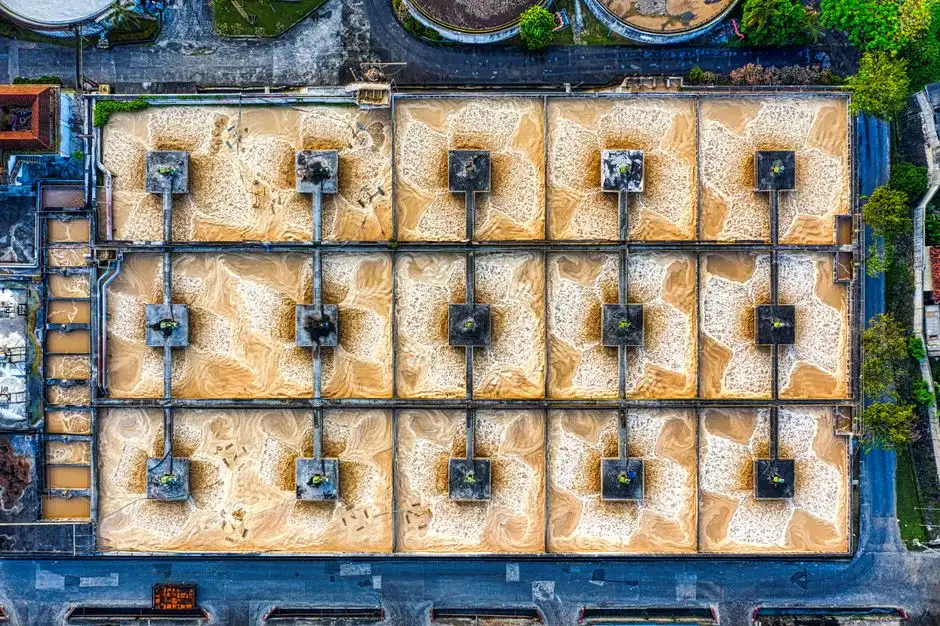
The basis-of-design for a Monterrey CTBD train runs side-stream filtration → clarification and chemical polishing → ultrafiltration → high-recovery membrane stack, with controlled salt precipitation or MVC evaporation as optional Stage 4a/5 polishers. Stage 1 — side-stream filtration treats 1-5% of the recirculating flow through self-cleaning mechanical filters (10-25 µm) that drop suspended solids and biological loading continuously; CAPEX typically lands at USD 50K-200K and the steady-state SDI reduction is what makes the downstream membranes operable (per Genesis, 2026). Stage 2 — clarification and chemical polishing uses a DAF unit for biocide and TSS reduction in blowdown or a lamella clarifier to float out flocculated solids, oils, and phosphate-laden sludge, followed by pH trim and an antiscalant/bisulfite dosing skid ahead of the membranes. Stage 3 — ultrafiltration with 0.01-0.1 µm PVDF membranes operates at 10-30 psi with 90-95% recovery and automatic backwash on a PVDF ultrafiltration system for RO pretreatment; this stage is the membrane guard, removing colloids, biofoulants, and any residual emulsified oil that slipped past the DAF (per Genesis, 2026). Stage 4 — the high-recovery membrane stack is where the BWRO design earns its keep: an industrial RO system for cooling blowdown recovery running at 150-400 psi with 50-85% local recovery and 95-99% rejection produces 10-50 mg/L TDS permeate ready to return to the cooling loop. Stage 4a — controlled-salt-precipitation upgrade routes the RO concentrate into a fluidized-bed reactor where scaling inhibitors are intentionally deactivated and silica, CaCO₃, and CaSO₄ precipitate onto seed pellets, leaving an NaCl-dominant brine that can be re-pressurized in a closed loop; this is the chemistry that pushes overall recovery to ~95% with permeate silica around 1 mg/L (per IDE, 2026). Optional Stage 5 — MVC evaporation for partial or full zero-liquid-discharge (ZLD) hits 95-98% recovery with distillate below 10 mg/L TDS at 15-25 kWh per 1,000 gallons, but only justifies its USD 1-3M capex when discharge is not permitted or freshwater cost-equivalence makes the thermal stage pencil out.
Choosing between discharge, reuse and ZLD: a Monterrey decision matrix
Three end-use strategies are technically defensible in 2026, and the choice is usually a function of the site's permit path and water-stewardship target rather than technology availability. Surface or sewer discharge under NOM-001-SEMARNAT-2021 means polishing the blowdown to meet monthly-average limits on BOD, COD, TSS, nitrogen, phosphorus, oils and greases, and metals — typically through DAF, carbon polishing, and, if TDS is constrained, partial RO — and accepting a municipal tarifa de descarga or a CONAGUA surface-discharge title. Reuse as cooling-tower makeup under NOM-003-SEMARNAT-1997 treats the blowdown to non-potable service-water thresholds (BOD <30 mg/L, TSS <30 mg/L, fecal coliforms <240 NMP/100 mL, plus residual chlorine or an alternative disinfection) and blends or substitutes permeate into the cooling loop, which directly cuts municipal water bills and descarga-permit friction. Partial or full ZLD with MVC and crystallizer runs the train to 95-99% recovery and converts the residual brine to a solid cake, which only makes economic sense at hyperscale or where discharge is banned outright. For a 5-20 MW plant in the Monterrey metro, reuse as cooling-tower makeup typically offers 60-85% recovery at the strongest unit economics because it removes the discharge-permit question from the critical path.
| Strategy | Water recovery | CAPEX band | OPEX (USD/1,000 gal) | NOM compliance path | Monterrey fit (5-20 MW) |
|---|---|---|---|---|---|
| Discharge to municipal sewer with pretreatment | 0% (no recovery) | USD 150K-400K | USD 3-8 (tarifa de descarga) | NOM-001-SEMARNAT-2021 + CONAGUA descarga title | Acceptable for small edge sites; weak water-stewardship optics |
| Reuse as cooling-tower makeup (UF + BWRO) | 60-85% | USD 500K-1.5M | USD 1.50-4.00 | NOM-003-SEMARNAT-1997 service-water thresholds | Strongest fit: cuts municipal bills, avoids descarga friction |
| High-recovery reuse with controlled salt precipitation | ~95% | USD 1.5M-3M | USD 3-6 | NOM-003-SEMARNAT-1997; brine handled as solid waste | Good fit where freshwater cost is high or interceptor is constrained |
| Partial or full ZLD (MVC + crystallizer) | 95-99% | USD 3M-8M | USD 5-15 | NOM-001 effectively bypassed; solid waste handled under LGPGIR | Hyperscale only in 2026; justify only with strict discharge ban |
Monterrey-specific regulatory and siting considerations
The Mexican regulatory stack on a CTBD project is three permits wide: a CONAGUA title concession for groundwater extraction or a municipal supply contract for makeup, a CONAGUA descarga permit for any surface or sanitary-sewer discharge, and a NOM-003-SEMARNAT-1997 compliance package for any reuse as cooling-tower makeup. NOM-001-SEMARNAT-2021 sets monthly-average discharge limits keyed to receiving-body class (río, embalse, suelo, coastal/marine) and parameter (per Genesis, 2026; local counsel should confirm the most current DOF publication). NOM-003-SEMARNAT-1997 specifies the non-potable service-water thresholds — BOD <30 mg/L, TSS <30 mg/L, fecal coliforms <240 NMP/100 mL, plus residual chlorine 0.2-1.5 mg/L or an equivalent disinfection barrier — that any reuse-as-cooling-makeup train has to hit on a rolling basis. Site selection across the Monterrey metro materially shifts the cost stack: Apodaca, Pesqueria, and San Nicolas parks typically have municipal-sewer capacity at the park boundary, which lets a discharge-to-sewer strategy pencil out as a fast-track first phase. Santa Catarina and Garcia sites, by contrast, frequently face interceptor capacity constraints that push the project toward on-site polishing and a higher-recovery train (analogous to the alternatives-analysis workflow Black & Veatch runs for hyperscale developers, per B&V, 2026). Air permitting is the last local pinch point: ClO₂ or ozone polishing for the reuse path adds a SEMARNAT atmospheric-emissions consideration, while UV sidesteps the permit entirely and is the preferred barrier in dense urban or industrial-park settings.
| Parameter | NOM-001-SEMARNAT-2021 monthly average (industrial, illustrative) | NOM-003-SEMARNAT-1997 (non-potable service / cooling) |
|---|---|---|
| BOD₅ | 30-60 mg/L (receiving-body dependent) | <30 mg/L |
| COD | 120-200 mg/L | — |
| TSS | 40-75 mg/L | <30 mg/L |
| Total nitrogen | 15-40 mg/L | — |
| Total phosphorus | 5-20 mg/L | — |
| Oils and greases | 10-25 mg/L | — |
| Total metals (sum) | 1-5 mg/L (parameter-specific) | Parameter-specific |
| Fecal coliforms | 1,000-10,000 NMP/100 mL | <240 NMP/100 mL |
| Residual chlorine | — | 0.2-1.5 mg/L (or equivalent disinfection) |
Budgeting a 50,000 GPD blowdown train in the Monterrey market
The 50,000 GPD (≈190 m³/day) class is the right size to anchor a class-4 estimate for a 5-10 MW Monterrey plant. Published benchmarks: USD 250K-500K for a 50,000 GPD RO skid, USD 1.50-3.00 per 1,000 gal OPEX, USD 50K-200K for side-stream filtration, and USD 1-3M for a 10,000-30,000 GPD MVC system (per Genesis, 2026). On top of that, a Mexico siting adds import duties (typically 0-5% under IMMEX for project-classified equipment) plus 16% IVA on the dutiable portion, last-mile interconnect to the municipal sewer or a recharge basin, CONAGUA filing fees, and a USD 30K-80K climate-controlled equipment shelter sized for the summer-heat derate (ambient 38-42 °C is normal in Apodaca and Pesqueria from May through September). OPEX in the Mexican context is driven by CFE industrial tariffs: factor BWRO energy at 0.8-1.2 kWh/m³ of permeate, MVC at 15-25 kWh per 1,000 gal, antiscalant and CIP chemicals, membrane replacement amortized over 5-7 years, and one FTE operator per shift. A side-stream filter plus DAF plus UF plus BWRO plus UV for a 50,000 GPD system therefore lands at roughly USD 500K-900K CAPEX and USD 2.00-4.00 per 1,000 gal OPEX — treat as a class-4 budget, not a quote, and refine with site-specific load curves, discharge-permit assumptions, and CFE tariff schedule.
| Line item (50,000 GPD, reuse-as-makeup train) | CAPEX (USD) | OPEX driver | OPEX (USD / 1,000 gal) |
|---|---|---|---|
| Side-stream filtration (1-5% of circulation flow) | 50,000-200,000 | Solids disposal, routine service | 0.10-0.30 |
| DAF / lamella clarifier + chemical dosing skid | 80,000-250,000 | Flocculant, coagulant, pH adjuster | 0.20-0.50 |
| UF rack (PVDF, 0.01-0.1 µm) | 120,000-300,000 | CIP chemicals, membrane replacement (5-7 yr) | 0.30-0.70 |
| BWRO skid (50-85% local recovery) | 250,000-500,000 | Energy 0.8-1.2 kWh/m³, antiscalant, membranes | 1.50-3.00 |
| UV disinfection (reuse barrier) | 40,000-100,000 | Lamp replacement, low energy | 0.05-0.15 |
| Equipment shelter, HVAC, interconnect | 60,000-150,000 | Power, weather protection | 0.10-0.25 |
| CONAGUA filing, permitting, engineering | 40,000-120,000 | — | — |
| Totals (class-4, Mexico-sited) | 500,000-900,000 | — | 2.00-4.00 |
Frequently asked questions on data center wastewater in Monterrey
Does every Monterrey data center need a ZLD system?
No. A reuse-as-cooling-makeup train under NOM-003-SEMARNAT-1997 typically meets the project's water-stewardship and permit objectives at 60-85% recovery and a fraction of the CAPEX of a full ZLD; ZLD only pencils out when discharge is strictly prohibited or freshwater is constrained to the point of cost equivalence (per Genesis, 2026).
What is the cheapest way to hit NOM-001-SEMARNAT-2021 discharge limits?
Discharge to the municipal sanitary sewer with side-stream filtration, DAF, and polishing carbon, accepting the tarifa de descarga but avoiding the BWRO CAPEX. This is the right answer for small edge sites outside the Rio Bravo basin, but the sewer surcharge for high TDS often erodes the savings inside two to three operating years.
Can RO handle the silica in Monterrey's groundwater?
Not at high recovery on its own. Conventional BWRO hits silica scaling well before the 75-80% recovery ceiling the rest of the salt suite would tolerate; pair RO with a fluidized-bed precipitation reactor that drops silica, CaCO₃, and CaSO₄ onto seed pellets, or operate the RO at conservative recovery with a silica-rated antiscalant (per IDE, 2026).
How much water does a 10 MW data center in Monterrey use?
Roughly 200,000 L/day of makeup, with 50,000-60,000 L/day of blowdown at 4 cycles of concentration. That blowdown stream is the size class the 50,000 GPD budget in this guide is anchored to.
Is NOM-001-SEMARNAT-2021 the only discharge permit a data center needs in Mexico?
No. A CTBD project typically requires a CONAGUA descarga title for any surface or sanitary-sewer discharge, a CONAGUA title concession (or municipal supply contract) for makeup extraction, and, for cooling-tower reuse, compliance with NOM-003-SEMARNAT-1997. Permit packages should be opened with CONAGUA and the local state environmental authority (Secretaría de Medio Ambiente de Nuevo León) on day one of the project, before the basis-of-design is locked.
Further Reading
- Data Center Cooling Blowdown Treatment in Astana, Kazakhstan (2026 Guide)
- Data Center Wastewater & Cooling Blowdown Treatment in Mombasa, Kenya (2026 Guide)
- Performance-Based Wastewater O&M Contracts: 2026 Engineering Guide
Frequently Asked Questions
What wastewater treatment does a data center in Monterrey Mexico need?
Data centers in Monterrey must treat cooling tower blowdown to remove suspended solids, hardness, and high concentrations of dissolved minerals common in the region's water supply. Standard treatment trains typically include multi-media filtration for turbidity reduction, followed by chemical softening or ion exchange to manage scale-forming ions, and membrane filtration such as reverse osmosis (RO) to meet local discharge or recycling standards.
How much cooling tower blowdown does a 10 MW data center produce per day?
A 10 MW data center operating with a typical cooling tower cycle of concentration between 4 and 6 produces approximately 40,000 to 70,000 liters of blowdown per day. This volume fluctuates based on the facility's Power Usage Effectiveness (PUE), local ambient humidity, and the specific water chemistry of the municipal supply, which necessitates precise blowdown flow control to maintain system efficiency.
Is ZLD required for data centers in Mexico?
Zero Liquid Discharge (ZLD) is not explicitly mandated by federal law for all data centers, but it is increasingly required in Monterrey due to severe regional water scarcity and local permits issued by CONAGUA. Facilities located in water-stressed zones are often incentivized or legally compelled to implement ZLD systems—utilizing evaporators and crystallizers—to achieve a 95% to 98% water recovery rate and minimize environmental impact.
What are NOM-001 discharge limits for industrial cooling blowdown?
The NOM-001-SEMARNAT-2021 standard dictates strict limits for industrial wastewater discharge into national waters. Key parameters for cooling blowdown include a pH range of 6.0 to 9.0, maximum allowable limits for Total Suspended Solids (TSS) at 125 mg/L, and specific concentrations for heavy metals and toxic substances. Compliance requires continuous monitoring and reporting to ensure that discharge does not exceed the permissible daily or monthly average loads specified in the standard.
Can RO treat silica-rich cooling tower blowdown in Monterrey?
Reverse Osmosis can treat silica-rich blowdown, but it requires specialized pretreatment to prevent membrane scaling. Because Monterrey’s groundwater and municipal sources often contain high silica levels, the treatment system must utilize anti-scalants specifically formulated for silica inhibition and potentially incorporate high-pH RO configurations or electrodialysis reversal (EDR) to prevent the precipitation of silica polymers on the membrane surface.