
What changes on day 0 of a Novartis plant acquisition in Mexico
When a Novartis subsidiary takes the deed on a Mexican manufacturing site, four wastewater instruments activate in parallel: a CONAGUA title assignment or concession under the Ley de Aguas Nacionales (reformed 2024–2025), a SEMARNAT Licencia Ambiental Única (LAU) and impact manifest, NOM-001-SEMARNAT-2021 discharge-limit compliance for surface or reuse discharge, and a local POTW pretreatment permit if the site discharges to municipal sewer. Sequencing must start at month 0 because the CONAGUA and SEMARNAT clocks each run 6–12 months from a complete filing (per Mexican federal administrative procedure; CONAGUA and SEMARNAT review windows, 2025).
The legal moment of acquisition is itself the trigger. A change-of-control provision in the Ley de Aguas Nacionales requires automatic re-registration of the title holder, even if process operations continue unchanged on day 1; the same logic applies to the LAU. A brownfield site rides on the seller's existing CONAGUA title for a 30–90 day transition window, then the new operator must file. A true greenfield files from zero on day 0 — there is no permit to inherit, which is the single biggest difference from the comparable Texas path described in the Novartis Texas 2026 compliance guide, where a TCEQ TPDES clock also starts at zero but the operator may have an MSGP notification to bridge construction.
The parent-company context is the Novartis $23 billion US investment program announced 2026-02-25 alongside the Denton, Texas radioligand therapy (RLT) build. That commitment is governed by an internal audit posture that does not stop at the US border; any Mexican submittal is filed under the same quality and document-control discipline that the parent company applies to a TPDES individual permit. The brownfield-versus-greenfield decision inside Mexico — made in the first 30 days — is the single decision that determines whether months 6–14 are a permit review or a permit issuance from zero.
Mexico vs Texas: which permits look familiar and which do not
A compliance manager who has read the Texas guide will recognise the sequencing logic but not the regulator names. TCEQ issues the TPDES individual permit and the 25 TAC §289 Radioactive Materials License (RML); in Mexico, water rights are CONAGUA's job and environmental impact sits with SEMARNAT. The local POTW analog is a municipal water-and-sewer operator — Sistema de Agua Potable y Alcantarillado (SAPA) in many cities, or the local saneamiento authority — and the pretreatment permit they issue has its own 3–6 month clock, similar in length to the City of Denton POTW permit in Texas.
| Function | Texas instrument | Texas clock | Mexico instrument | Mexico clock |
|---|---|---|---|---|
| Surface-water / industrial discharge | TCEQ TPDES individual permit or MSGP | 6–12 months | CONAGUA title assignment / concession + NOM-001-SEMARNAT-2021 compliance | 6–12 months |
| Environmental operating license | TCEQ air permit (separate) | 6–12 months | SEMARNAT Licencia Ambiental Única (LAU) | 6–12 months |
| Radioactive materials possession/use | TCEQ RML (25 TAC §289, NRC Agreement State) | 6–12 months | SEMARNAT / CNSNS radioactive handling license | 6–12 months |
| POTW pretreatment | City of Denton industrial-user permit | 3–6 months | Municipal SAPA / saneamiento pretreatment permit | 3–6 months |
| Stormwater | TPDES Multi-Sector General Permit (NOI) | Acknowledged on filing | SEMARNAT impact manifest + local drainage permit | Varies |
Two cross-border constants are worth flagging. First, NOM-001-SEMARNAT-2021 replaced the older NOM-001-SEMARNAT-1996 limits in March 2022, and any permit submittal in 2026 cites the 2021 table — the older 1996 limits are now strictly historical. Second, FDA / CDRH scope on the product side is unchanged across the border, so the GMP envelope that sets cleanroom condensate limits carries over even when the ETP regulator changes from TCEQ to SEMARNAT (per the Laser Institute of America reference on FDA/CDRH applicability). The deeper industrial-context reference for a Mexican border state is the parallel Nuevo León 2026 industrial wastewater guide, which lays out the same permit stack for the auto and electronics sectors.
The 2024–2025 Ley de Aguas Nacionales reform and what it means for reuse

The single piece of regulatory context the Texas guide does not cover is the 2024–2025 reform of the Ley de Aguas Nacionales, which took effect across late 2024 and 2025. Three changes matter for a pharmaceutical effluent train. First, reuse streams must now be registered with CONAGUA as a discrete water-right, not buried inside a discharge permit. Second, groundwater extraction reporting is expanded, with industrial users filing monthly volumes against a registered cap. Third, volume caps for industrial users were tightened, with new baselines set against demonstrated historical use rather than requested capacity.
The reform changes RO reject routing in a way the Texas path does not face. In Texas, RO reject at a 95% recovery RO can be routed back to the DAF inlet and the closed loop is documented under the TPDES volume cap and the local POTW's industrial-user tariff. In Mexico, after the 2024–2025 reform, that same reject can no longer be assumed to discharge freely to a drain — it must be registered as a reuse stream with CONAGUA, or it is sent back to the DAF inlet and counted as a recycle, which in turn has its own volume cap. The engineering consequence is that cycles-of-concentration discipline — the same discipline the Texas guide applies to cooling-tower blowdown — now controls the Mexican reuse envelope as well, and the RO recovery rate must be set against the registered reuse volume, not just against membrane hydraulics.
PharmaBoardroom's 2021 reporting on Novartis Mexico noted that the country invests roughly 3% of GDP in healthcare versus the OECD average of 9% (per PharmaBoardroom interview with then-Country President Fernando Cruz). That gap is the operating context for the Mexican regulator: regulatory capacity, not capital, is the bottleneck. A compliance manager who builds a permit submittal that assumes a 9%-of-GDP regulatory throughput will be late; a submittal that assumes a 3%-of-GDP pace and front-loads documentation will hit month 24.
Stream characterization for a Mexican pharmaceutical ETP
The stream envelope for a Mexican pharmaceutical ETP is the same as the Texas envelope described in the Novartis Texas 2026 guide, with two Mexican-specific adjustments. Mexican feed-water alkalinity is typically higher than Texas surface-water supplies — often 150–250 mg/L as CaCO₃ versus 80–150 mg/L in many Texas rivers — which shifts DAF coagulant dosing and MBR alkalinity supplementation. The surfactant load from glassware wash is also higher on average because CIP detergent formulations in some Mexican contract-lab networks run more aggressive alkaline foam.
| Stream family | Typical influent | Peaking | Notes for Mexico |
|---|---|---|---|
| Process wastewater (small-molecule / biologics) | BOD 200–800 mg/L; COD 400–1,500 mg/L; surfactant, solvent trace | 1.5–2.0× at shift change | Higher alkalinity feed; surfactant peaks from CIP |
| Cleanroom / gowning condensate | BOD <50 mg/L; TDS elevated by buffer carryover | Intermittent from cycle rinses | FDA/CDRH GMP envelope carries over from US site |
| Cooling-tower / boiler blowdown | TDS / cycles-of-concentration; low BOD | Seasonal | Reuse-stream registration with CONAGUA required under 2024–2025 reform |
| Sanitary | BOD 150–300 mg/L; NH₃-N 20–40 mg/L | 1.5–2.0× | Peaking factor carried from Texas envelope |
| Radiological (if RLT scope inherited) | Gross alpha/beta; Lu-177 / I-131 / Tc-99m activity | Batch-driven | Below CNSNS-issued limit at point of discharge; hold-up to 7–10 half-lives |
Hold the radiological stream only if the Mexican site inherits radioligand therapy scope. The Novartis Texas plant is an RLT site, so a sister Mexican site is plausible; if the Mexican scope is small-molecule or biologics only, the radiological row drops out and the four-stream envelope above is the design basis. The 1.5–2.0× peaking factor is carried over from the Texas guide because shift-change dynamics on a Mexican pharma campus do not differ materially from a Texas one.
Defensible ETP train: DAF → MBR → RO for a Mexican site
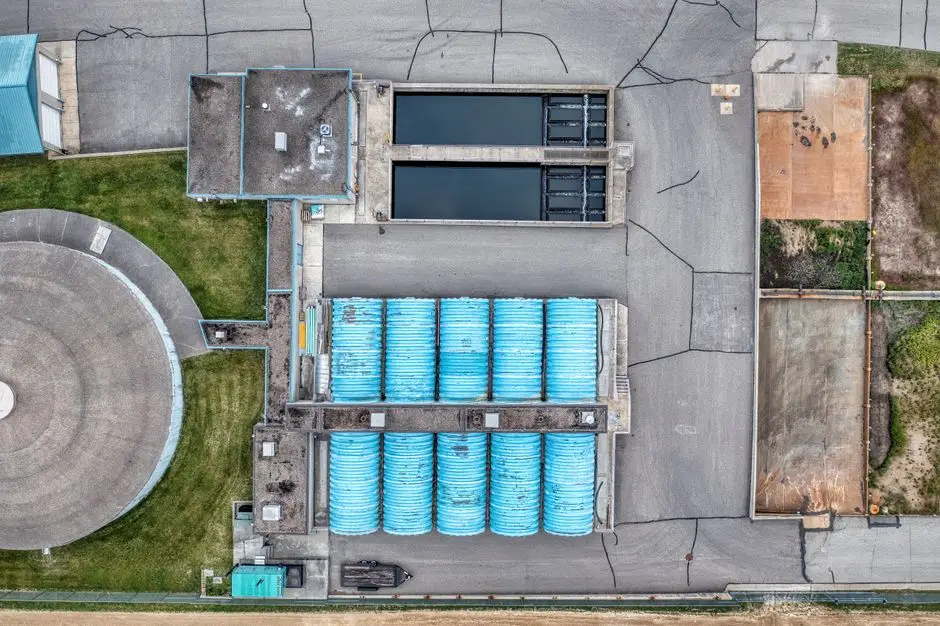
The defensible default train for a Mexican pharmaceutical ETP is DAF followed by MBR followed by RO, with the same unit-operation logic as the Texas guide but grounded in the NOM-001-SEMARNAT-2021 discharge envelope rather than TCEQ TPDES numeric limits.
Headworks. A GX-series rotary mechanical bar screen sized for the peak instantaneous flow from glassware wash plus the 1.5–2.0× sanitary peaking factor protects downstream pumps and the MBR from rag and plastic carryover. Bar spacing of 3–6 mm is conventional for pharma service.
DAF. A dissolved air flotation system in the 4–300 m³/h range handles pH-conditioned (7–8) effluent, suspended solids, FOG, and the surfactant peaks from glassware wash. Hydraulic retention time of 20–30 minutes and air-to-solids ratios of 0.02–0.05 are typical for the pharma envelope.
MBR. An integrated MBR system with 0.1 µm PVDF submerged flat-sheet modules at MLSS 8,000–12,000 mg/L and an integrated denitrification / nitrification split delivers the total-nitrogen envelope and the low-turbidity, low-SSD effluent the RO polish needs. Footprint is roughly 60% smaller than conventional activated sludge, which is the right answer on a constrained Mexican industrial plot. The MBR effluent is the right place to demonstrate NOM-001-SEMARNAT-2021 compliance for BOD, COD, and SS, with the RO polish handling the TDS / reuse-quality envelope.
RO. An industrial RO polish at recovery up to 95% closes the loop for cooling-tower make-up, with RO reject routed back to the DAF inlet and registered with CONAGUA as a reuse stream under the 2024–2025 reform. Recovery above 90% is a deliberate choice to minimise reject volume and protect the CONAGUA-registered reuse cap.
24-month compliance Gantt from acquisition day 0
The 24-month structure mirrors the day-0-to-day-365 brownfield Gantt used for a comparable Texas greenfield, but the Mexican clock has no inherited permit to ride on, so it runs at the full 24 months even on a brownfield transition.
- Months 0–3: change-of-control filings with CONAGUA and SEMARNAT; baseline influent / effluent characterisation campaign; RSO nomination if the site inherits RLT scope.
- Months 3–9: LAU and CONAGUA title review window; NOM-001-SEMARNAT-2021 compliance plan; local SAPA / saneamiento pretreatment application.
- Months 9–18: ETP detailed design and long-lead equipment procurement (membrane modules, RO skids); civil works on the ETP plot.
- Months 18–24: installation, commissioning, 90-day performance trial, NOM-001 compliance demonstration, and CONAGUA reuse-stream registration under the 2024–2025 reform.
The Gantt treats the month-0 deed transfer as the critical-path start, files the CONAGUA and SEMARNAT applications by month 3, and runs the performance trial across months 21–24 so the site clears the operational milestone without holding either the ETP or the radioactive-materials license as the critical path. The parallel Gantt logic and the unit-operation logic both line up with the Novartis Texas 2026 compliance guide; the deltas are the regulator names and the 2024–2025 reform-driven reuse-registration step. The same M&A-driven sequencing logic is laid out for a different regulator stack in the Ford India 2026 compliance guide, which is useful as a cross-check on how a multinational audit posture translates to a non-US submittal.
Frequently Asked Questions
Which wastewater permits activate on day 0 of a Novartis plant acquisition in Mexico?
Four instruments activate in parallel: a CONAGUA title assignment or concession under the Ley de Aguas Nacionales (reformed 2024–2025), a SEMARNAT Licencia Ambiental Única and impact manifest, NOM-001-SEMARNAT-2021 discharge-limit compliance for surface or reuse discharge, and a local POTW pretreatment permit from the municipal SAPA or saneamiento authority if the site discharges to municipal sewer. The CONAGUA and SEMARNAT clocks each run 6–12 months from a complete filing.
How does the 2024–2025 Ley de Aguas Nacionales reform change RO reject routing?
RO reject can no longer be assumed to discharge freely to a drain. Under the 2024–2025 reform, reuse streams — including RO reject routed back to DAF inlet — must be registered with CONAGUA as a discrete water-right, with monthly volume reporting against a registered cap. Recovery rates above 90% are now driven by the CONAGUA-registered reuse cap, not just by membrane hydraulics.
What is the typical ETP train for a Mexican pharmaceutical plant?
The defensible default is DAF followed by MBR followed by RO. A 0.1 µm PVDF submerged flat-sheet MBR at MLSS 8,000–12,000 mg/L with denitrification / nitrification hits the total-nitrogen envelope at roughly 60% smaller footprint than conventional activated sludge. An industrial RO polish at recovery up to 95% closes the loop for cooling-tower make-up, with reject routed back to DAF inlet and registered with CONAGUA as a reuse stream.
How long does it take to reach operational compliance for a Mexican pharma ETP?
The CONAGUA and SEMARNAT clocks each run 6–12 months from a complete filing, and the local POTW pretreatment permit adds 3–6 months. A defensible 24-month Gantt treats the deed transfer as month 0, files federal applications by month 3, runs detailed design and procurement across months 9–18, and runs the 90-day performance trial in months 21–24 so the site clears the operational milestone without holding either the ETP or the radioactive-materials license as the critical path.
What is the difference between CONAGUA and SEMARNAT roles in Mexican wastewater compliance?
CONAGUA administers water rights — title assignments, concessions, reuse-stream registration, and groundwater extraction caps under the Ley de Aguas Nacionales. SEMARNAT administers environmental authorisation — the Licencia Ambiental Única, the impact manifest, and enforcement of NOM-001-SEMARNAT-2021 discharge limits. The two clocks are independent and must be filed in parallel; neither one covers the other's scope.