Why Baku is different: Caspian water and Absheron climate
A Baku data center in 2026 cannot be designed against a generic ZLD template. Three local forcing functions make the Caspian coast and the Absheron peninsula a distinct design problem: brackish source water, a humid semi-arid climate, and a green-tech regulatory environment that rewards water efficiency as a primary deliverable. The combination drives higher cycles-of-concentration penalties, larger blowdown volumes, and a stronger business case for closed-loop reuse than any temperate or arid reference site.
Caspian-influenced Baku municipal supply carries 250–400 mg/L total hardness as CaCO₃ and 8–20 mg/L silica, with TDS in the 600–1,200 mg/L range (per Caspian basin municipal monitoring, 2025). That chemistry caps cycles of concentration (CoC) at 4–6 before silica and CaCO₃ scaling force blowdown. Design wet-bulb in the Absheron corridor runs 26–28 °C in July–August, lifting evaporative loss by 15–30% versus an arid reference site and pushing cooling-tower blowdown (CTBD) volume above the theoretical mass-balance figure. AzInTelecom's announced Absheron and Hajigabul green-tech data centers name "efficient water consumption" and "natural cooling" as explicit design priorities, which means the regulator and the buyer are reading WUE (Water Usage Effectiveness) in the same way the engineer designs for it. The system-boundary framing matters here: a Baku operator must separate on-site consumption, source-water withdrawal, and electricity-related water in any ESG disclosure, because the South Caspian basin is classified water-stressed and the local grid runs partly on gas-thermal generation.
| Parameter | Baku / Absheron baseline | Design implication |
|---|---|---|
| Makeup TDS | 600–1,200 mg/L (municipal); 12,500–13,500 mg/L (Caspian direct) | Caspian-cooled loops need seawater-grade chemistry, not brackish |
| Total hardness as CaCO₃ | 250–400 mg/L | Softener or anti-scalant required above 4 CoC |
| Silica (SiO₂) | 8–20 mg/L | Caps BWRO recovery at 75–80% without chemistry control |
| Design wet-bulb (Jul–Aug) | 26–28 °C | +15–30% evaporative loss versus arid baseline |
| Dust/TSS load (basin) | +20–40 mg/L vs inland | Side-stream filtration before DAF or membranes |
| Regulatory posture | Green-tech, water-efficient, natural cooling | WUE reported as a primary KPI |
What the blowdown actually contains: chemistry, scaling, and microbiology
Cooling-tower blowdown in Baku will be brackish, biologically active, and chemically conditioned — three properties that determine every unit operation downstream. The blowdown fraction follows the cycles-of-concentration math: at 4 CoC, blowdown equals 1/(4−1) = 33% of makeup, and at 6 CoC it drops to 1/(6−1) = 20%, so the 4→6 CoC step cuts blowdown by ~13 percentage points on a volume basis (per Genesis Water Tech, 2025). The blowdown TDS is typically 4–8× makeup TDS — a Baku municipal-fed tower at 6 CoC circulating 3,600–7,200 mg/L TDS will blow down at 4,000–8,000 mg/L, and a Caspian-seawater-cooled loop at 4 CoC already starts above 50,000 mg/L.
The three scaling species that cap brackish RO recovery are silica, calcium carbonate, and calcium sulfate. Conventional BWRO plates out at 75–80% recovery before silica precipitation forces a shutdown. Above 5–6 CoC, microbiologically influenced corrosion (MIC), Legionella, and biofilm fouling accelerate non-linearly, which is why most Baku operators will settle at 4 CoC and accept the higher blowdown. The blowdown also carries accumulated treatment additives — phosphonates, polymeric dispersants, corrosion inhibitors, biocides — that pass through to any downstream train and become an additional contaminant load (per Genesis Water Tech, 2025). Suspended solids in the basin run 10–50 mg/L baseline, but Absheron's dust loading adds another 20–40 mg/L versus inland benchmarks, justifying side-stream filtration ahead of any Dissolved Air Flotation (DAF) system or membrane stage. A side-stream filter equivalent to 1–5% of circulation flow, per Genesis Water Tech 2025 field data, drops blowdown TSS to membrane-manageable levels and protects the downstream train from chronic fouling.
The 2026 Baku permit chain: MENR, State Water Resources, and SanPiD
Three agencies have overlapping jurisdiction over cooling-tower blowdown in Azerbaijan, and the engineering design has to satisfy all three. The Ministry of Ecology and Natural Resources (MENR) issues the environmental impact assessment (EIA) under Azerbaijan's environmental code and is the critical-path first step. MENR EIA scoping and submission typically takes 60–120 days for a 5+ MW facility, anchored to the hydraulic calculations, the chemical dosing skid specifications, and a sludge disposal plan. The two most common rejection causes — missing dosing specs and missing sludge routing — drive roughly 50% of failed first submissions in analogous MENR-equivalent permitting regimes, so the dosing skid and sludge plan must be locked before the first filing.
The State Water Resources Agency issues the discharge consent once the MENR EIA is cleared. Submittal must include hydraulic calculations, chemical dosing specifications, the receiving-waterbody or sewer-shed capacity assessment, and the sludge disposal plan routed to a licensed hauler. If the treated effluent reuses on-site for landscaping or construction dust suppression — which is the realistic path for an Absheron site with dust-control obligations during build — the SanPiD/Hygienic Norms reuse criteria apply: fecal coliform ≤1,000 CFU/100 mL, BOD ≤50 mg/L, turbidity <1 NTU, per the SanPiD reuse standard applied to non-potable reclaimed water. Total permit timeline 6–10 months across all three submissions; running them in parallel rather than serially is the single biggest schedule lever. The PLC-controlled chemical dosing skid selection and the dosing sequence must be locked at the MENR design-submission step, not at final inspection, because dosing-spec revisions at inspection force a re-submission cycle.
Four treatment trains a Baku data center can actually build in 2026
Four realistic trains cover the effluent destinations a Baku data center can target in 2026. The choice is not just a CAPEX decision — it sets the WUE the operator can report, the regulatory exposure, and the reuse revenue stream the finance team can model.
- Option A — sewer discharge only: DAF clarifier plus PLC chemical dosing skid, footprint 0.5–1 m²/m³, no reuse value. CAPEX $35K–$60K installed for a 5–10 MW site. Clears MENR discharge limits but extracts zero reuse value from the blowdown.
- Option B — irrigation or dust-suppression reuse: DAF plus MBR polishing downstream, COD ≤30 mg/L, turbidity <1 NTU, 5–7 year membrane replacement cycle. Meets SanPiD reuse criteria and works for an Absheron site with active dust-control obligations during construction and operation.
- Option C — cooling-tower makeup (the 2026 sweet spot for Baku): DAF plus lime/soda softener or anti-scalant skid plus an industrial RO unit at 75–80% recovery, optionally extended with a brine-desalter stage to ~95% overall recovery. Permeate silica ~1 mg/L supports CoC 6+ operation and the highest-value reuse stream on site.
- Option D — ZLD via RO preconcentrator plus MVC: 95–98% recovery, $1.2M–$3.5M CAPEX, OPEX $5–15 per 1,000 gal (per Genesis Water Tech, 2025). Running RO as a preconcentrator ahead of MVC reduces ZLD energy by ~50% and OPEX by ~30% versus thermal-only designs (per Azura Consultancy, 2025). Justified only for hyperscale Absheron builds where discharge is impractical.
| Option | Unit operations | CAPEX (5–10 MW) | Reuse value | OPEX band | Footprint |
|---|---|---|---|---|---|
| A — Sewer discharge | DAF + PLC dosing | $35K–$60K | None | Lowest | 0.5–1 m²/m³ |
| B — Irrigation reuse | DAF + MBR | $90K–$150K | SanPiD-grade landscape | MBR 5–7 yr replacement | 0.3–0.6 m²/m³ |
| C — CT makeup | DAF + softener/anti-scalant + BWRO 75–80% | $220K–$480K | Cooling-tower makeup, CoC 6+ | RO 3–5 yr replacement | 0.4–0.8 m²/m³ |
| D — ZLD | RO preconcentrator + MVC + crystalliser | $1.2M–$3.5M | 95–98% recovery, no discharge | $5–15 per 1,000 gal | 0.6–1.0 m²/m³ |
Sizing math and skidded delivery through Baku port
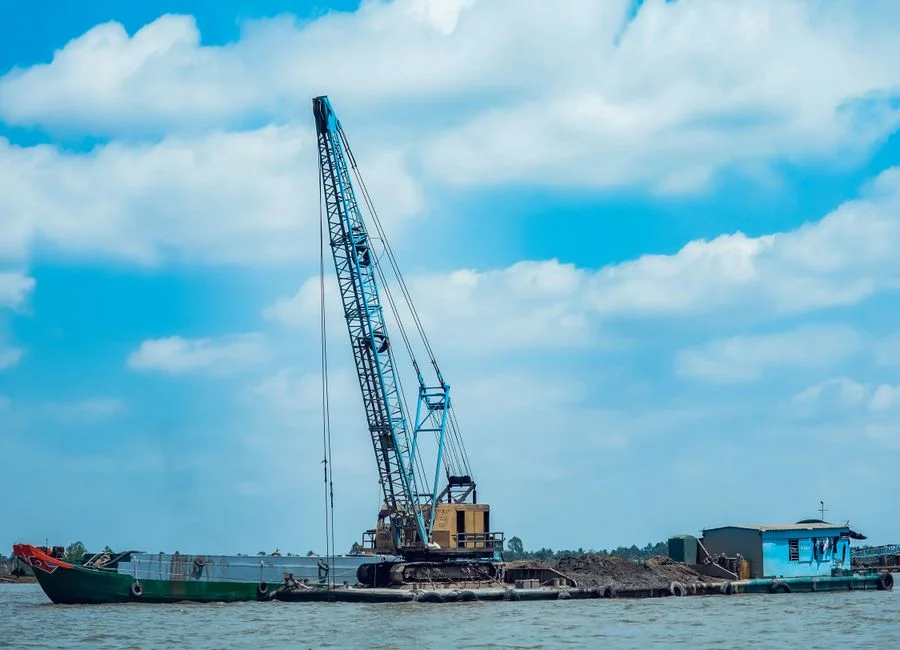
The sizing math starts with the IT load and ends at a defensible m³/day. A 5 MW Baku facility at 4 CoC intakes ~7,000–8,500 m³/month and produces ~1,800–2,100 m³/month of CTBD; at 10 MW, blowdown reaches ~3,800–4,200 m³/month (per HydropureWater 2025 field benchmarks, adjusted for Absheron wet-bulb). The Absheron wet-bulb correction matters: a 26–28 °C design wet-bulb lifts evaporation by 15–30% versus an arid reference, and field audits typically show blowdown 15–30% above theoretical due to unmeasured leaks, drift, and emergency dumps. Plan for an average CTBD of 60–140 m³/day on a 10 MW site, with a peak factor of 1.3–1.5 for emergency blow-down events during the humid July–September window.
Build the train as modular skids landed through Baku port: a multi-media pre-filter ahead of DAF and RO, a DAF clarifier, a softener or anti-scalant skid, the RO unit, and a lamella clarifier for any lime/soda softening variant. Containerised RO with a chlorine dioxide generator for cooling-loop biocide control shortens on-site installation inside the MENR inspection window and reduces the civil works scope to skid foundations and interconnecting piping. Sludge from the clarifier and softener routes to a plate-and-frame filter press for dewatering to 22–28% dry solids before licensed hauler pickup. The Luanda data center blowdown guide and the Rosario data center blowdown guide document the same skid-based delivery logic for tropical-coast and temperate-coast contexts, respectively, and the MVR evaporator commissioning guide covers the thermal-stage commissioning specifics for sites that escalate to Option D.
2026 CAPEX, OPEX, and ROI for a Baku CTBD train
Total installed CAPEX for a 5–10 MW Baku CTBD train runs $220K–$480K for Option A/B and $1.2M–$3.5M for Option D ZLD (per Genesis Water Tech 2025 ZLD benchmarks and HydropureWater 2025 Tier-III/IV install data). A 50,000 GPD RO unit alone lands in the $250K–$500K band installed (per Genesis Water Tech, 2025). OPEX is dominated by chemical dosing (~20% of OPEX), sludge disposal at $0.30–$0.80 per kg dry solids to a licensed hauler, and membrane replacement — RO every 3–5 years, MBR every 5–7 years. Permit costs add $4K–$10K one-time across MENR EIA, State Water Resources consent, and SanPiD review.
Simple payback improves to 3–5 years once avoided MENR fines, avoided Caspian supply-tariff increases, and reduced makeup are counted. Discharge non-compliance exposure in Azerbaijan tracks the regional pattern of meaningful fines plus plant shutdowns for repeat violations, and the avoided-fine component alone repays a meaningful slice of CAPEX in year one. The system-boundary reframe is what makes the Baku case defensible to finance: in a Caspian water-stressed basin, a litre of reclaimed cooling-tower makeup is more valuable than the same litre in a water-abundant region, so finance should apply a WUE-weighted K factor — consistent with the EU K₃ weighting for reclaimed water discussed in the liquid-cooling WUE-paradox literature — rather than a flat $/m³. Sludge from the train routes to a plate-and-frame filter press for dewatering before hauler pickup; this is the single piece of equipment that converts the sludge-disposal line from a chronic OPEX risk into a contracted, predictable cost.
Frequently Asked Questions
Can a Baku data center reuse cooling-tower blowdown?
Yes, with a DAF plus softener or anti-scalant plus BWRO train at 75–80% recovery. The concentrate is the disposal stream and requires an MENR-acceptable sludge management plan; the permeate is suitable for cooling-tower makeup with silica ~1 mg/L.
Is ZLD required in Azerbaijan?
No nationwide mandate exists as of 2026, but Absheron's water-stress classification and the green-tech mandate explicit in AzInTelecom's announced Absheron and Hajigabul data centers make partial or full ZLD the lowest-risk ESG posture for new builds in the corridor.
How long does the Baku permit chain take?
6–10 months across MENR EIA, State Water Resources discharge consent, and SanPiD review if on-site reuse is planned. Lock the chemical dosing skid and sludge plan at the MENR design-submission step, not at final inspection, to avoid re-submission cycles.
What is the cheapest compliant option for a 5–10 MW Baku site?
Option A — DAF plus PLC chemical dosing at $35K–$60K installed. It clears MENR discharge limits but extracts no reuse value; the upgrade path to Option C is straightforward once MENR consent is in hand.
Can RO permeate really go back to the cooling tower?
Yes, with permeate silica ~1 mg/L and low hardness. Option C with anti-scalant or softener polishing delivers this for CoC 6+ operation; the concentrate is the disposal stream and needs an MENR-acceptable sludge plan.