
Why Fabricated-Metals Wastewater in Twin Falls Is a Different MBR-vs-CAS Question
Twin Falls, Idaho sits on the Snake River Plain, and its fabricated-metals sector is dominated by job-shop stamping, structural steel fabrication, powder-coating lines, and plating rinse operations. These shops generate 50–500 m³/day of process wastewater in batch discharges tied to shifts, part runs, and cleaning cycles. The influent profile is nothing like the domestic sewage academic MBR-vs-CAS reviews assume: pH swings between 2 and 11 from pickling and alkaline cleaning baths, oil and grease from stamping and drawing lubricants at 50–500 mg/L, COD of 300–2,500 mg/L, TSS of 100–800 mg/L, and dissolved zinc, nickel, copper, and chromium loading of 5–200 mg/L. Plating lines add intermittent cyanide and EDTA complexing agents that defeat simple hydroxide precipitation unless they are pre-treated. Discharge to the City of Twin Falls wastewater utility is governed by the Idaho DEQ Wastewater Rules and the local POTW pretreatment program, which sets site-specific limits on metals, oil and grease, and pH before effluent can enter the municipal system. Cold winters with sub-zero air temperatures drop biological activity in any open basin, and a roughly four-month irrigation-season reuse window (typically May through September on Magic Valley crops) creates an economic case for on-site reuse of treated effluent in process rinse-water make-up. That combination — variable flow, metal toxicity spikes, cold climate, and a reuse lever — pushes Twin Falls fabricators toward compact, high-rate biological systems rather than the textbook CAS basin sized for municipal BOD.
How MBR and Conventional Activated Sludge Work — and Why It Matters for Metals
Conventional activated sludge (CAS) oxidizes organics in an aeration basin and separates biomass from clarified effluent in a downstream gravity settling tank. The clarifier depends on floc settleability, so any toxicity spike that disrupts floc structure — dissolved zinc at 50 mg/L, for example, or a pH excursion to 3 — triggers bulking, washout, and permit excursions. Mixed liquor suspended solids (MLSS) in CAS is typically held at 2,000–4,000 mg/L because denser mixed liquor simply will not settle in a clarifier.
A membrane bioreactor (MBR) runs the same biological stage but replaces the clarifier with a submerged PVDF flat-sheet membrane module operating at a nominal pore size of 0.1–0.2 μm. Because solids separation is by physical barrier rather than gravity settling, the basin can run at 8,000–12,000 mg/L MLSS and a solids retention time (SRT) of 20–60 days versus 5–15 days for CAS. The longer SRT sustains slow-growing nitrifiers and metal-tolerant consortia that outcompete the filamentous organisms responsible for bulking in CAS under metal loading. MBR effluent is also free of particulates larger than about 1 μm, which is the same size class that carries adsorbed metals, oil droplets, and pathogens — directly relevant when effluent goes to irrigation or to on-site process rinse reuse. CAS still has real advantages: roughly a century of operating data, simple controls, and no membrane replacement. MBR's advantages are a smaller aeration basin, no clarifier, and roughly 60% footprint reduction per the integrated MBR system for industrial wastewater specification. A Twin Falls fabricator retrofitting an existing concrete tank for reuse will care far more about the footprint and effluent-quality story than the academic tradeoff charts suggest.
MBR vs CAS for Fabricated Metals: Head-to-Head Parameter Comparison
The table below summarizes the operating envelope a Twin Falls plant engineer should expect. Values are drawn from plant-wide modelling studies and manufacturer specifications, not from municipal-sewage design manuals.
| Parameter | CAS (conventional activated sludge) | MBR (membrane bioreactor) |
|---|---|---|
| SRT (solids retention time) | 5–15 days | 20–60 days |
| MLSS (mixed liquor suspended solids) | 2,000–4,000 mg/L | 8,000–12,000 mg/L |
| HRT (hydraulic retention time) at 100 m³/d | 18–30 h | 8–14 h |
| Footprint per m³/d | ~0.6–0.9 m² | ~0.25–0.4 m² (~60% smaller) |
| Effluent TSS | 10–30 mg/L | <2 mg/L (often <1 mg/L) |
| Effluent COD | 40–80 mg/L | <30 mg/L |
| Effluent turbidity | 5–15 NTU | <1 NTU |
| Dissolved Zn / Ni / Cu removal (after precipitation) | 90–95% with stable floc | 95–99% with stable floc |
| Oil & grease tolerance | Limited; upset above ~100 mg/L | Tolerates residual emulsified oil with DAF upstream |
| Response to pH / toxicity shock | Filamentous bulking risk | Higher SRT buffers shocks; no washout |
| Sludge yield (observed cell yield, Y) | 0.30–0.40 g VSS/g COD | 0.15–0.25 g VSS/g COD (lower per Ma et al. 2018, cited in Mannina et al.) |
| Energy demand | ~0.3–0.5 kWh/m³ (aerobic only) | ~0.6–1.0 kWh/m³ (incl. membrane scour aeration) |
| Membrane fouling management | N/A | Inline relaxation + periodic CIP every 6–12 months |
| Direct GHG emissions | 0.85 kgCO₂eq/m³ | 0.91 kgCO₂eq/m³ (per Mannina et al. plant-wide model) |
| Microplastics in effluent (proxy for fine particulate rejection) | ~1.0 MP/L (per Lares et al. 2018) | ~0.4 MP/L (per Lares et al. 2018) |
| CAPEX class (per m³/d capacity) | Baseline | ~1.3–1.8× CAS (lower if retrofitting existing basin) |
| OPEX class | Higher sludge-hauling cost | Higher aeration energy; lower sludge hauling |
The MBR advantage on particulate rejection — 0.4 MP/L versus 1.0 MP/L for CAS in the Lares et al. (2018) microplastics data — is a useful proxy because the same 0.1–0.2 μm physical barrier that strips microplastics also strips oil-coated metal particulates that would otherwise carry zinc or nickel into the discharge stream. The slightly higher direct GHG footprint of MBR (0.91 versus 0.85 kgCO₂eq/m³, per the plant-wide model published by Mannina et al.) is real but small in absolute terms and is routinely offset by the avoided embodied carbon of a smaller concrete basin and the elimination of a clarifier. For metal-finishing duty specifically, the operating envelope above points to MBR as the more robust choice when the influent includes the kinds of metal spikes a Twin Falls plater or coater sees on a typical week.
Pretreatment Train Twin Falls Fabricated-Metals Plants Need in Front of Either System
Neither MBR nor CAS will survive on raw fabricated-metals wastewater. A Twin Falls plant should plan on the following sequence regardless of which biological system is selected downstream.
- Equalization basin. A 24-hour equalization volume dampens batch peaks from plating lines and cleaning baths, stabilizes pH into a controllable range, and prevents hydraulic surges from washing biomass out of the aeration basin.
- Cr(VI) reduction and pH adjustment. Hexavalent chromium is reduced to trivalent chromium with sodium bisulfite or ferrous sulfate at low pH, then raised to pH 8.5–9.5 for hydroxide precipitation of Cr(OH)₃, Zn(OH)₂, Ni(OH)₂, and Cu(OH)₂. The reaction stoichiometry and pH setpoint determine downstream metal concentrations more than the choice of biological system does.
- Dissolved air flotation (DAF). DAF removes free oil, emulsified drawing and stamping lubricants, and the floating fraction of metal-hydroxide floc before it reaches the biological stage. The industrial DAF for oil and metal-hydroxide removal units cover 4–300 m³/h across 13 standard models and are sized to match the equalized flow from a 50–500 m³/d shop.
- Flow splitting and cyanide destruction. Plating rinse streams carrying free cyanide are routed through alkaline chlorination at pH >10 before rejoining the main flow. Splitting protects biological treatment from acute cyanide toxicity.
- Sludge dewatering. Metal-bearing hydroxide sludge from DAF and from the biological wasting stream is dewatered on a plate-and-frame filter press for metal-bearing sludge (1–500 m² filtration area) to a 25–35% dry solids cake suitable for hazardous-waste disposal under RCRA metals characterization.
This pretreatment train is non-negotiable for both MBR and CAS. The MBR's advantage is that the small, equalized, precipitated, and oil-stripped stream reaching the membranes is far easier to filter at sustainable flux than the same stream fed to a clarifier, and the higher SRT absorbs the residual variability that survives equalization.
CAPEX, OPEX and Payback: What an MBR Upgrade Actually Costs in Twin Falls
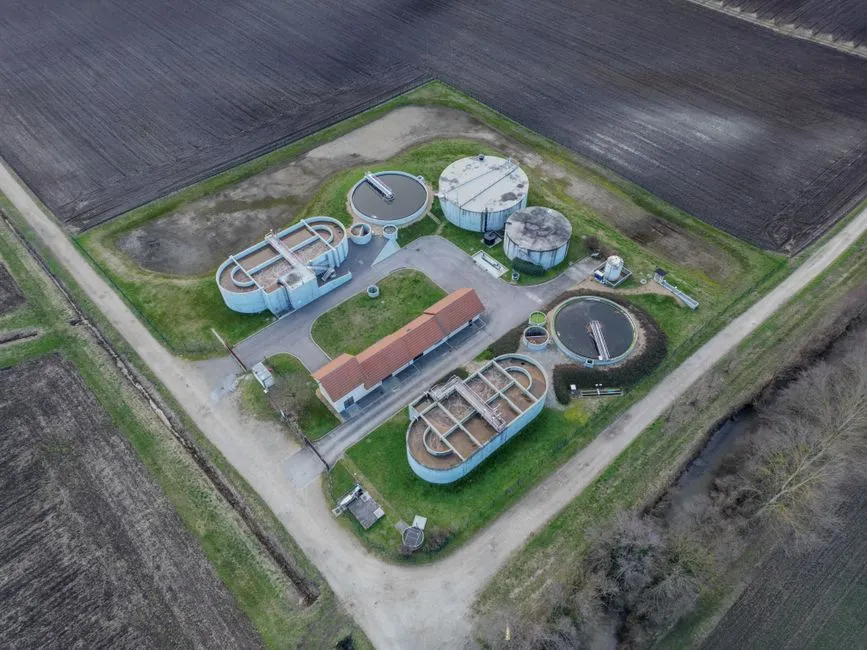
The procurement question the academic literature skips over is where Twin Falls plant owners and CFOs actually live. Use the table below as a directional envelope, not a quotation.
| Cost line | CAS (new build) | MBR (packaged skid) |
|---|---|---|
| CAPEX, equipment + civil (per m³/d capacity) | Baseline | 1.3–1.8× CAS (retrofit into existing concrete tanks is lower than greenfield) |
| Footprint CAPEX (concrete, excavation, building shell) | Baseline | ~40% of CAS footprint per the 60% reduction above |
| Energy OPEX | Aeration blower only | Aeration + membrane scour blower (≈ 0.6–1.0 kWh/m³) |
| Sludge OPEX | Higher volume, higher hauling cost | Lower cell yield at high SRT, less hauling |
| Chemical OPEX (polymer, CIP reagents) | Polymer for sludge thickening | Polymer + periodic NaOCl / citric CIP every 6–12 months |
| Reuse offset (process rinse make-up) | Limited by clarifier TSS | 20–40% of municipal water purchase offset at 100 m³/d |
| Long-horizon total cost (per Karim & Mark 2017) | Lower short-term | Lower over >67 years of operation due to reuse and effluent-quality savings |
| Short-horizon total cost (per Bertanza et al. 2017) | Lower | Higher |
Two literature findings on long-horizon cost are worth stating honestly. Karim and Mark (2017) found that MBR becomes the lowest total-cost option when the horizon exceeds roughly 67 years, because the initial CAPEX premium is amortized against reuse savings and avoided clarifier rebuilds. Bertanza et al. (2017), comparing three full-scale plants on a shorter horizon, found CAS won on pure economics. For a Twin Falls job-shop making a 10–20 year capital decision, the reuse offset is typically the lever that flips the answer. A 100 m³/d shop that sends MBR effluent to on-site rinse-water make-up can offset 20–40% of municipal water purchases — at Magic Valley industrial water rates, that is a payback lever worth running, not a promise of a specific ROI number.
Which System Fits Your Twin Falls Plant: A Decision Framework
The decision below assumes the pretreatment train in the previous section is already in scope. Both systems need equalization, pH adjustment, metals precipitation, DAF, and sludge dewatering.
- Pick CAS if influent flow is steady, the site has at least 0.7 m² of footprint per m³/d, the only compliance target is discharge to the City of Twin Falls POTW, and CAPEX budget is constrained. CAS is the lower-risk retrofit when reuse is off the table.
- Pick MBR if the site is footprint-constrained, irrigation-season reuse is in scope, the influent carries metal toxicity spikes (Zn, Ni, Cu above 50 mg/L batch), or future discharge limits are expected to tighten. MBR's higher SRT buffers the spikes and produces the <1 NTU effluent that reuse applications require.
- Pick MBR with chemical precipitation + DAF upstream if Zn, Ni, Cu, or Cr(VI) are in the influent above local limits. Both CAS and MBR need metal precipitation — MBR's higher SRT and MLSS simply tolerate the residual loading better than CAS floc.
- Pick a packaged MBR skid if capacity is 10–2,000 m³/d, the project timeline is short, and the site wants factory-tested, PLC-controlled operation with minimal civil work. The integrated MBR system for industrial wastewater ships with submerged PVDF flat-sheet MBR membrane modules rated for 32–135 m³/d each, so capacity scales by adding modules rather than rebuilding basins.
Frequently Asked Questions
Is MBR better than conventional activated sludge for fabricated-metals wastewater?
MBR is better than CAS on footprint (about 60% smaller), effluent quality (sub-1 μm filtration, near-reuse-ready), and tolerance of heavy-metal-loading shock. MBR is worse than CAS on CAPEX and on the membrane-scour aeration energy that drives OPEX. The right answer depends on whether reuse and footprint matter more than first cost on the specific project.
Can MBR remove heavy metals like zinc, nickel, and copper?
MBR does not destroy dissolved metals. It must be paired with pH adjustment and chemical precipitation to convert dissolved Zn, Ni, and Cu to their hydroxide solids, which DAF or the biological floc then captures. Once metals are precipitated, MBR's higher SRT and MLSS tolerate the residual soluble loading better than CAS floc, and the membrane's physical barrier retains precipitated fines that would otherwise escape a clarifier.
What footprint savings does an MBR give versus CAS?
About 60% smaller footprint than a CAS system of equal capacity, because the secondary clarifier is eliminated and the aeration basin runs at 8,000–12,000 mg/L MLSS rather than 2,000–4,000 mg/L. For a 100 m³/d shop, the typical envelope is 25–40 m² of process footprint for MBR versus 60–90 m² for CAS, before the savings on the building shell and blower room are counted.
How cold-tolerant is MBR in Twin Falls winters?
Sub-zero air temperatures drop biological activity in any open basin, whether CAS or MBR. Enclosed or heated bioreactor enclosures and insulated tanks are standard for Twin Falls installations, and MBR's smaller basin volume is easier and cheaper to keep above 10 °C than an equivalent CAS basin. The membrane modules themselves operate in the mixed liquor regardless of ambient air temperature.
What capacity MBR systems are available for a 50–500 m³/d metal-fabrication plant?
Packaged integrated MBRs scale from 10 m³/d to 2,000 m³/d, with modular flat-sheet DF-series membrane modules each rated for 32–135 m³/d. A 50–500 m³/d Twin Falls fabricator typically lands on one to four modules in a single packaged skid, with a small equalization basin, a DAF unit for oil and precipitate removal, and a plate-and-frame filter press for the metal-bearing hydroxide sludge. The skid arrives factory-tested, which compresses the on-site civil and commissioning window compared with a greenfield CAS basin.