
The Verdict for a 2026 Pharma Manufacturing Plant
For a pharmaceutical manufacturing plant treating both API/formulation effluent and factory domestic sewage in 2026, a packaged STP wins on speed-to-install, footprint, modularity, and compliance consistency. Cast-in-place concrete STPs only justify their higher CAPEX and 6–12 month build when flow exceeds ~500 m³/day, the influent is highly corrosive, or the plant must serve a 25-year horizon. For most mid-size pharma sites, the buried modular A/O package plant is the lower-risk choice.
Before any vendor meeting, the engineering manager needs one decision answered in plain language, and that is it. Both the process wastewater stream from API synthesis, formulation washouts, and equipment cleaning, and the domestic sewage stream from toilets, canteens, and laundry must be characterized for flow, COD, BOD, pH, ammonia, and solvent traces. The choice between a packaged STP and a cast-in-place concrete STP is downstream of that characterization, not upstream of it. Treat this article as a decision memo: the conclusion is fixed for the 80% case, and the remaining 20% is mapped to a branching rule at the end.
Three caveats sharpen the verdict. First, "packaged" in 2026 is not the 5 m³/day plastic box of 2005; current skid-mounted and buried modular A/O units run reliably to 80 m³/h with MBR options above that. Second, "cast-in-place" is not automatically more robust; documented heat-of-hydration cracking in mass pours can compromise tank integrity long before the 25-year design life is reached. Third, neither system replaces upstream API effluent pretreatment — solvent recovery, pH equalization, and cyanide or API stripping happen before either STP sees the water.
Why Cast-in-Place Concrete STPs Long Dominated Pharma
Cast-in-place concrete sewage treatment plants became the default at large pharmaceutical manufacturing plants in India and abroad for three defensible reasons: a design service life of 25–30 years, large equalization volume to absorb shock loads from batch API discharges, and tolerance of high-temperature effluent and aggressive chemistry that would degrade welded steel or FRP. A reinforced-concrete equalization tank sized at 8–24 hours of plant flow gave operators a buffer when an API campaign dumped a high-COD slug, and the structural mass kept temperatures stable enough for downstream biological treatment to recover within hours rather than days.
What the legacy decision rarely accounted for was the heat-of-hydration behavior of mass concrete pours themselves. Elias (San José State University, 2007) documented that the cement hydration reaction in thick concrete sections — exactly the geometry used for STP tanks and dividing walls — generates internal temperature gradients that produce micro-cracking at the aggregate-paste interface even when external curing is controlled. For a pharma tank that will later hold solvent-bearing or low-pH API effluent, those micro-cracks become preferential pathways for chemical attack on rebar, accelerating the very failure mode the concrete was chosen to prevent.
The other historical driver of cast-in-place was the on-site labor model: rebar tying, formwork erection, pour sequencing, and 28-day cure cycles. That model assumes a 6–12 month construction window, a contractor experienced in water-retaining structures, and a capex envelope large enough to absorb interest during construction. In 2026, with pharma capex committees compressing payback windows and regulators tightening consent-to-operate timelines, that 6–12 month window is often the deal-breaker — not the concrete itself.
How a Packaged STP Actually Works (Three-Zone A/O Logic)
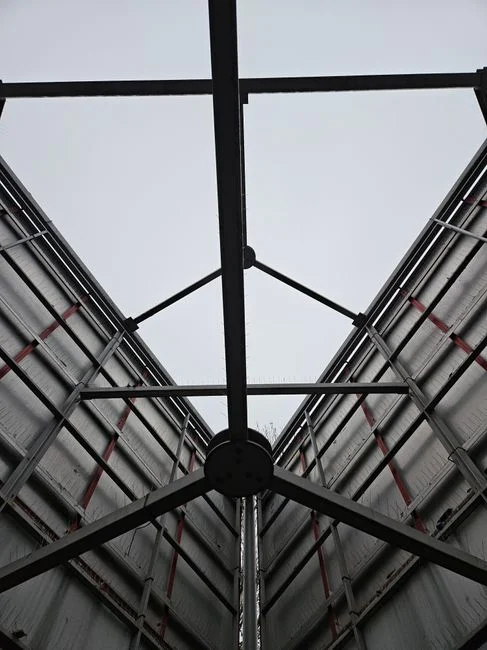
The skepticism that packaged STPs cannot handle pharma effluent traces back to a 1990s mental image of small municipal boxes with a single aeration chamber. Modern packaged plants are built around a three-zone A/O process that maps directly onto what a concrete STP does at ten times the footprint and cost.
Zone 1, the solid separation zone, receives the screened and grit-removed influent. Solids settle while scum floats; the settled sludge is stabilized in an anaerobic digestion zone that reduces volatile solids by 40–60% before periodic desludging. Zone 2 is the aeration zone, fitted with submerged plastic media that provide surface area for biofilm attachment — typically 150–300 m² of media per cubic meter of tank volume. Air from blowers keeps dissolved oxygen at 1.5–2.5 mg/L and continuously sloughs biomass so that mixed liquor suspended solids (MLSS) stay in the 3,000–5,000 mg/L range. Zone 3, final sedimentation, separates the clarified effluent; settled sludge is returned to Zone 1 as return-activated sludge, maintaining the active biomass inventory.
The plastic-media biofilm matters disproportionately for pharma effluent treatment. Unlike purely suspended-growth activated sludge, the attached-growth population buffers the system against influent variability — a 3× COD spike that would wash out a conventional MLSS culture only partially suppresses a biofilm reactor because organisms embedded in the media survive the shock. The same three-zone logic scales from a 1 m³/h buried unit up to the 80 m³/h range, and above that, MBR variants replace Zone 3 with ultrafiltration membranes delivering a tighter effluent suitable for reuse rather than just discharge. For plants that must hit reuse targets for cooling-tower makeup or gardening, the MBR package plant is the relevant configuration, not the standard A/O unit.
Head-to-Head: Packaged STP vs Cast-in-Place Concrete STP
The table below is the single artifact most readers will forward to procurement. It assumes a combined API/formulation + domestic sewage stream in the 50–500 m³/day range discharging to inland surface water under CPCB norms. Costs are framed as drivers, not absolute figures, because tariff, civil, and PLC integration costs vary sharply by state and by site condition; for a state-by-state CAPEX/OPEX breakdown see an industrial STP cost breakdown with CAPEX and OPEX data.
| Parameter | Packaged STP (modular A/O or MBR) | Cast-in-Place Concrete STP |
|---|---|---|
| Install time on site | 2–6 weeks (skid delivered, crane-set, piped) | 6–12 months (excavation, rebar, pour, 28-day cure) |
| Primary CAPEX driver | Equipment cost + freight; minimal civil work | Civil works, rebar, formwork, contractor markup |
| Footprint (for 200 m³/day) | ~80–120 m² (often buried) | ~300–500 m² (above-grade basins) |
| COD removal (influent 800–1500 mg/L) | 85–92% on A/O; 95–98% on MBR | 85–92% with sufficient HRT; sensitive to short-circuiting |
| BOD removal | Typically <30 mg/L post-A/O; <5 mg/L post-MBR | <30 mg/L achievable with good sludge return control |
| Effluent vs CPCB inland surface water | A/O meets BOD 30, COD 250, pH 5.5–9.0; MBR undercuts all three | Same discharge envelope; consistency depends on operator skill |
| Modularity / future capacity expansion | Add a parallel skid; tie into common manifold | Drain, retrofit, or build an adjacent basin — high disruption |
| Primary OPEX driver | Blower kWh + membrane replacement (MBR only) | Civil inspection, rebar exposure repair, larger blower duty |
| 25-year durability risk | HDPE/FRP tank service life 20–30 years; replaceable | Heat-of-hydration micro-cracking risk; chemical attack on rebar at joints |
| Upstream API pretreatment required | Yes — solvent recovery, pH equalization, DAF for oil/grease | Yes — same; concrete tolerates variability better but does not eliminate it |
Neither system is a substitute for upstream API effluent pretreatment. Solvent recovery (for methylene chloride, methanol, acetone traces), pH equalization to 6.5–8.5, cyanide stripping where applicable, and a skid-mounted DAF pretreatment for oil, grease, and suspended API solids all happen before either STP sees the polished stream. Comparing packaged versus cast-in-place on raw API effluent is the wrong question; the comparison only becomes meaningful once both streams have been pretreated to a comparable, biologically treatable envelope.
Where Each System Loses: Failure Modes Specific to Pharma
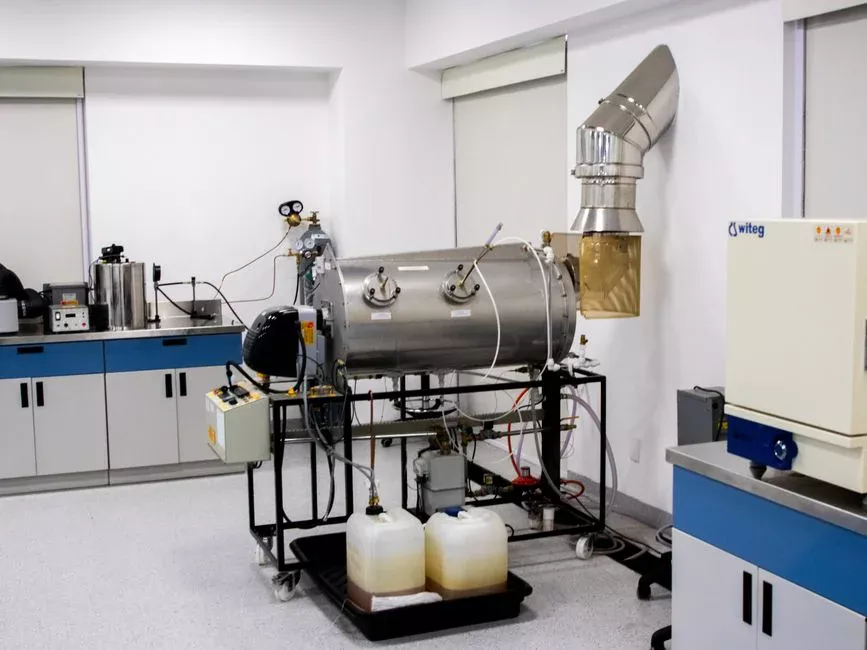
Stress-testing the recommendation against the worst-case scenarios an EHS manager will raise is non-negotiable. Packaged STPs have three honest weaknesses in a pharma context. First, tank-volume ceiling: a single skid handles up to ~80 m³/h economically, and above that, the number of parallel skids, common manifolds, and blower redundancy starts to erode the footprint and simplicity advantage. Second, limited equalization: a packaged unit's buffer volume is fixed at fabrication, so a sustained shock load — a 24-hour API campaign discharge that pushes influent COD to 8,000 mg/L — will either need a separate upstream equalization tank or will force a temporary reduction in API batch activity. Third, retrofitting larger blowers or adding a third stage later is more disruptive than the marketing literature suggests because the skid frame, piping, and PLC were sized for the original duty; for an ammonia removal methods see ammonia removal methods for wastewater reference data.
Cast-in-place concrete STPs have a different failure profile, and it is the one most often missing from vendor decks. Beyond the heat-of-hydration micro-cracking documented by Elias (SJSU, 2007), mass concrete walls in a chemical-plant environment develop expansion-joint failures within 10–15 years when exposed to low-pH API effluent, especially chlorides and sulfates from process washouts. The 6–12 month construction window is itself a compliance risk: if a State Pollution Control Board forces a new build or expansion, the delay between consent and commissioning can stretch the consent-to-operate renewal into a public-hearing scenario. For a deeper treatment of this trade-off see the package plant vs conventional treatment plant comparison.
For dual-stream pharma plants — the realistic case in 2026 — the most defensible architecture is hybrid: a packaged STP sized for the domestic sewage stream plus a separate skid-mounted DAF for the API/formulation effluent, with combined polishing through a single MBR or A/O skid if reuse is targeted. This decouples the two hydraulic profiles (domestic is steady; API is batchy) and lets each unit operate in its design envelope, rather than over-sizing a single concrete basin to handle both.
Decision Framework: Choosing the Right STP for Your Pharma Site
The branching rule below covers ~95% of pharma STP decisions in 2026. The remaining 5% — a 2,000 m³/day API plant with 40% solvent load, or a site with a regulator-mandated 30-year design life — needs a bespoke feasibility study and is outside the scope of a packaged-versus-concrete decision.
Step 1 — Size the combined stream. If average daily flow is under 500 m³/day and peak wet-weather flow on the domestic side is under 1.2× average, packaged STP wins. If average flow exceeds 500 m³/day or the site must hold 25-year durability as a board-level capex criterion, cast-in-place concrete enters the conversation.
Step 2 — Check the discharge target. If effluent is going to inland surface water under CPCB norms (BOD 30 mg/L, COD 250 mg/L, pH 5.5–9.0), a standard A/O packaged unit is sufficient. If the plant is targeting reuse for cooling-tower makeup, gardening, or toilet flushing, specify an MBR package plant with 0.1 μm PVDF flat-sheet membranes — the membrane barrier is what makes reuse defensible to an EHS auditor.
Step 3 — Always size for 1.2× peak wet-weather flow on the domestic stream. This is the single most common under-design error in packaged STP procurement; vendors quote nominal capacity, not peak. The biology can handle 1.2× for 24 hours; it cannot handle 2× for a week.
Step 4 — Pretreat the API stream upstream. No packaged or concrete STP tolerates raw API effluent. Solvent recovery, pH adjustment, and a DAF unit for oil and suspended API solids are non-negotiable prerequisites, not optional add-ons.
Frequently Asked Questions
Can a packaged STP handle both API process water and domestic sewage?
Only after both streams are pretreated to a biologically compatible envelope. A packaged STP is sized for the combined flow, but the API stream must first go through solvent recovery, pH equalization, and typically a DAF unit to remove oil, grease, and suspended API solids. Once pretreated, a modular A/O packaged plant handles the combined stream reliably up to ~80 m³/h; above that, an MBR package plant is the configuration of choice for tighter effluent.
How long does a packaged STP take to install vs concrete?
A packaged STP typically takes 2–6 weeks on site once the civil foundation is ready: crane-set, piped, wired, and commissioned. A cast-in-place concrete STP takes 6–12 months from excavation through the 28-day concrete cure and tank hydro-test. For a 2026 pharma project with a tight consent-to-operate window, the packaged timeline is usually the deciding factor on its own.
What CPCB effluent limits apply to a pharma plant discharging to inland surface water?
Per CPCB discharge standards, the inland surface water envelope is pH 5.5–9.0, BOD 30 mg/L maximum, COD 250 mg/L maximum, and total residual chlorine 1 mg/L maximum. Public sewer limits are looser (BOD 350 mg/L) and land-for-irrigation limits are tighter in some parameters (BOD 100 mg/L). A standard A/O packaged plant meets the inland surface water envelope; an MBR package plant undercuts all three.
When is cast-in-place concrete the right call for pharma wastewater?
Cast-in-place concrete is defensible when average daily flow exceeds 500 m³/day, when the influent is highly corrosive enough that HDPE/FRP packaged tank service life is unacceptable, or when the corporate capex criterion is a 25-year design life with no mid-life replacement. Even in those cases, the upfront 6–12 month construction window and the heat-of-hydration micro-cracking risk in mass pours should be priced into the risk register, not ignored.
Do packaged STPs need a dedicated operator?
Yes, but the requirement is lighter than for a concrete plant. A packaged A/O unit needs 1–2 hours per day of operator attention for MLSS checks, scum removal, and blower inspection. An MBR package plant adds 30 minutes per week for membrane integrity testing and periodic chemical cleaning. A cast-in-place concrete STP with multiple basins typically requires a full-time operator plus on-call civil maintenance, which is a recurring OPEX line that packaged STPs largely avoid.