Why paint booth and battery process wastewater break a gravity oil-water separator
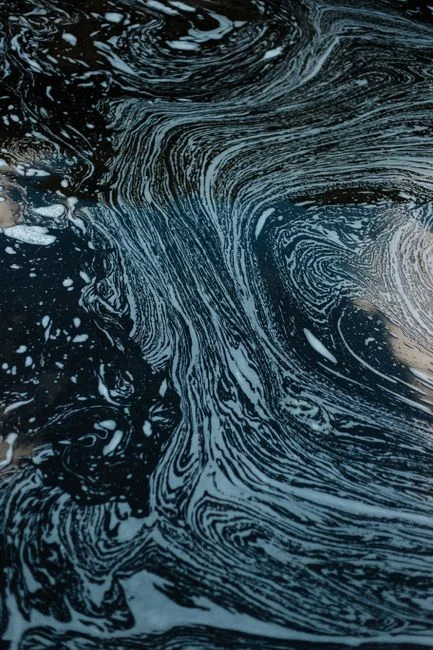
Paint booth curtain water and battery process wastewater arrive at primary treatment as stable emulsions, and an API 421 gravity separator is built for free oil that isn't there. Waterborne basecoat, clearcoat, and solventborne primer overspray enter the curtain as 5–15 µm oil droplets stabilized by resin surfactants; they carry pigment particles and residues of xylene, toluene, and acetone into the sump. Typical automotive curtain water runs 800–2,500 mg/L FOG and 500–1,500 mg/L TSS, with the actual envelope set by model year, robot speed, and dry-off oven temperature — always confirm with site jar testing. Battery process wastewater is a different emulsion but the same problem: N-methyl-2-pyrrolidone (NMP) coating-solvent rinse water carries PVDF binder residues, graphite and carbon black fines from anode coating, and lithium-bearing suspended solids, typically 200–800 mg/L FOG, 300–1,200 mg/L TSS, and a high COD load from the NMP itself. Both streams arrive with droplet sizes well below 150 µm, the API 421 design floor.
The API basin is sized for a different job. A 5:1 length-to-width rectangular tank, 1.5–2.5 m deep, holds the flow 1.5–2.5 hours and lets Stokes' Law pull free oil >150 µm to the surface. Sub-20 µm emulsified droplets don't rise in that window — their buoyancy is overwhelmed by viscosity and surfactant charge — so the API effluent leaves the unit essentially unchanged in oil content. EHS managers running jar tests on API effluent from a paint shop typically see 50–100 mg/L O&G pass through to the biological stage, where it smothers biomass and triggers permit excursions. The same failure shows up on NMP-bearing anode coating water, where the solvent itself resists gravity separation. The sizing math for an automotive paint shop or anode-coating line is covered in the DAF sizing for paint booth curtain water guide.
| Parameter | Paint booth curtain water (typical) | Battery process wastewater (typical) |
|---|---|---|
| FOG (influent) | 800–2,500 mg/L | 200–800 mg/L |
| TSS (influent) | 500–1,500 mg/L | 300–1,200 mg/L |
| Oil droplet size | 5–15 µm, resin-stabilized | Sub-20 µm, NMP/solvent-stabilized |
| Key contaminants | Pigments, xylene/toluene/acetone residues | NMP, graphite/carbon black fines, PVDF binder, Li-bearing TSS |
| COD contribution | Moderate (solvent residues) | High (NMP) |
How DAF and API separators actually separate oil — the physics that drives the gap
The performance gap isn't incremental — it's the difference between using external energy to accelerate separation and waiting for gravity to do work it can't do. A dissolved air flotation system recycles 20–30% of clarified effluent, pressurizes it to 5–7 bar (70–100 psi) in a saturation vessel, and dissolves air into the water. When the pressurized "whitewater" returns to the flotation tank at atmospheric pressure, the dissolved air comes out of solution as 10–100 µm microbubbles that attach to flocculated oil and solids. The combined bubble–particle agglomerate has an effective density below water and rises at separation velocities up to 10× faster than Stokes' Law allows (HydropureWater field data, 2025; S1, S2). Hydraulic retention drops to 10–30 minutes and surface loading rates run 10–20 m/h (245–490 GPD/ft²).
The API separator is built on a different equation. Rise velocity follows v = g(dp² − dw²)/18μ, where the variables are oil droplet diameter, density difference, and fluid viscosity. The standard removes oil droplets larger than 150 µm under quiescent conditions over 1.5–2.5 hours of residence time (S1) — and up to 4 hours for tougher streams (S2). Surface loading rates are 0.5–1.5 m/h, an order of magnitude lower than DAF. The API cannot remove sub-150 µm droplets because the rise velocity falls below any practical hydraulic retention time, and it cannot destabilize surfactant-stabilized emulsions because it adds no chemical or bubble energy to the system. That residence-time gap — 10–30 minutes versus 1.5–4 hours — is the single biggest mechanical reason an API separator cannot be retrofitted to handle emulsion-loaded automotive streams without a downstream DAF anyway.
Side-by-side performance on automotive and EV wastewater streams
Mechanism translates directly into numbers an engineer can put in front of a plant manager. DAF removes 90–98% of total FOG on automotive streams and 90–95% of TSS, with effluent O&G routinely below 20 mg/L and well under the 10 mg/L threshold that 40 CFR 433 demands (S1, S2). With coagulant and flocculant aid, DAF also strips 70–90% of emulsified oil that gravity can't touch (S1). An API separator, by contrast, removes 60–75% of free oil and below 20% of emulsified oil, leaving 50–100 mg/L O&G in the effluent (S1, S2). On TSS, API performance typically breaks down above 500 mg/L influent — well below the lower end of either automotive stream (S2).
Footprint is where DAF earns its keep inside a paint shop. DAF occupies 30–50% less floor area than API for the same hydraulic load (S1, S2). At 50 m³/h, a DAF unit fits in roughly 10 m² versus 14 m² for an API basin (S2) — the difference between a skid inside the building envelope and a civil-works project outside it. Throughput envelope runs 4–300 m³/h across 13 standard skid-mounted models (S2, product catalog); API separators can scale to 10,000 m³/h in refinery service, but single-plant automotive or battery lines rarely exceed 200 m³/h, putting them squarely in DAF territory. One caveat: DAF microbubble efficiency drops above 3.5% salinity due to bubble coalescence (S2). Some battery recycling rinse waters fall in that range, and an IAF or hybrid reactor should be evaluated if conductivity is high. Sludge character is the other quiet advantage — DAF float thickens to 2–4% solids during flotation, versus API bottom sludge at 5–10% of influent volume, which sharply cuts hauling tonnage (S2).
| Performance parameter | DAF (with chemical conditioning) | API 421 gravity separator |
|---|---|---|
| FOG removal (total) | 90–98% | 60–75% (free oil only) |
| Emulsified oil removal | 70–90% | <20% |
| TSS removal | 90–95% | Fails above ~500 mg/L TSS influent |
| Effluent O&G | <20 mg/L (typically <10 mg/L) | 50–100 mg/L |
| Surface loading rate | 10–20 m/h | 0.5–1.5 m/h |
| Hydraulic retention | 10–30 minutes | 1.5–4 hours |
| Footprint at 50 m³/h | ~10 m² | ~14 m² (plus civil basin) |
| Sludge character | Float, 2–4% solids | Bottom sludge, 5–10% of influent volume |
| Flow envelope (standard) | 4–300 m³/h | Up to 10,000 m³/h (refinery scale) |
| High-salinity tolerance | Drops above 3.5% salinity | Not affected by salinity |
CAPEX, OPEX and five-year total cost of ownership
The headline CAPEX gap is real and the buyer's first objection. At 50 m³/h, equipment-only CAPEX runs roughly $120,000 for a DAF skid versus $40,000 for an API basin (S2) — a ~3× capital premium for DAF, before civil work. OPEX reverses the direction of travel: DAF runs $0.10–$0.30/m³ (compressors, recycle pump, PLC-controlled coagulant and flocculant dosing), while API runs $0.02–$0.10/m³ (gravity only, minimal energy, occasional sludge pumping) (S2). On a 50 m³/h plant running 16 hours/day, that's $2,900–$8,800/m³-year in DAF variable cost versus $580–$2,900/m³-year for API. The swing factor the CAPEX comparison misses is sludge disposal. API bottom sludge at 5–10% of influent volume ships far more tonnage than DAF float thickened to 2–4% solids (S2). For the same 50 m³/h × 16 h/d plant, that difference is typically $15,000–$40,000/year in avoided hauling and disposal cost, enough on its own to wipe out most of the DAF OPEX penalty.
The hidden cost is the one nobody prices in the original CAPEX line: if the API effluent cannot meet 40 CFR 433 (<10 mg/L O&G) or a local pretreatment surcharge, the plant installs a DAF downstream anyway. That retrofit costs roughly the same as having specified DAF first, plus the civil demolition or repurposing of the abandoned API basin. The TCO crossover typically lands within 3–5 years for any plant that must hit <50 mg/L O&G in a single primary stage, faces municipal FOG surcharges, or ships hazardous sludge (S2). Below that crossover, the spreadsheet favors API on equipment spend; above it, the spreadsheet favors DAF on compliance risk and disposal. Paint shops and gigafactories on tight discharge permits usually cross over inside year two once permit surcharges and audit findings are priced in.
| Cost line at 50 m³/h | DAF | API 421 separator |
|---|---|---|
| Equipment CAPEX | ~$120,000 | ~$40,000 |
| OPEX (per m³) | $0.10–$0.30 | $0.02–$0.10 |
| Sludge character | Float, 2–4% solids | Bottom sludge, 5–10% of influent volume |
| Annual sludge disposal swing | Baseline (less tonnage) | $15,000–$40,000/year higher hauling cost |
| Civil work | Compact skid, indoor or outdoor | Open basin or below-grade concrete |
| TCO crossover vs. compliance | 3–5 years for plants targeting <50 mg/L O&G or FOG surcharges | — |
| Retrofit risk if undersized | Low (modular expand) | High (downstream DAF still required) |
Compliance map for automotive and EV factory discharges
The compliance lever is where the higher DAF CAPEX is justified to EHS and legal. In the United States, EPA 40 CFR Part 433 (Metal Finishing) sets a categorical pretreatment standard of 10 mg/L O&G; 40 CFR Part 425 covers oil and grease discharge in industrial sectors including petroleum refining, with NPDES FOG limits as low as 15 mg/L in California refinery permits (S1, S2). API alone cannot meet 10 mg/L on emulsified paint or NMP streams — the physics doesn't allow it. DAF with chemical conditioning routinely hits <10 mg/L and is the de facto baseline technology for any plant that has to discharge to a POTW with a categorical standard. In the EU, Industrial Emissions Directive 2010/75/EU sets BAT-AELs for surface treatment of metals and plastics; BAT-AEL for TSS is typically <20 mg/L in sensitive watersheds, achievable with DAF plus a filtration polish (S2). China GB 30485 (emission standard for pollutants from auto-manufacturing coating) and equivalent India CPCB/IS 2490 norms push automotive plants in those jurisdictions toward DAF-class primary treatment for both paint shop and battery assembly wastewater.
The right way to defend the technology choice in a permit application or an audit is to anchor it to jar testing and a pilot trial on actual plant wastewater. Influent swings between model years, color changes, and battery chemistry updates (LFP versus NCM cathode, silicon-blend anode) can shift the DAF coagulant/flocculant dose by 20–50% and change the achievable effluent envelope. A two-week pilot with the proposed industrial DAF system on real shift samples gives the EHS reviewer a defensible number for the permit renewal, not a vendor brochure figure.
Decision framework — when API, when DAF, when both
Use the rule below in a vendor meeting and you'll cover 95% of automotive and EV factory cases. Choose API as the only primary stage when the wastewater is essentially free oil >150 µm, contains no surfactants, the site has unlimited land, and the discharge permit is permissive. That profile describes a 1970s refinery slop water, not a 2026 paint shop or anode-coating line. Choose DAF as the only primary stage when the stream contains emulsified oil, pigments, NMP, fine suspended solids, or any discharge limit stricter than 50 mg/L O&G / 100 mg/L TSS — which is essentially every automotive and EV factory built to current standards. The hybrid API → DAF configuration (API as bulk roughing, DAF as polish) is only worth the civil cost when flow exceeds 500 m³/h with frequent free-oil slugs, the kind of envelope seen in refinery desalter water. A 50–200 m³/h paint shop or battery line almost never justifies the API stage in 2026.
Rule of thumb to take into the next design review: if jar testing shows oil droplets below 150 µm or surfactant levels above trace, the API stage is civil-work cost without treatment benefit and should be skipped. Site data and pilot results from the DAF vs lamella clarifier for EV and auto factories reference cases back the same conclusion.
| Decision criterion | API only | DAF only | Hybrid API → DAF |
|---|---|---|---|
| Oil droplet size | >150 µm free oil only | Any, including <20 µm emulsified | Mixed free oil + emulsified |
| Surfactant load | None / trace | Any (paint, NMP, cleaning agents) | Intermittent slugs |
| Discharge limit on O&G | Permissive (>100 mg/L) | Strict (<50 mg/L, often <10 mg/L) | Strict, with high flow variability |
| Flow envelope | Any | 4–300 m³/h (typical plant scale) | >500 m³/h with slug events |
| Footprint / civil work | Large basin, outdoor | Compact skid, indoor fit | Two-stage civil + skid |
| 5-year TCO | Lowest if limits are permissive | Lowest if limits are strict | Justified only at refinery scale |
Frequently asked questions
Can a DAF remove emulsified oil from paint booth curtain water?
Yes. With coagulant and flocculant conditioning, a DAF system reaches 70–90% removal of emulsified oil on paint booth curtain water by destabilizing the resin-stabilized droplets so the 10–100 µm microbubbles can attach to the agglomerated floc and float it (HydropureWater field data, 2025; S1). Effluent O&G routinely lands below 20 mg/L and below 10 mg/L with optimized chemistry — meeting 40 CFR 433 pretreatment without a downstream polish.
What is the difference between a DAF and an API separator?
A DAF (dissolved air flotation) unit pressurizes 20–30% of clarified effluent to 5–7 bar, saturates it with air, and releases the pressure to generate 10–100 µm microbubbles that attach to flocculated oil and solids, lifting them in 10–30 minutes. An API (American Petroleum Institute) separator is a gravity basin designed to API Recommended Practice 421, sized for free oil droplets >150 µm separating under Stokes' Law over 1.5–4 hours. DAF removes 90–98% of FOG including emulsified oil; API removes 60–75% of free oil and below 20% of emulsified oil (S1, S2).
Why does the API separator fail on automotive paint shop wastewater?
Paint overspray arrives as 5–15 µm oil droplets stabilized by resin surfactants, with FOG typically 800–2,500 mg/L. The API 421 design floor is 150 µm free oil and 1.5–2.5 hours of residence time. Emulsified droplets don't rise in that window, so the API effluent leaves the unit with 50–100 mg/L O&G — unchanged from influent for the emulsified fraction. The same physics defeats API on NMP-bearing anode coating water from battery cell assembly.
When does a DAF pay back the higher CAPEX versus an API separator?
At 50 m³/h the DAF equipment premium is roughly $80,000 ($120,000 vs $40,000). DAF OPEX is $0.08–$0.20/m³ higher than API, but API sludge at 5–10% of influent volume adds $15,000–$40,000/year in disposal cost that DAF float at 2–4% solids avoids. The TCO crossover typically lands within 3–5 years for any plant that must hit below 50 mg/L O&G, faces FOG surcharges, or ships hazardous waste — and inside two years once permit excursions are priced in (S2).
Is a hybrid API followed by DAF ever the right answer for an EV factory?
Rarely. The hybrid only makes economic sense at flows above 500 m³/h with frequent free-oil slugs, which is refinery scale rather than a single 50–200 m³/h automotive paint shop or battery assembly line. For a modern EV gigafactory built to 2026 discharge limits, a standalone DAF with chemical conditioning meets 40 CFR 433 and EU IED BAT-AELs without the civil cost and floor space of an upstream API basin. The API stage is justified only when free-oil bulk removal is required to protect a sensitive downstream membrane or SBR — neither of which is typical at automotive primary treatment.