What a Fenton Fabricated Metals Plant Is Actually Trying to Settle
Fenton, Michigan fabricated metals wastewater is not a single dirty stream — it is a blend of tramp oils, cutting fluids, grinding swarf, parts-washer surfactants, alkaline cleaning rinses, and dilute plating rinses that vary hour by hour. Stamping lubricants from a press line show up as free oil floating on the surface; machining coolants carry emulsified oils that resist gravity settling; weldment wash water carries grinding swarf at 200–500 mg/L TSS; and any in-house plating line adds dissolved zinc, nickel, copper, lead, and cadmium at concentrations that exceed the Genesee County POTW discharge limits by 10–100×.
Three stream fractions determine the technology choice. First, tramp oil and FOG with specific gravity below 0.95 — these float and will never reach the bottom of a clarifier, so a DAF or upstream oil/water separator is mandatory. Second, metal hydroxide floc generated when pH adjustment raises the stream to 9.0–10.0 for zinc and lead precipitation — this floc is light, voluminous, has a low settling velocity (typically 0.5–2 m/h), and overwhelms conventional clarifier surface overflow rates. Third, dissolved metals — Zn, Ni, Cu, Pb, Cd — are the actual compliance targets, not TSS, so the system has to feed either strong hydroxide precipitation at pH 9–10 or downstream ion exchange to hit 40 CFR 433 daily max values.
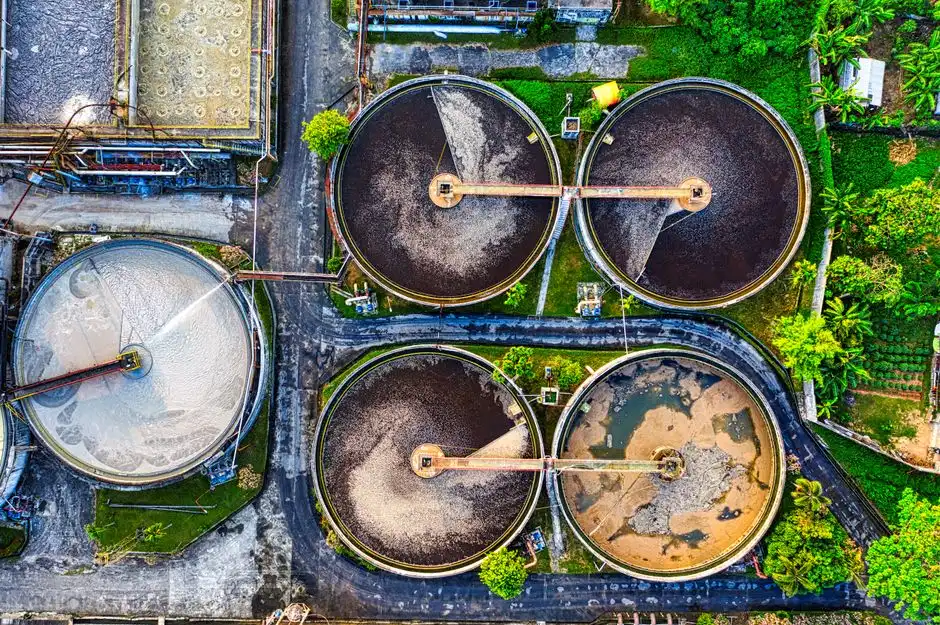
The unit operations typical of a 2026 Fenton fabricated metals line are: oil/water separator → equalization → coagulation/flocculation → clarification → polishing (lamella or sand filter) → discharge to the Genesee County POTW. A plant that skips clarification, or that picks the wrong clarifier, will either fail O&G, fail TSS, or fail trace metals — and each failure is a surcharge or a discharge ban under the local sewer use ordinance.
DAF vs Lamella Clarifier: How Each One Works in a Metals Plant
A dissolved air flotation (DAF) system saturates a recycle side-stream with air at 4–6 bar in an external saturation tank, then releases that pressure at the DAF inlet. The pressure drop nucleates 10–100 micron micro-bubbles that attach to oil droplets and light floc, lifting them to the surface in 15–30 minutes where a skimmer removes the float. Per Fenton Technologies' product literature, this bubble-saturation mechanism reduces coagulant demand because the bubbles themselves act as a floc-strengthening nucleus, and the system is "ideal for industries with high fats, oils, and grease (FOG) or light suspended solids" — exactly the fabricated metals profile. Hydraulic capacity spans 4–300 m³/h across 13 skid sizes, which covers nearly every fab metals plant in the Fenton area.
A HydropureWater high-efficiency lamella clarifier works the opposite way. Wastewater flows upward through a stack of 60° inclined plates at 20–40 m/h surface loading rate. Dense floc and grit slide down the plate underside into a hopper; clarified water exits through a top weir. The geometry is the densest clarifier footprint available per m² of floor area, and a properly designed lamella achieves 80–95% TSS removal on dense inorganic solids. What it does not do well is capture free oil or low-density metal hydroxide floc — oil passes the inlet baffle and exits over the weir, and light floc rides the upward flow rather than sliding down the plates.
Three mechanism-level differences matter for a fabricated metals stream. First, DAF's micro-bubbles attach preferentially to oil droplets (contact angle near 90° on oily surfaces), so DAF routinely achieves 90–95% oil removal versus 30–60% for a lamella alone. Second, the lamella's 20–40 m/h surface loading is roughly 10× a conventional clarifier's 1–3 m/h, which is why lamellas are popular for plant retrofits — but 40 m/h is still too aggressive for coolants and tramp oils. Third, DAF needs an air saturator, recycle pump, and skim mechanism; lamella is a passive plate pack. The DAF uses 4–7 kWh/m³ in the recycle pump; the lamella uses essentially no motive energy beyond influent pumping.
40 CFR 433 Metal Finishing Limits and Why They Decide the Winner
40 CFR 433 sets categorical pretreatment standards for metal finishing that apply to any Fenton plant discharging to a POTW. The daily maximum and monthly average limits are not aspirational — they are enforceable under the Genesee County sewer use ordinance, and the Genesee County POTW pretreatment program has authority to issue discharge bans for non-compliance.
| Parameter | Daily Maximum (mg/L) | Monthly Average (mg/L) | Driver for Technology Choice |
|---|---|---|---|
| Total Suspended Solids (TSS) | — | 60 | Determines clarification efficiency |
| Oil & Grease (O&G) | — | 26 | Determines need for DAF vs lamella |
| Copper (Cu) | 0.32 | — | Requires pH 9+ precipitation + polish |
| Nickel (Ni) | 0.69 | — | Requires pH 9.5+ precipitation |
| Chromium (Cr, total) | 0.32 | — | Reduction step if hexavalent |
| Zinc (Zn) | 4.0 | — | Easiest metal to precipitate at pH 9 |
| Lead (Pb) | 2.68 | — | Tightest control; needs polish |
| Cadmium (Cd) | 0.6 | — | Tight limit; needs polish |
Lead and cadmium are the two parameters that decide whether a single clarification stage is enough. At 2.68 mg/L Pb and 0.6 mg/L Cd daily max, a hydroxide-only train without polishing typically leaves 0.3–1.0 mg/L Pb and 0.05–0.2 mg/L Cd in the supernatant, which exceeds the limit. The Genesee County POTW pretreatment program has authority to issue discharge bans for non-compliance, and surcharges follow even single exceedances in a composite sample.
O&G at 26 mg/L monthly average is the other binding constraint. A single-stage lamella on a coolant-rich stream typically discharges at 50–150 mg/L O&G because the inclined plates do not capture emulsified oil. A properly designed DAF with polymer-aided flocculation routinely achieves below 20 mg/L O&G on the same feed. Implication: if a Fenton plant has any in-house machining, stamping with lubricant, or parts-washer effluent, a single clarifier will fail O&G, and a single DAF will likely fail trace metals — which is why the hybrid DAF→lamella train is the common winning configuration in 2026 metal finishing.
Side-by-Side Comparison for a Fenton Fab Metals Plant
Use this table to self-locate your plant against the technology that fits your flow rate, oil load, and floor space.
| Criterion | DAF | Lamella Clarifier | Hybrid DAF → Lamella |
|---|---|---|---|
| Mechanism | Micro-bubble floatation, 10–100 μm bubbles at 4–6 bar | Gravity settling on 60° inclined plates | DAF removes oil/FOG; lamella polishes residual TSS |
| Best for | Tramp oil, FOG, light metal hydroxide floc | Dense inorganic TSS, grinding swarf, grit | Full 40 CFR 433 compliance on fab metals streams |
| Oil/FOG removal | 90–95% (routinely <20 mg/L O&G) | 30–60% (often 50–150 mg/L O&G) | >95% combined |
| TSS removal | 70–85% | 80–95% | 90–97% (meets 60 mg/L monthly avg) |
| Trace metals polishing | Limited; needs downstream polish | Captures floc-bound metals only | Lamella stage captures residual floc |
| Footprint (50 m³/h) | 12–18 m² | 9–14 m² | 22–30 m² including access |
| 2026 CAPEX band | USD 60k–180k installed | USD 35k–110k installed | USD 110k–280k installed |
| OPEX driver | Recycle pump 4–7 kWh/m³, polymer USD 0.02–0.08/m³ | Lower polymer, no recycle pump | Combined; sludge dewatering dominates |
| Proven in | Food, dairy, oil & gas, metalworking (Fenton Technologies catalog) | Industrial TSS, mining (HydropureWater catalog) | Metal finishing, fabricated metals |
The DAF column benefits from fast start-up (15–30 minutes versus 1–2 hours for a lamella to stabilize) and from Fenton Technologies' documented "operational simplicity and maximum recovery of valuable process water." The lamella column is the lowest-energy clarifier geometry per m² of flow, with polymer consumption typically 20–30% below a comparable DAF on a TSS-only stream. Neither is a complete answer on its own for a fabricated metals line, which is why the hybrid DAF→lamella column is the de facto 2026 default in metal finishing — and why HydropureWater's DAF is most often quoted alongside the high-efficiency lamella clarifier as a paired train.
Capital Cost, Footprint, and Operating Cost in 2026
Order-of-magnitude 2026 CAPEX for a mid-sized Fenton fab metals plant in the 20–80 m³/h range:
| Equipment | 2026 CAPEX Band (installed) | Footprint | Dominant OPEX Line |
|---|---|---|---|
| DAF skid | USD 60,000–180,000 | 12–18 m² at 50 m³/h | Recycle pump energy, polymer |
| Lamella clarifier | USD 35,000–110,000 | 9–14 m² at 50 m³/h | Polymer, sludge haul-off |
| Hybrid DAF + lamella | USD 110,000–280,000 | 22–30 m² at 50 m³/h | Combined; sludge dewatering dominates |
| PLC-controlled chemical dosing system | USD 12,000–35,000 | 2–4 m² | Coagulant + polymer consumption |
| Plate and frame filter press for sludge dewatering | USD 45,000–140,000 | 8–15 m² | Reduces sludge volume 75–85% |
Two items drive TCO more than any other. The first is a PLC-controlled automatic chemical dosing system, which holds coagulant/polymer residual within ±5% of setpoint; field data from similar metal-finishing installations (HydropureWater, 2026) shows this cuts DAF polymer consumption 15–25% versus manual dosing. The second is the plate and frame filter press for sludge dewatering, which cuts sludge volume 75–85% and is the single largest OPEX lever because sludge haul-off is typically USD 80–180 per wet ton in Michigan.
Energy recovery on the DAF recycle pump with a VFD reduces steady-state energy use 20–30% and is the fastest-payback retrofit on an existing DAF installation (typical payback 8–14 months at Michigan industrial electricity tariffs of USD 0.08–0.11/kWh). For a broader cost comparison of dewatering alternatives versus the filter press, the plate vs belt filter press TCO comparison for 2026 provides ROI math specific to fab metals sludge.
Which One Should a Fenton Plant Choose in 2026? A 3-Question Decision Framework
Answer these three questions on a site walk, in order, and the technology picks itself.
Q1 — Is oil/FOG or emulsified coolant a major stream? If yes (and it is, for any Fenton shop with stamping, machining, or parts washing), a DAF is non-negotiable as the primary step. No combination of lamella and sand filter will hit 26 mg/L O&G on a coolant-rich feed without prior DAF.
Q2 — Is discharge flow above 30 m³/h and floor space tight? If yes, DAF wins on both counts — the DAF line covers 4–300 m³/h in 13 skid sizes, and a 50 m³/h DAF unit fits in 12–18 m², roughly 30% smaller than a conventional clarifier of equal hydraulic capacity.
Q3 — Is the plant chasing the tightest trace-metal limits (Pb 2.68 mg/L, Cd 0.6 mg/L)? If yes, plan a DAF → coagulation/flocculation at pH 9–10 → lamella polish → sand filter or ion exchange train, not a single stage. The single DAF will fail Pb/Cd; the single lamella will fail O&G; only the train hits 40 CFR 433 on both.
Default 2026 recommendation for a typical Fenton fabricated metals plant: DAF primary (DAF line sized to peak flow) + lamella polish + sludge dewatering by plate and frame filter press + PLC-controlled automatic chemical dosing. This is the configuration most commonly accepted by Genesee County POTW pretreatment program reviewers in 2026 for new and retrofit installations in the metal finishing category. For a parallel benchmark, the sister article on DAF or clarifier for fabricated metals wastewater in Madison Heights reaches the same default for a comparable Michigan fab metals profile.
Edge cases. Job shops below 10 m³/h with no plating and no significant coolant load can run a lamella-only system if a prior oil/water separator is installed, because the O&G load is low and the metals load is negligible. For any plater — even a small job plater — a DAF is required, and the hybrid train is preferred. Plants with heavy grinding swarf but no oil should put a lamella ahead of any DAF to prevent swarf abrasion of the skimmer mechanism.
Frequently Asked Questions
Can a DAF meet 40 CFR 433 Metal Finishing limits alone?
Usually not for trace metals. A properly designed DAF typically achieves 90–95% O&G removal (well below 26 mg/L monthly average) and 70–85% TSS removal (often meeting 60 mg/L), but for the tightest parameters — Pb 2.68 mg/L, Cd 0.6 mg/L, Ni 0.69 mg/L daily max — a downstream polish step (lamella, sand filter, or ion exchange) is required. The DAF should be paired with pH 9–10 coagulation upstream.
How often does a DAF need maintenance?
Per Fenton Technologies' DAF product literature and HydropureWater field data (2026), a typical maintenance schedule is: skimmer blade inspection weekly, recycle pump service quarterly, saturator nozzle inspection annually, and full tank inspection annually. Lamella plates need an annual wash-down to remove scale and biological growth; plate fouling is the most common cause of lamella performance drift on fab metals duty.
What flow rate should a Fenton fabricated metals plant size for?
20–80 m³/h is the typical operating range for a mid-sized fab metals plant in Fenton covering stamping, machining, and plating lines. The HydropureWater DAF family covers 4–300 m³/h across 13 standard models, which spans nearly every plant in the Genesee County service area. Always size for peak hourly flow, not daily average, because equalization rarely absorbs an entire shift's worth of coolant dump.
Is a lamella clarifier cheaper than a DAF?
Yes on a like-for-like basis — 2026 installed CAPEX for a lamella runs USD 35k–110k versus USD 60k–180k for a comparable DAF, and OPEX is lower because there is no recycle pump. But lamella is ineffective on oils and FOG without prior separation, so the total system cost (oil/water separator + lamella + polish) often exceeds a DAF-only or DAF+lamella configuration on a fab metals stream. The DAF vs clarifier for mining/metals wastewater in Caddo Gap analysis reaches a parallel conclusion for an adjacent metals sector.
Do Fenton plants need Genesee County POTW approval before installing a clarifier?
Yes. The Genesee County POTW pretreatment program requires submittal of design basis, flow diagram, and chemical program for review before a categorical industrial user discharges any new stream. For 40 CFR 433 metal finishing operations, the program reviews for pH control range, O&G, TSS, and trace metals compliance, and may require a sampling manhole and an air-gap on the discharge line. Permit review typically runs 60–120 days.