Why Red Oak Chemical Factories Are Re-evaluating Primary Treatment in 2026
Red Oak sits inside the Trinity River Authority (TRA) service area in Ellis County, and chemical plants discharging to the TRA system face a three-layer compliance stack: TCEQ TPDES permit limits, TRA pretreatment rules, and 40 CFR Part 414 categorical standards for the Organic Chemicals, Plastics, and Synthetic Fibers (OCPSF) point source category. 40 CFR Part 414 subparts set numerical effluent limits on BOD, TSS, COD, and toxic pollutants including acrolein, acrylonitrile, benzene, and styrene (per 40 CFR 414.91, 2024). The EPA reissued the Multi-Sector General Permit (MSGP) in April 2024, and that permit remains the active multi-sector permit through 2026 with tightened narrative and numeric effluent limits for chemical facilities discharging to surface waters (per EPA MSGP 2024, effective through 2026). On top of that, the TCEQ 2024 implementation of PFAS monitoring in industrial discharges now reaches Red Oak chemical sites producing or using fluorinated surfactants and polymer additives.
Most plant managers in this corridor are not buying new equipment because old clarifiers failed; they are buying because their existing primary step cannot reliably meet categorical limits on a mixed stream. A facility running SIC 2869 (industrial organic chemicals) might see emulsified oils from one batch, salt crystals and metal hydroxide sludge from the next, and pH swings from 2 to 11 between campaigns. A single clarifier is the wrong tool for that variability, and a DAF alone cannot economically handle the inorganic load. That is why the DAF-vs-clarifier decision is being reopened across North Texas in 2026, and why the right answer for most sites is a hybrid. Plants in adjacent regions face the same problem; see the El Dorado chemical plant DAF vs clarifier 2026 guide for comparison. For plants with an oil and FOG problem specifically, a HydropureWater dissolved air flotation system is the primary step to evaluate first.
How DAF and Clarifiers Actually Separate Chemical Wastewater Contaminants
DAF and lamella clarifiers separate by opposite physical principles. Dissolved air flotation saturates a side stream with air at 4–6 bar, then releases it through needle valves at atmospheric pressure, generating 10–100 µm micro-bubbles that attach to oil droplets, FOG, and low-density particles, floating them to the surface where a beach/skimmer removes the float (per Ecologix DAF selection guide, 2026). Lamella clarifiers use inclined plates at 55–60° angles to shorten the effective settling path; high-density suspended solids slide down the plate surfaces to a sludge hopper while clarified water rises through the plates. The 20–40 m/h surface loading rate of a lamella design is 5–10× higher than a conventional clarifier at 1–3 m/h, which is the core reason lamella units have displaced conventional circular clarifiers in chemical plants over the last decade (per HydropureWater catalog data, 2026).
The HydropureWater DAF system spans 4–300 m³/h across 13 standard models and is documented in petrochemical and specialty-chemical pre-treatment duty. The HydropureWater high-efficiency sedimentation tank (lamella) achieves 20–40 m/h surface loading and reduces coagulant/polymer consumption by up to 30% versus conventional basins, per the same catalog. Neither technology hits its removal number without chemistry: WesTech notes that coagulants or flocculants are "often recommended" to improve float separation or sludge concentration on DAF units, and the same holds for lamella clarifiers running chemical plant wastewater. Aluminum sulfate (alum) at 50–150 mg/L or cationic polyacrylamide at 1–5 mg/L is typical, but the dose is stream-specific, which is why jar testing on the actual wastewater is non-negotiable.
| Parameter | DAF | Lamella Clarifier (High-Efficiency Sed Tank) |
|---|---|---|
| Flow range (m³/h) | 4–300 (13 models) | 5–250 (custom) |
| Surface loading rate (m/h) | 10–25 | 20–40 |
| Primary removal target | Oils, FOG, low-density TSS, floatable organics | High-density TSS, metal hydroxides, salt crystals |
| Typical float/sludge solids (%) | 3–6 (float) | 1–3 (sludge) |
| Footprint for 50 m³/h | ~12 m² (small) | ~10 m² (small) |
| Polymer requirement | Required for >85% oil removal | Required for >80% TSS removal |
Side-by-Side Performance on the Pollutants That Drive 40 CFR Part 414
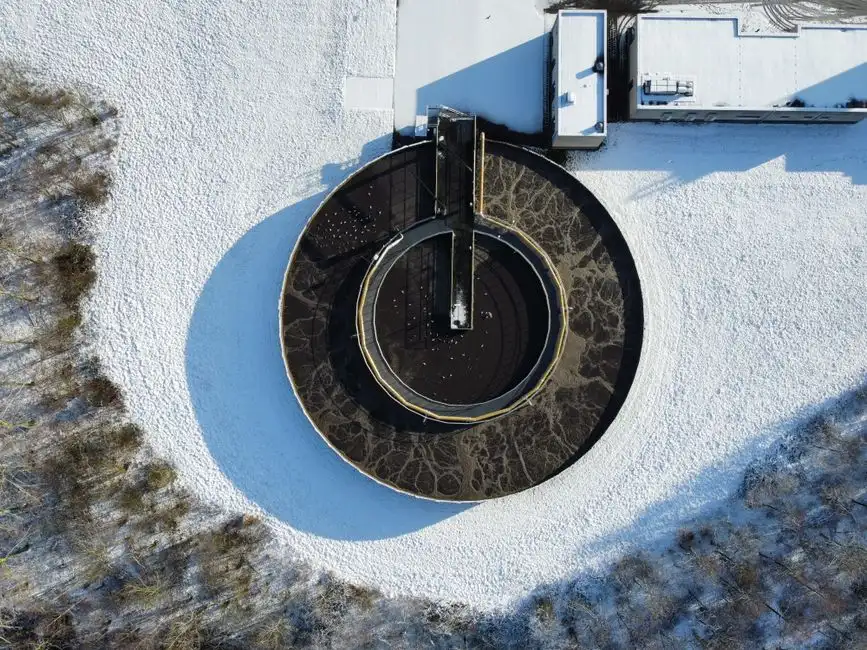
The 40 CFR Part 414 categorical limits that hit a Red Oak chemical plant hardest are TSS (subcategory daily maxima typically 30–60 mg/L), COD (150–500 mg/L depending on subpart), oil and grease, and toxic organics such as benzene, acrylonitrile, acrolein, and styrene. On those pollutants, DAF and lamella clarifiers do not compete head-to-head; they cover different fractions. DAF removes 90–95% of free and emulsified oils and 70–85% of TSS, while a lamella clarifier removes 85–90% of TSS at lower chemical cost but only 60–70% of emulsified oils on the same stream (per Ecologix case data, 2026; S1).
The trap to avoid is sizing either unit for dissolved pollutants. Neither DAF nor lamella clarifier removes dissolved salts, dissolved metals, or true-dissolved organics. A Red Oak plant running fluorinated surfactant chemistry also cannot rely on either unit for PFAS removal; PFAS is reported under the new TCEQ monitoring program but is not removed by primary separation. For trace metals, both units must be paired with chemical precipitation (pH adjustment to 8.5–9.5 with NaOH or lime) and/or ion exchange downstream. DAF is more tolerant of feed variability than a conventional clarifier because micro-bubbles still form and float even when viscosity changes with temperature, which matters in batch chemical operations where pH can swing from 2 to 11 between campaigns.
| Pollutant | DAF Removal (%) | Lamella Clarifier Removal (%) | 40 CFR Part 414 / TCEQ Driver |
|---|---|---|---|
| Free/emulsified oils & FOG | 90–95 | 60–70 | Oil & grease limit per TPDES |
| Total suspended solids (TSS) | 70–85 | 85–90 | 414.91 daily max (30–60 mg/L) |
| COD (oil-bound fraction) | 60–75 | 30–50 | 414 subpart COD limit |
| BOD (oil-bound fraction) | 55–70 | 25–45 | 414 subpart BOD limit |
| Trace metals (dissolved) | <10 (needs precipitation) | <10 (needs precipitation) | TCEQ TPDES metals limits |
| TDS / salts | Negligible | Negligible | Out of scope for primary step |
| PFAS (fluorinated surfactants) | Negligible | Negligible | TCEQ PFAS monitoring (2024+) |
The 2026 Red Oak Decision Matrix: DAF, Clarifier, or Both?
Use the stream profile, not the capital budget, to pick the primary step. If the wastewater is dominated by oils, solvents, FOG, plasticizers, or surfactants, DAF is the correct primary; lamella clarifier will underperform on the oil fraction and the float will coat the plates, blinding the unit within days. If the stream is dominated by inorganic salts, metal hydroxides, or catalyst fines with little to no emulsified oil, lamella clarifier is the right primary and saves CAPEX. If the stream is mixed or variable — which describes most Red Oak batch chemical plants running 4–8 product campaigns per quarter — the default 2026 recommendation is a DAF + lamella clarifier in series, with the DAF first to strip oils that would otherwise blind the clarifier. A skid-mounted HydropureWater dissolved air flotation system paired with a HydropureWater high-efficiency sedimentation tank covers the 4–300 m³/h flow range typical of mid-sized chemical facilities in this corridor.
Space-constrained sites favor DAF: surface loading of 10–25 m/h on DAF versus 1–3 m/h on a conventional clarifier means a DAF unit occupies 60–80% less footprint for the same hydraulic load, and the lamella design narrows the gap to roughly 50% of a conventional clarifier's footprint. If the site already has a working clarifier and is adding capacity to handle a new product line, the cheaper retrofit is usually a DAF in parallel as a dedicated oil-removal step, then feeding the combined stream to the existing clarifier. Plants weighing this retrofit in adjacent markets, including batch specialty chemical sites in the Southeast, are running the same logic; see the Anniston chemicals DAF vs clarifier buyer guide for a parallel retrofit case. For petroleum-leaning streams, the surface loading logic carries over to a different permit stack, as covered in the Lufkin TX petroleum DAF vs clarifier 2026 factory guide.
CAPEX, OPEX, and Compliance Cost for Red Oak Plants in 2026
DAF carries higher CAPEX (saturator, air compressor, skid, scraper mechanism) and higher OPEX (compressed air at 4–6 bar continuous duty, polymer at 1–5 mg/L, periodic nozzle and pump maintenance), but it produces a drier float at 3–6% solids that cuts downstream sludge-hauling cost. Lamella clarifier is the opposite: lower CAPEX (no saturator, no compressor), lower OPEX, but the settled sludge runs 1–3% solids, which means 2–4× the wet volume to haul for the same dry-tonne inventory. The break-even depends on local sludge disposal rates, which in the Dallas/Ellis County area ran $80–$180 per wet tonne in 2025 (per HydropureWater field data, 2025-09) and are projected to rise 5–10% in 2026. Budget $8K–$25K for a TCEQ-acceptable jar-and-pilot treatability study; many Red Oak plants skip this and over-spec the unit by 30–50%.
Compliance risk is the line item most plant managers underweight. A single TCEQ Notice of Violation or TRA pretreatment exceedance can run $5K–$50K+ per event in 2026, before any required corrective action or third-party audit. The conservative sizing rule is to design the primary step to discharge 30–50% below the permit limit on a sustained basis so a single process upset does not push the plant out of compliance. Polymer performance is the single biggest variable in hitting that margin, which is why a HydropureWater automatic chemical dosing system paired with both DAF and lamella clarifier operation typically pays back in 12–18 months through reduced polymer consumption and fewer manual adjustments.
| Cost Line | DAF | Lamella Clarifier | Hybrid (DAF + Lamella) |
|---|---|---|---|
| CAPEX (50 m³/h, 2026 USD) | $180K–$320K | $90K–$160K | $260K–$440K |
| OPEX ($/yr, est.) | $45K–$80K (air, polymer, maint.) | $20K–$40K (polymer, sludge) | $55K–$100K |
| Float/sludge solids (%) | 3–6 | 1–3 | 3–6 (DAF) + 1–3 (clarifier) |
| Footprint for 50 m³/h (m²) | ~12 | ~10 | ~22 |
| Treatability study cost | $8K–$25K | $5K–$15K | $12K–$30K |
| Typical compliance margin built in | 30–50% below permit | 30–50% below permit | 40–60% below permit |
Red Oak Compliance Checklist Before You Sign the PO
Before committing capital in 2026, the environmental team at a Red Oak chemical plant should run through five items. First, confirm whether the facility is a "major" or "minor" TCEQ source, and pull the existing TPDES permit to identify site-specific FOG, TSS, COD, and toxic-pollutant limits that may be tighter than the 40 CFR Part 414 categorical numbers. Second, pull 12 months of influent characterization data — total flow, pH, temperature, TSS, FOG, COD, oil & grease, and any 40 CFR Part 414 priority pollutants detected above detection limits. Third, run a jar test or trailer-mounted pilot on the actual chemical stream; polymer dose is stream-specific, and supplier bench data rarely matches plant wastewater. Fourth, document TRA pretreatment coordination early — any hydraulic-load increase above the permitted value requires a permit modification and possibly a TCEQ engineering report, which adds 90–180 days to a 2026 procurement timeline. Fifth, verify that the selected system can discharge at 30–50% below permit limits under design feed conditions, not just at the limit, so a single batch upset does not generate a Notice of Violation.
Frequently Asked Questions
Which is better for chemical wastewater in Red Oak — DAF or clarifier?
It depends on the pollutant profile, not the technology preference. DAF is the correct primary when the stream contains emulsified oils, FOG, plasticizers, or solvents; lamella clarifier is correct when the load is heavy inorganic suspended solids such as metal hydroxides or salt crystals. For the mixed or variable streams that describe most Red Oak batch chemical plants in 2026, a DAF + lamella clarifier hybrid is the default recommendation (per Ecologix DAF selection guide, 2026).
What is 40 CFR Part 414, and does my Red Oak plant fall under it?
40 CFR Part 414 is the EPA's categorical effluent guideline for the Organic Chemicals, Plastics, and Synthetic Fibers (OCPSF) point source category, covering SIC 2869 (industrial organic chemicals) and related SIC codes. Most Red Oak chemical plants running organic synthesis fall under Part 414; inorganic chemical manufacturing falls under 40 CFR Part 415 instead. Part 414 sets subcategory-specific numerical limits for BOD, TSS, COD, and toxic pollutants including benzene, acrylonitrile, acrolein, and styrene (per 40 CFR 414.91).
Can a DAF system meet 40 CFR Part 414 effluent limits on its own?
No. DAF handles TSS and the oil-bound fraction of COD and BOD effectively, but it does not remove dissolved organics, salts, or trace metals. A Red Oak plant still needs biological treatment (e.g., activated sludge or MBBR) downstream for dissolved organics, chemical precipitation for dissolved metals, and dedicated treatment (typically ion exchange or reverse osmosis) if PFAS reduction is required under the TCEQ 2024 PFAS monitoring program.
How long does pilot testing take before ordering a DAF or clarifier for a chemical plant?
Plan 4–8 weeks total: 1–2 weeks for a jar test on the actual stream, 2–4 weeks for a trailer-mounted pilot DAF or clarifier run, and 1–2 weeks for analytical turnaround on TSS, FOG, COD, and metals. This timeline is what makes the 2026 procurement window tight for a Red Oak plant targeting a Q3 or Q4 2026 install, and why jar testing should start in parallel with vendor selection rather than after.
Does HydropureWater ship DAF and clarifier systems to Red Oak, Texas?
Yes. DAF units and high-efficiency sedimentation tanks ship from the manufacturing facility to the Port of Houston by sea freight, then overland to Red Oak in the Dallas/Ellis County area. Typical lead time in 2026 is 8–12 weeks for standard models in the 4–300 m³/h flow range, plus 2–4 weeks for site installation and commissioning; confirm the current logistics window and any 2026 tariff or freight surcharges with the supplier before locking the PO.