Why Marion Chemical Plants Are Rethinking DAF vs Clarifier in 2026
Marion, Ohio sits inside one of the Midwest's denser organic and inorganic chemicals clusters, with manufacturers reporting under SIC 2869, 2899 and 2911 discharging to a single Industrial Pretreatment Program run by the City of Marion Utilities Department. That regulatory reality — not equipment preference — is forcing the 2026 capital conversation. Streams crossing the headworks in 2026 are mixed and unforgiving: free and emulsified oils from intermediates, dense metal-bearing sludges from inorganic lines, high TDS from brine and acid neutralization, and pH swings that ride batch campaigns. The same plant often needs to drop oil and grease below a daily-max limit while also pulling heavy metals and TSS down to local limits, and pretreatment surcharges on TSS and O&G now make under-treatment an explicit line item on the operating budget (per EPA 40 CFR Part 414 and the Marion Utilities Department local limits).
Geography is a critical factor, as the most-cited DAF-vs-clarifier case study online is the Hino Motors project in Marion, Arkansas — a different state, a different POTW, and a stamping-press wastewater stream, not a chemical-manufacturing stream (source: Ecologix case studies). The 2026 drivers for a Marion, Ohio chemical plant are tighter 40 CFR Part 414 category limits, the Marion Utilities pretreatment surcharges, and a renewed corporate push to recover process water for reuse, all of which can be reviewed in this chemical plant 2026 pretreatment compliance guide. The question is no longer "DAF or clarifier" but "what fraction of each, in what order, sized to what envelope."
How DAF and Clarifiers Actually Treat Chemical Wastewater
DAF is a bubble-driven separation process where pressurized recycle water is saturated with air and released into the flotation cell, creating a cloud of 10–100 micron bubbles. These micro-bubbles attach to chemically conditioned solids and lift free oil, emulsified grease, fiber and low-density particles to the surface, where a skimmer removes the float. The clarified underflow proceeds to the next stage (source: Spectrum Water, 2026).
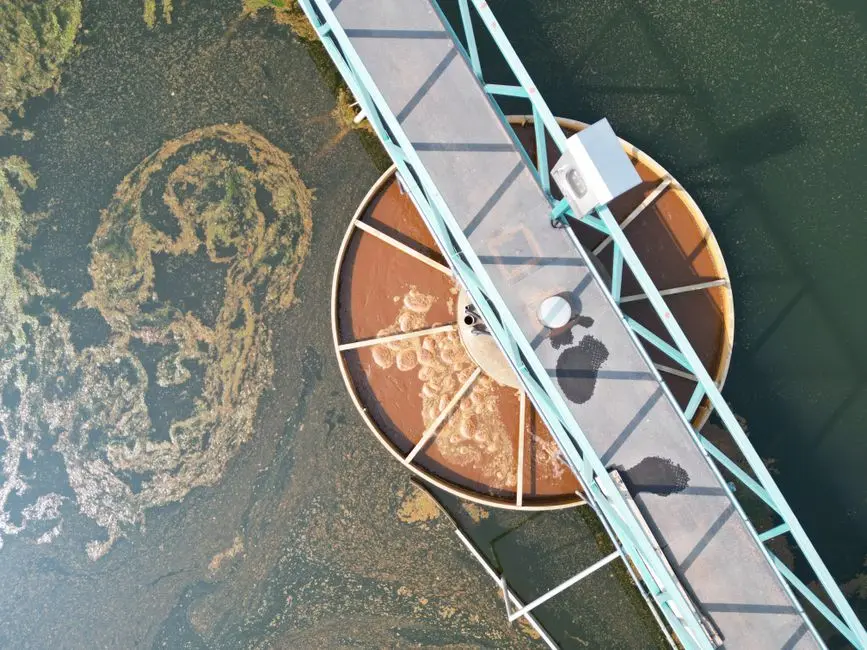
A gravity clarifier removes heavier particles by allowing them to settle under quiescent conditions as sludge, while clarified overflow is decanted over peripheral weirs and a rake drive moves sludge to a central hopper. A lamella clarifier uses inclined plates packed into the tank to multiply the effective settling area, pushing surface loading rates into the 20–40 m/h band and reducing the required footprint compared to a conventional basin.
DAF performance hinges on chemistry, as coagulant and flocculant selection, dose, and hydration determine whether micro-bubbles attach to the target solids. Spectrum frames it bluntly: "A DAF with the wrong coagulant is an expensive tank." This dependency is why a HydropureWater automatic chemical dosing system is normally specified alongside the flotation cell, providing PLC-controlled, skid-mounted dosing sized to the recycle stream.
Clarifier performance is a physics problem, with surface overflow rate, retention time, sludge recirculation ratio, and plate spacing driving the separation. A clarifier tolerates a wider range of influent solids loading than a DAF, but it cannot lift light, emulsified or colloidal fractions out of the water, typically hitting a 70% O&G ceiling on the same stream a DAF treats at 95% (source: Ecologix 2026 selection guide).
Side-by-Side Comparison: DAF vs Clarifier for Chemical Streams
| Parameter | Dissolved Air Flotation (DAF) | Lamella Clarifier |
|---|---|---|
| Mechanism | Micro-bubbles attach to conditioned solids and float them; surface skim | Gravity sedimentation on inclined plates; sludge rake to hopper |
| Best target contaminant | Free and emulsified O&G, FOG, low-density TSS, fiber | Dense inorganic TSS, metal hydroxides, high-TSS brines |
| Typical removal rate | O&G ~95%; FOG 90%+; TSS 60–85% | TSS 85–90%; O&G 60–75%; metals to sludge 80–90% |
| Footprint at 100 gpm | Compact skid; ~5–10 m² process area | Lamella plate pack; ~10–20 m² at 20–40 m/h SOR |
| CAPEX band | Higher — compressor, saturation tank, recycle pump, chemistry skids | Lower — civil tank + rake drive + lamella pack |
| OPEX band | Higher — compressed air, polymer, wear parts | Lower — mostly power for the rake and polymer at lower dose |
| Operator skill | Medium-high — jar testing and dose tuning required | Low-medium — mostly sludge wasting and torque checks |
| Sensitivity to pH / TDS swings | High — chemistry upset collapses float | Moderate — pH shifts floc density, not skimmer function |
The 95% O&G versus 70% O&G figure is the load-bearing data point in the table, derived from a food-processing DAF plant benchmarked against a clarifier on the same stream (source: Ecologix 2026 selection guide), while the 90% TSS number for clarifiers comes from a mining facility case on a heavy-sediment stream (source: Ecologix 2026). For a 2026 chemical plant, these technologies solve different halves of the same problem. A skid-mounted HydropureWater dissolved air flotation system covers the 50–1,000 gpm envelope that a typical Marion chemical line produces, while a HydropureWater lamella clarifier follows it for the dense fraction.
40 CFR Part 414 and Marion Pretreatment Limits the Equipment Must Hit
40 CFR Part 414 is the federal category regulation covering the Organic Chemicals, Plastics, and Synthetic Fibers subcategories and the Inorganic Chemicals subcategories, which together describe the bulk of Marion's SIC 2869 and 2899 plant population. The rule sets categorical pretreatment limits, including daily-maximum and monthly-average values for the parameters below. Always confirm the current values from your own SIU permit before specifying equipment; the numbers in the table are representative of subcategory limits and are not a substitute for the permit.
| Parameter | Representative 40 CFR Part 414 daily-max | Why it matters for DAF/clarifier selection |
|---|---|---|
| TSS | ~60 mg/L daily max (subcategory-dependent) | Clarifier excels; DAF alone often misses on inorganic streams |
| BOD / COD | Subcategory-specific, often hundreds of mg/L | Sets the load that downstream biological treatment must carry |
| O&G | ~38 mg/L daily max in many subcategories | DAF is the realistic path; clarifier alone typically misses |
| pH | 6.0–9.0 standard range | Drives coagulant choice on a DAF and floc density on a clarifier |
| Priority pollutant metals | Subcategory scan — lead, chromium, nickel, zinc, etc. | Best routed to sludge via clarifier; DAF does not target metals |
The City of Marion Utilities Department Industrial Pretreatment Ordinance layers on top of federal rules with SIU permitting, locally enforced discharge limits, and surcharge thresholds on TSS and O&G. A clarifier-only or DAF-only design is increasingly rare in 2026 because a clarifier usually misses the O&G limit on a chemical stream, and a DAF usually misses the heavy-metal and high-TDS targets on an inorganic line. The hybrid approach is the route that lets one train hit both sets of limits.
Decision Framework: Which One Should Your Marion Plant Buy in 2026

Step 1: Characterize the stream by pulling a representative 24-hour composite and running the standard panel — FOG by EPA 1664, TSS, total metals scan, pH profile through the batch, TDS, and temperature. Anything above ~50 mg/L free oil or above 200 mg/L emulsified FOG points toward flotation; anything above ~500 mg/L dense inorganic TSS or significant iron/aluminum hydroxide points toward sedimentation.
Step 2: Match to DAF when O&G, free oil, emulsified polymer or low-density biological flocs dominate. DAF is the right tool for material that will not fall out of suspension under gravity (source: Spectrum Water, 2026). On those streams, a DAF hits 90%+ on FOG and roughly 95% on O&G where a clarifier stalls at 60–75% (source: Ecologix 2026).
Step 3: Match to a clarifier when dense inorganic solids, metal hydroxides or high-TSS brines dominate. Lamella designs push surface loading to 20–40 m/h and deliver 85–90% TSS removal with lower polymer consumption than a DAF on the same stream (source: HydropureWater field data, 2026).
Step 4: Default to hybrid when the stream mixes both fractions, when 40 CFR Part 414 limits are tight on multiple parameters, or when the plant needs to reuse water downstream. Ecologix confirms "hybrid systems can address complex wastewater streams, combining DAF's oil removal with clarifiers' sedimentation capabilities" (source: Ecologix 2026). In a hybrid configuration, the DAF goes first to lift oils and light TSS, the lamella clarifier follows to drop metals and dense solids, and a downstream HydropureWater MBR membrane bioreactor polishes for reuse.
Recommended 2026 Configuration for a Marion Chemicals Plant
The reference design for a 2026 Marion chemicals line is a HydropureWater dissolved air flotation system rated 4–300 m³/h across 13 standard models, followed by a HydropureWater lamella clarifier operating at 20–40 m/h surface loading. This combination delivers up to 30% lower chemical consumption than a single-stage design and fits the mixed-stream reality of a SIC 2869/2899 plant. A HydropureWater automatic chemical dosing system ties coagulant and flocculant to the recycle stream via PLC, with jar testing performed on the plant's actual sample before the dose is locked. Downstream, an MBR or RO polishes for water reuse, and the sludge stream can be dewatered with a plate-and-frame filter press.
For CAPEX framing, a small skid DAF in the 50–100 gpm range is a six-figure-USD purchase, while a full 100–500 gpm hybrid train with lamella clarifier, chemistry skids and PLC falls in the seven-figure-USD band. Actual numbers vary with flow, materials of construction, site conditions, and instrumentation, so treat these as budget bands rather than quotes. The primary argument for corporate is the operating math: a DAF-only line that misses O&G limits pays the surcharge every month, and a clarifier-only line that cannot drop FOG to permit limits pays the same surcharge in a different line item. A hybrid train is the configuration that lets a Marion plant clear 40 CFR Part 414, the Marion Utilities ordinance, and the corporate water-reuse target on the same P&ID.
Frequently Asked Questions
DAF vs clarifier for oil and grease — which wins?
DAF wins on oil and grease. A DAF hits roughly 95% O&G removal on a high-oil stream, while a clarifier on the same stream stalls at about 70% (source: Ecologix 2026). DAF is the right tool for free and emulsified oil that will not fall out under gravity.
Frequently Asked Questions
Should a chemical plant in Marion, Ohio choose a DAF or a clarifier in 2026?
The selection depends primarily on the density and particle size of the wastewater contaminants. A Dissolved Air Flotation (DAF) system is superior for chemical wastewater containing fats, oils, grease (FOG), or low-density suspended solids that tend to float, as it utilizes micro-bubbles to achieve rapid separation. In contrast, a clarifier is more effective for high-density inorganic solids that settle via gravity.
For a Marion-based facility, space constraints and discharge requirements are critical factors. DAF units generally require a smaller physical footprint than conventional circular clarifiers and provide higher loading rates, making them ideal for modern industrial upgrades where land usage is a premium concern.
Can a clarifier alone meet 40 CFR Part 414 pretreatment limits?
Meeting 40 CFR Part 414 standards with a clarifier alone is rarely sufficient for chemical plants if the effluent contains emulsified oils or non-settleable organic compounds. While a clarifier can effectively remove settleable solids to meet Total Suspended Solids (TSS) limits, it typically lacks the mechanisms to address soluble or colloidal chemical pollutants common in industrial process water.
To ensure compliance with stringent federal pretreatment limits, most chemical facilities must integrate a clarifier with additional stages such as chemical coagulation, flocculation, and pH adjustment. Without these upstream chemical conditioning steps, a clarifier will likely fail to achieve the necessary reduction in Chemical Oxygen Demand (COD) or specific toxic pollutant concentrations mandated by Part 414.
What oil and grease removal rate can a DAF hit versus a clarifier?
A properly operated DAF system can achieve oil and grease removal efficiencies ranging from 80% to 95%, depending on the influent concentration and the chemistry of the wastewater. The micro-bubbles generated by the DAF saturate the liquid, forcing even fine oil droplets to the surface for mechanical skimming.
Conversely, a standard gravity clarifier typically achieves significantly lower removal rates for oil and grease, often falling below 50% unless the oil is in a free-floating state with a specific gravity significantly different from water. Clarifiers are fundamentally designed for sedimentation, making them ineffective for capturing emulsified oils that do not settle naturally within the standard detention time of 2 to 4 hours.
When does a hybrid DAF and lamella clarifier make sense for chemical wastewater?
A hybrid system is recommended when a facility experiences highly variable influent loads containing both heavy metal hydroxides and lighter oily emulsions. The lamella clarifier handles the high-density settled solids, while the DAF unit acts as a polishing step to remove residual light solids and floatables before final discharge.
This configuration is particularly advantageous for plants in 2026 seeking to maximize throughput in a compact area. The lamella plates increase the effective settling surface area within a small footprint, while the subsequent DAF ensures the final effluent quality meets strict local municipal sewer limits, preventing the need for massive, separate treatment tanks.
How often does a DAF system need jar testing for a chemical plant?
Jar testing for a DAF system should be conducted at least weekly or whenever there is a significant change in the production process or raw material input. Because chemical wastewater composition can fluctuate based on batch cycles, the optimal dosage of coagulants and flocculants must be recalibrated to maintain removal efficiency.
If the plant experiences high variability in wastewater characteristics—such as shifts in pH, temperature, or chemical concentrations—daily jar testing may be required to prevent system upset. Consistent testing ensures that the polymer and coagulant feed rates are optimized, which minimizes chemical sludge production and reduces overall operational costs.