What the Germantown Sewer Use Law actually caps
Chemical plants discharging to the Germantown Sewer District No. 1 must meet a 17-parameter "Limits of Toxic Substances in Sewage at Point of Entry into Municipal Systems" table at the point of sewer entry, with both a 30-day average and an 18-hour average column (per the Germantown Sewer Use Law, Section XIV). The conventional-pollutant caps are written as "shall not exceed" values rather than design targets: BOD 300 ppm, TSS 350 ppm by weight, and chlorine demand 15 ppm (Germantown Sewer Use Law, Section XIV ¶15). The Sewer Use Law puts the four metal parameters most likely to bind a chemical plant — total chromium 4.0/8.0 mg/L, hex chromium 0.2/0.4 mg/L, free cyanide 0.4/0.8 mg/L, and phenol 4.0/8.0 mg/L — at concentrations tight enough that a single batch dump can exceed the 18-hour column even when the 30-day average still looks comfortable.
| Parameter | 30-Day Average (mg/L) | 18-Hour Average (mg/L) |
|---|---|---|
| Cadmium | 0.4 | 0.8 |
| Hex Chromium | 0.2 | 0.4 |
| Total Chromium | 4.0 | 8.0 |
| Copper | 0.8 | 1.6 |
| Lead | 0.2 | 0.4 |
| Mercury | 0.2 | 0.4 |
| Nickel | 4.0 | 8.0 |
| Zinc | 1.2 | 2.4 |
| Arsenic | 0.2 | 0.4 |
| Available Chlorine | 50.0 | 50.0 |
| Cyanide (free) | 0.4 | 0.8 |
| Cyanide (complex) | 1.6 | 3.2 |
| Selenium | 0.2 | 0.4 |
| Sulfide | 6.0 | 12.0 |
| Barium | 4.0 | 8.0 |
| Manganese | 4.0 | 8.0 |
| Gold | 0.2 | 0.4 |
| Silver | 0.2 | 0.4 |
| Fluorides (fresh water) | 4.0* | 8.0* |
| Fluorides (saline water) | 36.0 | 72.0 |
| Phenol | 4.0 | 8.0 |
*May be multiplied by a factor of 15 if the municipal water supply is not fluoridated. (Germantown Sewer Use Law, Section XIV)
The Sewer Use Law's enforcement language is blunt. Section XIV ¶15 states that any discharge exceeding the BOD 300 ppm / TSS 350 ppm / chlorine demand 15 ppm thresholds, or any quantity of substance above the previously described limits, "shall be subject to the review and approval of the Engineer for the Town" — and the Owner "shall provide at his expense, such preliminary treatment as may be necessary" to bring values back inside the cap (Germantown Sewer Use Law, Section XIV). For a chemical plant, that means pretreatment is not optional once any of these ceilings is crossed; it is a cost the Sewer Use Law assigns to the discharger.
The federal 40 CFR Part 403 layer on top of local limits
Before any chemical plant reaches the Germantown table, the federal pretreatment program has already drawn a line. EPA's National Pretreatment Program is the cooperative federal-state-local framework that authorizes POTWs like the Germantown Sewer District No. 1 to issue permits, run monitoring, and take enforcement action against industrial users (per EPA, National Pretreatment Program). The federal floor sits in 40 CFR Part 403, and it works in two layers: general prohibitions and specific prohibitions.
The general prohibitions at 40 CFR 403.5(a) forbid any discharge that causes "pass-through" or "interference." Pass-through is defined at 40 CFR 403.3(p) as a discharge that exits the POTW in quantities or concentrations that, alone or in combination, cause a violation of the POTW's own NPDES permit. Interference, at 40 CFR 403.3(k), is a discharge that inhibits or disrupts the POTW, its treatment processes, or its sludge use or disposal, and is a cause of an NPDES or sludge permit violation (per EPA, 40 CFR 403.5 general and specific prohibitions). For a chemical plant, the practical read is: if your slug knocks the Germantown plant off its NPDES permit — or ruins its biosolids — the federal floor has been tripped, even if your local numbers technically pass.
The specific prohibitions at 40 CFR 403.5(b) add eight categorical blocks. The ones chemical plants hit most often are: closed-cup flashpoint below 140°F (60°C); pH lower than 5.0 unless the works is specifically designed to accept it; solid or viscous pollutants that obstruct flow; oxygen-demanding pollutants released at flow rates or concentrations that cause interference; heat that pushes the POTW above 40°C (104°F); petroleum oil and non-biodegradable cutting oil; toxic gases, vapors, or fumes that threaten worker safety; and trucked or hauled pollutants discharged at non-designated points (per EPA, 40 CFR 403.5(b)).
On top of those, 40 CFR Part 437 — the Organic Chemicals, Plastics, and Synthetic Fibers category — is the likely categorical standard for most chemical plants discharging to the Germantown POTW. Categorical standards apply at the point of discharge and govern even where local limits are silent, so a chemical plant cannot use the absence of a Germantown number as cover (per EPA, Summary of Categorical Standards, December 2024). The Germantown Sewer Use Law is the local implementation vehicle; the federal program is what gives it teeth.
A chemical-plant treatment train that maps to the Germantown numbers
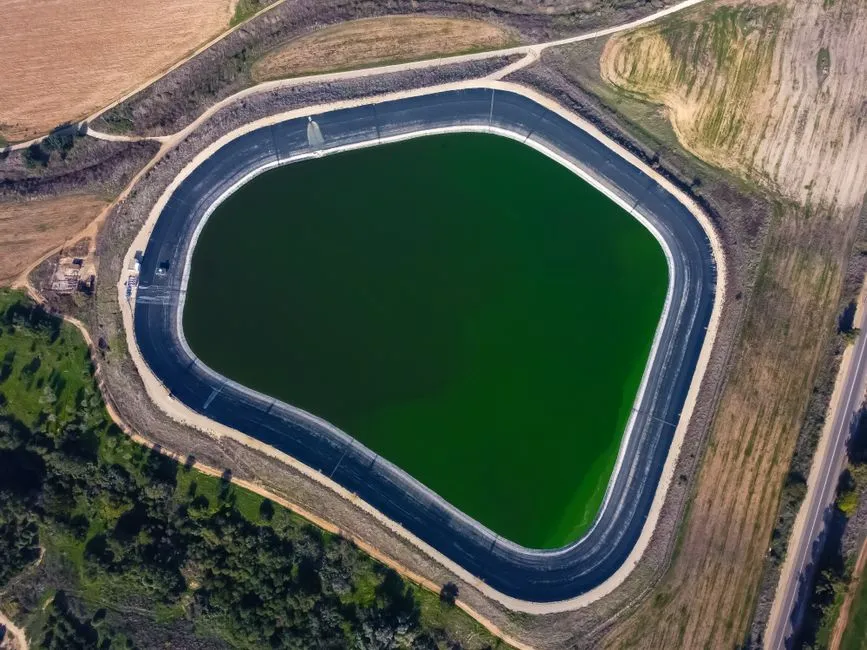
The unit operations below are the reference train a chemical plant sizes against to take a typical batch effluent from raw wastewater to the Germantown point-of-entry caps. Each step is mapped to the specific limit it controls.
- Equalization / flow buffering. Batch specialty-chemical production generates slug discharges; the 18-hour average column will catch an undamped slug before the 30-day column does. A lined equalization basin sized to 24–48 hours of design flow with mechanical mixing dampens both concentration and hydraulic spikes.
- pH adjustment. Two-stage acid/base dosing with PLC-controlled metering pumps holds pH in the 6.5–9.0 band — comfortably above the 40 CFR 403.5(b) floor of 5.0 (per EPA, 40 CFR 403.5(b)(2)) and inside the conventional POTW operating range. Manual dosing fails the 30-day average test because pH drifts between operator rounds.
- Chemical precipitation for metals. Hydroxide precipitation (lime or NaOH) at pH 9–10 is the workhorse for cadmium, copper, lead, nickel, and zinc; sulfide precipitation handles the tighter residuals on mercury and silver. A coagulant (ferric chloride or alum) and an anionic flocculant are dosed ahead of clarification to build a settlable floc. Jar tests should be run on each process stream — typical stoichiometric demand is 1.3–1.5× the theoretical metal loading.
- DAF or lamella clarification for TSS reduction. A DAF system for chemical-plant pretreatment is standard practice where oils, emulsions, or low-density floc are present — DAF reliably hits single-digit ppm TSS in chemical and petrochemical service and is the unit operation most plants pair with metals precipitation. Where footprint is constrained, a lamella plate clarifier is the alternative; sizing guidance is covered in our lamella clarifier sizing reference. Either device is the step that brings TSS to ≤350 ppm at the sewer entry (Germantown Sewer Use Law, Section XIV).
- Cyanide destruction. Alkaline chlorination (NaOCl or Cl₂ at pH ≥10.5) converts free cyanide to cyanate, then to CO₂ and N₂; this is the standard route to ≤0.4 mg/L free cyanide 30-day average (Germantown Sewer Use Law, Section XIV). For total cyanide including complexes, oxidation of weak-acid-dissociable species targets the 1.6 mg/L 30-day column. ORP-controlled dosing tied to a PLC-controlled chemical dosing skid is the difference between passing and failing compliance audits.
- Hexavalent chromium reduction. If Cr(VI) is present, reduce to Cr(III) with ferrous sulfate or sodium metabisulfite at pH <3, then re-precipitate as Cr(OH)₃ in the metals-precipitation stage. This is the only practical route to the 0.2 mg/L 30-day hex chromium cap (Germantown Sewer Use Law, Section XIV).
- Polishing and pH trim. A final pH correction and a multimedia polish filter handle residual suspended solids and any TSS carryover from upstream upsets.
- Sludge dewatering. Clarifier underflow and DAF float are routed to a plate and frame filter press for volume reduction prior to disposal. Cake solids of 30–45% are typical for chemical-plant hydroxide sludges and cut hauled-waste volume an order of magnitude versus liquid transfer.
| Unit Process | Influent Parameter (typical chemical plant) | Effluent Target at Point of Sewer Entry | Germantown / Federal Anchor |
|---|---|---|---|
| Equalization basin | Slug BOD/TSS/metal spikes | Damped 18-hour averages | Section XIV 18-hr column |
| pH adjustment (two-stage) | pH 1–13 swings | pH 6.5–9.0 | 40 CFR 403.5(b)(2); pH floor 5.0 |
| Chemical precipitation | Cd, Cu, Pb, Ni, Zn, Cr, Hg 1–50 mg/L | Meets 30-day metal caps | Section XIV (e.g., Cu 0.8, Pb 0.2 mg/L) |
| DAF or lamella clarification | TSS 200–3,000 ppm | TSS ≤350 ppm | Section XIV ¶15 |
| Alkaline chlorination (cyanide) | Free CN 1–50 mg/L | Free CN ≤0.4 mg/L; complex CN ≤1.6 mg/L | Section XIV cyanide row |
| Cr(VI) reduction + re-precipitation | Hex Cr 1–100 mg/L | Hex Cr ≤0.2 mg/L; total Cr ≤4.0 mg/L | Section XIV chromium rows |
| Plate and frame filter press | Sludge 1–4% solids | Cake 30–45% solids | Volume reduction for disposal |
Manual chemical dosing is the most common failure mode in this train. Operator rounds run every 4–8 hours, but the 30-day average is computed from continuous or composite samples — any drift between rounds shows up in the data the Town sees. Inline pH, ORP, and flow meters tied to a PLC-controlled chemical dosing skid close that loop.
The 2-year permit, the 15-day rule, and the no-dilution clause
The paperwork mechanics matter as much as the chemistry, and three clauses in the Germantown Sewer Use Law bite chemical plants specifically.
Industrial waste discharge permit (2-year term). The owner of an establishment producing industrial waste applies for an industrial waste discharge permit on a Town-furnished form. The maximum permit term is two years, extendable on application, and "the terms and conditions may be subject to modification and change by the Town of Germantown" (Germantown Sewer Use Law, Article V). For a 2026 permit application, that means designing any treatment upgrade on the assumption the permit will be reopened, not on a 5- or 10-year amortization horizon.
15-day accidental-discharge notice. The Sewer Use Law requires immediate verbal notification of an accidental discharge, followed by a detailed written statement within 15 days of the occurrence describing the cause and the measures being taken to prevent recurrence (Germantown Sewer Use Law, Section XIV). A chemical plant that misses the 15-day written window has handed the Town an easy enforcement exhibit — keep a templated incident form pre-approved by EHS so the field operator can fill it in the same day.
No-dilution clause. The Sewer Use Law states: "No user shall ever increase the use of process water or, in any way, attempt to dilute a discharge as a partial or complete substitute for adequate treatment to achieve compliance with the limitations contained in the Federal Categorical Pretreatment Standards, or in any other Pollutant specific limitation developed by the Town or State unless authorized by State or Federal regulations" (Germantown Sewer Use Law, Section XIV). For a chemical plant tempted to route a concentrated stream through a cooling-water cross-connection to drop the concentration, this is the clause that turns an operational shortcut into a permit violation. Dilution does not count as treatment under either the Germantown Sewer Use Law or the federal categorical standards.
Enforcement path. The Town is authorized to issue a cease-and-desist order against any user not complying with the prohibitions, limits, or permit conditions, and the Town Board reserves the right to change the Sewer Rent Charge and the Sewer Capital Charge "from time to time" (Germantown Sewer Use Law, Article VIII). The practical consequence: non-compliance hits both the permit file and the monthly OPEX line through revised sewer rent and capital charges, so the cost of inadequate pretreatment compounds across the budget, not just the compliance ledger.
Frequently Asked Questions
What are the Germantown Sewer District No. 1 BOD and TSS limits for industrial discharges?
BOD ≤300 ppm and TSS ≤350 ppm by weight, measured at the point of sewer entry, per the Germantown Sewer Use Law Section XIV ¶15. These are "shall not exceed" values, not design targets — any exceedance triggers review by the Engineer for the Town and pretreatment at the owner's expense.
What hexavalent chromium limit applies to chemical plants discharging to Germantown?
Hex chromium ≤0.2 mg/L (30-day average) and ≤0.4 mg/L (18-hour average); total chromium ≤4.0 mg/L (30-day) and ≤8.0 mg/L (18-hour), per the Germantown Sewer Use Law Section XIV. Federal categorical standards under 40 CFR Part 437 may also apply on top of the local cap.
What federal categorical pretreatment standard covers most chemical plants discharging to Germantown?
40 CFR Part 437 (Organic Chemicals, Plastics, and Synthetic Fibers) is the likely categorical standard for most chemical operations, applied at the point of discharge. Categorical limits apply even where Germantown's local limits are silent, per EPA's Summary of Categorical Standards (December 2024).
How long is an industrial waste discharge permit in Germantown, and what is the accidental-discharge notification rule?
The maximum permit term is two years, extendable on application and subject to modification by the Town (Germantown Sewer Use Law, Article V). Accidental discharges require immediate verbal notice followed by a detailed written statement within 15 days, per the Germantown Sewer Use Law Section XIV.
Does dilution count as adequate treatment under the Germantown Sewer Use Law?
No. The Sewer Use Law prohibits any user from increasing process-water use or otherwise attempting to dilute a discharge as a partial or complete substitute for adequate treatment, unless authorized by state or federal regulation (Germantown Sewer Use Law, Section XIV). The same prohibition is enforced through 40 CFR Part 403.
What should a chemical plant confirm with the Engineer for the Town before any 2026 capital spend on pretreatment?
Permit terms, monitoring frequency, and local-limit methodology may be updated by the Town, and the Town Board reserves the right to revise Sewer Rent and Capital Charges "from time to time" (Germantown Sewer Use Law, Article VIII). Reconfirm current permit terms, the active local-limit table, and any pending 40 CFR Part 437 applicability determination with the Engineer for the Town before specifying equipment.