Why Hutchinson Fabricated Metals Plants Face a DAF-vs-Clarifier Decision in 2026
Fabricated metals plants in Hutchinson, KS operate under the federal categorical pretreatment standards at 40 CFR 433, which the Hutchinson Water & Wastewater Department enforces at the POTW boundary (per EPA 40 CFR 433.10). The four priority metals — lead, copper, zinc, and nickel — each carry daily maximum limits that a primary clarifier must hit before the stream ever reaches the municipal collection system. A typical structural steel or job-shop stream combines cutting fluids, drawing compounds, rinse water with dissolved metals, and metal hydroxide floc from pH adjustment, which is a four-phase matrix that simple sedimentation handles poorly.
Hutchinson sits on the Arkansas River in Reno County, and the local pretreatment program layers surcharges on top of federal categorical limits. Plants discharging oil & grease above 100 mg/L or TSS above 250 mg/L typically face monthly surcharges on top of compliance monitoring, so the local economic signal is just as sharp as the federal regulatory one. Confirm current surcharge thresholds and any local limits tighter than EPA with Hutchinson Utilities before finalizing equipment selection.
The 2026 capital planning question is therefore narrow: which primary solids-removal device — a dissolved air flotation (DAF) system or a lamella clarifier — best handles a fabricated metals stream while leaving room for coagulation, flocculation, filtration, and polishing downstream? For most Hutchinson fabricators, the answer is DAF first, sometimes followed by a lamella polish. The two units are competing primary steps, not interchangeable full treatments.
40 CFR 433 Metals Limits That Drive the Equipment Choice
40 CFR 433.10 sets daily maximum metal limits that any primary clarifier on a fabricated metals stream must help the plant meet. The four priority metals most likely to drive a Notice of Violation at a Hutchinson POTW are lead at 0.43 mg/L, copper at 1.27 mg/L, zinc at 1.48 mg/L, and nickel at 1.38 mg/L daily maximum, with total metals capped at 2.38 mg/L daily maximum. These are categorical limits, and the POTW applies them at the discharge sampling point regardless of stream dilution.
Chemistry determines which unit handles the resulting sludge best. pH adjustment to roughly 8.5–9.5 drops zinc, copper, nickel, and lead out of solution as low-density metal hydroxide floc. That floc has a specific gravity close to water, so it floats more easily than it settles — that is the physical reason DAF outperforms a plain clarifier on metal-finishing wastewater (HydropureWater field data, 2026). If oil and grease is not removed upstream, it coats the inclined plates of a lamella and progressively reduces the effective settling area, which is why DAF almost always sits ahead of a lamella in flowsheets where oil is present.
For a broader regulatory anchor, see the treatment-train discussion in UPM's pulp-mill expansion and high-recovery RO — the same metals-removal logic applies, just on a different feed matrix.
| Pollutant | 40 CFR 433 Daily Maximum (mg/L) | Form at pH 8.5–9.5 | Removal behavior |
|---|---|---|---|
| Lead (Pb) | 0.43 | Pb(OH)2 floc | Light, floatable; benefits from DAF |
| Copper (Cu) | 1.27 | Cu(OH)2 floc | Fine colloidal; needs coagulant aid |
| Zinc (Zn) | 1.48 | Zn(OH)2 floc (amphoteric above pH 10) | Floatable below pH 9.5; pH control critical |
| Nickel (Ni) | 1.38 | Ni(OH)2 floc | Slow-settling; coagulant required |
| Total metals | 2.38 | Mixed floc | Combined ceiling; one metal can crowd the limit |
| Oil & grease (local POTW surcharge trigger) | ~100 (typical local) | Free + emulsified | Must be removed before lamella plates |
How a DAF Clarifier Works on a Metals Stream
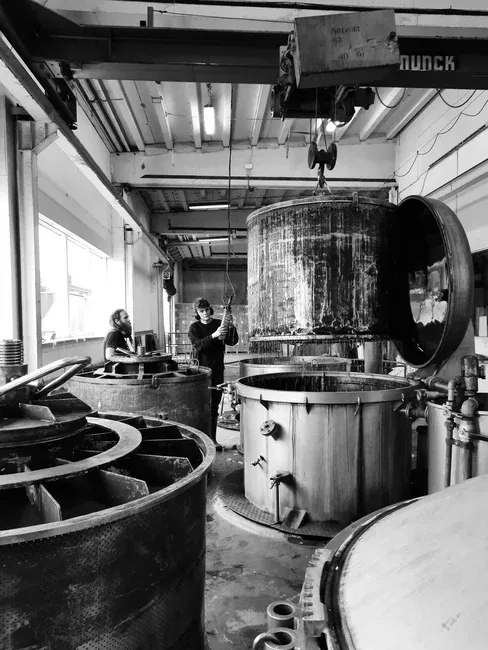
A DAF clarifier saturates a pressurized side-stream — typically 20–30% of the main flow — at 60–80 psig, then releases it through nozzles to generate a cloud of 20–50 micron micro-bubbles (per SigmaDAF/Clearwater and DAF Corp specifications). Those bubbles attach to oil droplets and metal hydroxide floc, lifting them to the surface in roughly 3–5 minutes. A gravity clarifier needs 60–90 minutes to do the equivalent settling work, and on light hydroxide floc it does not do it well at all.
Removal performance scales with tank geometry. DAF Corp's round FC Maximizer, which uses a zero-velocity shallow circular tank design, achieves 92–98% TSS removal across flows from 10 to 11,000 GPM. The rectangular RC UniMax delivers 85–90% TSS removal on flows from 10 to 1,000 GPM (source: dafcorp.com, 2025). Skimmed sludge reaches 2–4% dry solids, which roughly halves downstream hauling cost compared to a clarifier producing 1–2% sludge (HydropureWater field data, 2026).
Chemistry makes the physical separation work. Coagulant — typically polyaluminum chloride (PAC) at 50–150 mg/L — is dosed first to neutralize colloidal charge, then an anionic polyacrylamide flocculant at 1–5 mg/L builds a strong floc that bubbles can lift. Both reagents are mixed in serpentine tubes or an in-line static mixer ahead of the flotation cell, which is the standard DAF configuration. For an integrated skid that bundles the air-saturation package, reaction tubes, and the cell, see the HydropureWater dissolved air flotation system range, which covers 4–300 m³/h (about 18–1,320 GPM) across 13 standard models.
How a Lamella Clarifier Works and Where It Fits
A lamella clarifier uses a stack of inclined plates set at 55–60° to shorten the effective settling distance. Solids settle onto the plate face, slide down into a sludge hopper, and clarified water flows upward through the plate pack. The compact plate geometry is what gives a lamella its footprint advantage: surface loading rates of 20–40 m/h are typical, against roughly 1–2 m/h for a conventional clarifier (HydropureWater internal product catalog, 2026), which translates to a 60–70% smaller footprint for the same flow.
The lamella's strength is also its constraint. It works best on streams that are already oil-free, low-TSS, and chemically conditioned — a polishing step, not a workhorse. Typical fits are post-DAF polishing, rainwater runoff, and machine coolant blowdown after a CPI or DAF has pulled the free and emulsified oil. If free oil exceeds roughly 50 mg/L going in, the plates foul, the effective settling area drops, and the unit under-performs badly. The same floc-utilization advantage that makes a lamella efficient on low-TSS streams also yields up to 30% chemical savings versus conventional sedimentation, which is the real economic argument for putting one in.
For a packaged inclined-plate unit sized for fab-shop flows, see the HydropureWater high-efficiency lamella sedimentation tank line. The same comparison logic applies to other process streams — see also DAF vs Clarifier for Industrial Organic Chemicals & Petroleum Wastewater in Dickinson, US: 2026 Selection Guide for an organic-chemistry side of the matrix.
DAF vs Lamella Clarifier: 2026 Comparison Matrix
For a Hutchinson fabricator staring at a 50 GPM combined wastewater stream with cutting fluids, drawing compounds, dissolved metals rinse water, and hydroxide floc, the DAF-vs-clarifier decision reduces to four factors: solids load, oil and grease tolerance, footprint, and CAPEX. The table below is built for that decision, not a generic technology shootout. Two engineering reference points anchor it: 40 CFR 433 daily-maximum metals and the DAF Corp and SigmaDAF published removal performance.
| Decision factor | DAF (FC Maximizer, RC UniMax) | Lamella clarifier (inclined plate) | Use this when… |
|---|---|---|---|
| TSS removal efficiency | 85–98% (FC Maximizer 92–98%, RC UniMax 85–90%) | 70–85% on conditioned, low-TSS feed | DAF if feed TSS >300 mg/L; lamella if <300 mg/L |
| Oil & grease tolerance | Handles >200 mg/L O&G including emulsified | Requires O&G <50 mg/L upstream | DAF if O&G >50 mg/L; lamella only after CPI/DAF |
| Footprint per GPM | Larger cell; surface loading ~5–10 m/h | 20–40 m/h surface loading; 60–70% smaller | Lamella when floor space is constrained and feed is clean |
| CAPEX per GPM band | Skid 20–50 GPM: $80K–$180K; 100–200 GPM: $200K–$450K | 20–50 GPM: $40K–$90K; 100–200 GPM: $90K–$180K | Lamella wins on CAPEX alone — but only on clean feed |
| OPEX (energy + chemicals) | 5–10 scfm compressed air per 50 GPM; saturation pump; PAC + anionic PAM | Feed pump only; lower polymer dose (up to 30% savings vs conventional) | Lamella wins on OPEX; DAF wins on sludge handling cost |
| Sludge dryness | 2–4% dry solids (skimmer) | 1–2% dry solids (hopper underflow) | DAF cuts hauling trips roughly in half |
For fabricators whose discharge limits are tighter than 40 CFR 433 — a common Hutchinson scenario for shops near an industrial drainage basin — the right answer is often a hybrid flowsheet: DAF primary to strip oil and float the bulk of the floc, followed by a lamella polish to catch the residual TSS before multimedia filtration. That is also the configuration that delivers the lowest combined CAPEX-plus-hauling OPEX for shops above 30 GPM (HydropureWater field data, 2026).
Sizing and CAPEX Bands for a Hutchinson Fab Shop in 2026
A 50 GPM combined wastewater flow is the most common design point for a small-to-mid Hutchinson fabricator, and it lines up with the lower half of the HydropureWater dissolved air flotation system range (4–300 m³/h, 13 standard models). For that flow, a skid-mounted DAF including saturation package, reaction tubes, skimmer, and PLC will land in the $80K–$180K band. A lamella clarifier of equivalent capacity sits in the $40K–$90K band, which is why procurement keeps asking about it — the CAPEX delta is real.
OPEX flips the math. DAF compressed-air demand is 5–10 scfm per 50 GPM at 60–80 psig, plus a saturation recycle pump. A lamella needs only a feed pump and a lower dose of polymer (up to 30% chemical savings versus conventional settling). Where DAF recovers the cost is in sludge: 2–4% dry solids skim versus 1–2% hopper underflow, which roughly halves the volume hauled and pays back the CAPEX delta in 12–24 months for a typical fab shop (HydropureWater field data, 2026).
Hutchinson winters add a line item. From November through March, ambient temperatures regularly drop below freezing, and an uncovered DAF cell will see ice, viscosity changes, and polymer activity loss. Insulated enclosures or indoor installation typically add 10–15% to CAPEX but protect removal efficiency and prevent freeze-cracked piping.
| Flow range (GPM) | DAF CAPEX band (skid, 2026) | Lamella CAPEX band (2026) | Notes for Hutchinson, KS |
|---|---|---|---|
| 20–50 | $80K–$180K | $40K–$90K | Most job shops; pilot recommended above 30 GPM |
| 50–100 | $150K–$280K | $70K–$140K | Enclosure adds 10–15% CAPEX in winter |
| 100–200 | $200K–$450K | $90K–$180K | Consider DAF + lamella polish for tight local limits |
| 200–500 | $400K–$900K | $150K–$350K | Multiple cells; OPEX gap widens at this scale |
Frequently Asked Questions
Is DAF required for fabricated metals under 40 CFR 433?
No. 40 CFR 433 sets metals limits and oil-and-grease expectations, not a specific technology. In practice, DAF is the most common primary step for 40 CFR 433 streams because metal hydroxide floc formed at pH 8.5–9.5 is light and floatable, and DAF handles the free and emulsified oil that almost always rides along with the metals.
Can a lamella clarifier replace DAF for a small Hutchinson fab shop?
Yes, if oil and grease stays below 50 mg/L and TSS stays below 300 mg/L after chemical conditioning. Most Hutchinson fabricators exceed one or both thresholds once cutting fluids and drawing compounds are mixed in, so a stand-alone lamella usually ends up undersized for the actual feed it sees.
What micro-bubble size should I specify for a metals DAF?
Specify 20–50 micron bubbles. DAF Corp's Micro Bubble Generator publishes a 20–40 micron range; SigmaDAF publishes 30–50 microns. Below 20 microns the bubbles lack lifting force; above 50 microns they break the floc and reduce attachment efficiency.
How often does a DAF need sludge removal?
Continuous surface sludge removal via a paddle skimmer is standard, with a daily underflow purge on the heavy-solids collection zone. Skim sludge at 2–4% dry solids goes to a sludge holding tank or bag filter press; the underflow is typically returned to the equalization basin for re-flotation.
Does Hutchinson require a pilot test for an industrial DAF?
For flows above 30 GPM, a pilot is the safe path before committing CAPEX. DAF Corp offers a 48 GPM FC-60 pilot and an 80–100 GPM RC UniMax pilot for exactly this kind of feasibility work, and most pretreatment programs accept the pilot data as the basis for full-scale design.