Chemical plants near Cincinnati meet 2026 pretreatment limits by operating a four-stage train — source segregation, primary oil/water separation, dissolved air flotation (DAF) polishing, and biological or MBR polish — designed to hit 100–200 mg/L HEM ceilings and ~250 mg/L TSS ceilings set by Metropolitan Sewer District (MSD) under 40 CFR Part 403. Local limits are derived using EPA's MAHL method against the receiving POTW's NPDES permit, Ohio water quality standards, and Part 503 biosolids criteria. Compliance is judged on pass-through (40 CFR 403.3(p)) and interference (40 CFR 403.3(k)), not on the chemistry of the discharge itself.
The Regulatory Chain a Cincinnati Chemical Plant Hands an Ohio EPA Inspector
Five links define the citation chain a chemical-plant compliance engineer reproduces in any 2026 audit, and each is citable on its own: the Clean Water Act of 1972 (33 U.S.C. § 1251 et seq.) authorizes EPA to regulate industrial discharges to publicly owned treatment works (POTWs); 40 CFR Part 403 general pretreatment regulations translate that authority into enforceable pass-through and interference prohibitions; Ohio EPA holds the NPDES pretreatment delegation for the state and approves each POTW's pretreatment program; Metropolitan Sewer District of Greater Cincinnati (MSD) issues the per-user local limits derived under that approved program; and any applicable 40 CFR categorical subpart (Part 414 organic chemicals, Part 415 inorganic chemicals, Part 422 plastics) rides on top of those local limits. MSD's Pretreatment Program was approved by Ohio EPA per the August 5, 2011 approval letter (per msdgc.org) and remains the Ohio-EPA-approved mechanism for Significant Industrial User (SIU) permitting in the Greater Cincinnati service area (Hamilton County and northern Kentucky).
The legal pivot is the receiving plant's effluent quality and biosolids, not the discharger. Pass-through under 40 CFR 403.3(p) is a discharge that exits the POTW into waters of the U.S. in quantities or concentrations that, alone or in combination with other discharges, cause a violation of the POTW's NPDES permit. Interference under 40 CFR 403.3(k) is a discharge that inhibits or disrupts the POTW, its treatment processes, or its sludge use and disposal. MSD Rules & Regulations Section 1516 prohibits direct discharges to a manhole without a permit, and Section 1514 places restrictions on radioactive material (per MSD 1988 regulations, Hamilton County, Ohio, as cited by EPA-Cincinnati in nepis.epa.gov archive). MSD uses Table 1517-1 as the compliance-schedule mechanism in its initial enforcement action, which means the table values on the permit are what an inspector will check first.
Are You Categorical or Noncategorical? The 40 CFR Question That Changes Everything
The first classification question a chemical-plant engineer answers is whether the site is a categorical industrial user under one of EPA's effluent-guideline subparts, or a noncategorical SIU that rides 40 CFR Part 403 plus MSD local limits. Categorical limits ride on top of local limits — a plant under Part 414 must meet both, and the more restrictive number wins on each parameter. The subparts most likely to apply to a Cincinnati chemical site are: 40 CFR Part 414 (organic chemicals, plastics, and synthetic fibers), 40 CFR Part 415 (inorganic chemicals manufacturing), 40 CFR Part 417 (soap and detergent manufacturing), 40 CFR Part 418 (fertilizer manufacturing), 40 CFR Part 422 (plastics manufacturing — distinct from the synthetic-fibers portion of Part 414), and 40 CFR Part 423 (steam electric), with 40 CFR Part 419 (petroleum refining) only applying if the site is a true refinery. A noncategorical SIU is governed by 40 CFR Part 403 plus MSD local limits derived using EPA's MAHL/MAIL method.
The dilution prohibition applies uniformly: no user shall increase process water use or attempt to dilute a discharge as a substitute for adequate treatment to meet federal categorical or local limits. This is enforced at the Cincinnati POTW manhole, not at the plant's internal sample point, which is why flow metering and chain-of-custody matter more than the chemistry inside the plant. For plants straddling two NAICS codes — for example a specialty chemical site that also blends detergents — the rule of thumb is to take the most restrictive categorical subpart that applies to the smallest production line and apply that standard across the affected wastestream. A parallel process-industry framing for a different geography is laid out in the Terre Haute chemical-plant pretreatment guide.
How MSD Local Limits Are Actually Built (the MAHL Method)
The number on a Cincinnati chemical-plant permit is not arbitrary. It is the output of EPA's Maximum Allowable Headworks Loading (MAHL) method, which converts four regulatory inputs into a per-SIU allocation. Per the 2020 St. Joseph, MO TBLL evaluation by Black & Veatch (cited in hydropurewater.com S1), those four MAHL inputs are: (1) NPDES permit limits on the receiving POTW; (2) state water quality standards for the receiving stream; (3) Part 503 biosolids disposal criteria; and (4) local worker/ecosystem protection factors such as NIOSH thresholds. The POTW then converts the MAHL into a Maximum Allowable Industrial Loading (MAIL) for each SIU, allocates mass against flow, and prints the result as daily-maximum and monthly-average numbers on the discharge permit.
The MAHL → MAIL conversion is where the "headworks math" happens: MSD divides the headworks allocation (in lb/day) by the SIU's design flow, applies a safety factor, and prints a concentration-based limit at the plant's monitoring manhole. The parameter set a Cincinnati chemical SIU is judged on tracks the standard municipal local-limits framework — but MSD issues per-permit, not as a generic table, so the numbers on the reader's permit are the only authoritative values. Cincinnati-area POTWs that discharge into water-reuse basins or upstream of Ohio River drinking-water intakes push daily-maximum HEM toward 50 mg/L, which is roughly 25–50% tighter than the 100–200 mg/L federal ceiling. The local geography and receiving-water use matter as much as the federal floor.
Matching the Treatment Train to the Chemical Stream
Chemical-plant waste streams are not generic "oil/water." A chemical site near Cincinnati typically routes the following into the pretreatment train: tank-bottom water, reactor wash, scrubber blowdown, transfer-line drip, equipment wash, hydrostatic test water, and stormwater that contacts process areas. Each carries a different droplet-size distribution, and droplet size drives stage selection. Free oil in the 60–150 µm range belongs on a primary gravity stage; emulsified oil in the 10–25 µm range belongs on a DAF; colloidal and dissolved species belong on a biological or MBR polish. Trying to push free oil directly to a DAF crashes the air-to-solids ratio because the free-oil film blankets the bubble surface, and that is the single most common field failure mode in chemical-plant retrofits.
Source segregation is the cheapest control available. Segregated laterals for process pads, covered dump valves, and dedicated oil/water sewering on loading islands reduce the volume hitting the train by 40–70% in field retrofits (HydropureWater field data, 2025–2026), and convert most of the remaining flow from "design problem" to "design choice." Acid/alkaline and high-COD streams need pH adjustment to 6.5–7.5 ahead of the DAF and a coagulant or demulsifier dose of 50–200 mg/L via an automatic chemical dosing system. Where the permit swings from a 50 mg/L HEM ceiling to <20 mg/L in a water-reuse loop, the polishing step moves from biological — an MBR with 0.1 µm PVDF flat-sheet modules — to adsorption (GAC). The four-stream matrix below is the engineering decision input most pretreatment guides skip.
| Chemical stream | Typical target parameters | Droplet / species size | Primary stage | Polishing stage |
|---|---|---|---|---|
| Organics (solvents, glycols, phenols) | BOD/COD 500–5,000 mg/L; HEM 100–500 mg/L; phenols, BTEX | Free 60–150 µm plus dissolved | CPI or API | Dissolved air flotation system + biological (MBR) |
| Inorganics (acids, bases, metals-bearing) | pH 2–12 swings; TSS 200–2,000 mg/L; metals (Ni, Cr, Zn, Cu) | Particulate 10–100 µm | Equalization + pH adjust to 6.5–7.5 | DAF + chemical precipitation + GAC |
| Acid/alkaline wash water | pH; sulfates; TSS | Predominantly dissolved | EQ basin with pH interlock | Neutralization + DAF |
| Solvent-bearing (MEK, toluene, xylene) | HEM; SVOC; BTEX; COD | Free plus emulsified | API or CPI (covered, vapor-balanced) | DAF + GAC (closed-loop) |
Choosing the Primary Separator: API, CPI, or Coalescer
The primary separator is the highest-leverage equipment decision in the entire train, and the four technologies occupy different performance bands. They are not interchangeable, and selecting the wrong one locks in a structural under-performance that no downstream polish can fully fix. The robust Cincinnati path is CPI or API as primary, then a dissolved air flotation system as the emulsified-oil polisher, sized with a 20–30% safety margin on hydraulic and air-to-solids loading.
API separators handle high-throughput sites with large flow swings; they cannot break emulsions, are sensitive to turbulence, and require ≥30 minutes of residence time at peak flow. CPI (corrugated plate interceptor) units are compact with vertical configurations, fit small-to-mid sites with steady flow, retrofit into existing concrete vaults, run plate spacing in the 1–2 inch range with corrugation angle near 45°, and rarely meet <100 mg/L on emulsified waste without polishing. Plate or multimedia coalescers operate at 5–10 gpm/ft² (vendor-specific), suit polishing stages or low-flow sites with strict <50 mg/L needs, and carry higher O&M with media replacement every 1–3 years. DAF targets 10–25 µm emulsified or colloidal droplets, runs surface hydraulic loading of 2–5 gpm/ft² with ASR ~0.02–0.05, fits truck-loading or emulsified-oil duty, and is slug-sensitive without an upstream primary.
| Technology | Droplet range | Surface / area loading | Best-fit duty | Key limitation |
|---|---|---|---|---|
| API separator | Free oil ≥150 µm | Vendor-specific; ≥30 min residence at peak | High-throughput, large flow swings | Cannot break emulsions; turbulence-sensitive |
| CPI (corrugated plate interceptor) | Free oil ≥60 µm | Plate spacing 1–2 in; angle ~45° | Small-to-mid sites; vault retrofit | Rarely meets <100 mg/L on emulsified waste |
| Plate / multimedia coalescer | Emulsified 20–60 µm | 5–10 gpm/ft² | Polishing or low-flow <50 mg/L sites | Higher O&M; media replacement 1–3 yr |
| DAF | Emulsified / colloidal 10–25 µm | 2–5 gpm/ft²; ASR ~0.02–0.05 | Truck-loading or emulsified-oil duty | Slug-sensitive without upstream primary |
Three Numbers Drive a Defensible Design
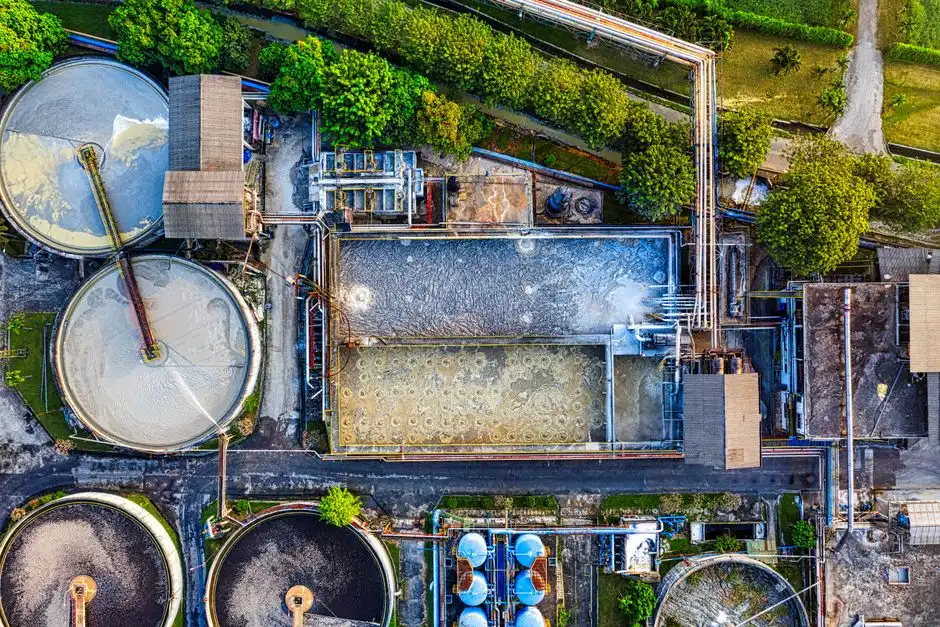
Three design inputs are what a 2026 reviewer or Ohio EPA inspector checks first, and getting them wrong propagates into every downstream sizing decision. The first is peak instantaneous flow, in gpm or m³/h — not the daily average. Slug loads during a coalescer dump, a reactor batch drop, or a tank-bottom pump-out can spike 3–5× the daily mean, and undersizing the primary on the daily mean is the most common field cause of a DAF crash. The second is daily O&G and COD load, in lb/day or kg/day, calculated from tank turnover, wash-rack volume, reactor batch discharge, and drip rates. The third is target residual HEM, COD, and TSS in mg/L, taken from the local permit ceiling or, ideally, set 20–30% below it to absorb sampling and operational variance.
Sampling taps must be accessible, the flow meter calibrated annually, and the chain-of-custody defensible. Most Significant Noncompliance (SNC) findings at industrial sites originate from sampling-procedure deficiencies rather than from underlying treatment performance (HydropureWater field data, 2025–2026) — chain-of-custody and flow-meter calibration are the cheap wins. For sites that need a closed-loop supervisory layer, the PLC control architecture for industrial wastewater piece covers interlocks, trending, and audit-trail logging. A related plastics-stream comparison is in the Cincinnati plastics DAF vs clarifier guide.
Self-Monitoring, Reporting, and the 24-Hour Slug Rule
The minimum self-monitoring cadence most MSD-issued permits expect in 2026: daily visual free-oil inspection at the outlet weir (logged, dated, initialed), weekly TSS grab, monthly HEM composite per EPA Method 1664A (24-hour flow-proportional where the permit specifies), and a 24-hour flow-proportional composite for BTEX/TPH where the local limit is non-zero. The flow meter must be calibrated on at least an annual cycle, and the chain-of-custody forms must reconcile against the field logbook entries to the minute. The hardware answer that closes most of the audit risk is an automatic chemical dosing system on the EQ-basin outlet with interlock to the sewer shutoff valve, so a slug cannot get past the POTW manhole undetected.
SNC is triggered by any of the following, per EPA's National Pretreatment Program: a numerical limit exceeded by ≥1.5× on any single day, a numerical limit exceeded for >5% of measurement days in a 6-month period, or required reports more than 30 days late. The 24-hour rule under 40 CFR 403.5 applies to slug events: any discharge that could cause interference or pass-through must be reported within 24 hours. Reports filed on the 15th of every month without exception are the operational standard an MSD coordinator will check against the EPA National Pretreatment Program audit checklist categories.
Audit-Ready BMPs an MSD Coordinator Will Look For in 2026
The BMP list an MSD pretreatment coordinator will physically walk during a 2026 audit: spill containment around aboveground storage tanks sized to 110% of the largest single container, drip pans under loading arms, covered and locked dump valves on coalescers, segregated sewer laterals that keep process pads out of the clean stormwater system, visible tagging of all sample points, and a written SPCC plan (40 CFR Part 112) tied to the sewer map. The procedural BMPs are equally concrete: file reports on the 15th of every month without exception, keep a pre-audit file using the EPA National Pretreatment Program audit checklist categories, and maintain a written chain-of-custody form that reconciles to the flow-meter totalizer and the field logbook on a per-sample basis. The process BMP is to deploy equalization with chemical-dose interlock on the EQ outlet to the sewer shutoff valve, so a pH or HEM excursion triggers the shutoff before the slug reaches the POTW manhole.
Frequently Asked Questions
What HEM limit applies to a chemical plant discharging to MSD?
Typical 2026 daily-maximum HEM ceilings for a Cincinnati chemical SIU sit in the 100–200 mg/L range, with Cincinnati-area POTWs that discharge into water-reuse basins or upstream of Ohio River drinking-water intakes pushing toward 50 mg/L. HEM is the federally used O&G surrogate under 40 CFR § 401.16 and EPA Method 1664A (n-hexane extraction), and is what most permits cite as "O&G."
Does a chemical plant need a categorical or noncategorical pretreatment permit?
It depends on the NAICS code and primary product line. Organic chemicals, plastics, and synthetic fibers plants ride 40 CFR Part 414; inorganic chemicals ride Part 415; plastics manufacturing can also fall under Part 422; soaps and detergents under Part 417; fertilizers under Part 418. Noncategorical SIUs are governed by 40 CFR Part 403 plus MSD local limits derived using EPA's MAHL/MAIL method. Categorical limits ride on top of local limits, and the more restrictive value applies on each parameter.
What is the MAHL method and how does it produce a chemical-plant permit number?
The MAHL (Maximum Allowable Headworks Loading) method converts four inputs into a per-SIU allocation: (1) NPDES permit limits on the receiving POTW, (2) state water quality standards for the receiving stream, (3) Part 503 biosolids disposal criteria, and (4) local worker/ecosystem protection factors such as NIOSH thresholds. The POTW converts the MAHL into a Maximum Allowable Industrial Loading (MAIL), allocates mass against flow, and prints the result as daily-maximum and monthly-average concentration numbers on the discharge permit.
Why does a DAF need a primary separator upstream?
A DAF alone without a primary gravity stage fails under slug loads because free oil from coalescer or API dumps blankets the bubble surface and crashes the air-to-solids ratio (HydropureWater field data, 2026). The robust configuration is a CPI or API primary, then a DAF polisher sized with a 20–30% safety margin on hydraulic and air-to-solids loading. Skipping stage 2 to save capex is the single most common cause of DAF underperformance in the field.
What triggers a Significant Noncompliance (SNC) finding in 2026?
Three numerical triggers: a numerical limit exceeded by ≥1.5× on any single day, a numerical limit exceeded for >5% of measurement days in a 6-month period, or required reports more than 30 days late. A fourth trigger is the 24-hour slug reporting rule under 40 CFR 403.5: any discharge that could cause interference or pass-through must be reported within 24 hours. An SNC can lead to enforcement action, surcharges, or permit termination.
Related Equipment
- PVDF flat-sheet MBR module — specifications, capacity range, and technical data