Why Pharmaceutical Wastewater in Mozambique Is a Public-Health Problem, Not Just a Discharge Problem
Residual antibiotics in pharmaceutical effluent select for resistant bacteria at concentrations as low as 1–10 µg/L, turning a Maputo Bay or Incomati estuary outfall into an antibiotic-resistance selection point rather than a simple COD source (Li et al. 2024, J. Water Process. Eng. 63, 105404). Pharmaceutical wastewater in Mozambique is therefore not defined by BOD or COD alone — it is defined by four overlapping pollutant classes: (1) readily biodegradable organics from fermentation and formulation; (2) recalcitrant solvents and intermediates from API synthesis; (3) active pharmaceutical ingredients (APIs) at µg/L to mg/L levels; and (4) antibiotic resistance genes (ARGs) carried on mobile genetic elements. Each API or formulation plant in the Maputo or Beira corridor generates a different mix: chemical-synthesis API lines discharge 1,500–8,000 mg/L COD with high sulfate and solvent load, formulation lines sit at 500–2,500 mg/L COD with intermittent batch peaks, and traditional-medicine decoction lines carry high TSS and tannins that foul membranes. Mozambique's coastal receiving waters — Maputo Bay, Sofala Bank — have low dilution capacity during the dry season and support artisanal fisheries, so the ARG selection pressure is not theoretical: it lands on people. The implication for 2026 ETP design is that the biological step must be followed by an oxidation step specifically sized for ARG removal, not just for COD polishing.
Mozambique Regulatory Framework: MFA, MITADER, and Diploma Ministerial 93/2005
Discharge permits in Mozambique are issued by the Ministry of Agriculture and Food Security (MFA) through its regional water directorates, while environmental licensing falls under the Ministry of Land, Environment and Rural Development (MITADER), now reorganized as MMAIP. The numerical effluent limits that an ETP must meet are set in Diploma Ministerial 93/2005 (Regulamento sobre os Valores Limites de Descarga de Efluentes), which remains the operative framework in 2026. A plant discharging to a municipal sewer faces stricter MFA permit conditions than the generic Decreto 18/2004 baseline because MFA imposes site-specific load caps tied to the receiving STP's hydraulic and biological capacity. There is no Mozambique-specific numerical limit for individual APIs; instead, regulators require environmental risk assessment (ERA) following WHO/EMA triggers, with site-specific ecotoxicity testing where receiving-water dilution is below 10:1.
| Parameter | Diploma Ministerial 93/2005 limit (water body) | MFA sewer-discharge limit (typical permit, 2026) |
|---|---|---|
| pH | 6.0–9.0 | 6.0–9.0 |
| COD | ≤ 50 mg/L | ≤ 150 mg/L |
| BOD₅ | ≤ 20 mg/L | ≤ 50 mg/L |
| TSS | ≤ 30 mg/L | ≤ 60 mg/L |
| Total nitrogen | ≤ 10 mg/L | ≤ 15 mg/L |
| Total phosphorus | ≤ 3 mg/L | ≤ 5 mg/L |
| Fecal coliforms | ≤ 100 CFU/100 mL | ≤ 200 CFU/100 mL |
| APIs / ARGs | ERA-triggered | ERA-triggered |
The 100 CFU vs. 200 CFU/100 mL split is the first decision point: a Maputo coastal plant must design for the water-body column, not the sewer column, even if the physical connection runs through municipal infrastructure.
Typical Influent Characteristics for API and Formulation Plants in Mozambique
No published Mozambique-specific influent survey exists, so the design basis is built by transferring Li et al.'s 2024 dataset of 229 Chinese plants to Mozambique and adjusting for tropical intake-water salinity and grid instability. The table below is conservative for a 2026 Maputo or Beira greenfield — it assumes chemical-synthesis API co-existing with formulation lines, which is the common configuration for African generics manufacturers. The BOD/COD ratio of 0.20–0.40 is high enough to justify a full anaerobic stage but low enough that physico-chemical pretreatment must precede the UASB to prevent shock from solvents and high-strength batch dumps.
| Parameter | API synthesis range | Formulation range | Design value (100 m³/d Maputo basis) |
|---|---|---|---|
| COD (mg/L) | 1,500–8,000 | 500–2,500 | 4,500 |
| BOD₅ (mg/L) | 300–2,500 | 200–1,200 | 1,600 |
| BOD/COD | 0.20–0.40 | 0.30–0.50 | 0.35 |
| TSS (mg/L) | 200–1,500 | 100–600 | 800 |
| TN (mg/L) | 50–400 | 20–80 | 180 |
| NH₃-N (mg/L) | 20–150 | 5–30 | 60 |
| TP (mg/L) | 5–40 | 2–10 | 15 |
| Sulfate (mg/L) | ≤ 1,500 | ≤ 200 | 800 |
| Conductivity (µS/cm) | 2,000–8,000 (coastal intake) | 1,000–3,000 | 5,000 |
| Salinity / TDS (mg/L) | 2,000–5,000 | 500–1,500 | 3,000 |
| Temperature (°C) | 25–32 | 25–32 | 28 |
Two Mozambique-specific stress factors sit on top of these numbers. First, tropical year-round temperatures of 25–32 °C favor mesophilic anaerobic biology — a UASB runs near optimum without heating. Second, intake water at the Maputo coastal sites can push TDS to 3,000–5,000 mg/L, which sets a salinity ceiling for nitrification and pushes the design toward halotolerant biomass or a partial-denit configuration.
The 2026 Process Train: Pretreatment + Anaerobic + MBR + Advanced Oxidation
The defensible 2026 train for a Maputo API plant is seven stages, each with a published evidence base and a clear sizing envelope. The order is not arbitrary: equalization absorbs the 10:1 batch swings typical of API synthesis campaigns; Fenton or iron-carbon pretreatment strips recalcitrant solvents and breaks down antibiotic molecules; UASB converts the bulk COD to biogas while reducing aeration demand downstream; the anoxic-oxic (A/O) or SBR stage completes nitrification and denitrification; the MBR delivers the low-TSS, low-COD polishing needed before ozone; ozone or catalytic ozone destroys residual APIs and ARGs; and RO is held in reserve for water reuse on CIP and cooling make-up. Hou et al. (2019, Water Res. 162, 346–357) demonstrated that this exact combination — UASB + anoxic-oxic + advanced oxidation — achieves 2–4 log removal of both antibiotics and ARG targets simultaneously, which is the empirical case for running all three stages rather than substituting one for another.
| Stage | Unit operation | Key design parameters | Function |
|---|---|---|---|
| 1 | Equalization + chemical dosing | 24–48 h HRT, pH 6–9, coagulant/polymer dosing | Buffer batch peaks; settle suspended API crystals using an automatic chemical dosing system |
| 2 | Fenton or iron-carbon microelectrolysis | Fe²⁺/H₂O₂ at pH 3–4, 60–90 min; Fe-C contact 30–60 min | Strip recalcitrant solvents and break down antibiotic rings (Liu et al. 2019, Ind. Water Treatment) |
| 3 | UASB or EGSB | 30–37 °C, 24–48 h HRT, 0.5–1.5 kg COD/m³·d OLR | Convert bulk COD to biogas; tolerate up to 1,500 mg/L sulfate (Li et al. 2015, Chem. Eng. J.) |
| 4 | A/O or SBR | HRT 18–30 h, MLSS 3,000–5,000 mg/L, DO 1.5–2.5 mg/L | Nitrification/denitrification; degrade remaining antibiotics (Elmolla & Chaudhuri 2012, Desalination) |
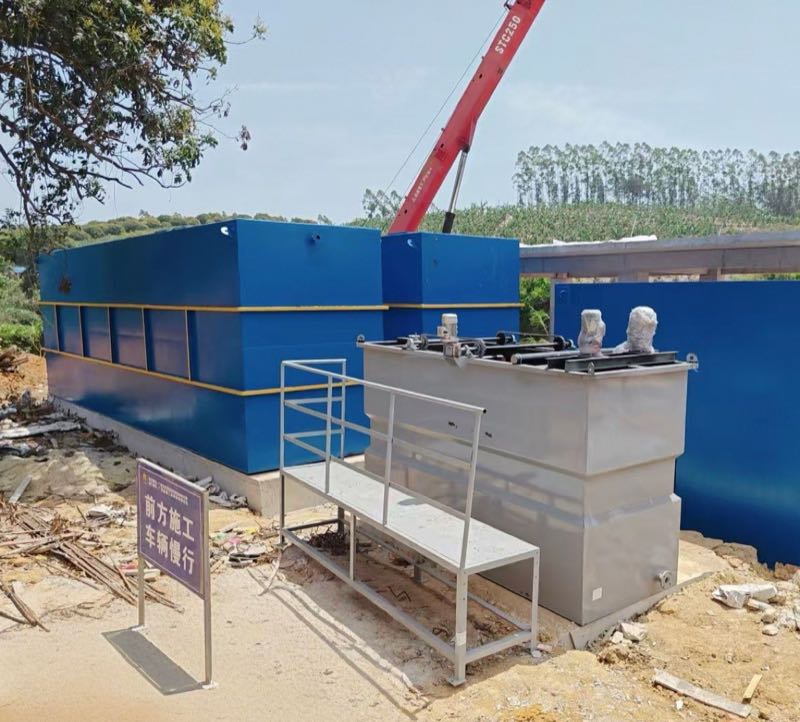
| 5 | Submerged MBR | PVDF 0.1–0.4 µm, flux 15–25 LMH | Solid–liquid separation; deliver low-SSD effluent using an integrated MBR membrane bioreactor with a DF series PVDF flat sheet membrane module |
| 6 | Ozonation or catalytic O₃ | 5–20 mg O₃/L, 10–30 min contact | Destroy residual APIs and ARG targets (Dai et al. 2014, Sep. Purif. Technol.) |
| 7 (optional) | RO | 75–85% recovery, 10–15 bar | Water reuse for CIP and cooling make-up (Košutić et al. 2007, Sep. Purif. Technol.) |
Mass-balance language an engineer can take to a P&ID: at 4,500 mg/L COD and 100 m³/d, the train must remove roughly 430 kg COD/d before the MBR; the UASB carries 60–75% (260–320 kg/d), the A/O another 50–60% of the residual, and ozone polishes 30–50% of the remaining COD. Daily biogas from the UASB at 0.35 m³ CH₄/kg COD removed is 90–110 m³/d — enough to fire a 50 kW thermal boiler for sludge drying.
Comparing Three Realistic Trains for a 100 m³/d Maputo API Plant
Three trains cover the cost-versus-reuse decision space. Train A is the legacy option many African generics plants inherited from India or China in the 2010s; it is cheap and grid-resilient but is not designed for ARG removal. Train B is the 2026 default for Mozambique, balancing UASB biogas economics with MBR polish and O₃ polishing. Train C is justified only when the plant is water-stressed or selling recovered water to a neighbouring facility. Hou et al. (2019) provide the direct evidence that Train B's combination removes both antibiotics and ARGs simultaneously; Trains A and C trade either cost (A) or reuse (C) for that combination.
| Criterion | Train A: Fenton + SBR + Cl₂ | Train B: Fe-C + UASB + MBR + O₃ (recommended) | Train C: Fenton + UASB + MBR + RO |
|---|---|---|---|
| CAPEX envelope (USD, 100 m³/d) | $0.4–0.7 M | $0.7–1.2 M | $1.0–1.6 M |
| Footprint (m²) | 350–500 | 250–400 | 320–480 |
| Power draw (kWh/d) | 30–55 | 45–80 | 90–140 |
| COD removal | 85–92% | 95–99% | 98–99.5% |
| ARG removal (log) | < 1 | 2–4 | 3–5 (with RO) |
| Water reuse fit | Poor | Limited (< 30% reuse) | Excellent (> 75% reuse) |
| Grid sensitivity | Low (robust to outages) | Moderate (UASB buffer) | High (RO is energy-intensive) |
| Best fit | Cost-driven retrofit | Default 2026 Mozambique | Water-stressed or export-oriented site |
MABR (membrane-aerated biofilm reactor) is worth flagging as a forward-looking option for the aerobic step where footprint is constrained and aeration energy is the dominant OPEX line — see the related MBR common problems and solutions guide for the operational trade-offs.
Sludge, Reuse, and Disinfection: Closing the Loop
Closing the mass balance means handling the solids and the permeate. Waste activated sludge yield from the MBR and SBR sidestreams runs 0.15–0.35 kg DS per kg COD removed, which at 4,500 mg/L COD and 95% removal gives 60–100 kg DS/d from a 100 m³/d plant. A plate and frame filter press dewaterings to 22–28% DS, dropping volume to 250–350 L/d of cake for off-site disposal. Mozambique classifies pharmaceutical sludge as hazardous under MMAIP guidance; secure landfill or high-temperature incineration is the realistic disposal path in 2026, with no pharmaceutical-sludge incinerator currently operating in-country — most plants ship cake to South African facilities. For final disinfection of the MBR permeate, an on-site chlorine dioxide generator sized for 2–5 mg/L ClO₂ residual hits both WHO and USEPA fecal-coliform targets without forming the trihalomethanes associated with chlorine at high organic load. Treated effluent at >90% recovery is suitable for landscape irrigation and cooling-tower make-up, which is the strongest economic case for Train C in water-stressed sites and the weakest case for Train A.
2026 CAPEX, OPEX, and Footprint Benchmarks for Mozambique
No public Mozambique-specific cost database for pharma ETPs exists in 2026, so the figures below are conservative envelopes built from comparable African installations, China export pricing, and a 12–18% contingency for import duties, port handling, and MZN/USD volatility. The procurement reader should treat these as a feasibility envelope, not a quote, and lock final numbers only after a site-specific engineering study.
| Item | Train A | Train B (recommended) | Train C |
|---|---|---|---|
| CAPEX (USD, 100 m³/d) | $0.4–0.7 M | $0.7–1.2 M | $1.0–1.6 M |
| Footprint (m²) | 350–500 | 250–400 | 320–480 |
| Power draw (kWh/d) | 30–55 | 45–80 | 90–140 |
| OPEX (USD/m³ treated) | $0.5–1.0 | $0.8–1.6 | $1.2–2.2 |
| Biagas / reuse offset | None | 30–45% (biogas-to-boiler) | 40–55% (biogas + water reuse) |
| Suggested CAPEX contingency | +12–18% | +12–18% | +15–20% |
Two additional notes for the finance reader. First, the import-duty line typically adds 7.5–15% on equipment landed at Maputo port, and the MZN has lost 8–12% against the USD in rolling 12-month windows through 2025–2026 — both belong in the contingency. Second, the industrial wastewater treatment equipment selection guide covers how to right-size the MBR module count and chemical dosing capacity against actual flow variability rather than nameplate flow, which is where most African ETP budgets slip at commissioning. For peer-region cost and process context, the pharmaceutical wastewater treatment in Ghana guide and the pharmaceutical wastewater treatment in Morocco guide offer useful benchmarks with similar regulatory framing.
Frequently Asked Questions
What is the typical COD of pharmaceutical wastewater in Mozambique?
COD for an API synthesis line in Mozambique typically sits at 1,500–8,000 mg/L; for formulation-only plants, 500–2,500 mg/L is the realistic band (Li et al. 2024, transferred from analogous tropical pharma plants).
Can UASB alone meet MFA discharge limits for a pharmaceutical plant?
No — a UASB at 30–37 °C with 24–48 h HRT achieves 60–85% COD removal and leaves 500–1,500 mg/L COD plus residual APIs, which is well above the 50–150 mg/L MFA effluent limits in Diploma Ministerial 93/2005.
Which technology best removes antibiotic resistance genes?
Combined UASB + anoxic/oxic + O₃ or O₃/H₂O₂ achieves 2–4 log ARG removal (Hou et al. 2019, Water Res. 162, 346–357); standalone chlorination typically delivers under 1 log on ARG targets.
Is MBR or SBR better for the aerobic step in Mozambique?
MBR is preferred when footprint is constrained and a stable low-SSD feed is needed for RO or ozone; SBR is cheaper, more tolerant of grid outages, and operationally simpler at small flows.
What permits are required to discharge pharma effluent in Mozambique?
An MFA industrial discharge permit (Licença de Descarga) is required for every plant, plus an MITADER/MMAIP environmental license for facilities above 100 m³/d or those handling substances listed in MMAIP hazardous-waste schedules.