Why Textile Effluent Is a 2026 Compliance Priority in Australia
Australia's textile sector carries the lowest recovery rate of any major waste category in the country (S3, ScienceDirect 2023), which means on-site treatment and reuse are no longer optional sustainability gestures — they are strategic infrastructure decisions for any mill planning a 2026 upgrade. Globally, the textile sector is among the top three water-demand industries after food and recreation/culture (per the European Environment Agency, cited in the PMC bibliometric review S2), and the World Bank estimates 17–20% of all industrial wastewater is generated during dyeing and finishing (Ding et al., cited in S2). For an Australian mill facing a 2026 specification, that translates into a plant water demand of 80–250 L per kg of finished fabric, much of which currently leaves the site as coloured effluent.
Australian discharge regulation is layered rather than single-instrument. The National Environment Protection Measure (NEPM) sets the framework for general wastewater quality, but textile-specific limits are enforced at the state level through NSW EPA's POEO Act, EPA Victoria's industrial guidelines, QLD DES, SA EPA, and WA DWER. There is no single national textile effluent standard, so each plant must map its discharge to its state regulator's licence conditions — typically expressed as COD, TSS, colour, salinity, temperature, and heavy-metal limits at the boundary. The textile sector also accounts for roughly 10% of global CO2 emissions (S3), which now feeds directly into Scope 3 ESG reporting demanded by Australian retailers such as the major supermarket apparel contracts. A 2026 Curtin University study (S1, Sci Rep, 02 Jun 2026, PMID 42230660) confirmed that Australian academic research is actively targeting real local textile effluent, signalling that regulators and procurement teams can no longer treat reuse as a future option.
Influent Characterization: What Is Actually in Australian Textile Effluent
A defensible influent profile is the starting point for any equipment specification, and Australian textile effluent sits at the high-strength end of the industrial spectrum. Typical concentration ranges drawn from the S2 and S4 reviews are: COD 800–3,000 mg/L, BOD 200–800 mg/L, TSS 200–1,500 mg/L, TDS 2,000–10,000 mg/L, colour 500–3,000 Pt-Co units, pH 6–11, and temperature 30–60°C. Hot discharge from dyehouse batches is the norm, and pH swings of 3–4 units between batches are common in plants without proper equalisation.
The dye chemistry matters as much as the bulk parameters. Per S4, 60–70% of textile dyes are azo-group compounds, and 15–20% of the total dye applied is lost to the effluent stream (Akpan and Hameed 2009; Ouasif et al., cited in S4). Beyond dyes, S2 lists the realistic contaminant load: acids and alkalis from scouring, bleaches from preparation, EDTA from metal-sequestering steps, surfactants (wetting agents and soaps), and trace heavy metals including Hg, As, and Pb. Dye classes behave differently in a treatment train: reactive dyes hydrolyse into permanently coloured by-products that resist biological oxidation; disperse dyes are partly particulate and respond to coagulation; acid dyes are highly soluble and exit conventional biology largely intact; vat dyes are insoluble and remove well with physical separation. The Curtin 2026 study (S1) deliberately used real textile wastewater rather than synthetic dye solutions, because the colour-and-COD matrix from a working mill behaves very differently from a single-component lab solution.
| Parameter | Typical range | Source |
|---|---|---|
| COD | 800–3,000 mg/L | S2, S4 |
| BOD | 200–800 mg/L | S2 |
| TSS | 200–1,500 mg/L | S2 |
| TDS | 2,000–10,000 mg/L | S2 |
| Colour | 500–3,000 Pt-Co | S4 |
| pH | 6–11 | S2, S4 |
| Temperature | 30–60 °C | S2 |
| Azo dye share | 60–70% of total dyes | S4 |
| Dye loss to effluent | 15–20% of applied | S4 |
| Key trace metals | Hg, As, Pb | S2 |
The 2026 Process Train: Stage-by-Stage Engineering for Australian Mills
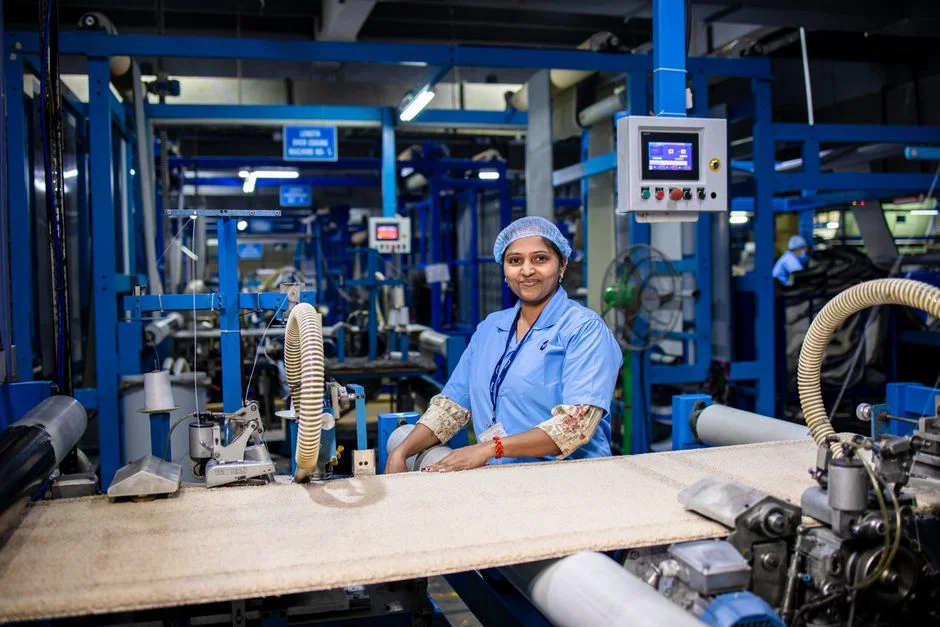
A 2026 Australian textile process train runs in six stages, each with a defined loading and discharge target.
- Screening. A rotary bar screen removes lint, fibres, plastics, and rags that foul downstream pumps and membranes. This is the cheapest insurance against unplanned membrane replacement.
- Flow and pH equalisation. Batch discharges from the dyehouse are balanced over 8–24 h HRT with chemical dosing for pH correction. Without equalisation, biology downstream cannot hold a stable population.
- DAF pre-treatment. Dissolved air flotation removes suspended solids, oils, and colloidal dye particles before biology. Lab-scale ceramic UF paired with DAF has shown 93% turbidity and 96% colour removal (S4); full-scale DAF typically removes 60–90% of suspended solids and a significant fraction of colloidal colour.
- Biological treatment. Activated sludge (A/O or A2/O) or, increasingly, MBR. Per Brik et al. (cited in S2), MBR can deliver above 87% dye removal, but the bibliometric review (S2) explicitly notes that MBR often needs NF post-treatment to match superior colour limits. A flat-sheet MBR footprint is roughly 60% smaller than conventional activated sludge at the same loading.
- Advanced oxidation / polishing. Ozone, Fenton, or adsorption-ozonation. The 2026 Curtin study (S1) demonstrated that activated Canna indica biochar combined with ozonation enhances COD and colour removal from real Australian textile effluent, following pseudo-second-order adsorption kinetics with chemisorption as the dominant mechanism.
- RO polishing for reuse. Per Marcucci et al. (cited in S2), RO achieves dye and salt recovery over 90%; Alardhi et al. (cited in S2) report above 97% dye removal with NF/RO. This is the stage that closes the loop to dyeing wash water or boiler feed.
Sludge handling is a parallel train: combined DAF float and waste-activated sludge are dewatered on a plate and frame filter press to roughly 22–28% dry solids, cutting disposal cost and volume.
| Stage | Equipment | Key performance |
|---|---|---|
| 1 Screening | Rotary bar screen | Removes fibres, plastics, rags |
| 2 Equalisation | EQ tank + dosing | HRT 8–24 h, pH 6–9 |
| 3 DAF | Dissolved air flotation | 60–90% TSS, colour cut |
| 4 Biology / MBR | A/O or MBR | >87% dye removal (S2) |
| 5 AOP / polishing | Ozone, Fenton, biochar-ozone | Enhanced COD + colour (S1) |
| 6 RO reuse | Industrial RO system | >90% dye + salt recovery (S2) |
| Sludge | Plate and frame filter press | 22–28% dry solids |
Matching Dye Chemistry to Treatment Technology
Investment decisions for a 2026 upgrade should be driven by the dominant dye class in the mill's effluent, because each class responds to a different unit operation. The matrix below maps the five major dye classes against the four main technology blocks. For mills running predominantly reactive dyes, the practical reality is that the hydrolysed colour is permanent; biological treatment alone will not meet state EPA colour limits, and either AOP (ozone, Fenton) or RO must be in the train. The data underlying this is the bibliometric finding that MBR achieves above 87% dye removal (Brik et al., S2) but typically requires NF post-treatment to reach tight colour limits.
For mills with a high disperse-dye load, DAF removes a meaningful fraction of the particulate colour, but NF or RO is still needed for full colour and salt recovery — Alardhi et al. (S2) report above 97% dye removal with these membranes. Acid dyes are the most soluble, so biological treatment plus AOP is the standard route, but the high salt load means RO energy consumption is a real OPEX line item. Azo dyes (60–70% of the market, S4) can be anaerobically cleaved at the azo bond, generating aromatic amines — a known toxicity issue that demands a post-aerobic polishing step. Vat dyes are highly insoluble and remove well with DAF or coagulation, but residual colour usually requires a polishing stage.
| Dye class | Coagulation / DAF | Biological / MBR | AOPs | NF / RO |
|---|---|---|---|---|
| Reactive | Poor (hydrolysed colour) | Limited | Effective | Effective |
| Disperse | Partial | Partial | Effective | Effective (salt recovery) |
| Acid | Poor | Partial | Effective | Effective (energy-intensive) |
| Azo (60–70% of market) | Partial | Effective (anaerobic + aerobic) | Effective | Effective |
| Vat | Effective | Partial | Polishing | Polishing |
Equipment Specifications for a 4–300 m³/h Australian Textile Plant
Translating the process train into a procurement-ready spec is straightforward when each unit operation is matched to a duty range. For pre-treatment, a dissolved air flotation system covers 4–300 m³/h across 13 models; the micro-bubble design with automatic skimming is the right choice for fibre-laden textile effluent. Small dyehouses or satellite streams that need a packaged biological step can use a WSZ underground A/O contact-oxidation unit at 1–80 m³/h, fully buried with no dedicated operator. The main biological stage is sized as an integrated MBR membrane bioreactor system at 10–2,000 m³/day, paired with a DF series PVDF flat sheet membrane module at 0.1–1 μm pore size — a configuration that delivers the above 87% dye removal reported by Brik et al. (S2) at roughly 60% of the conventional activated-sludge footprint. For reuse, an industrial RO system specified at 95% recovery suits both dyeing wash water and boiler feed. Sludge is handled on a plate and frame filter press at 1–500 m², and recycled-loop disinfection is covered by a chlorine dioxide generator from 50 g/h to 20,000 g/h, compliant with EU 98/83/EC drinking-water and WHO guidelines.
| Equipment | Capacity range | Notes |
|---|---|---|
| DAF | 4–300 m³/h | Micro-bubble, auto-skim, 13 models |
| WSZ underground STP | 1–80 m³/h | A/O contact oxidation, buried, unattended |
| Integrated MBR | 10–2,000 m³/day | PVDF 0.1–1 μm, >87% dye removal (S2) |
| DF flat-sheet module | Per skid | 60% smaller footprint vs CAS |
| Industrial RO | 95% recovery | >90% dye + salt recovery (S2) |
| Plate and frame filter press | 1–500 m² | 22–28% dry solids sludge cake |
| ClO₂ generator | 50 g/h – 20,000 g/h | EU 98/83/EC, WHO compliant |
2026 Australian Compliance, Reuse Targets, and CAPEX/OPEX Framing
The 2026 compliance picture is best read as state-by-state parameter limits benchmarked against the international CPCB reference values from S4 (COD 250 mg/L, TSS 100 mg/L, BOD 30 mg/L, colour 5 mg/L, TDS 2,000 mg/L). Australian state EPAs typically enforce these or tighter values, with additional constraints on temperature, salinity, and trace metals. For reuse, MBR + RO trains routinely achieve 60–80% reuse rates, which translates to a 30–50% reduction in fresh-water intake at a typical Australian metro plant (engineering estimate based on HydropureWater project data, 2026) — a defensible planning number for the finance conversation, though not a peer-reviewed figure.
Indicative CAPEX bands, presented as engineering judgement for planning purposes rather than study citations, are: small plant (≤50 m³/h) AUD 0.4–1.2M; mid plant (50–200 m³/h) AUD 1.2–4M; large plant (>200 m³/h) AUD 4M and above. OPEX is dominated by aeration energy, membrane replacement, and chemical dosing for coagulation and pH adjustment — the same energy levers covered in the SBR energy efficiency 2026 engineering guide for cutting aeration kWh. The ESG tie-in is direct: reuse plus sludge volume reduction supports Scope 3 reporting, and the circular-economy framing is consistent with the textile waste management findings in S3. For context on how the same drivers play out in other jurisdictions, see the textile wastewater treatment in Canada 2026 process guide; for the residential side of the Australian market, the residential wastewater treatment in Australia 2026 standards reference sets out the parallel framework.
| Parameter | CPCB benchmark (S4) | Typical Australian state EPA target |
|---|---|---|
| COD | 250 mg/L | ≤250 mg/L (state dependent) |
| BOD | 30 mg/L | ≤30 mg/L |
| TSS | 100 mg/L | ≤100 mg/L |
| Colour | 5 mg/L (Pt-Co) | ≤5 mg/L Pt-Co, often lower |
| TDS | 2,000 mg/L | Site-specific salinity cap |
| Reuse rate | — | 60–80% achievable with MBR + RO |
Frequently Asked Questions
What is the typical 2026 process train for an Australian textile mill?
A standard 2026 Australian textile train runs screening → flow and pH equalisation (HRT 8–24 h) → DAF pre-treatment (60–90% TSS removal) → biological treatment or MBR (above 87% dye removal per Brik et al., S2) → advanced oxidation or biochar-ozonation polishing (S1) → RO for reuse (above 90% dye and salt recovery per Marcucci et al., S2), with sludge dewatered on a plate and frame filter press.
Which Australian regulations govern textile effluent discharge in 2026?
There is no single national textile-specific limit. The NEPM provides the general framework, but enforceable limits sit with state regulators — NSW EPA under the POEO Act, EPA Victoria, QLD DES, SA EPA, and WA DWER — typically expressed as COD, BOD, TSS, colour, salinity, temperature, and heavy-metal caps in the site licence.
Can MBR alone meet Australian colour discharge limits?
Not reliably. MBR achieves above 87% dye removal (Brik et al., S2) but the bibliometric review (S2) explicitly notes that MBR often needs NF or RO post-treatment to meet strict colour limits, especially for hydrolysed reactive dyes. AOPs such as ozone or Fenton are commonly inserted between MBR and RO to protect the membranes and lift colour removal.
What reuse rate can a 2026 MBR + RO train realistically deliver?
Engineering experience on Australian metro plants points to 60–80% reuse rates, supporting a 30–50% reduction in fresh-water intake (engineering estimate, HydropureWater project data 2026). Actual rates depend on influent salinity, the share of reactive dyes, and how much RO permeate can be absorbed back into dyeing wash water or boiler feed.
Is adsorption-ozonation on biochar ready for full-scale textile plants in 2026?
No — the Curtin 2026 study (S1) is lab-scale and uses real textile effluent, but biochar production, contactor hydraulics, and ozone integration at 50–300 m³/h flows are not yet commercially proven for Australian mills. The work is best treated as a forward-looking R&D signal for polishing-stage intensification rather than a drop-in 2026 specification.