Why Peshawar Hospitals Need a Dedicated WWTP in 2026
Hospital wastewater in Peshawar typically carries 120–500 mg/L COD, ~150 mg/L TSS, and confirmed drug-resistant E. coli (University of Peshawar, 2025), and must be treated to PEPA NEQS limits before discharge. A 2026-compliant train for a 100–500 bed KPK hospital uses fine screening, equalization, MBR (PVDF, <1 µm), and ClO₂ or ozone disinfection, sized at ~250 L/patient/day (≈70–125 m³/day for 300 beds) with on-site sludge dewatering.
The case for a dedicated on-site plant in 2026 rests on three Peshawar-specific facts. First, a 2025 peer-reviewed study by the Centre of Biotechnology and Microbiology, University of Peshawar, and Abasyn University isolated highly drug-resistant Escherichia coli carrying multiple evolutionary resistance mutations from hospital wastewater at Peshawar (Mol Biotechnol, 2025-03). That evidence puts AMR squarely in the influent — not as a theoretical risk, but as a documented loading on the city's drainage network. Second, post-COVID wastewater-based surveillance for SARS-CoV-2 RNA in hospital sewers has made effluent disinfection a public-health monitoring question, not a regulatory checkbox (PMC review, 2020-11). Third, the major Peshawar teaching hospitals — LRH, KTH, HMC — generally discharge to municipal drains or soak pits without dedicated pre-treatment, so packaged on-site WWTPs are the practical 2026 path, not a sewer tie-in.
For design purposes, "hospital wastewater" in Peshawar covers four streams: blackwater from wards (high BOD, fecal coliforms), greywater from OTs, CSSDs and laundries (high TSS, surfactants), laboratory waste (pathogens, chemical residues), and trace cytotoxic drugs, iodinated contrast media, hormones, and quaternary ammonium disinfectants. Designing only for BOD/COD misses the AMR gene load, the iodine load on receiving drains, and the trace organics — all of which are now in the KPK EPA reviewer's scope.
Peshawar Hospital Influent & Effluent Numbers to Design Against
Hospital effluent in Peshawar typically runs 120–500 mg/L COD and 150–160 mg/L TSS, with BOD averaging ~200 mg/L across published Asia/Europe data, against a developing-country flow benchmark of 290 m³/hospital/day and 250 L/patient/day (PMC review, 2020-11). A 300-bed Peshawar teaching hospital therefore averages 75 m³/day at the bed-day rate, with a 1.5–2.0 peaking factor giving an instantaneous design flow of 110–150 m³/day. By contrast, a 1,120-bed Portuguese tertiary hospital discharges 1,000 m³/day — about 10× the Peshawar tertiary flow band (PMC review, 2020-11). Peshawar's hospitals sit firmly in the 50–200 m³/day design envelope, which is the band where packaged MBR plants are most competitive.
The effluent envelope used in 2026 KPK EPA reviews is the PEPA NEQS municipal sewer discharge schedule: BOD₅ ≤80 mg/L, COD ≤150 mg/L, TSS ≤200 mg/L, and fecal coliform ≤1,000 CFU/100 mL after disinfection. pH must land in 6.0–9.0 and residual chlorine in 0.5–1.0 mg/L where chlorination is the disinfection step. Antibiotic residues, iodinated contrast media, hormones, and the AMR gene load documented in Peshawar hospital wastewater (Mol Biotechnol, 2025-03) are not all individually regulated under NEQS, but KPK EPA reviewers increasingly require a disinfection step capable of ≥3-log reduction of resistant coliforms before consent.
| Parameter | Influent (design) | PEPA NEQS effluent target | 2026 design basis |
|---|---|---|---|
| COD | 120–500 mg/L | ≤150 mg/L | Design to 500 mg/L, target ≤100 mg/L post-MBR for reuse headroom |
| BOD₅ | ~200 mg/L | ≤80 mg/L | MBR typically delivers <10 mg/L |
| TSS | 150–160 mg/L | ≤200 mg/L (≤30 mg/L for reuse) | PVDF MBR delivers <1 mg/L |
| Fecal coliform | 10⁶–10⁸ CFU/100 mL | ≤1,000 CFU/100 mL | ClO₂ or ozone for ≥5-log kill |
| pH | 5.5–9.0 (variable) | 6.0–9.0 | Equalize to 6.5–7.5 pre-MBR |
| Flow, 300-bed Peshawar | 75 m³/day avg | — | 110–150 m³/day peak (1.5–2.0×) |
The 2026 Process Train: From Screening to Disinfected Effluent
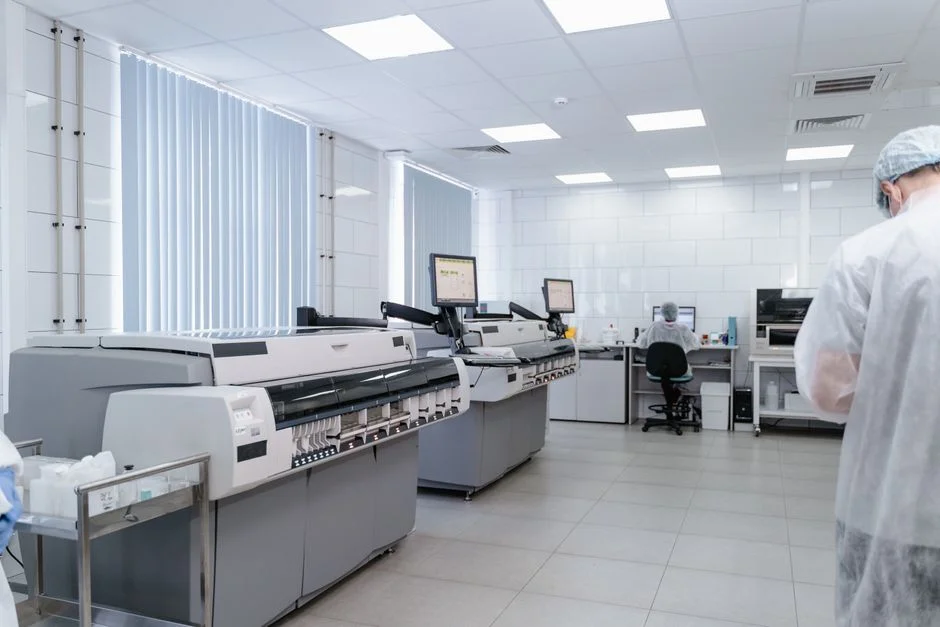
A defensible 2026 train for a Peshawar hospital is a five-stage sequence: fine screening → equalization → MBR → ClO₂/ozone disinfection → on-site sludge dewatering. Each stage has a specific sizing parameter, and the train is sized so that the disinfection step is the last barrier before discharge to the municipal drain.
Stage 1 — Fine screening. A rotary mechanical bar screen with 3–5 mm aperture protects downstream pumps and membranes from gauze, PPE, and plastic waste. For sites with manual handling only, a rotary mechanical bar screen sized to the hospital's peak flow drops labor cost and prevents ragging of the MBR pre-filters.
Stage 2 — Equalization. An 8–12 hour HRT buffer damps the diurnal peaks that characterize hospital flows (1.5–2.0× average). Inline pH correction to 6.5–7.5 protects the downstream biology and is sized for the design flow, not the average.
Stage 3 — Biological treatment — MBR. A skid-mounted MBR system for 30–200 m³/day Peshawar hospital plants with PVDF flat-sheet membranes, 0.1–0.4 µm pore size, MLSS 8,000–12,000 mg/L, and HRT 6–10 h typically achieves >95% COD removal at 10–2,000 m³/day per HydropureWater MBR catalog data. Against SBR and conventional A/O at the 50–150 m³/day scale, MBR wins on footprint (about 30–40% smaller than SBR), effluent quality for reuse, and sludge age control — SBR remains viable above 200 m³/day where civil works cost per m³ drops. For a parallel reference point on a smaller system, see this 30 m³/day hospital dialysis MBR design case.
Stage 4 — Disinfection. UV alone does not deliver the >3-log reduction of drug-resistant coliforms the KPK EPA reviewers expect given the Peshawar AMR evidence. On-site ClO₂ generation sized for hospital effluent (0.5–1.0 mg/L residual, 30 min contact) or ozone (99%+ kill) is the standard 2026 finishing step. ClO₂ is preferred where the effluent runs in a long KPK sewer line to the receiving drain, because residual survives the transit; ozone is preferred where reuse for landscaping or toilet flushing is planned.
Stage 5 — Sludge handling. Waste activated sludge is thickened in a lamella clarifier and dewatered to ≥22% dry solids via a plate-and-frame filter press for hospital sludge dewatering (1–500 m² plate area range, per HydropureWater catalog). Cake goes off-site to a KPK EPA-approved secure landfill or licensed incinerator. Hospitals cannot discharge liquid sludge to municipal drains under PEPA NEQS.
| Stage | Unit operation | Key parameter (2026 design) | Typical value |
|---|---|---|---|
| 1 | Fine screening | Aperture | 3–5 mm rotary bar screen |
| 2 | Equalization | HRT | 8–12 h, pH 6.5–7.5 |
| 3 | MBR (PVDF flat-sheet) | Pore / MLSS / HRT | 0.1–0.4 µm; 8,000–12,000 mg/L; 6–10 h |
| 4 | ClO₂ or ozone | Dose / contact | 0.5–1.0 mg/L ClO₂, 30 min; or ozone ≥99% kill |
| 5 | Sludge dewatering | Cake DS | ≥22% DS via plate-and-frame press |
Choosing the Right Equipment for a Peshawar Site
Equipment selection in 2026 follows flow band, operator skill, and reuse intent — not brand familiarity. For ≤30 m³/day clinics, dental hospitals, and diagnostic labs, a containerized ozone-based medical wastewater unit is the lowest-CAPEX plug-and-play option, with a 0.5 m² footprint, no chemical dosing, and an integrated ozone stage meeting 99%+ kill (catalog, 2026). For the 30–200 m³/day band — which covers most Peshawar teaching hospitals including LRH, KTH, and HMC at 50–125 m³/day — a skid-mounted MBR with DF-series flat-sheet membranes (0.1 µm, 80–225 m² modules producing 32–135 m³/day per rack) is the design sweet spot. Above 200 m³/day, civil-built SBR or A/O with a separate MBR cube and a dedicated chemical dosing skid (coagulant, pH adjuster) is more economic. Across all bands, pair the biological stage with an on-site ClO₂ generator (50–20,000 g/h) for residual disinfection that survives long KPK sewer runs. For a comparable West African case at similar flow, the parallel 2026 hospital WWTP guide for Dakar walks through the same selection logic. On OPEX specifically, the 2026 MABR OPEX and lifecycle cost reference gives membrane-replacement intervals and energy benchmarks that apply to flat-sheet MBRs at the same order of magnitude.
2026 Capital & Operating Cost Bands for KPK Hospitals

2026 cost bands in USD (convert at 1 USD ≈ 278 PKR, State Bank reference, 2026-01) for a Peshawar hospital turnkey plant, excluding building works and grid connection:
| Plant size | Typical application | CAPEX band (USD, 2026) | CAPEX band (PKR) | OPEX (USD/m³) |
|---|---|---|---|---|
| 5–10 m³/day | Clinic / dental / diagnostic lab | 18,000–35,000 | 5.0–9.7 million | 0.10–0.18 |
| ~50 m³/day | 100–150 bed Peshawar hospital | 80,000–150,000 | 22–42 million | 0.08–0.15 |
| 100–200 m³/day | 300–500 bed tertiary hospital with dewatering | 250,000–450,000 | 70–125 million | 0.07–0.12 |
OPEX is dominated by energy (aeration + permeate pumps), membrane cleaning chemicals (typically 1–2 CIP cycles per quarter), ClO₂ precursor cost, and membrane replacement every 7–10 years. Peshawar-specific cost drivers to budget for: a 15–25% CAPEX uplift for backup generator integration (grid reliability is the single biggest availability risk), perimeter security fencing (KP hospitals are tier-1 security sites), and structured operator training — most failures in 2024–2025 KPK hospital plants traced back to operator turnover, not equipment. Frame the spend as compliance insurance: a single KPK EPA non-conformance penalty or an AMR outbreak traced back to under-treated effluent will dwarf CAPEX over a 10-year horizon, and tender evaluators are increasingly weighing that risk in award decisions.
Frequently Asked Questions
What is the design flow for a 300-bed Peshawar hospital WWTP?
At 250 L/patient/day, a 300-bed hospital averages 75 m³/day; with a 1.5–2.0 peaking factor, the design peak is 110–150 m³/day. The MBR skid should be sized to the peak flow, with equalization providing the 8–12 h buffer (PMC review, 2020-11). For sizing in practice, a skid-mounted MBR with 80–225 m² of flat-sheet membrane area handles 32–135 m³/day per rack.
Does UV disinfection meet PEPA NEQS for hospital effluent in Peshawar?
UV alone is not the 2026 standard. PEPA NEQS requires ≤1,000 CFU/100 mL fecal coliform, and reviewers expect ≥3-log reduction of drug-resistant organisms after the 2025 Peshawar AMR evidence. Pair UV with ClO₂ (0.5–1.0 mg/L, 30 min contact) or use ozone for ≥99% kill, delivered via an on-site ClO₂ generator sized to the design flow.
Can a small Peshawar clinic use a containerized WWTP instead of civil works?
Yes. For ≤30 m³/day clinics and diagnostic labs, a containerized ozone-based medical wastewater unit meets PEPA NEQS in a 0.5 m² footprint with no chemical dosing and no civil works, and is the lowest-CAPEX 2026 path for sites that lack space or operator staff (catalog, 2026).
How often do MBR membranes need replacement in a KPK hospital plant?
PVDF flat-sheet membranes in a hospital MBR typically run 7–10 years before replacement, assuming 1–2 CIP cycles per quarter and feed TSS <160 mg/L protected by upstream screening. Lifecycle OPEX is dominated by energy and ClO₂ precursor cost, not membrane replacement; the 2026 OPEX benchmark is 0.08–0.15 USD/m³ for a 50–150 m³/day Peshawar hospital plant (HydropureWater field data, 2026).