What Makes Factory Shower Greywater Different from Domestic Greywater
Factory shower greywater is wastewater discharged from worker washrooms, locker rooms, and shift-change shower blocks — it is not process effluent and it is not blackwater. Its contaminant profile is distinct from domestic bathroom greywater in three ways that matter for equipment sizing. First, surfactant loading is higher because industrial hand soaps and degreasing soaps (commonly anionic surfactants in the 10–30 mg/L MBAS range) are used in addition to personal-care products. Second, lint and hair loadings are elevated because shower blocks serve dozens to hundreds of workers per shift, generating continuous fibrous solids. Third, intermittent soil and trace metals enter the stream when workers rinse PPE or soiled work clothing at the washroom — a loading pattern domestic bathroom greywater rarely sees.
Two further characteristics drive the process design. Pathogen load is low compared to blackwater (no fecal contribution in a well-managed shower block), which makes the stream well-suited to non-potable reuse rather than full sewage treatment. And the volume opportunity is large: shower greywater represents 50–89% of total domestic wastewater volume in buildings (MDPI 2025), and in a factory with 200+ workers on a single shift it is typically the single largest reusable stream on site. The trade-off is hydraulic pattern — sharp flow peaks at shift start and shift end concentrate surfactant and lint pulses into a 30–60 minute window, so equalization is not optional.
Reuse Quality Standards a Factory Must Hit for Toilet Flushing
Every equipment choice in a shower greywater reuse train should be traced back to a number in a published reuse standard. The two references that govern most factory projects in 2026 are the EPA 2012 Guidelines for Water Reuse and GB/T 18920-2020 (China). The Chinese standard is the one most procurement engineers in Asian factory projects will see on the specification sheet, and it sets tight secondary-treatment-equivalent limits: BOD ≤ 10 mg/L, TSS ≤ 10 mg/L, turbidity ≤ 5 NTU, plus fecal coliform and residual chlorine requirements. The EPA 2012 document covers the same parameter set for non-potable urban reuse, including toilet flushing, and is the reference for projects in the Americas, Middle East, and Africa.
The parameters that actually drive equipment selection are BOD, COD, TSS, turbidity, total coliforms / E. coli, residual chlorine, and surfactant (measured as MBAS). BOD and COD set the biological-stage sizing; TSS and turbidity set the membrane or media protection requirements downstream of the biological step; coliforms and residual chlorine set the disinfection dose; and MBAS sets the DAF pre-treatment target. A head-to-head pilot published in Springer (2019) confirmed that both MBR and BAF effluents met the toilet-flushing reuse standard, with terminal disinfection simulated at 5 mg/L NaClO dosed at 28 °C — the operating condition that the rest of this article treats as the design baseline.
| Parameter | EPA 2012 (toilet flushing) | GB/T 18920-2020 | Design driver |
|---|---|---|---|
| BOD | ≤ 10 mg/L | ≤ 10 mg/L | Biological stage sizing |
| TSS | ≤ 10 mg/L | ≤ 10 mg/L | Membrane/media protection |
| Turbidity | ≤ 5 NTU | ≤ 5 NTU | Disinfection effectiveness |
| Fecal coliform / E. coli | Non-detectable (per application) | ≤ 3 CFU/L (fecal coliform) | Disinfection dose |
| Residual chlorine | ≥ 0.2 mg/L (distribution) | ≥ 0.05 mg/L (≥ 30 min contact) | Disinfection contact time |
| MBAS (surfactant) | Site-specific | ≤ 0.5 mg/L | DAF performance target |
The Standard Process Train: Screening → DAF → Biological → Disinfection
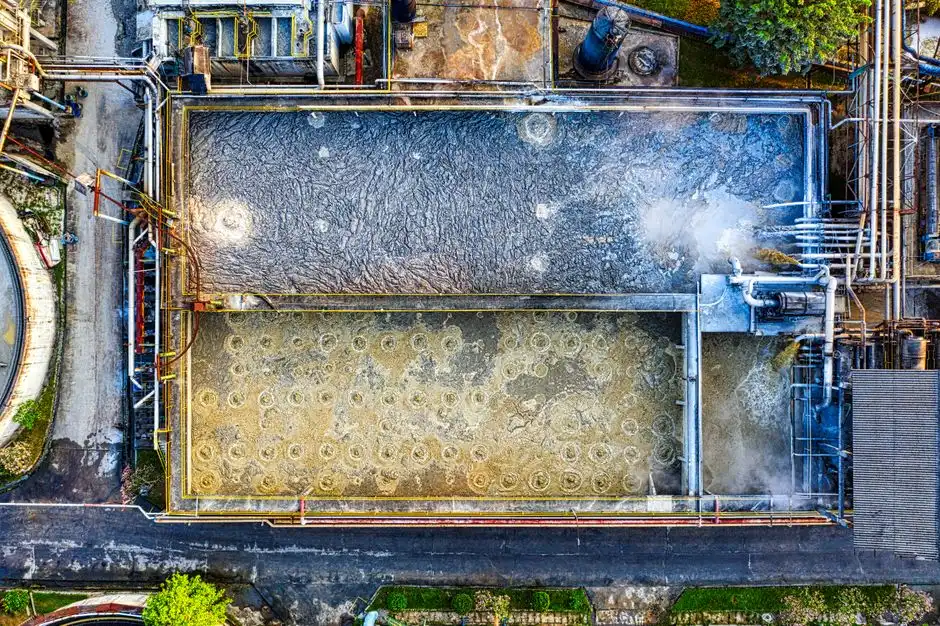
A factory shower greywater reuse system has six functional steps. Each one has a specific job, and skipping any of them is the most common cause of premature failure on real installations.
- Coarse screening. A rotary bar screen at the headworks removes hair, lint, and the larger fibrous solids that would otherwise blind downstream equipment. A continuous-duty headworks option sized for shift-peak flow is the standard first unit in the train.
- Equalization. A buffer tank sized for 4–8 hours of average flow flattens the shift-end peak so the biological stage sees a near-constant loading. Without it, BOD excursions at the end of every shift are guaranteed.
- DAF pre-treatment. Dissolved air flotation strips soaps, surfactants, oils, and floated solids. Micro-bubbles (typically 20–80 μm) attach to oil and surfactant particles and carry them to the surface for skimming. This is the step that protects every downstream membrane and BAF media bed from fouling, and it is the step most often wrongly skipped on the assumption that shower water "looks clean". A packaged DAF pre-treatment skid is normally specified as a standalone unit ahead of the biological stage.
- Biological treatment. MBR or BAF removes the dissolved organic load (COD, BOD) to single-digit mg/L. Both are validated for toilet-flushing reuse per the Springer (2019) pilot study.
- Disinfection. NaClO or ClO₂ dosing delivers the residual chlorine the reuse standard requires. A site that prefers on-site chlorine dioxide production — typically because the storage and handling of bulk hypochlorite is unattractive — will specify an on-site ClO₂ generator sized to the reuse flow.
- Reuse storage and distribution. A covered tank feeds the toilet flush lines through a dedicated purple pipe network with backflow prevention per local plumbing code.
The headworks rotary bar screen is normally selected on peak shift flow with a 2–3 mm aperture; apertures above 3 mm let too much lint through to the DAF and foul the skimmer.
MBR vs BAF vs MBR+RO: Choosing the Core Biological Step
Three documented process options exist for the biological step in a factory shower greywater reuse train, plus a fourth hybrid (BAF+UF) reported in the same Springer (2019) study. The choice is driven by site constraints — footprint, influent variability, and whether the reuse water has a single end use (toilet flushing) or multiple end uses (toilet flushing plus cooling or process water). MBR uses submerged PVDF membranes with a nominal pore size below 1 μm, delivers near-reuse-quality effluent directly, and runs at a mixed liquor suspended solids concentration of 8,000–12,000 mg/L — about 60% smaller footprint than conventional activated sludge for the same loading. A packaged submerged MBR system in the standard product range covers 10–2,000 m³/day, which brackets the typical 50–200 m³/day factory shower stream. BAF is a compact attached-growth biological stage — it costs less than MBR in membrane replacement and aeration energy, but the media bed is vulnerable to surfactant carry-over if the upstream DAF underperforms, and it produces a slightly higher effluent TSS that the disinfection step must still handle. MBR+RO adds a reverse osmosis polish to the MBR permeate, driving recovery to about 95% and pushing the reuse water into boiler-feed or cooling-tower makeup quality — relevant if the same skid is feeding more than one end use.
| Option | Effluent BOD | Effluent TSS | Footprint | Relative CapEx | Best fit |
|---|---|---|---|---|---|
| MBR | < 5 mg/L | < 5 mg/L | Compact (~60% of CAS) | Mid | Tight factory footprints, variable loading |
| BAF | < 10 mg/L | 10–20 mg/L | Moderate | Low | Larger flows, steady loading |
| MBR+RO | < 2 mg/L | < 1 mg/L | MBR + RO skid | High (~1.5–2× MBR) | Multi-end-use reuse, cooling/process |
| BAF+UF | < 5 mg/L | < 2 mg/L | Moderate | Mid | Existing BAF upgrade path |
Selection rule: pick MBR when footprint is constrained or influent surfactant loading varies; pick BAF when the site has space and the loading profile is steady; pick MBR+RO only when the same reuse water must feed cooling or process use in addition to toilet flushing — the energy and membrane cost of RO is not justified for a single end use. For a deeper side-by-side against extended-aerobic activated sludge, the MBR vs extended aeration comparison covers footprint and effluent trade-offs. For the RO step specifically — including pretreatment, recovery, and concentrate handling — see the cooling tower blowdown RO reuse reference. The MBR module itself (flat-sheet or hollow-fiber PVDF) is normally a separate line item from the skid, and the DF-series MBR module is the typical replacement-part specification for ongoing operation.
2026 Cost and Footprint Reality Check for a 50–200 m³/day Factory System
Indicative 2026 CapEx bands for a packaged factory shower greywater reuse train run as follows. A 50 m³/day MBR skid (screening + equalization + DAF + MBR + disinfection, skid-mounted) lands in the low six figures USD. A 200 m³/day packaged MBR STP — same process train, larger equalization and DAF, multiple MBR modules — lands in the mid-to-high six figures. Adding RO polish to a 200 m³/day train typically multiplies total CapEx by 1.5–2× because of the high-pressure pumps, RO vessels, and concentrate handling. OpEx is dominated by aeration energy (roughly 0.4–0.8 kWh/m³ treated for MBR), membrane cleaning chemicals (annual CIP cost around 5–10% of membrane replacement value), and the NaClO or ClO₂ dose. An on-site ClO₂ generator in the 50 g/h to 20,000 g/h capacity band covers everything from a small factory to a multi-building campus.
Payback framing for a management case: a 200-worker factory running two shifts typically displaces 30–40 L/worker/day of toilet-flushing demand, or 12–16 m³/day at full two-shift operation — call it 5,000 m³/year. At a local water tariff of USD 1.50–3.00/m³, that is USD 7,500–15,000/year in direct water-cost offset, not counting sewage discharge fees. On that basis, a packaged 200 m³/day MBR system pays back in 2–4 years depending on tariff and on whether the same reuse water feeds any cooling or landscape irrigation load. Where the available surface footprint is limited, a buried underground integrated sewage treatment package cuts the above-grade building cost and frees the surface for parking or landscaping — a common requirement on tight factory sites. The civil-works implications of that buried installation are covered in the containerized MBR STP civil works guide.
Common Design Mistakes and How to Avoid Them
Four mistakes account for the majority of factory greywater reuse commissioning failures. Mistake 1 — skipping DAF. Shower influent looks clean but the surfactant and oil load fouls MBR membranes and BAF media within weeks. Always include a DAF pre-treatment step ahead of the biological stage. Mistake 2 — undersized equalization. Shift-end peaks shock-load the biological stage and trigger BOD excursions. Size equalization for 4–8 hours of average flow, not 1–2 hours. Mistake 3 — NaClO dose without chlorine demand check. Soap and surfactant chlorine demand can push the required dose well above the 5 mg/L baseline reported in the Springer (2019) pilot. Bench-test the actual demand before specifying the dosing pump. Mistake 4 — ignoring cross-connection risk. Backflow preventers and purple-pipe labelling are mandatory in most jurisdictions for any non-potable reuse line. Skipping them is a code violation and a contamination liability.
Frequently Asked Questions
What is the standard process train for factory shower greywater reuse?
The standard train is coarse screening → equalization → dissolved air flotation (DAF) → biological treatment (MBR or BAF) → disinfection (typically 5 mg/L NaClO at 28 °C) → covered reuse storage. Both MBR and BAF effluents are documented to meet the toilet-flushing reuse standard in a head-to-head pilot (Springer 2019).
Why is DAF necessary before MBR or BAF on shower greywater?
Shower greywater carries anionic surfactants (10–30 mg/L MBAS), body oils, and lint. Without DAF, these carry over into the biological stage, foul PVDF membranes in MBR systems, and clog the media bed in BAF. DAF pre-treatment is what protects the downstream equipment and keeps the membrane replacement interval on schedule.
Does factory shower greywater meet EPA 2012 or GB/T 18920 reuse standards after MBR treatment?
Yes. MBR effluent typically lands below BOD 5 mg/L, TSS 5 mg/L, and turbidity 1 NTU, which meets both the EPA 2012 Guidelines for Water Reuse and GB/T 18920-2020 toilet-flushing limits when paired with NaClO or ClO₂ disinfection to deliver the required residual chlorine. The head-to-head Springer (2019) pilot confirmed MBR and BAF both met the reuse standard.
How much does a 50–200 m³/day factory shower greywater reuse system cost in 2026?
A 50 m³/day packaged MBR skid (screening + equalization + DAF + MBR + disinfection) sits in the low six figures USD; a 200 m³/day packaged MBR STP sits in the mid-to-high six figures; an MBR+RO train runs 1.5–2× the MBR-only price. OpEx is dominated by aeration energy at 0.4–0.8 kWh/m³ and membrane cleaning chemicals.
What is the payback period for a factory shower greywater reuse system?
A 200-worker two-shift factory displaces 30–40 L/worker/day, or roughly 5,000 m³/year of toilet-flushing demand. At a water tariff of USD 1.50–3.00/m³, that is USD 7,500–15,000/year in direct offset, giving a 2–4 year payback on a packaged MBR system before any sewage-discharge fee savings.
Which standard governs toilet-flushing reuse water quality in a factory?
Toilet-flushing reuse in a factory is governed by the EPA 2012 Guidelines for Water Reuse in the Americas, Middle East, and Africa, and by GB/T 18920-2020 in China. Both set limits of BOD ≤ 10 mg/L, TSS ≤ 10 mg/L, turbidity ≤ 5 NTU, and require residual chlorine in the distribution system to confirm ongoing disinfection.