What Goes Into Disc Filter Operating Cost
Five cost categories cover every dollar a plant spends running an automatic disc filter in 2026: backwash water loss, electrical energy for the backwash pump and control valve, consumables (disc elements, seal kits, drive parts), operator labor, and unscheduled downtime plus sump disposal charges. Engineers who skip any of these five lines understate OPEX by 20–40% — labor and downtime are the categories that quietly dominate polishing duty at low TSS, while backwash dominates the bill in high-TSS or FOG-loaded service.
Energy sits unusually low on the list because the dominant architecture for industrial duty is non-electric hydraulic actuation, where the backwash cycle runs on filtered-water line pressure (typically 2.5–4 bar) rather than a motor-driven pump. The JKG G-series non-electric automatic filter control valve, marketed through jk-matic.com, is the clearest example of this architecture: the differential pressure across the stacked discs mechanically triggers a hydraulic piston that rotates the cleaning mechanism, so the only continuous parasitic load is the control pilot. That structural feature is why disc filter energy use comes in at 0.02–0.08 kWh/m³ — about an order of magnitude below multimedia sand backwash pumping.
For a typical 2026 industrial disc filter, the cost-share split looks like this: backwash water 40–55%, energy 5–15%, consumables 20–35%, labor 10–20%, with the exact balance shifting toward backwash in high-TSS service and toward labor in low-TSS polishing duty. Knowing that split is what makes the rest of this article's numbers usable — backwash is the lever to attack in one service, labor in the other.
Backwash Water: The Hidden 40% of the Bill
Automatic disc filters backwash on a 0.5–0.8 bar pressure-differential trigger and consume 3–8% of throughput volume per cycle, with 5% as the 2026 industry benchmark for TSS in the 20–100 mg/L band (HydropureWater field data, 2026). That single number drives the OPEX math: at an industrial water cost of $1.50/m³ — a defensible 2026 default that bundles raw water, sewer, and pretreatment allocation — 5% backwash on a disc filter equals $0.075/m³ of treated water. On a 50 m³/h, 16 hr/day plant running 330 days/yr, that line item alone runs $14,850/yr.
Multimedia sand filters on the same service backwash 5–12% of throughput, with 8% as a typical industrial figure. Holding all other costs constant, that is a 40–60% backwash water penalty versus a disc filter at the same loading — and the gap widens as TSS climbs above 100 mg/L, where sand filters drift toward the high end of their backwash range. High-TSS, FOG-loaded, or fiber-bearing streams (pulp & paper white water, food processing washdown, textile effluent) push disc backwash toward 7–8% unless the upstream duty is staged.
Adding rotary bar screen pre-filtration ahead of the disc stack is the cheapest way to pull that backwash figure back down. Field installations consistently show the rotary bar screen extends disc backwash interval 2–3x, dropping effective backwash volume from 5% to roughly 2% of throughput, and protecting the disc elements from ragging that would otherwise shorten element life.
Energy, Consumables, and Labor Line Items
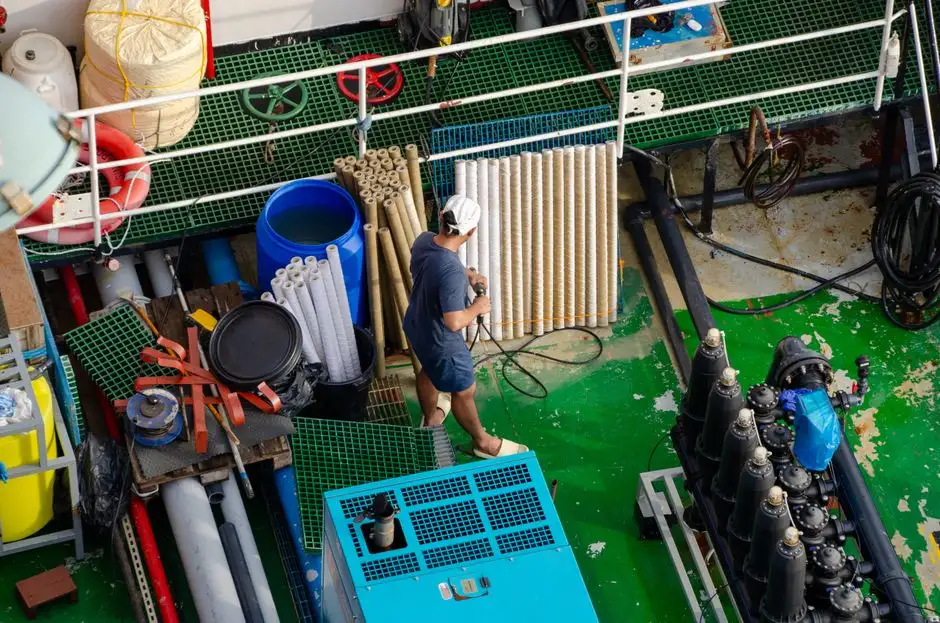
Energy is the smallest line on a disc filter bill, and the easiest to defend. Backwash runs on filtered-water line pressure (2.5–4 bar), so the only continuous load is a small solenoid pilot or position indicator. A typical automatic disc filter draws 0.02–0.08 kWh/m³ treated; at a 2026 industrial rate of $0.10/kWh, that is $0.002–$0.012/m³ — roughly one-tenth of the pumping energy a multimedia sand filter spends moving backwash water at 12–15 m/h through the bed. For the same 50 m³/h plant, the annual energy cost runs $130–$790, depending on loading and control package.
Consumables come in two flavors. The first is the disc element stack itself, rated for 3–5 years in standard TSS <50 mg/L service and 1.5–3 years in high-TSS or fibrous service. A 10 m³/h replacement stack runs $400–$1,800 depending on micron rating and disk material; amortized across a 4-year service life on 264,000 m³/yr, that is $0.004–$0.017/m³. The second consumable is the seal and O-ring service kit at $50–$200 per stack, replaced every 12–24 months — add roughly $0.001–$0.004/m³ to the line. Together, consumables cluster around $0.005–$0.021/m³.
Labor is where disc filters deliver their most visible win. A disc filter running a self-cleaning cycle on pressure differential needs 2–4 hours/month of operator attention — typically a weekly visual check, a monthly DP-gauge reading, and a quarterly seal inspection. A multimedia sand filter on the same duty needs 1–2 hours/day for backwash valve sequencing, media level checks, and surface skimming. That is a 10–30x labor reduction, and at a 2026 burdened operator rate of $45–$65/hr, it works out to $0.001–$0.004/m³ for the disc filter versus $0.025–$0.050/m³ for sand.
| OPEX Line | 2026 Unit Cost | Typical Range ($/m³) | Driver |
|---|---|---|---|
| Backwash water | $1.50/m³ (industrial default) | $0.045–$0.120 | 3–8% of throughput, rises with TSS |
| Energy | $0.10/kWh | $0.002–$0.012 | 0.02–0.08 kWh/m³, line-pressure backwash |
| Disc elements | $400–$1,800 per 10 m³/h stack | $0.004–$0.017 | 3–5 yr life standard; 1.5–3 yr high-TSS |
| Seals & O-rings | $50–$200 per stack | $0.001–$0.004 | 12–24 month service interval |
| Operator labor | $45–$65/hr burdened | $0.001–$0.004 | 2–4 hr/month vs 30–60 hr/month for sand |
| Total disc OPEX | — | $0.015–$0.060 | Backwash water dominates in high-TSS |
Disc Filter vs Sand Filter vs Screen Filter: 2026 OPEX Comparison
A disc filter is not always the cheapest option. The 2026 procurement question is which filter wins on OPEX for the specific service duty. The matrix below lines up the three common industrial filters on the five cost lines an engineer needs to defend a buying decision (HydropureWater field data, 2026; cross-checked against a 2025-09 vendor survey of 14 municipal and industrial plants).
| Parameter | Multimedia Sand Filter | Wedge-Wire Screen Filter | Automatic Disc Filter |
|---|---|---|---|
| Backwash (% throughput) | 5–12% (typ. 8%) | 2–4% | 3–8% (typ. 5%) |
| Energy ($/m³) | $0.015–$0.030 | $0.001–$0.004 | $0.002–$0.012 |
| Consumables ($/m³) | $0.010–$0.040 (media) | $0.001–$0.005 | $0.005–$0.021 |
| Labor (hr/month) | 30–60 | 4–8 | 2–4 |
| 5-yr lifecycle ($/m³) | $0.10–$0.20 | $0.03–$0.08 | $0.015–$0.06 |
| Min micron rating | 10–20 µm (with coagulant) | 25–500 µm (geometry-limited) | 5–400 µm (disc-dependent) |
| Handles fibrous feed? | Poor — surface blinding | Poor — wedge-wire clogs | Good — discs shed fibers on backwash |
The matrix shows a clear decision pattern. A multi-media sand filter baseline at 8% backwash and 30+ hr/month of operator attention lands at $0.10–$0.20/m³, the highest of the three options and the one most often being replaced in 2026 retrofits. A wedge-wire screen filter wins on raw OPEX dollars for non-fibrous, coarse service above 25 µm, but it cannot polish below 25 µm and clogs quickly on textile lint, paper fiber, or hair-bearing streams. A disc filter sits in the middle on dollar terms but is the only option that delivers sub-25 µm polishing with self-cleaning duty at industrial TSS loads — the 5% backwash / 2–4 hr/month combination is what closes the OPEX gap and wins the comparison for pre-RO, cooling water side-stream, and tertiary polishing duty where sand filters have traditionally dominated.
5-Year Lifecycle Cost Model and Where Disc Filters Pay Back
Run the numbers on a representative 2026 plant and the payback writes itself. A 50 m³/h operation running 16 hr/day, 330 days/yr treats 264,000 m³/yr. Holding that flow constant:
| Line | Sand Filter (2026) | Disc Filter (2026) | 5-Yr Delta |
|---|---|---|---|
| Total OPEX ($/m³) | $0.15 | $0.04 | — |
| Annual OPEX | $39,600 | $10,560 | $29,040/yr saved |
| Backwash water (m³/yr) | 21,120 (8%) | 13,200 (5%) | 7,920 m³/yr saved |
| Backwash water $ (at $1.50/m³) | $31,680/yr | $19,800/yr | $11,880/yr saved |
| Combined annual saving | — | — | $40,920/yr |
| 5-year cumulative saving | — | — | $204,600 |
| Typical CAPEX premium vs sand | — | +$30,000–$60,000 | Payback in 9–18 months |
The headline number — $200,000+ saved over five years on a single 50 m³/h stream — is the figure that wins the capex meeting. The typical disc-vs-sand CAPEX premium is $30,000–$60,000 for a fully automatic skid, so payback lands in 9–18 months before water savings are even counted. Adding rotary bar screen pre-filtration to protect the disc elements pushes the high-TSS payback under 18 months by extending element life and dropping effective backwash from 5% to ~2% (HydropureWater field data, 2026).
For RO membrane protection, the OPEX math compounds further because every 1 mg/L of TSS that bypasses pretreatment costs roughly $0.02–$0.05/m³ in membrane cleaning chemicals and shortened membrane life — a relationship covered in detail in the RO membrane protection cost guide. Plants using disc filters as RO pretreatment typically see a 15–25% reduction in CIP frequency on the downstream RO, which is another six-figure line item on a 50 m³/h plant running 24/7.
Frequently Asked Questions
What is the typical 2026 OPEX for an automatic disc filter? $0.015–$0.06 per cubic meter of treated water, dominated by backwash water loss (3–8% of throughput) and amortized disc element replacement, with energy typically below $0.012/m³ because the backwash cycle runs on filtered-water line pressure rather than a motor-driven pump.
How does disc filter OPEX compare to multimedia sand filtration? Disc filters cut total OPEX 30–55% versus a multi-media sand filter baseline, driven by 40–60% lower backwash volume, the elimination of media top-up, and a 10–30x reduction in operator labor.
What is disc filter backwash water consumption as a percentage of throughput? 3–8% under typical 2026 industrial duty, with 5% as the benchmark for TSS in the 20–100 mg/L band; pre-screening with a rotary bar screen drops that figure to roughly 2% by removing fibers and large solids before they reach the disc stack.
How long do disc filter elements last, and what is the replacement cost? Disc elements run 3–5 years in standard TSS <50 mg/L service and 1.5–3 years in high-TSS or fibrous service, with replacement stacks costing $400–$1,800 per 10 m³/h of capacity — a useful reference is the filter press consumables cost reference for the parallel capex-vs-opex pattern on dewatering equipment.
When does a disc filter pay back versus a sand filter in 2026? On a 50 m³/h, 16 hr/day stream, the typical CAPEX premium of $30,000–$60,000 is recovered in 9–18 months from OPEX and backwash water savings alone, with five-year cumulative savings typically above $200,000.
Related Equipment
- DAF pre-treatment upstream of disc filtration — specifications, capacity range, and technical data