
What a SCADA System Does in a Municipal Wastewater Plant
A SCADA system for a municipal wastewater plant is a four-tier control architecture — field instruments, PLCs, industrial network, and supervisory server with HMI — that monitors and automates headworks, aeration, clarification, disinfection, and solids handling in real time. In 2026, municipal specs must comply with IEC 62443-3-3 SL-2, ISA-101.01 HMI graphics, and America's Water Infrastructure Act Section 2013 risk assessments for OT cybersecurity.
SCADA sits above PLCs and RTUs and below the enterprise/MES layer, which is the distinction that separates it from a DCS (process-controller-heavy, vendor-locked) and a BMS (building-only) or IoT platform (cloud-native, non-deterministic). In the water sector, SCADA owns supervisory visibility for unit processes from headworks screening through effluent outfall monitoring, including primary clarification, activated-sludge aeration with dissolved-oxygen control, secondary clarification, UV or chlorine disinfection, sludge thickening and dewatering, lift stations, and reuse pumping.
The four functional layers map directly onto the ISA-95 / Purdue Reference Model levels 0-3: (0) field instrumentation, (1) control (PLC/RTU), (2) communication network, (3) supervisory (SCADA server, HMI, historian). Above level 3 sits the operations management plane where the historian feeds reporting, asset management, and digital-twin models. The scale anchor for this article is the 400 MGD Houston NEWPP expansion — a $1.4 billion CAPEX project covering 90 acres with twin 108-inch water mains (VTScada case study, 2024-2025), demonstrating the magnitude of SCADA scope at large municipal plants. Screening and primary treatment rely on equipment like the rotary mechanical bar screen used in headworks pretreatment and the MBR integrated treatment skid, both of which require PLC supervisory integration for continuous monitoring.
Reference Architecture: Field, Control, Network, and Supervisory Layers
At Level 0, the field instrumentation stack typically includes pH/DO/turbidity analyzers in aeration basins and effluent, magnetic flow meters on influent and effluent lines, level transducers in clarifiers and digesters, pressure transmitters on RAS and WAS lines, and VFDs driving blowers and pumps. Sizing detail for the magnetic flow meters — including liner/electrode selection for raw sewage — is covered in the electromagnetic flow meter sizing guide.
Level 1 control hardware centers on redundant PLCs with hot-standby CPUs — Allen-Bradley ControlLogix, Siemens S7-1500, or Schneider M580 are the three dominant platforms in 2026 U.S. municipal bids. Each PLC has a local I/O rack sized per the process unit, and remote lift stations are typically served by dedicated RTUs (Allen-Bradley MicroLogix, Schneider SCADAPack, or Siemens SIMATIC RTU3030C) with cellular or licensed-radio backhaul.
Level 2 networking uses segmented industrial Ethernet on managed Layer-2/3 switches, with EtherNet/IP, PROFINET, or Modbus TCP as the dominant fieldbus choices — OPC UA is the 2026 preferred integration standard for new builds, particularly where PLC-to-PLC and PLC-to-historian traffic must traverse a Purdue Level 3.5 DMZ. VLAN separation between OT and corporate IT is now treated as a baseline IEC 62443-3-3 SL-2 control, not an option. Lift stations beyond the plant's Ethernet reach use cellular 4G/5G or 900 MHz licensed radio, with sub-second edge RTU logic that runs independently of WAN availability.
Level 3 supervisory hardware is a redundant SCADA server pair (primary + hot-standby) running the HMI/SCADA software, an industrial historian (OSIsoft PI, AVEVA Historian, or open-source InfluxDB + Grafana for budget-constrained plants), HMI workstations in the control room, and a web client for off-site operators. Alarms are managed per ISA-18.2 lifecycle methodology, and the alarm-philosophy document is a binding deliverable, not a footnote.
I/O Count and PLC Sizing by Plant Capacity
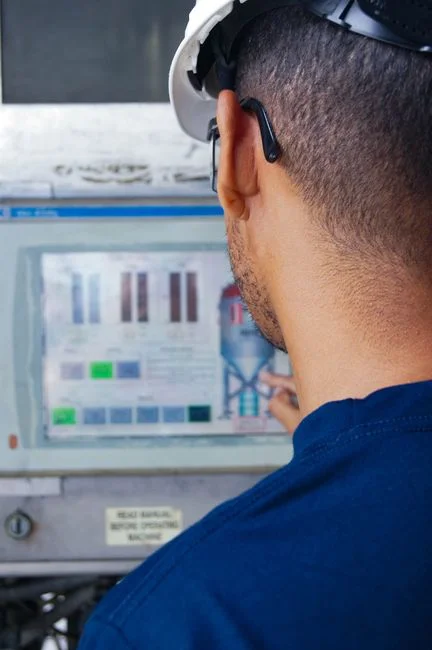
Procurement almost always asks for an I/O budget before they approve a SCADA line item. The table below gives a defensible parametric range based on standard municipal WWTP designs and recent bid documents.
| Plant Capacity (MGD) | Total I/O Points | PLC Count | Typical Architecture |
|---|---|---|---|
| 1 | 400-600 | 2-3 | Single SCADA server, hot-standby PLC pair on headworks/aeration |
| 5 | 1,200-1,600 | 4-6 | Single SCADA server pair, dedicated PLCs per process train |
| 10 | 1,800-2,400 | 6-10 | SCADA server pair, separate PLCs for headworks, primary, aeration, disinfection, solids |
| 25 | 3,200-4,500 | 10-15 | Multi-rack PLCs, redundant SCADA server pair, dedicated lift-station RTU network |
| 50 | 5,000-8,000 | 15-25 | Multi-server SCADA, separate train controllers, plant-wide historian |
| 100+ | 10,000+ | 25-40 | Multi-server SCADA, separate train controllers, plant-wide historian, redundant control room |
The I/O mix on a typical municipal plant is roughly 40% analog inputs (sensor feedback), 35% digital inputs (pump/valve status, level switches), 10% analog outputs (VFD speed reference, dosing setpoints), and 15% digital outputs (pump start, valve open/close commands). Headworks and primary treatment are I/O-dense per MGD because of high mechanical equipment counts; secondary aeration and disinfection scale sub-linearly because DO probes and UV banks are shared across basin volume. The practical rule: a 10x capacity increase produces roughly 4-5x the I/O, not 10x. Always allocate 20-25% spare I/O per rack for future expansion and for the cybersecurity isolation switches required by IEC 62443 zone-and-conduit modeling.
Cybersecurity and Compliance in 2026: IEC 62443, NIST CSF 2.0, AWIA Section 2013
AWIA Section 2013 requires every U.S. community water system serving more than 3,300 persons to conduct a risk and resilience assessment of its SCADA/OT environment and to maintain an emergency response plan, with re-certification every five years. Since the original 2018-2020 deadline, EPA enforcement actions in 2024-2025 have shifted Section 2013 from a paperwork exercise to a deliverable that procurement must fund with capital budget — and that auditors can (and have) cited when plants fail (EPA enforcement records, 2025).
IEC 62443-3-3 Security Level 2 (SL-2) is the de-facto municipal baseline. SL-2 — "casual / coincidental" adversary resistance — covers the seven foundational requirements: identification and authentication (SR 1.x), use control (SR 2.x), system integrity (SR 3.x), data confidentiality (SR 4.x), restricted data flow (SR 5.x), timely response to events (SR 6.x), and resource availability (SR 7.x). At the network layer this translates to Purdue Level 3-3.5 DMZ architecture, jump hosts for vendor remote access, MFA on HMI login, role-based access aligned to ISA-99 zone-conduit modeling, encrypted historian backups, and USB port disablement on engineering workstations.
NIST CSF 2.0 (released February 2024) added the Govern function, giving OT environments a risk-management framework that maps cleanly to AWIA Section 2013 deliverables. CISA's water-sector cross-sector industrial control system guidance (updated 2024) reinforces this alignment. State-level mandates have also tightened the procurement environment — New Jersey and Connecticut now require designated OT cybersecurity officers at WWTPs serving populations above defined thresholds, and Texas SB 2610 (passed 2025) imposes similar requirements on systems serving >100,000 persons. In practice, plants that wrote SCADA specs in 2024 are rewriting them in 2026 to add cybersecurity as a first-class line item rather than a percentage add-on.
KPIs, Alarm Management, and HMI Standards (ISA-18.2 and ISA-101.01)
Every SCADA acceptance test plan should define the seven municipal KPIs: effluent BOD/COD/TSS compliance against the NPDES permit, energy consumption in kWh per m³ treated, MLSS concentration and SRT in aeration basins, blower airflow versus DO setpoint, RAS flow rate, digester gas production, and on-spec disinfection residual (chlorine residual or UV transmittance). The relationship between DO setpoint and aeration energy is quantified in the aeration energy optimization with DO control guide — typically 0.2-0.5 mg/L of setpoint error translates to 5-10% of plant energy cost.
Alarm management follows ISA-18.2 and EEMUA 191 targets: fewer than 5 nuisance alarms per operator per shift, fewer than 300 alarms per day per 1,000 I/O, mean time to acknowledge under 5 minutes, and mean time to resolve under 30 minutes. The alarm-philosophy document — including priority classification, shelving rules, and rationalization methodology — is a contractual deliverable, not an appendix. Operators should be able to point to a priority distribution where at least 80% of alarms are Priority 3 (informational) and fewer than 5% are Priority 1 (immediate action).
HMI graphics follow ISA-101.01 high-performance HMI conventions: a Level 1 plant overview, Level 2 unit-process displays, and Level 3 detail drill-downs. Color semantics are fixed across all screens — red for alarm, yellow for warning, green for running, gray for stopped, blue for selected. Trend overlays on every process display should provide a minimum of 1-hour and 24-hour windows with operator-selectable ranges. ISA-101.01 compliance is increasingly written into 2026 municipal bid documents, particularly where plant operators have already been trained on the standard.
2026 CAPEX and OPEX Benchmarks for SCADA on a Municipal WWTP
The all-inclusive CAPEX range below covers servers, software licenses, PLC hardware, panel build, factory acceptance testing, site acceptance testing, and commissioning. The numbers reflect 2026 bid tabs and engineering estimates from publicly funded U.S. municipal projects.
| Plant Capacity (MGD) | CAPEX Range (2026 USD) | Notes |
|---|---|---|
| 1 | $250K-$500K | Single SCADA server, 2-3 PLCs, panel build included |
| 5 | $800K-$1.5M | SCADA server pair, 4-6 PLCs, dedicated lift-station RTUs |
| 10 | $1.5M-$3M | Full redundant server pair, 6-10 PLCs, plant-wide historian |
| 25 | $3M-$6M | Multi-rack PLCs, separate train controllers, lift-station network |
| 50 | $5M-$10M | Multi-server SCADA, plant-wide historian, redundant control room |
| 100 | $10M-$20M | Multi-server SCADA, 10,000+ I/O, full digital-twin integration |
OPEX runs at 8-15% of CAPEX per year for software subscription or support, 3-5% per year for hardware support, $20K-$80K per year for cybersecurity monitoring (SIEM, vulnerability scanning, OT-specific MDR), and $50-$200 per site per month for cellular backhaul to remote lift stations. The 2026 industry trend is a shift from perpetual license plus support contracts to subscription and SaaS pricing — AVEVA, Ignition, and Rockwell have all moved to subscription tiers. Subscription lowers entry CAPEX by 20-30% but raises 10-year TCO by 10-15% unless the contract is carefully modeled. Open-architecture SCADA on commodity hardware delivers 30-40% lower 20-year TCO than a proprietary DCS stack, with the trade-off being higher integration engineering effort during the first 18-24 months of operation.
Architecture Choices: Proprietary DCS vs. Open SCADA vs. Hybrid Cloud-Edge
The decision framework below maps three architecture options against the criteria a municipal procurement evaluation typically scores.
| Criterion | Proprietary DCS | Open-Architecture SCADA | Hybrid Cloud-Edge |
|---|---|---|---|
| Integration risk | Low (single vendor) | Medium-High (multi-vendor PLCs) | Medium (cloud + on-prem integration) |
| 20-yr TCO (baseline = 100) | 130-140 | 90-95 | 95-105 |
| OT-IT convergence | Limited | Strong | Strongest |
| Cybersecurity posture | Vendor-managed | Customer-managed (requires skilled staff) | Shared (cloud + on-prem) |
| Time to first-value | 18-24 months | 12-18 months | 15-20 months |
| Lift-station edge support | Vendor-specific | Multi-vendor | Native |
Option A — Proprietary DCS (Honeywell, Emerson, ABB) — fits plants that are extending an existing 10+ year-old DCS install with proven spares inventory and trained operations staff. Option B — Open-architecture SCADA (Ignition by Inductive Automation, VTScada, WinCC) — is the strongest fit for new municipal builds above 5 MGD where the procurement team values IT/OT convergence and lower 20-year TCO. Option C — Hybrid cloud-edge — places the SCADA server on-prem while running the historian and analytics layer in AWS or Azure, with lift-station RTUs performing sub-second edge logic independently of WAN availability. This is the architecture gaining ground in 2025-2026 procurements, particularly for utilities consolidating multiple lift stations and smaller plants under a single operations center. The digital twin for wastewater plant guide covers how cloud historian data feeds simulation models used for operator training and process optimization.
Frequently Asked Questions
What protocols does SCADA use in wastewater plants? The dominant 2026 protocols are Modbus TCP, EtherNet/IP, PROFINET, and DNP3 (particularly at lift-station RTUs talking to utility SCADA masters). OPC UA is now the preferred integration standard for new builds because it carries semantic metadata and works cleanly across the Purdue Level 3.5 DMZ.
How long does a SCADA upgrade take? For a 10 MGD plant, budget 9-18 months end-to-end: 3 months for design and specification, 3-6 months for procurement and factory acceptance testing, 2-4 months for installation and cutover, and 1-2 months for site acceptance testing and operator training. Plants above 50 MGD typically run 18-30 months, with phased cutover to keep the existing plant running.
Can SCADA work with cloud? Yes. The standard 2026 pattern is on-prem SCADA with historian-to-cloud sync (typically 1-5 second latency) and cellular backhaul at remote lift stations. Real-time control stays on-prem or in edge RTUs; the cloud layer handles analytics, dashboards, and long-term archiving. Sub-second response is preserved by keeping the control loop out of the cloud.
What cybersecurity standard applies? For OT, IEC 62443-3-3 SL-2 is the technical baseline. For governance, NIST CSF 2.0 (with the 2024 Govern function) maps to the AWIA Section 2013 risk and resilience assessment. AWIA Section 2013 itself is the regulatory driver for U.S. community water systems serving more than 3,300 persons.
How much does a wastewater SCADA system cost in 2026? All-inclusive CAPEX runs $250K-$500K for a 1 MGD plant, $1.5M-$3M for 10 MGD, and $10M-$20M for 100 MGD. The 30-40% TCO advantage of open-architecture SCADA over proprietary DCS compounds over the 20-year asset life, but requires skilled integration during the first two years.
Related Equipment
- fully automated buried treatment package — specifications, capacity range, and technical data
- PLC-controlled chemical injection skid — specifications, capacity range, and technical data
- PLC-controlled sludge dewatering press — specifications, capacity range, and technical data