Commercial Laundry Wastewater Phosphorus Removal Process: 2026 Engineering Guide
Commercial laundry wastewater phosphorus removal typically relies on chemical precipitation with alum (Al2(SO4)3) or PAC at pH 5.5–6.5, achieving 85–95% TP removal down to 0.5–2 mg/L in effluent. Biological phosphorus removal (EBPR) is viable when loadings exceed 100 m³/day, and constructed wetlands can reach 95–99% removal but require 5+ day HRT. A hybrid chemical-then-biological train is the most footprint-efficient 2026 solution for hotel and hospital laundries.
Why Commercial Laundry Phosphorus Is Harder Than Municipal
Laundry influent TP routinely runs 5–40 mg/L, driven by phosphate builders (sodium tripolyphosphate), fabric softener quats, and enzymatic detergent carriers — compared with 3–8 mg/L for a typical municipal works (source: HydropureWater field data, 2026). That 3–10× loading alone disqualifies textbook municipal dose curves. Add pH 9–11 from alkali detergent carryover and 50–70°C wash water, and you have moved orthophosphate chemistry into a regime where alum is operating well above its 5.5–6.5 optimum. A laundry plant hitting BOD and TSS can still miss a 1 mg/L TP limit by 5× because of these matrix effects alone.
Surfactant interference is the second failure mode. Linear alkylbenzene sulfonate (LAS) above 50 mg/L complexes orthophosphate and reduces chemical precipitation efficiency by 15–25% at stoichiometric dose. Most wash cycles exceed that threshold before any equalization, so a DAF upstream only partially frees the phosphate for the downstream precipitant. The 1996 Galarneau & Gehr work showed the active removal product is a mixed Al(OH)3·PO4 precipitate, not stoichiometric AlPO4 — meaning a 1:1 Al:P molar ratio (the textbook dose) under-doses real laundry wastewater by 30–50%. Treat laundry TP as a hydroxide-co-precipitation problem, not a salt-formation problem, and your dose calculator finally matches jar tests.
Chemical Precipitation: The 2026 Workhorse

Alum (Al2(SO4)3·14H2O) dosed at a 1.5:1 Al:P molar ratio delivers 85–95% TP removal from laundry effluent with 2–5 mg/L residual P, per Galarneau & Gehr (1996) mixed-precipitate kinetics re-validated on laundry matrices in 2024–2025 pilot work. PAC (polyaluminum chloride) is the 2026 retrofit default: 30–50% lower sludge volume, a wider working pH band of 5.0–7.5, and roughly 2× faster floc formation that holds up in 50–60°C water. For a 30 mg/L TP influent, the 2026 chemical cost is alum at $0.08–0.12 per m³ treated versus PAC at $0.12–0.18 per m³ — the PAC premium pays back in lower sludge hauling.
pH correction is non-negotiable. Sulfuric acid dosing to bring pH from 9–11 to 6.0 ± 0.3 runs $0.02–0.05/m³ of acid; an automatic coagulant and pH-correction dosing skid with online ORP/pH trim keeps residual P within ±0.3 mg/L of setpoint. For solids separation, a DAF system for alum floc and surfactant separation outperforms lamella plates by 20–30% in this service because hot, low-density floc floats better than it settles. Sludge yield is 4–7 kg dry solids per kg P removed — drive the downstream dewatering spec from peak P load, not daily average, and size the filter press for at least 1.3× the stoichiometric chemical feed.
Enhanced Biological Phosphorus Removal in Laundry Service
EBPR works through polyphosphate-accumulating organisms (PAOs) in alternating anaerobic/aerobic zones, where luxury uptake under aerobic conditions pulls orthophosphate into the biomass at 3–5× normal cell quotas. The hard rule for stable EBPR is a BOD:TP ratio of at least 20:1. Raw laundry effluent typically clears this, but if upstream biological polishing is used to drop LAS below the 50 mg/L inhibition threshold, residual BOD can fall to a COD:TP ratio below 15:1 and starve the PAOs.
Surfactant toxicity is the deal-breaker that academic papers understate. LAS above 50 mg/L inhibits PAO metabolism within 2–3 HRT cycles, so EBPR must sit after biological COD/LAS polishing, not before. Once positioned correctly, EBPR removes 80–92% TP with 60% less sludge than chemical-only trains and the wasted sludge carries recoverable struvite (MgNH4PO4) potential — relevant given the 6.1% CAGR nutrient-recovery market (see the 2026 nutrient recovery market outlook). For polishing below 0.5 mg/L, the Liu et al. magnetic MFC@La(OH)3 sorbent (45.45 mg P/g adsorption capacity at 30°C) is the emerging 2025–2026 hybrid worth piloting. EBPR footprint runs 1.5–2× larger than a chemical-only train but eliminates acid dosing and most chemical OPEX.
Constructed Wetlands and Nature-Based Alternatives

The Surabaya Equisetum hymale study remains the most directly applicable data point for laundry TP: 95.49–99.43% PO4-P removal at 1–5 day HRT in gravel-sand-soil media, with second-order kinetics (R² = 0.9999). Phosphorus distributes 14.80% into soil media and 9.23% into plant tissue — so the system is a long-term accumulator, not a true recycler, and media replacement at 5–7 year intervals must be budgeted into lifecycle cost.
Land requirement is the binding constraint: roughly 5–10 m² per m³/day for 95%+ removal. That works for a resort laundry with surplus grounds; it is a non-starter for a 200-room urban hotel. Climate is the second filter — performance drops 30–50% below 10°C, which excludes most of Northern Europe, Northern China, and Canadian sites for winter operation. Position wetlands as a polishing step after chemical precipitation, not a primary: LAS above 50 mg/L kills Equisetum, so surfactant reduction must happen upstream or the wetland becomes a die-off basin within one season.
Process Comparison: Selecting the Right Train for Your Site
For a defensible 2026 specification, run the four viable trains against the same nine parameters. The table below consolidates the dose, footprint, and cost data from the preceding sections into a single artifact you can take into a design review or vendor meeting.
| Parameter | Chemical (Alum/PAC) + DAF | EBPR (standalone) | Constructed Wetland | Hybrid (Chemical + MBR) |
|---|---|---|---|---|
| TP removal efficiency | 85–95% | 80–92% | 95–99% | 95–99% |
| Effluent TP achieved | 0.5–2 mg/L | 1–3 mg/L | 0.2–1 mg/L | <0.5 mg/L |
| Footprint (m² per m³/d) | 0.3–0.6 | 0.8–1.2 | 5–10 | 0.5–0.9 |
| CAPEX ($/m³/d) | $50–150 | $200–400 | $30–80 (land-dependent) | $300–500 |
| OPEX ($/m³ treated) | $0.10–0.20 | $0.08–0.15 | $0.03–0.08 | $0.18–0.30 |
| Sludge yield (kg DS/kg P) | 4–7 | 1.5–2.5 | 0.5–1 (media-bound) | 3–5 |
| Surfactant tolerance (LAS mg/L) | Up to 200 with over-dosing | <50 (toxic above) | <30 (Equisetum die-off above) | Up to 300 (MBR strips LAS first) |
| Climate tolerance | All climates | >10°C | >10°C (–30–50% below) | All climates (enclosed) |
| 2026 technology readiness | Mature, commodity | Mature, surfactant-sensitive | Site-specific, land-limited | Best-in-class for <1 mg/L TP |
For 100–500 m³/day hotel and hospital laundries with strict <1 mg/L TP limits, the hybrid chemical + MBR polishing step in a hybrid P-removal train combined with the DAF system for alum floc and surfactant separation is the 2026 best-in-class: it pairs the 95–99% removal of the chemical step with MBR's residual polishing and intrinsic LAS stripping. For a worked selection logic, see the FAQ below; the full MBR design context is in the MBR for detergent wastewater engineering guide.
Integration with Upstream and Downstream Unit Operations
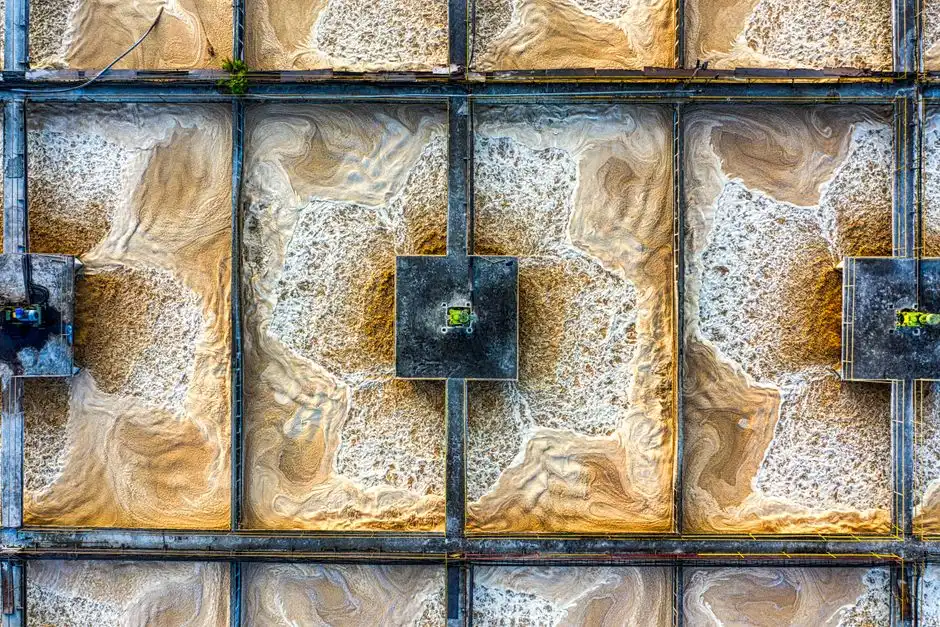
Phosphorus removal is not a standalone chemistry problem — it lives in a train. Upstream: lint screens (0.5–1 mm wedge-wire) followed by oil/grease DAF and equalization should normalize flow, pH, and temperature before any precipitant or PAO contactor. P removal works best once temperature is <40°C, so an equalization tank with 4–8 hour HRT is usually a prerequisite.
Mid-train: biological COD/LAS reduction (typically an MBR or moving-bed biofilm reactor) should precede EBPR but can follow chemical P precipitation as a polishing step. For sites targeting water reuse, RO polishing after P removal is mandatory — residual calcium phosphate above 0.5 mg/L fouls RO membranes within 40–80 hours of operation; pairing P removal with a reverse osmosis polishing stage prevents the calcium phosphate scaling that otherwise kills membrane life. Downstream sludge dewatering must be sized for peak P loading: a filter press for chemical phosphorus sludge dewatering rated for 4–7 kg DS/kg P at 1.3× design chemical dose handles the worst case without cake-blow failures. For high-end textile-adjacent sites considering AI-driven feedforward control on the precipitation step, the AI process control for textile wastewater plants piece walks through the data architecture.
Frequently Asked Questions
What chemical dose is needed to remove phosphorus from laundry wastewater?
Alum at a 1.5:1 Al:P molar ratio (roughly 110–140 mg/L Al2(SO4)3 per 30 mg/L TP influent) at pH 6.0 ± 0.3, or PAC at 1.2:1 with 30–50% lower sludge volume. Dose scales with TP, not flow, so on-line P analyzers save 15–25% on chemical OPEX.
Can laundry wastewater meet 0.5 mg/L TP without chemical dosing?
Only via EBPR plus a polishing sorbent (e.g., MFC@La(OH)3 at 45.45 mg P/g) or a constructed wetland with 5-day HRT, and only if LAS is held below 50 mg/L upstream. Chemical-free compliance is possible but doubles the footprint and is climate-sensitive below 10°C.
How much does it cost to remove phosphorus from commercial laundry effluent in 2026?
OPEX runs $0.10–0.20/m³ for chemical-only trains and $0.18–0.30/m³ for hybrid chemical+MBR, including acid, coagulant, polymer, and sludge hauling. Wetland OPEX is lowest at $0.03–0.08/m³ but is land-dependent and excludes media replacement every 5–7 years.
What is the best phosphorus removal technology for a 200 m³/day hotel laundry?
A hybrid PAC precipitation + DAF + MBR train delivers 95–99% TP removal to <0.5 mg/L, with 0.5–0.9 m²/m³/d footprint and $300–500/m³/d CAPEX. For resort sites with >2,000 m² available land, a polishing wetland after chemical DAF is cheaper but climate-limited.
Does MBR remove phosphorus from laundry wastewater?
An MBR alone removes only 20–40% TP because biomass assimilation is limited and no luxury uptake is engineered in. MBR's value in a P-removal train is residual polishing below 0.5 mg/L and simultaneous LAS stripping, not primary TP reduction — pair it with chemical precipitation upstream.