Myanmar's Wastewater Treatment Market in 2026: What Buyers Are Actually Facing
Myanmar wastewater treatment plant buyers in 2026 are operating under the National Environmental Quality (Emission) Guidelines 2015, which set the municipal discharge ceiling at BOD ≤30 mg/L, COD ≤125 mg/L, TSS ≤50 mg/L, and pH 6–9; industrial sectors carry tighter, case-specific limits enforced by the Environmental Conservation Department. Permit delays in Yangon and Mandalay routinely run 6–9 months, so RFQ timing needs to back-calculate from the commissioning target, not the other way around.
The climate is a process variable, not background. Monsoon seasons push mixed-liquor suspended solids out of balance when surface temperatures swing 10–12 °C within 48 hours, and ambient peaks at 38–40 °C reduce dissolved oxygen below 4 mg/L in open basins, which cuts nitrification efficiency by roughly 20–30%. Equipment enclosures should be specified at IP54 minimum, with cable glands and control panels rated to 45 °C ambient; anything less typically fails within 18 months on a Yangon rooftop or a Mandalay industrial estate.
On the supply side, 2024–2026 currency volatility and import-licence friction have pushed most buyers toward factory-built, containerised, or skid-mounted packaged plants rather than stick-built EPC. Containerised MBR and SBR units ship in 6–10 weeks from Chinese ports to Thilawa, can be craned onto a prepared civil pad, and cut site work by roughly 40% compared with field-erected systems — a significant saving when Myanmar kyat depreciation has added 12–18% to imported equipment landed cost over the last 24 months.
Four sectors generate the bulk of the RFQ volume: food and beverage (rice milling, fish sauce, edible oil — typically 1,500–6,000 mg/L COD), textiles and garment (Yangon industrial belt, COD 800–3,000 mg/L plus colour), oil and gas (Myanmar Petroleum Refinery, Yadana produced-water streams, oil and grease 50–500 mg/L), and municipal growth tied to new townships around Yangon and Mandalay. For deeper process-side context before you talk to vendors, the MBR vs MBBR engineering comparison lays out the same trade-offs in industrial-plant detail.
Matching Treatment Technology to Myanmar's Industrial Influent
Influent characterisation drives the technology choice more than any other variable. Food-processing wastewater in Myanmar typically arrives at COD 2,000–8,000 mg/L with high BOD₅/COD ratios (0.45–0.6) and significant suspended solids from wash-down streams; textile effluent from Yangon dyeing houses runs COD 800–3,000 mg/L with strong colour and variable pH (4–11), often with sulphide and reactive-dye residuals; oil and gas produced water lands at COD 500–2,000 mg/L with oil and grease 50–500 mg/L and total dissolved solids often above 5,000 mg/L; municipal sewage sits in the 250–500 mg/L COD range with relatively stable composition.
Almost every industrial site in Myanmar needs a screen + flow equalisation + DAF pre-treatment step before the biological stage. The rotary bar screen removes rags and large solids, equalisation smooths the diurnal and monsoon-driven spikes (Myanmar factories often see 3–4× flow variation between dry-shift and wash-down), and DAF strips emulsified oils and floating colloids. Standard DAF units ship in a 4–300 m³/h capacity window with 13 model sizes, so most Myanmar flows can be matched to a catalogue SKU without custom fabrication. For a detailed view of DAF pre-treatment specifications or to pair it with a rotary bar screen headworks unit, the product datasheets cover hydraulic loading and footprint directly.
For high-strength or reuse-targeted streams — food plants that want to recycle wash water, textile mills facing a water-stress site — MBR membrane bioreactor systems are the default choice. MBR delivers roughly 60% smaller footprint than conventional activated sludge at equivalent flow, filtration below 1 µm, and packaged capacities from 10 to 2,000 m³/day, which covers the bulk of Myanmar's industrial mid-range. For mid-strength influent (COD 500–2,000 mg/L) with limited civil footprint, MBBR remains the retrofit-friendly workhorse. For low-cost municipal and small community clusters with relatively stable sewage, SBR keeps CAPEX down. Conventional activated sludge is only worth specifying above 2,000 m³/day, where the per-m³ economics start to dominate the operational-skill penalty.
| Sector | Influent COD (mg/L) | Key stress | Recommended core process |
|---|---|---|---|
| Food & beverage (rice, fish sauce, edible oil) | 2,000–8,000 | High SS, FOG, diurnal peaks | MBR (reuse) or SBR (discharge) |
| Textiles & garment | 800–3,000 | Colour, pH swing, sulphide | MBR with coagulation pre-stage |
| Oil & gas / refinery | 500–2,000 | O&G 50–500 mg/L, high TDS | DAF + MBBR, with O&G removal upstream |
| Municipal sewage | 250–500 | Variable monsoon load | SBR (<2,000 m³/day) or CAS (>2,000 m³/day) |
Four Plant Types Compared: MBR vs SBR vs MBBR vs Conventional Activated Sludge
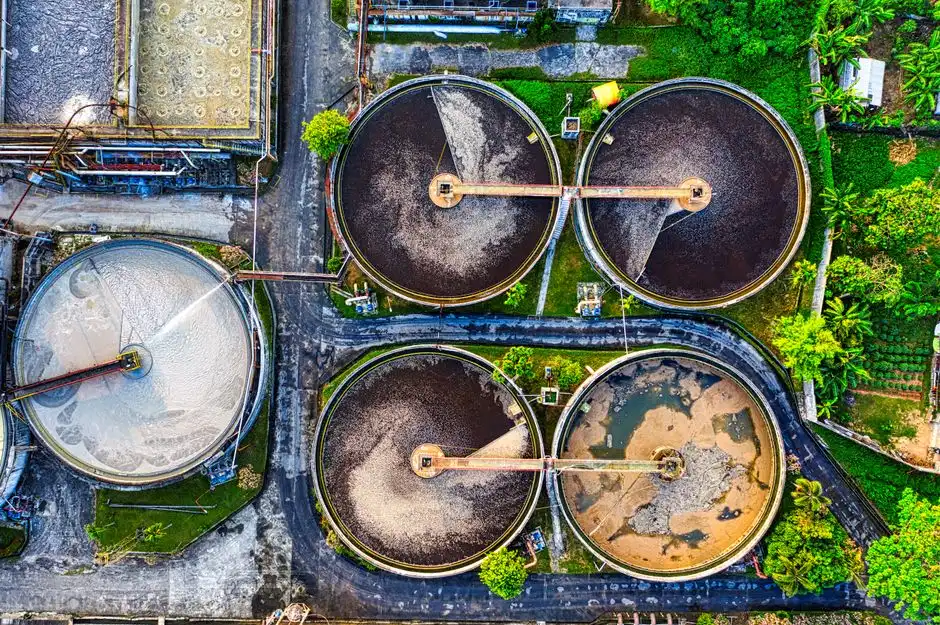
No single plant type wins across the board. MBR costs more per cubic metre of capacity but pays back when the plant needs to hit reuse-grade effluent on a tight footprint; SBR is the cheapest route to compliance for a small municipal or seasonal-flow food plant; MBBR hits the middle ground for textile and mid-strength industrial where retrofitting an existing basin matters; conventional activated sludge only pencils out above 2,000 m³/day, where its simplicity offsets the need for a trained operator on every shift. For sub-2,000 m³/day community and small-industrial flows, the WSZ packaged sewage plant format — typically an SBR core in a buried FRP/carbon-steel tank — dominates the Yangon municipal segment because it disappears below grade and needs no dedicated building.
MBR effluent typically runs BOD <5 mg/L, COD <30 mg/L, TSS <1 mg/L, and turbidity <1 NTU — well inside reuse thresholds for cooling-tower make-up and many wash-down loops. SBR and MBBR effluent generally land at BOD <20 mg/L, COD <80 mg/L, TSS <20 mg/L when properly operated, which clears NEQEG municipal limits but rarely clears a reuse spec without a polishing RO or UF stage. For deeper membrane-module specification on the MBR side, submerged MBR modules datasheets list the operating fluxes and cleaning protocols you should expect a supplier to reference in the RFQ response.
| Plant type | Flow range (m³/day) | Footprint index | Effluent BOD / COD / TSS (mg/L) | CAPEX (USD per m³/day) | OPEX (USD per m³) | Best-fit Myanmar sector |
|---|---|---|---|---|---|---|
| MBR | 10–2,000 | 0.4× (≈60% smaller) | <5 / <30 / <1 | 1,200–1,800 | 0.35–0.55 | Food, textile, reuse-targeted industrial |
| SBR | 50–5,000 | 0.7× | <20 / <80 / <20 | 800–1,300 | 0.18–0.30 | Small municipal, seasonal food plants |
| MBBR | 100–10,000 | 0.6× | <20 / <80 / <20 | 700–1,100 | 0.20–0.35 | Textile, mid-strength industrial, retrofits |
| Conventional activated sludge | 1,000+ | 1.0× (baseline) | <20 / <80 / <20 | 500–900 | 0.15–0.25 | Large Yangon/Mandalay municipal works |
Supplier Categories Operating in Myanmar in 2026
Four distinct supplier archetypes compete for Myanmar RFQs in 2026, and each carries a different risk profile that a procurement manager should weigh before shortlisting.
Chinese turnkey suppliers — concentrated in Shandong, Jiangsu, and Zhejiang — dominate the containerised and skid-mounted segment. CAPEX is typically 30–50% below European equivalents, factory lead time is 6–10 weeks, and container delivery to Thilawa adds 14–21 days. The non-negotiable: confirm a Yangon-domiciled service agent, English-language O&M manuals, and a documented SAT protocol. Any supplier that cannot produce a Myanmar reference plant treating similar influent should be downgraded immediately.
Indian EPC firms deliver a strong civil–electrical balance and are competitive on CAS and SBR builds above 1,000 m³/day, but sea-freight transit to Myanmar ports is typically 10–14 days longer than Chinese routes, and Myanmar-domiciled service is usually indirect through a local partner.
European and Japanese OEMs (Veolia, Suez, Kubota) command a 2–3× CAPEX premium, but bring proven process guarantees, membrane module lifecycles of 8–12 years, and engineering documentation that survives an ECD audit. They are justified only on large municipal tenders, pharmaceutical, semiconductor, or any site with a corporate ESG reporting line that demands a tier-1 OEM.
Local Yangon and Mandalay system integrators offer the fastest response and the strongest local-language support, but are typically limited to skid assembly of imported components. They are a strong fit for sub-100 m³/day projects and for ongoing service contracts on plants originally supplied by overseas OEMs. For chemical dosing and automatic chemical dosing requirements on a packaged plant, local integrators often pair imported skids with locally fabricated dosing rigs — workable, provided the dosing skid itself is from a traceable manufacturer.
2026 Cost Benchmarks for Myanmar Wastewater Treatment Plants
Defensible 2026 CAPEX bands for Myanmar industrial plants run USD 80,000–250,000 for 10–50 m³/day, USD 150,000–1,500,000 for 100–500 m³/day, and USD 1,500,000–8,000,000+ for 500–5,000 m³/day, with the upper band reserved for fully equipped MBR packages that include sludge dewatering, chemical dosing, and a SCADA panel. Civil works, which often surprise first-time Myanmar buyers, typically add 25–40% to the equipment CAPEX when the site is greenfield.
OPEX benchmarks track the process choice. SBR sits at USD 0.18–0.30 per m³, MBBR at USD 0.20–0.35 per m³, MBR at USD 0.35–0.55 per m³, and conventional activated sludge at USD 0.15–0.25 per m³. Electricity dominates at 60–70% of OPEX (aeration is the biggest line item), followed by sludge hauling at 10–15% and chemical consumables at 5–10%. Sludge dewatering is the easiest place to claw back OPEX — a properly sized plate and frame filter press can cut sludge-hauling volume by 75–80% and pay back in 12–18 months on a 200+ m³/day plant. For primary solids capture upstream of the biological stage, a high-efficiency sedimentation tank running at 20–40 m³/m²·h surface loading is the typical spec to anchor.
Hidden costs to budget explicitly: 15–25% on top of equipment CAPEX for shipping plus Myanmar customs duty (rates vary by HS code and ASEAN origin status), 10–15% for installation supervision if a foreign engineer is on-site, and 5–8% per year for spares holding. Membrane replacement on an MBR typically recurs every 5–8 years at USD 40–80 per m² of membrane area for hollow-fibre modules.
| Cost element | Range | Notes |
|---|---|---|
| CAPEX, 10–50 m³/day | USD 80K–250K | Containerised skid, no major civil |
| CAPEX, 100–500 m³/day | USD 150K–1.5M | Includes civil + dosing + dewatering |
| CAPEX, 500–5,000 m³/day | USD 1.5M–8M+ | MBR with full SCADA, larger civil |
| OPEX — SBR | USD 0.18–0.30/m³ | Lowest energy per m³ |
| OPEX — MBBR | USD 0.20–0.35/m³ | Mid-range |
| OPEX — MBR | USD 0.35–0.55/m³ | Membrane replacement + aeration |
| Shipping + Myanmar customs | 15–25% of equipment CAPEX | Verify HS code and ASEAN origin |
| Installation supervision | 10–15% of equipment CAPEX | If foreign engineer on-site |
| Spares holding | 5–8% of CAPEX per year | Membranes, pumps, instruments |
Vendor Vetting Checklist Before You Sign the PO
Five items decide whether a supplier survives the warranty period in Myanmar. First, demand 12 months of effluent test data from an existing reference plant treating similar influent — not pilot data, not laboratory data. A supplier who can only point to a pilot has not proven the design at scale. Second, verify monsoon-rated enclosure (IP54 or better), 380V/415V 50Hz three-phase compatibility to match Myanmar grid standards, and ambient operating rating to 45 °C, with derating curves if your site sits above 200 m elevation.
Third, confirm membrane and module warranty terms in writing — typical hollow-fibre MBR modules carry 5-year prorated warranties — and pin down local consumable stocking plus guaranteed response time. Target: under 72 hours in Yangon, under 5 days in Mandalay. Anything longer is a service risk. Fourth, check the supplier's experience with Myanmar NEQEG documentation and ECD permitting workflow, not just ISO 9001; an ISO certificate without a Myanmar-specific track record is not a permit substitute. Finally, require SAT/FAT protocols in writing, a 12-month defect liability period, and performance liquidated damages tied to the contracted effluent parameters — usually a daily penalty for each parameter day out of spec, capped at 10–15% of contract value.
For the polishing or disinfection step that often anchors the end of the train, suppliers offering a chlorine dioxide generator alongside the main plant simplify the consumable supply chain. Where reuse is the end goal and dissolved solids are a constraint, a reverse osmosis polishing stage is the conventional pairing after an MBR, and should be scoped in the same RFQ to avoid integration mismatches later.
Frequently Asked Questions
What is the cost of a 100 m³/day wastewater treatment plant in Myanmar?
A 100 m³/day packaged MBR or SBR plant delivered to a Yangon site in 2026 typically lands at USD 150,000–350,000 for the equipment, plus USD 40,000–90,000 for civil works and installation — a total of roughly USD 190,000–440,000 depending on influent strength, enclosure rating, and whether sludge dewatering is included (HydropureWater field data, 2026).
Which treatment is best for textile wastewater in Myanmar?
MBR with a coagulation pre-stage is the strongest fit for Yangon-area textile effluent (COD 800–3,000 mg/L, variable pH, reactive dyes), because the membrane stage retains biomass through colour and salt shocks and produces reuse-grade water for dyeing-house wash loops (per NEQEG 2015 industrial sector guidance).
Do Chinese wastewater treatment plant suppliers support installation in Myanmar?
Reputable Shandong, Jiangsu, and Zhejiang suppliers typically offer 7–14 day on-site supervision by a Chinese engineer plus a Yangon-domiciled service agent; however, this must be contractually pinned down before PO, because the same supplier may not offer local service for a sub-100 m³/day order (per HydropureWater project-execution experience, 2024–2026).
What effluent parameters must a Myanmar plant meet to discharge to surface water?
Under NEQEG 2015, the municipal-sector ceilings are BOD ≤30 mg/L, COD ≤125 mg/L, TSS ≤50 mg/L, pH 6–9, and oil and grease ≤10 mg/L; industrial sectors carry tighter sector-specific limits enforced by the Environmental Conservation Department.
How does the Myanmar monsoon affect wastewater treatment plant design?
Monsoon rainfall can lift influent flow by 3–5× within hours, drop mixed-liquor temperature 10–12 °C, and reduce dissolved oxygen below 4 mg/L — design responses include upstream flow equalisation sized to 8–12 hours of peak flow, IP54+ enclosures, and aeration rated for 40–45 °C ambient operation.