Why Hospital Wastewater in Hamburg Is a 2026 Priority
Hospital wastewater treatment in Hamburg is moving from conventional biological treatment to a four-stage train — screening, equalization, MBR or AOP polishing, and ClO₂ or ozone disinfection — driven by the April 2025 UKE/HAW/Hamburg Wasser research project, which demonstrated 90%+ removal of pharmaceuticals such as metoprolol and sulfamethoxazole (hamburg-business.com, 2025-05). Effluent must meet EU Urban Waste Water Directive 91/271/EEC limits before discharge to Hamburg's central WWTP, which is itself adding a fourth treatment phase by 2030.
The trigger for action in 2026 is the UKE/Hamburg Wasser/HAW Hamburg study, which ran for over two and a half years and benchmarked membrane filtration and activated carbon against biological treatment alone. All tested technical options retained trace substances significantly better than biological-only treatment (hamburg-business.com, 2025-05). The University Hospital Hamburg-Eppendorf separately investigated multi-resistant pathogens in hospital wastewater — a Hamburg-specific public-health driver because antibiotic-resistant bacteria (ARB) circulate between clinical effluent, the Elbe tributary network, and downstream drinking-water abstractions.
Quantitatively, hospital effluent is pharma-rich. A 2019 multi-hospital study of five facilities in Slovakia and Czechia measured the following peak concentrations: cotinine 6,700 ng/L, bisoprolol 5,200 ng/L, metoprolol 2,600 ng/L, tramadol 2,400 ng/L, sulfamethoxazole 1,500 ng/L, and ranitidine 1,400 ng/L (Springer, Environ Sci Pollut Res, 2019). Translated to Hamburg, these are the compounds a 2026 pre-treatment plant must be designed against, alongside the binding requirements of the EU Urban Waste Water Directive 91/271/EEC and the German Abwasserverordnung (AbwV) Annex 1.
Influent Characteristics: What a Hamburg Hospital Pretreatment Plant Must Handle
The basis-of-design for any Hamburg hospital pre-treatment starts with a defensible influent envelope. The 2019 Springer dataset on 74 pharmaceuticals and metabolites remains the most-cited parameter reference for European hospital effluent, and it pairs with conventional municipal-strength organics and high pathogen counts. Grouping the micropollutants by class clarifies which unit operations will bear the load: beta-blockers (bisoprolol, metoprolol), analgesics (tramadol), antibiotics (sulfamethoxazole), nicotine metabolites (cotinine), and H₂ receptor antagonists (ranitidine) (Springer, 2019).
Conventional parameters for a German hospital of 300–800 beds typically fall in the following design envelope (typical hospital range — flag as design assumption):
| Parameter | Typical hospital range | Design implication |
|---|---|---|
| COD | 400–1,200 mg/L | Size biological stage for upper bound |
| BOD₅ | 180–450 mg/L | Confirm F/M ratio at peak load |
| TSS | 150–400 mg/L | Specify DAF for colloid removal |
| Total nitrogen | 30–80 mg/L | Verify denitrification volume |
| Total phosphorus | 5–15 mg/L | Confirm chemical precipitation dose |
| Fecal coliforms | 10⁶–10⁷ CFU/100 mL | Disinfection sizing mandatory |
| ESBL / MRSA / VRE | 10³–10⁵ CFU/100 mL | Per UKE 2025 multi-resistant pathogen findings |
Diurnal peaks are the variable that derails most undersized systems. Morning surgery blocks (07:00–11:00), the dialysis shift (06:00–14:00), and the evening radiology flush of iodinated contrast media all produce 2–4× spikes in COD and total micropollutant load. A 24-hour equalization volume sized at 8–12 hours of average dry-weather flow is the standard damper; anything shorter leaves the downstream MBR or AOP exposed to shock loads that no control loop can fully absorb.
The 2026 Process Flow: Screening to Disinfection in Six Stages
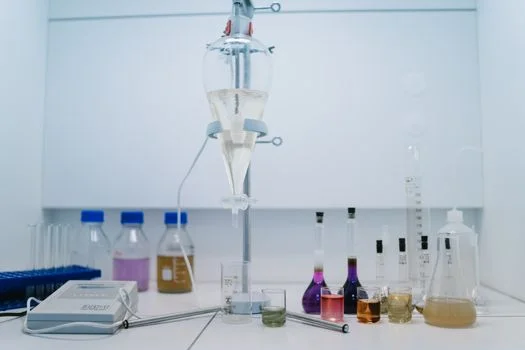
A 2026-ready hospital pre-treatment train is a six-stage process, not a single reactor. Each stage is mapped to a vendor package, a CAPEX line, and a measurable effluent target.
- Stage 1 — Screening. A rotary bar screen for hospital headworks with 1–3 mm aperture protects downstream pumps and membranes from gauze, swabs, plastics, and surgical textiles. Aperture selection is a CAPEX-versus-membrane-life trade-off: 1 mm protects best but raises organics on the screen.
- Stage 2 — Equalization. Buffer tank sized at 8–12 hours of average dry-weather flow to flatten pharmaceutical and ARB pulses. A 24-hour hydraulic retention time (HRT) is the upper bound for the largest UKE-class hospitals.
- Stage 3 — DAF. A DAF pre-treatment for hospital effluent removes emulsified fats, blood residue, and colloids, typically 4–25 m³/h per unit at <30 mg/L residual TSS. DAF also strips a meaningful fraction of hydrophobic pharmaceuticals (e.g., metoprolol, bisoprolol) on the floated sludge.
- Stage 4 — MBR or AOP polishing. An MBR membrane bioreactor for hospital pre-treatment with submerged PVDF at 0.1–0.4 µm pore size delivers TSS <5 mg/L; downstream AOP using modified Fenton or boron-doped diamond (BDD) electrodes achieves >90% removal of 74 tested micropollutants and 100% ARB kill (Springer, 2019).
- Stage 5 — Disinfection. An on-site chlorine dioxide generator for hospital disinfection sized 50 g/h to 20,000 g/h, or ozone, to meet the UWWTD fecal coliform threshold of <100 CFU/100 mL where direct discharge applies. ClO₂ is preferred over Cl₂ in Hamburg urban zones because it does not form trihalomethanes with the iodinated contrast media typical of hospital effluent.
- Stage 6 — Sludge handling. Lamella clarifier thickening followed by a plate-and-frame filter press producing 22–28% dry-solids cake for off-site incineration, which is the Hamburg municipal norm for clinical sludge.
| Stage | Unit operation | Design parameter window | Vendor package |
|---|---|---|---|
| 1 | Rotary bar screen | 1–3 mm aperture | GX series bar screen |
| 2 | Equalization tank | 8–12 h ADWF | Civil / GRP |
| 3 | DAF | 4–25 m³/h, TSS <30 mg/L | DAF |
| 4 | MBR + AOP | 0.1–0.4 µm PVDF, >90% micropollutant removal | MBR system + Fenton/BDD |
| 5 | ClO₂ or O₃ | 50–20,000 g/h ClO₂, <100 CFU/100 mL | ClO₂ generator |
| 6 | Sludge dewatering | 22–28% DS cake | Plate-and-frame press |
MBR vs AOP vs Activated Carbon: Choosing the Right Polishing Step
The polishing step is where 2026 hospital pre-treatment budgets are won or lost. MBR alone is not enough for a Hamburg hospital discharging pharma-rich effluent; the unit operation to pair it with is a budget and feedstock decision, not a fashion choice.
| Technology | Micropollutant removal | ARB kill | Footprint | OPEX driver | Best-fit hospital profile |
|---|---|---|---|---|---|
| MBR (submerged PVDF, 0.1–0.4 µm) | 30–60% standalone | 3–4 log | ~60% smaller than CAS | Aeration electricity, membrane replacement every 5–8 years | Pair with AOP or GAC for pharma-rich effluent |
| AOP (modified Fenton or BDD electrode) | >90% across 74 micropollutants (Springer, 2019) | 100% | Compact skid | H₂O₂, electrode wear, pH control | Oncology wards, university hospitals, high antibiotic load |
| PAC / GAC | Significantly higher than biological alone (UKE/HAW, 2025) | 2–3 log | Large contactor volume | Carbon replacement 6–12 months (PAC), 2–4 years (GAC) | Central WWTP 4th stage, large hospitals with footprint |
Decision rule for 2026: small Hamburg clinics (<50 beds) → MBR membrane bioreactor for hospital pre-treatment plus on-site ClO₂, optionally with a downstream GAC polisher. Large university hospitals in the UKE class (1,500+ beds) → MBR plus AOP, or MBR plus GAC if Hamburg Wasser rejects the AOP brine. Antibiotic-heavy oncology wards → AOP is mandatory, not optional. The UKE/HAW researchers explicitly found that all tested technical options retain trace substances significantly better than biological-only treatment (hamburg-business.com, 2025-05), which is why MBR alone does not satisfy the 2026 design envelope.
For a head-to-head engineering comparison of MBR against conventional activated sludge on energy, footprint, and micropollutant baseline, see the MBR vs Conventional Activated Sludge: 2026 Engineering Comparison.
Compliance Checklist: EU UWWTD, German AbwV and Hamburg Discharge Limits
Pre-treated hospital effluent in Hamburg is bound by two overlapping regimes. Failure on either is a permit issue; failure on both is a shutdown.
| Regime | Parameter | Limit | Applicability |
|---|---|---|---|
| EU UWWTD 91/271/EEC | BOD₅ | <25 mg/L | Discharges from >2,000 PE agglomerations |
| EU UWWTD 91/271/EEC | COD | <125 mg/L | Same |
| EU UWWTD 91/271/EEC | TSS | <35 mg/L | Same |
| German AbwV Annex 1 | AOX | <0.5 mg/L | Hospitals (adsorbable organically bound halogens) |
| German AbwV Annex 1 | Mercury | <0.05 mg/L | Hospitals |
| Hamburg Wasser / UWWTD bathing-water | Fecal coliforms | <100 CFU/100 mL | Triggered when pre-treated effluent is not biodegradable for the central WWTP |
Where the central Hamburg Wasser WWTP rejects non-biodegradable effluent, on-site disinfection to UWWTD bathing-water standards is triggered. A packaged medical wastewater system for small clinics can be sized to meet both the EU UWWTD and German AbwV envelope in approximately 0.5 m² of process footprint, which is the configuration most procurement leads paste into a small-clinic RFQ. For the cross-jurisdiction context — discharge rules, equipment selection, and cost benchmarks for a comparable large-population state — see the Hospital Wastewater Treatment in Punjab, India: 2026 Compliance & Equipment Guide.
2026 Cost Benchmarks for a Hamburg Hospital Pretreatment Plant
Procurement and hospital finance will want ranges, not vendor quotes. The 2026 envelope for a complete screening-to-disinfection train in Hamburg sits in the following bands (2026 vendor-range assumption):
| System scale | CAPEX envelope (2026) | OPEX band (€/m³ treated) | Sludge disposal |
|---|---|---|---|
| Small clinic, ~5 m³/h package skid | ~€180,000 | €0.18–0.42 | €80–140/t cake |
| Mid-size hospital, ~50 m³/h MBR + AOP | ~€650,000 | €0.18–0.42 | €80–140/t cake |
OPEX drivers split roughly as: electricity 30–40% (MBR aeration dominant), chemicals 40–50% (ClO₂ precursors or H₂O₂ for AOP), and membrane replacement every 5–8 years at 12–18% of CAPEX. Sludge disposal at €80–140 per tonne of cake in the Hamburg metropolitan area is the line item that frequently gets missed until year two of operation. A 50 m³/h plant producing 22–28% DS cake at typical hospital yield will spend €25,000–€60,000 per year on incineration alone. For a deeper OPEX drilldown, the DAF Plant Operating Cost Breakdown: 2026 OPEX Guide breaks down aeration, polymer, and electricity line items per cubic metre.
A 2026 Vendor Specification Template You Can Paste into an RFQ
Copy the block below into the technical specification section of your hospital pre-treatment RFQ. It is intentionally vendor-neutral and binding on compliance:
- Design flow: ____ m³/h; peak factor 1.8–2.5×; equalization 8–12 h ADWF.
- Influent envelope: COD ≤1,200 mg/L; BOD₅ ≤450 mg/L; TSS ≤400 mg/L; total micropollutant load per the 2019 Springer 74-compound list.
- Effluent limits: BOD₅ <25 mg/L, COD <125 mg/L, TSS <35 mg/L (EU UWWTD 91/271/EEC); AOX <0.5 mg/L, Hg <0.05 mg/L (German AbwV Annex 1); fecal coliforms <100 CFU/100 mL where direct discharge applies.
- Footprint constraint: ____ m²; max envelope height ____ m.
- Noise: <55 dB(A) at 10 m.
- Automation: PLC + SCADA, remote monitoring, data logging per 36 BImSchG.
- Materials of construction: SS304 (civil), SS316 (chloride service), PVDF (membrane housings).
- Certifications: CE; ATEX for chemical dosing rooms; DVGW / UBA listing for chemical precursors.
- Warranty: minimum 24 months from mechanical completion; membrane warranty 5 years pro-rata.
- O&M training: 40 h on-site for plant operators; bilingual manual (DE/EN).
- Disinfection: on-site ClO₂ generation only — no bulk chlorine transport in Hamburg urban zones.
- Compliance binding: EU UWWTD 91/271/EEC and German AbwV compliance is a contractually binding clause, not an option.
The packaged medical wastewater system for small clinics is one example of a configuration engineered to meet the small-clinic end of this template. For chemical-feed accuracy at the dosing stage, require an automatic chemical dosing system with redundant metering pumps and a calibration certificate traceable to PTB standards.
Frequently Asked Questions
What does hospital wastewater treatment in Hamburg typically cost in 2026? CAPEX for a complete train ranges from ~€180,000 for a small clinic (~5 m³/h package skid) to ~€650,000 for a mid-size hospital at ~50 m³/h with MBR + AOP. OPEX sits in the €0.18–€0.42 per m³ treated band for the screening-to-MBR-to-ClO₂ configuration (2026 industry benchmark).
Is a fourth treatment stage required for hospitals in Hamburg? Yes. The April 2025 UKE/HAW/Hamburg Wasser research project demonstrated that technical processes retain trace substances significantly better than biological-only treatment (hamburg-business.com, 2025-05), and Hamburg Wasser is feeding the findings into a fourth treatment phase at the central WWTP.
Which micropollutants are most critical to remove from hospital effluent in Hamburg? The 2019 Springer dataset on five European hospital effluents puts the priority compounds at cotinine 6,700 ng/L, bisoprolol 5,200 ng/L, metoprolol 2,600 ng/L, tramadol 2,400 ng/L, sulfamethoxazole 1,500 ng/L, and ranitidine 1,400 ng/L (Springer, Environ Sci Pollut Res, 2019).
Is MBR enough on its own for hospital wastewater? No. MBR alone delivers 30–60% micropollutant removal; pairing MBR with AOP or GAC is required to push >90% removal of the 74-compound spectrum and 100% ARB kill (Springer, 2019; UKE/HAW, 2025).
Does a small Hamburg clinic need its own pretreatment plant? Yes, when the central Hamburg Wasser WWTP rejects non-biodegradable effluent. A packaged medical wastewater system for small clinics in approximately 0.5 m² of process footprint can be sized to meet both the EU UWWTD and German AbwV envelope for sub-50-bed facilities.