Establish the Transaction and Permit Position
Wastewater should be handled as a condition-precedent issue, not assumed to transfer automatically. Before closing, the buyer should verify the target’s Hungarian water permit or water-use authorization, any sewer or indirect-discharger agreement, monitoring history, treatment performance, flood and outfall exposure, and historic soil or groundwater conditions. The acquisition framework then tests segregated fluoride/TMAH, CMP, solvent, and PFAS-bearing streams against equalization, pH control, solids removal, biological treatment, polishing, and sludge handling. If permits or performance cannot be verified, the buyer should condition closing, require a priced remediation and retrofit, withhold milestone-based funds, or walk. No target, permit, limit, flow, cost, or transfer deadline is currently verified.
The transaction discussed here is hypothetical. GlobalFoundries’ announcement dated 17 November 2025 concerned the acquisition of Advanced Micro Foundry in Singapore, including a 200 mm silicon-photonics platform and planned 300 mm scaling; it did not identify a Hungarian plant (GlobalFoundries, 2025-11-17). No Hungarian operator, receiving sewer, permit condition, discharge point, or site-specific flood designation can therefore be assumed. The buyer should begin with a document request covering the current Hungarian water permit or water-use authorization, every amendment, the named operator, permitted discharge points, flow basis, monitoring and reporting conditions, and expiry or renewal status.
Hungarian counsel must determine whether the permit transfers by law, requires amendment, or must be reissued. The competent water authority, sewer authority, plant operator, site operator, and any operator of shared collection infrastructure must be mapped, with every filing and operating duty assigned to a named party. Where the plant discharges to a sewer, the applicable indirect-discharger agreement and pretreatment conditions must be obtained because those terms may define the practical operating envelope.
Do not import German WHG, AbwV, BImSchG, or BBodSchG requirements, or treat a German transfer window as a Hungarian deadline. The research identifies the German 30–90 day period only as an acquisition benchmark, not Hungarian law. The same discipline applies to the comparison of Hungarian semiconductor wastewater treatment routes: these are a diligence structure, not substitute permit conditions.
| Permit or operating right | Required evidence | Closing acceptance criterion | If unresolved |
|---|---|---|---|
| Hungarian water permit or water-use authorization | Current instrument, amendments, named operator, discharge points, flow basis, monitoring, reporting, renewal status | Hungarian counsel confirms the transfer, amendment, or reissuance pathway | Condition closing or price approval delay |
| Indirect-discharger agreement | Applicable sewer agreement, discharge parameters, monitoring duties, surcharges, enforcement terms | Party, limits, and obligations align with the permit and operating plan | Condition closing; allocate sewer compliance risk |
| Shared infrastructure responsibility | Water authority, sewer authority, plant operator, site operator, and collection-system agreements | Each duty and filing has an accountable party | Do not close until responsibility is unambiguous |
| Flood and outfall exposure | Site address, mapped designation, applicable water-resilience requirements, outfall information | Exposed assets and emergency obligations are identified | Price retrofit or walk if exposure is unacceptable |
Map Every Discharge Route and Stream
The permit, sewer agreement, and site records must establish whether each discharge reaches surface water, groundwater, or a sewer before any treatment or retrofit scope is priced. A sewer discharge requires the applicable indirect-discharger or pretreatment agreement; a statement that the plant has a permit does not replace those operating limits. The route map should also distinguish direct discharge points from internal recycling, reuse, and off-site waste movements.
Build the inventory drain by drain, not around the generic label “semiconductor fab wastewater.” Separate HF and buffered oxide-etch fluoride, TMAH photoresist developer, copper-bearing CMP slurry, IPA and other solvents, and PFAS-bearing process streams. For every stream, identify its source tools or processes, destination, treatment unit, permit parameter, operator, and physical containment. This also makes cross-connections visible: a fluoride or alkaline-developer line entering biological treatment is a different risk from the same chemistry held in a correctly segregated equalization tank.
Use production-normalized flow records, batch-dump volumes, equalization data, and the permitted flow basis. The supplied 64,600 m³/day annual-average and 80,000–90,000 m³/day peak figures are Dresden-class benchmarks, not Hungarian inputs. Likewise, GlobalFoundries’ reported 23,582 ML/year of tertiary-treated discharge across 100% of its manufacturing sites is a global portfolio benchmark drawn from its 2023 CDP Water Security Questionnaire (2023-07-25); it is not a Hungarian design basis. Neither figure should enter a Hungarian equipment sizing calculation.
The buyer also needs a mass-balance route for residuals. CMP sludge, chemical precipitates, biological sludge, and treatment chemicals must be linked to thickening, dewatering, storage, manifests, licensed disposal, and receiving-site evidence. A permitted liquid discharge does not make the corresponding solid waste acceptable or establish that the disposal chain exists.
| Stream or route | Key constituents or risks | Evidence required | Decision if evidence fails |
|---|---|---|---|
| HF and buffered oxide-etch | Fluoride, acidity, batch pH excursions | Drain map, batch-dump records, fluoride and pH monitoring | Redesign equalization and chemical control |
| TMAH developer | High alkalinity and biodegradable organic demand | Source inventory, pH monitoring, COD/BOD data, equalization records | Exclude affected route or price segregation retrofit |
| CMP slurry | Copper, colloids, abrasive solids | Solids and copper characterization, solids balance, sludge route | Price solids removal and dewatering |
| IPA and other solvents | Organic load, fire and biological inhibition risk | Solvent inventory, segregation records, COD/BOD, ventilation controls | Repair segregation or redesign biological treatment |
| PFAS-bearing streams | Persistent dissolved contaminants and residual fate | Source inventory, PFAS sampling, permit and sewer requirements | Define treatment and residual-disposal strategy |
| Sewer or direct discharge | Destination-specific limits and enforcement | Current agreement or permit, discharge map, monitoring history | Condition closing or price unresolved exposure |
Test the Treatment Train Under Real Conditions
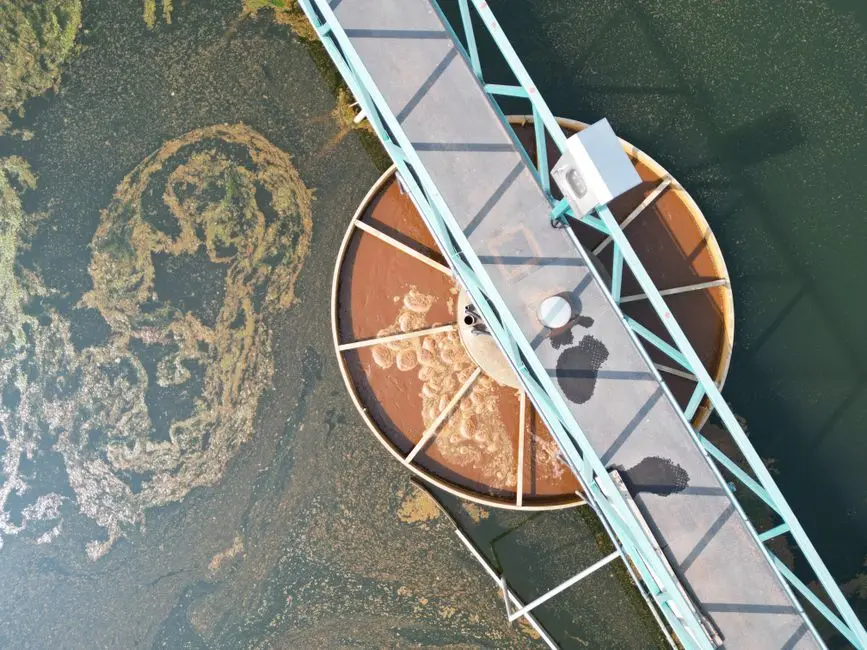
A treatment plant should be accepted only after its functions are tested against verified flow, load, and discharge conditions. The supplied Phase II concept calls for 24-hour composite samples collected over at least three operating days at the treatment-plant inlet, relevant biological-stage outlets, and the final discharge point (HydropureWater, “GlobalFoundries Hungary Plant: Wastewater Requirements 2026”). The final sampling plan should be adjusted to Hungarian permit requirements, sewer conditions, and actual production sequences.
The initial panel covers pH, COD, BOD5, SS, NH3-N, total nitrogen, total phosphorus, total heavy metals including copper, fluoride, TMAH, TPH, colour, and PFAS. Add or remove parameters only after reviewing the Hungarian permit, indirect-discharger agreement, and process chemistry. A laboratory result is useful only when its collection point, operating condition, analytical method, accreditation, and chain of custody are documented.
Challenge each function separately. Equalization and automatic pH control must contain excursions. DAF or equivalent physical removal is appropriate only where characterization confirms suspended solids, colloids, oil, or grease requiring physical separation; it does not establish dissolved fluoride, TMAH, or PFAS removal. Biological treatment addresses biodegradable organics and ammonia, subject to biomass compatibility and toxicity controls. Dedicated polishing or PFAS control should be scoped only after the relevant discharge requirement and constituent behavior are confirmed.
An “ETP compliant” statement is not acceptance evidence. Acceptance criteria should cover verified design flow, worst credible batch dumps, final permitted parameters, uptime, chemical consumption, sludge mass, monitoring response time, and operator competency. Evaluate how off-spec batches are contained, who may authorize a bypass, and what happens during dosing outages, membrane fouling, high inventory, or flood conditions. A single grab sample or one operating shift cannot establish performance for a variable semiconductor discharge.
Use an integrated MBR membrane bioreactor where the effluent objective, footprint, biomass separation, or reuse requirement supports it. The supplied system covers 10–2,000 m³/day, but site flow, permit conditions, and sewer limits determine suitability. For CMP sludge, evaluate a plate-and-frame sludge dewatering system against measured residual dry-solids generation, dewatering performance, and the disposal route; the supplied 1–500 m² equipment range is not a selection for this target.
| Treatment function | Performance test | Acceptance criterion | Owner |
|---|---|---|---|
| Equalization and pH control | Worst credible batch with flow, pH, fluoride, TMAH, and dosing records | No unacceptable excursion at the permitted discharge point | Process engineer |
| Solids, colloids, and oil removal | Flow-linked sampling across inlet and outlet | Verified mass removal, solids capture, oil recovery, and sludge route | Treatment lead |
| Biological treatment or MBR | Permit-panel compliance and biomass response | Required organic, ammonia, solids, filtration, and uptime performance | Operations and lab |
| PFAS or specialized polishing | Analyte-specific testing where required | Documented removal and residual-disposal route | Environmental lead |
| Sludge handling | Dry-solids balance and dewatering trial | Agreed cake or residual performance and licensed disposal evidence | EHS and contractor |
Turn Findings into Closing and Contract Conditions
Each unresolved environmental issue should produce one of four decisions: close, condition closing, price and hold back, or walk. The governing worksheet needs the missing record, owner, evidence, acceptance criterion, unresolved action, and contractual remedy. This prevents a generic environmental representation from quietly absorbing permit, operating, and historic-liability risks.
Request 36 months of inlet and outlet monitoring data, analyser calibration certificates, chemical and dosing records, sludge manifests, incident reports, regulator correspondence, penalties, and flood-risk and outfall information. The 36-month period and 30-day monitoring-gap warning are German acquisition benchmarks identified by the research, not Hungarian legal thresholds. Where available, make delivery of a valid permit, disclosure of all deviations, and a complete monitoring record conditions precedent, supported by a pre-closing compliance covenant and seller responsibility for permit transfer.
Allocate known exceedances, penalties, permit non-compliance, off-site disposal, sludge handling, historic soil and groundwater conditions, interim treatment costs, and approval delay separately. Tie any escrow or holdback to a quantified, contingency-loaded remediation or retrofit estimate and objective permit, commissioning, and sustained-compliance milestones. The research’s 1.5× factor and 36-month period are German transaction benchmarks, not Hungarian rules; they should not be inserted into the agreement without a target-specific cost basis.
Request itemized Hungarian quotations covering operating days, sampling points, analytical panel, PFAS scope, soil or groundwater work, accredited laboratory services, and chain of custody. The German EUR 35,000–90,000 range is expressly tied to German scope and is not a Hungarian price. The contract should separately cover known exceedances, unknown historic conditions, seller-controlled remediation, and post-closing compliance. The operating and performance-model provisions in the supplied wastewater plant operating and performance models are useful for structuring milestones, not evidence of Hungarian legal requirements.
| Closing-gate finding | Decision | Acceptance evidence | Contractual remedy |
|---|---|---|---|
| Valid permit and transfer pathway cannot be demonstrated | Condition closing or walk | Hungarian counsel opinion, agency pathway, and seller cooperation commitment | Condition precedent, seller covenant, and approval-delay allocation |
| Monitoring gaps or exceedances are identified | Price and hold back | Complete historical record and validated exceedance analysis | Specific environmental indemnity and milestone-based holdback |
| Worst-credible batch test fails | Redesign and price, or exclude affected asset | Corrective design, commissioning test, and sustained-compliance criteria | Capex adjustment, escrow, or exclusion |
| Historic soil or groundwater finding is unresolved | Price and hold back | Site-specific investigation and quantified remediation scope | Environmental indemnity with objective release milestones |
| Flood exposure or missing outfall information is unacceptable | Price and condition, or walk | Hungarian designation, exposure assessment, and resilience plan | Capex adjustment, covenant, or termination right |
Frequently Asked Questions
Can GlobalFoundries’ global wastewater discharge benchmark be used to size a Hungarian fab?
No. Its reported 23,582 ML/year tertiary-treated discharge across 100% of manufacturing sites is a global portfolio benchmark from the GF 2023 CDP Water Security Questionnaire (2023-07-25), not a site design basis. Size the Hungarian plant from the target’s permitted flow basis, production-normalized records, batch-dump volumes, measured loads, and drain-by-drain inventory.
What treatment equipment should be prioritized for a Hungarian semiconductor fab?
Prioritize the functions confirmed by the route map: equalization and pH control, solids removal where characterization supports it, biological treatment for biodegradable organics and ammonia, polishing where the discharge objective requires it, and sludge dewatering where residual dry-solids generation creates a bottleneck. Treat MBR and PFAS-control technologies as options to be tested against measured chemistry, footprint, reuse objectives, permit limits, and residual-disposal arrangements rather than as automatic requirements.
How should a buyer select and price wastewater due diligence for the Hungarian target?
Require one itemized Hungarian quotation covering sampling days, sampling points, the analytical panel, PFAS scope, soil or groundwater work, laboratory accreditation, and chain of custody. Require separate assumptions for mobilization, operating-day coverage, sample hold times, repeat testing, site access, and report issuance. The research provides no Hungarian price, so the buyer should not budget from the German EUR 35,000–90,000 range or any US or Chinese retrofit benchmark.
What should happen if the Hungarian permit or treatment performance cannot be verified before closing?
Condition closing where the legal and operational gaps are curable, require interim operating responsibility and a priced work plan, and protect the buyer through a targeted indemnity or milestone-based holdback. Walk if transfer cannot be established, the worst-credible batch cannot be contained within the required envelope, or the unresolved permit, retrofit, and historic-liability exposure is unacceptable.