Choose the blowdown endpoint before buying equipment
An Al Fayyum data center should choose between recovering cooling blowdown as makeup and treating it for sewer discharge only after measuring the cooling-side water balance and confirming the receiving utility’s current limits. At 4 cycles of concentration, blowdown equals 25% of makeup; at 6 CoC, it equals 20%. Equipment should therefore be sized from measured blowdown flow and seasonal water analysis—not IT load alone.
Cooling effluent is normally the larger data-center wastewater stream, while domestic wastewater remains comparatively limited. ASCE’s 2024 primer also reports that utilities increasingly require onsite pretreatment (ASCE, March/April 2024). Treat cooling blowdown and domestic wastewater as separate design packages: the former contains concentrated cooling-water chemicals and dissolved solids; the latter requires its own sanitary collection and treatment interfaces.
The decision should follow a route-selection matrix:
| Decision input | Reuse as cooling makeup | Treatment for sewer discharge | Evidence required from Al Fayyum |
|---|---|---|---|
| Freshwater availability and marginal cost | Makeup savings can support higher treatment capital. | Remains relevant, but sewer fees and treatment costs may dominate. | Current allocation, tariff and interruption record. |
| Sewer acceptance | Still needed for RO concentrate unless a zero-liquid-discharge route is developed. | Requires written acceptance of the final discharge quality and flow. | Receiving utility, connection point and pretreatment requirements. |
| Environmental requirements | Reuse quality must support cooling chemistry, equipment protection and the approved reuse plan. | Final effluent and concentrate must satisfy site-specific permit conditions. | Current environmental permit and receiving-water or sewer conditions. |
| Treated-wastewater availability | Alternative makeup may reduce freshwater demand. | Does not by itself resolve blowdown generation. | Confirmed availability and quality by season. |
| Avoided costs | Value includes avoided freshwater and, where applicable, sewer and compliance costs. | Value depends mainly on avoiding permit failure and treatment costs. | Tariffs, sewer charges, disposal costs and monitoring costs. |
The supplied research does not establish Al Fayyum’s final permit limits, sewer access conditions, water-allocation rules or source-water quality. These are verification items, not assumptions to transfer from Cairo or Giza. A 2026 reuse life-cycle assessment found an indirect water penalty of approximately 0.93 L/m³—less than 0.1% of direct freshwater displacement—but also showed that treatment energy and chemical use must be included in the business case (Open Engineering Inc., 2026).
Build the cooling-water balance from measured flows
The blowdown ratio is calculated as 1/(CoC − 1), so the treatment duty must be based on the measured blowdown working stream rather than server load. Genesis Water Technologies’ 2026 reference gives a 15 MW benchmark of roughly 15 million gallons of monthly intake and 3.75 million gallons of recoverable blowdown per month at 4 CoC. A hot, dry 100 MW class case can reach 2 million liters of intake per day, with 20–40% blowdown, but those conditions must not be transferred to Al Fayyum without site verification.
Use this worksheet during early design and replace each blank with measured or contracted data:
| Water-balance line | Calculation or entry | Al Fayyum value to obtain |
|---|---|---|
| Makeup-water flow | Measured meter reading | Average, peak and seasonal flow |
| Evaporation | Cooling-system calculation or measured water balance | Design and operating range |
| Cooling blowdown | Makeup ÷ (CoC − 1) | Average, peak and minimum flow |
| Domestic wastewater | Separate sanitary-flow estimate | Peak flow and discharge route |
| Condensate | Separate source metering | Flow, temperature and quality |
| RO permeate | Feed flow × projected recovery | Makeup replacement and other uses |
| RO concentrate | Feed flow − permeate flow | Volume, TDS and proposed destination |
| Waste sludge | Solids removed × dewatering factor | Moisture content, haul-off frequency |
Install metering on makeup, blowdown, reuse, concentrate and discharge streams before selecting equipment. ASCE recommends seasonal sampling of pH, conductivity, TDS, chlorides, silicon or silica, hardness, alkalinity and microbial counts (ASCE, March/April 2024). Include residual biocides, scale inhibitors, corrosion inhibitors, oil and suspended solids in the analytical program. The result should become the common design basis in the RFQ rather than relying on IT megawatt capacity as a proxy for wastewater flow.
Match pretreatment to blowdown contaminants
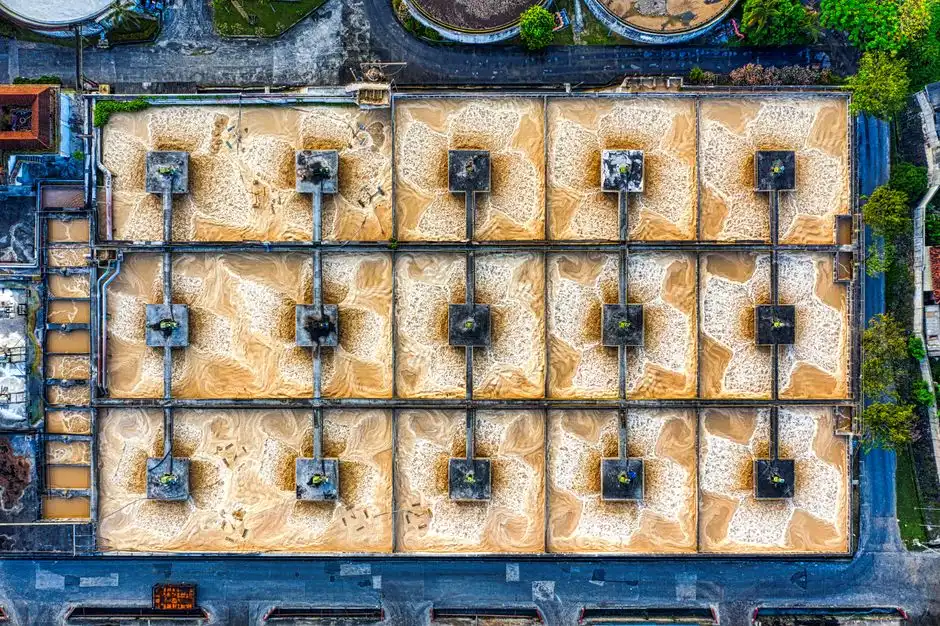
Cooling blowdown concentrates TDS, calcium and magnesium hardness, silica, chloride, sulfate, suspended solids, microbiological activity and residual treatment chemicals (Genesis Water Technologies, 2026). Pretreatment removes material that fouls membranes and protects downstream treatment from the blowdown’s concentrated chemistry.
A defensible sequence is rotary screening, DAF or lamella clarification, multi-media filtration, ultrafiltration and then RO where dissolved-ion removal is required. Use the comparison of cooling-blowdown treatment routes to examine route boundaries, then apply the following criteria:
| Unit operation | Selection criterion | Supplier information required |
|---|---|---|
| Rotary screen | Remove solids and fibrous debris before clarification. | Screen aperture, extracted-solids handling and duty on measured blowdown flow. |
| DAF | Preferred where emulsified oil or light suspended solids are significant. | Expected TSS and oil range, air demand and sludge-removal method. |
| Lamella clarification | Suited to higher-solids duties or a constrained footprint. | Clarifier loading, solids capture and washdown arrangement. |
| Multi-media filtration | Reduce turbidity and suspended solids before UF and RO. | Filtrate quality, backwash demand and treatment-loss allowance. |
| UF | Remove colloids, bacteria and residual suspended solids. | Feed-water limits, recovery, cleaning chemistry and cleaning frequency. |
The 0.03 μm ultrafiltration system uses 0.03 μm PVDF membranes, accepts turbidity up to 300 ppm, and includes automatic backwash and air scour; verify that the stated turbidity limit applies to the measured Al Fayyum feed and required recovery duty.
Do not compare UF+RO reuse only by water recovery. Open Engineering Inc.’s 2026 LCA found that the UF+RO scenario used more than five times the energy of the freshwater case, with treatment energy accounting for roughly 80% of the GWP difference (Open Engineering Inc., 2026). Improvements in cycles of concentration may reduce blowdown and chemical consumption, but the business case must compare incremental treatment energy and chemicals against avoided freshwater and disposal costs.
Size RO and disinfection around the reuse decision
RO is the principal treatment barrier for dissolved ions when permeate is reused as cooling makeup or polished for discharge. In the supplied Giza train, RO follows UF and precedes disinfection (HydropureWater, 2026). The industrial RO system should be sized from measured blowdown flow, feed-water temperature and the selected recovery target—not from nominal site intake.
Do not treat published RO values as Al Fayyum guarantees. The Cairo guide cites 95–99% dissolved-solids rejection and 75–80% recovery on silica-rich feed, but those values require confirmation through pilot testing or a design-specific vendor projection (HydropureWater, 2026). The buyer’s acceptance schedule should require:
| RO or disinfection item | Acceptance basis | Required supplier commitment |
|---|---|---|
| Projected recovery | Design water temperature and full feed analysis. | Recovery at the stated feed temperature, with no undisclosed assumption. |
| Concentrate | Measured feed flow, projected recovery and concentrate TDS. | Volume, quality and an accepted disposal route. |
| Antiscalant | Silica, hardness, sulfate and scaling assessment. | Chemical, dose range and control strategy. |
| Cleaning | Projected operating hours and feed chemistry. | Cleaning frequency, chemicals, time and spare membranes. |
| Downtime | Installed redundancy and maintenance plan. | Assumed outage duration and recovery procedure. |
| Disinfection | Reuse chemistry, residual needs and permit conditions. | UV dose or chlorine-dioxide generation and control basis. |
| Concentrate fallback | Written sewer acceptance or approved disposal route. | Partial or full zero-liquid-discharge concept where sewer acceptance is unavailable. |
UV provides chemical-free disinfection, while chlorine dioxide can provide on-site microbial control for industrial cooling loops. The final barrier must be selected against the reuse chemistry, required residual and current permit conditions. If the sewer will not accept RO concentrate, evaluate partial or full zero-liquid-discharge alternatives instead of assuming that concentrate can be discharged directly.
Issue an RFQ with acceptance criteria
Comparable bids require one site-specific design basis and one route for every supplier to price. Ask bidders to document performance against discharge parameters set by the responsible Egyptian environmental authority for the actual receiving sewer or water body; generic limits are not acceptable substitutes. The supplied research does not verify the final Al Fayyum permit, so issue the RFQ conditionally and freeze the compliance schedule when written consent is received.
Each bid should answer the following acceptance schedule:
| RFQ schedule | Required response | Reason for acceptance |
|---|---|---|
| Measured duty | Average and peak blowdown, reuse, concentrate and discharge flows. | Prevents equipment sizing from IT-load assumptions. |
| Route selection | DAF or lamella choice for the expected TSS range. | Tests whether pretreatment matches local water quality. |
| RO projection | Recovery at design temperature, concentrate quality and cleaning-in-place frequency. | Exposes yield and operating-cost assumptions. |
| Scope boundaries | Domestic wastewater, cooling blowdown, condensate, sludge, chemical dosing, instruments and sampling. | Prevents civil, mechanical and treatment interfaces from being omitted. |
| References | Comparable arid-climate facilities with stated scale and treatment duty. | Tests relevant operating experience. |
| Service | Named Cairo-region response times for membrane and chemical cleaning. | Protects recovery time and operating continuity. |
| Commissioning | Stable metering, water-quality results, operator training, spares and cleaning support. | Converts performance claims into handover requirements. |
Issue one clarification cycle against the same measured-water-analysis package. Require each supplier to state assumptions where information is missing rather than insert generic performance values. Keep the domestic wastewater scope visible in the scope matrix, but do not mix its sanitary acceptance criteria with the cooling-blowdown and reuse criteria.
Frequently Asked Questions
What cost benchmark should an Al Fayyum buyer use for cooling-blowdown recovery?
The supplied 15 MW water-stressed reference cites a $200,000 capital cost for 60% blowdown recovery and a 3–5 year payback after sewer, compliance and ESG costs are included (Genesis Water Technologies, 2026). This is a benchmark, not an Al Fayyum estimate. Request a site-specific quotation using measured blowdown flow, the selected endpoint, local water and sewer tariffs, concentrate disposal cost and treatment energy.
How should treatment equipment be sized for a cooling tower?
Use measured blowdown flow and the complete seasonal water analysis. The blowdown ratio is 1/(CoC − 1): it equals 25% of makeup at 4 CoC and 20% at 6 CoC (Genesis Water Technologies, 2026). Include average, peak and minimum duty, and specify recovery, redundancy and cleaning assumptions in the RFQ.
Which supplier qualifications should be checked before shortlisting?
Require route-specific guarantees, comparable arid-climate references, local service coverage, a concentrate destination and stated membrane-cleaning assumptions. Ask bidders to commit to recovery at the design water temperature and identify the DAF-versus-lamella rationale for the expected TSS range. A generic product list or generic industrial reference is not sufficient acceptance evidence.
What must be verified before choosing reuse or sewer discharge in Al Fayyum?
Confirm the applicable environmental permit, sewer consent, water-allocation conditions, receiving point, discharge parameters and any reuse approval with the responsible Egyptian authorities