Define the outlet before choosing the plant
An industrial effluent treatment plant in Berlin should be selected by matching the wastewater characteristics and intended outlet to a treatment train. A WSZ package plant combines anoxic/aerobic treatment, sedimentation and disinfection for 1–80 m³/h applications. DAF can remove suspended solids, oil and grease, FOG and colloidal matter, while MBR combines activated sludge with submerged PVDF filtration for 10–2,000 m³/day projects. UF provides fine solids and bacteria removal without chemicals, including for RO pretreatment. Academic research also identifies nanofiltration as an option for polishing WWTP effluent, but the supplied evidence does not establish Berlin-specific permit limits. The practical output is a worksheet covering flow, wastewater analysis, discharge route and reuse target.
Direct discharge, indirect discharge to a sewer and internal reuse are not interchangeable project routes. The first decision is to document the proposed outlet, the receiving authority or sewer operator, and the required effluent quality before comparing equipment. The supplied research does not state Berlin’s applicable discharge rules, so the site-specific requirements must be obtained from the responsible authority. The direct versus indirect discharge decision for German industrial wastewater provides a useful framing for this question, but it is not evidence of a Berlin permit limit.
For indirect discharge, ask the sewer operator which pretreatment or discharge requirements apply to the industrial stream and whether a discharge permit is required. For direct discharge, obtain the applicable receiving-water and effluent requirements, including the parameters and averaging basis that must be demonstrated. For internal reuse, specify the receiving process and its water-quality needs rather than relying on a generic “reuse-quality” description.
Nanofiltration is an advanced-polishing benchmark, not an assumed Berlin requirement. A University of Twente thesis describes nanofiltration as a technology for polishing wastewater treatment plant effluent to EU Water Framework Directive standards and producing effluent suitable for agricultural or potable uses. That research supports the technical role of membrane polishing, but it does not determine which route or treatment train applies to a particular Berlin site.
Map the wastewater to the required process
Wastewater analysis determines the treatment stages, whereas nominal capacity alone does not. Before issuing a supplier enquiry, obtain flow data and analyses covering pH, suspended solids, oil and grease, COD and BOD where relevant, together with contaminants specific to the industrial process. The supplier then needs to distinguish hydraulic loading from contaminant loading and identify which unit operations are required for equalization, solids removal, biological treatment, polishing and disinfection.
Use DAF as a front-end option when suspended solids, oil and grease, FOG or colloidal matter are the principal challenges. A DAF system for industrial wastewater pretreatment can remove these constituents before biological or membrane treatment, but the required pretreatment duty must be confirmed from the wastewater analysis and process knowledge. If the stream contains biodegradable organics and the reuse or discharge target calls for biological treatment, an integrated MBR wastewater treatment system combines activated sludge treatment with submerged membrane filtration.
Use a WSZ package when sanitary sewage is the main stream and a compact anoxic/aerobic, sedimentation and disinfection arrangement fits the site. For a wastewater-reuse treatment train, use UF where fine solids and bacteria removal are required without chemical cleaning aids, or where polishing ahead of RO is needed. The supplied research also supports constructed wetlands as a micropollutant-removal research option, but the Wageningen University thesis from September 2022 does not establish that a constructed wetland will satisfy a Berlin project’s permit or reuse requirements.
| Wastewater or project condition | Process implication | Evidence boundary |
|---|---|---|
| Suspended solids, oil and grease, FOG or colloidal matter are dominant | Consider DAF as front-end pretreatment | Confirm the required pretreatment duty from the wastewater analysis |
| Biodegradable organic load requires biological treatment | Consider WSZ for sanitary-sewage applications or MBR for combined biological treatment and membrane filtration | Catalog ranges are given below; hydraulic and contaminant loading still require verification |
| Fine solids and bacteria removal are required for reuse or RO pretreatment | Consider UF polishing | The supplied catalog describes chemical-free solids and bacteria removal and suitability for RO pretreatment |
| Micropollutants are a defined project concern | Assess constructed wetlands as a research-supported option | Wageningen University thesis, September 2022; local acceptance is unverified |
Choose biological treatment, flotation or membrane polishing
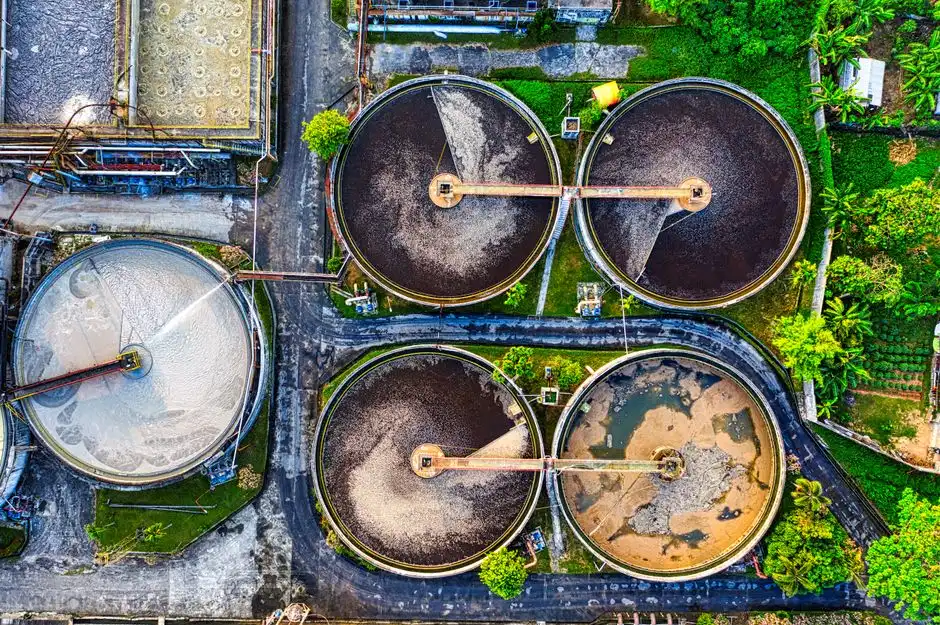
The four equipment categories solve different parts of the treatment problem: WSZ provides a compact biological package, MBR combines biological treatment with membrane separation, DAF removes floating and colloidal material before downstream treatment, and UF polishes an existing stream. The outlet route and wastewater composition determine which combination is justified.
The WSZ option is specified for 1–80 m³/h. Its treatment sequence combines anoxic/aerobic biological contact oxidation, sedimentation and disinfection in one buried package. This makes it a candidate where sanitary sewage is the principal stream and the site needs a compact installation rather than a collection of separate treatment units. The WSZ underground integrated sewage treatment system should be assessed against the wastewater composition, available footprint and utility constraints.
The MBR catalog range is 10–2,000 m³/day. Its treatment comprises activated sludge with submerged PVDF membrane filtration, and the catalog describes near-reuse-quality effluent below 1 μm. These are catalog claims, not evidence of Berlin-specific compliance or suitability for every industrial stream. Request the membrane specification, design loading basis, cleaning strategy and acceptance criteria.
DAF is available across 13 standard models with capacities from 4–300 m³/h. It is the appropriate front-end category to examine when oil, grease, FOG and suspended-solids removal drive the design. It should not be treated as a complete biological or disinfection train by itself.
UF is specified at 2,000–40,000 L/h with 0.03 μm PVDF membranes. The catalog describes chemical-free solids and bacteria removal, automatic backwash and air scour, and suitability as RO pretreatment. Nanofiltration research supports membrane polishing for wastewater reclamation, but the University of Twente thesis does not establish the required process for a Berlin site.
| Equipment category | Catalog range | Main treatment function | Buyer decision |
|---|---|---|---|
| WSZ package plant | 1–80 m³/h | Anoxic/aerobic contact oxidation, sedimentation and disinfection | Use as a candidate where sanitary sewage is the main stream and a compact package is required |
| MBR | 10–2,000 m³/day | Activated sludge plus submerged PVDF membrane filtration; catalog describes effluent below 1 μm | Use where biological treatment and membrane separation are both required |
| DAF | 4–300 m³/h; 13 standard models | Removal of suspended solids, oil and grease, FOG and colloidal matter | Use as pretreatment when those fractions control the design |
| UF polishing | 2,000–40,000 L/h | 0.03 μm PVDF membrane separation with chemical-free solids and bacteria removal, automatic backwash and air scour | Use for fine polishing or RO pretreatment where the upstream process provides the required feed quality |
Build the supplier-ready engineering package
A comparable quotation requires a defined wastewater, outlet and operating basis. Request average and peak flow, operating hours, wastewater analysis, available footprint, utility constraints, discharge route and required reuse or discharge quality. Include production changes, batch discharges, clean-in-place water, stormwater entry points and any expected future expansion. These inputs determine hydraulic design and whether pretreatment, equalization or storage is needed.
Specify the pretreatment duties rather than allowing an equipment list to substitute for process design. Depending on the wastewater, the train may require screening, flow equalization, DAF, pH adjustment, chemical dosing and sludge dewatering. A plate-frame filter press may be relevant if the treatment concept requires sludge dewatering, but its selection depends on sludge characteristics and the disposal route. The industrial pretreatment compliance decision path illustrates why pretreatment obligations should be established before comparing equipment.
Ask each supplier to provide a treatment-train flow diagram covering every inlet, bypass, outlet and sludge stream. Request the design duty cycle, membrane or media specifications, automation scope, utilities demand, maintenance requirements, spare-parts list, installation requirements and commissioning method. Define acceptance criteria in writing, including the tested parameters, sampling points, test duration, operating conditions and remedy for non-performance.
The process-based industrial ETP selection guide provides a useful general comparison framework, but its examples are not Berlin requirements. For supplier discovery, RevenueBase’s Germany listing reported 215 exact matches and eight Berlin company records as of September 2026. Those figures are database-search results, not evidence of service quality, technical capability, regulatory approval or current project availability.
Frequently Asked Questions
How much does an industrial effluent treatment plant in Berlin cost?
No reliable Berlin-specific price can be stated from the supplied research. A comparable quotation requires average and peak flow, wastewater analysis, discharge route, reuse target, available footprint, utility assumptions, pretreatment scope and acceptance criteria. Ask suppliers to separate equipment, civil works, installation, commissioning, controls, sludge handling and long-term operating costs so that quotations can be compared on the same scope.
How should a buyer select and verify an industrial wastewater treatment supplier?
Require a treatment-train flow diagram, duty cycle, membrane or media specifications, utility demand, automation scope, maintenance plan and written acceptance criteria before comparing providers. Check whether each proposed route addresses the actual wastewater constituents and whether the supplier has documented experience with the relevant application. Supplier-selection claims should be supported by project references and current technical personnel, not by database listings alone.
Which treatment equipment should be sized first: WSZ, MBR, DAF or UF?
Use the catalog ranges only to identify potential candidates: WSZ at 1–80 m³/h, MBR at 10–2,000 m³/day, DAF across 13 standard models from 4–300 m³/h, and UF at 2,000–40,000 L/h. Final sizing must verify both hydraulic flow and contaminant loading, including peak conditions, upstream pretreatment and the required outlet quality.
Which authority should confirm German indirect discharge requirements for a Berlin site?
The relevant authority or sewer operator must confirm the Berlin discharge route and local requirements because neither the applicable limits nor the approval pathway are included in the supplied research. Before ordering, obtain written confirmation of pretreatment requirements, discharge parameters, sampling and monitoring obligations, permit conditions and any restrictions on the sewer receiving the flow.