Define the sludge treatment objective before selecting equipment
A sludge treatment facility for a municipal plant should be designed around the sludge entering the process and its permitted final route. The documented design sequence places sludge blending and thickening before stabilization, while dewatering prepares solids for handling or disposal. The EPA identifies land application, landfilling and incineration as the three principal U.S. options for sewage sludge, and notes that biosolids must meet applicable federal, state, Tribal and local requirements. For a filter-press option, request feed-solids and flow data, required cake consistency, available floor area, operating mode and disposal specifications before selecting equipment.
The terminology should be controlled before equipment is specified. The U.S. Environmental Protection Agency generally uses “biosolids” for sewage sludge treated to meet the requirements of 40 C.F.R. Part 503 and intended for land application as a soil conditioner or fertilizer, according to EPA, Basic Information about Sewage Sludge and Biosolids. Untreated sewage sludge should not be described as biosolids merely because it has been dewatered.
Next, establish the governing final-use framework. EPA identifies land application, landfilling and incineration as the three principal U.S. options. Landfilling may involve a sewage-sludge-only monofill, surface disposal or co-disposal in a municipal solid waste landfill. Beneficial land application also has to satisfy applicable federal, state, Tribal and local requirements; EPA, Basic Information about Sewage Sludge and Biosolids. The destination therefore affects the required cake condition, storage method, transfer arrangement and acceptance testing.
Use a project basis of design to collect the information needed for comparison. It should identify the sludge source and age, representative flow and solids data, the intended end-use route, target dewatering result, available floor area, operating schedule, utilities, maintenance access and the responsible regulator. If primary sludge and waste activated sludge are blended, their individual flow and solids characteristics should be documented rather than replaced by a plant-wide average.
Map the municipal sludge treatment train
The first sludge-processing units in the documented municipal sequence are a sludge blending tank and sludge thickener, followed by sludge stabilization, according to Development of a Computer Programme for the Design of Municipal Wastewater Treatment Facilities, Part 6: Sludge Thickening and Blending Facility, published by Penerbit UTM Press. Dewatering then performs the solid-liquid separation needed for the selected handling or disposal route.
The principal sludge-flow inputs identified by that design source are the sludge effluent from primary sedimentation basins and from secondary or final clarifiers. These streams should therefore be requested separately, including their flow, solids concentration, blend proportion and operating variability. The same source states that the design program computes thickened-sludge withdrawal rate and thickener effluent quality from plant material-balance inputs. That supports a calculated thickening duty rather than selection from a generic equipment chart.
| Process stage | Required project input | Decision to establish |
|---|---|---|
| Blending | Primary sludge and waste activated sludge flow and solids data; intended blend | Which streams are combined, in what proportions and under what operating variation? |
| Thickening | Representative feed data, withdrawal requirement and downstream capacity | What solids concentration and flow must leave the thickener? |
| Stabilization | Thickened-sludge characteristics, treatment objective and regulatory route | What condition must the solids reach before dewatering? |
| Dewatering | Feed flow and solids concentration, required cake condition and schedule | Which technology meets the specified separation duty? |
| Storage, transfer and disposal | Final route, receiving-site criteria, storage time and transfer constraints | Where do the dewatered solids go, and who accepts them? |
Stabilization and dewatering duties should remain distinct. Stabilization addresses the treatment objective before final handling; dewatering changes the physical form and moisture content for transport or disposal. The selected route then determines whether additional storage, blending or transfer steps are needed. EPA distinguishes beneficial land application, surface disposal, co-disposal and incineration rather than treating them as interchangeable destinations.
Treat the thickening rate and dewatering performance as design outputs. The available research establishes the process sequence and input requirements, but it does not provide a universal performance value that can be applied to an unidentified municipal sludge. Those outputs must be calculated and verified against representative feed data before a supplier’s equipment becomes the plant basis.
Decide where a plate-and-frame filter press belongs
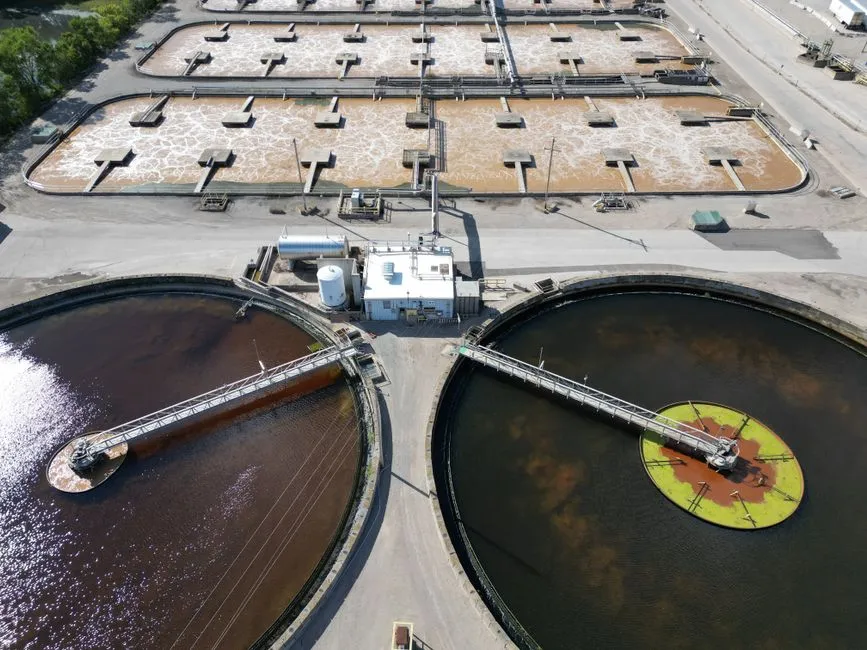
A plate-and-frame filter press belongs after the upstream blending, thickening and stabilization requirements have been defined because its primary role is solid-liquid separation. It should be compared with alternatives against the specified feed and required cake condition, not selected simply because the equipment can be described as dewatering.
The verified HydropureWater catalog defines a plate-and-frame sludge dewatering press range of 1 m² to 500 m², with manual, hydraulic and fully automatic PLC-controlled operation. This range establishes an initial configuration boundary, not a selection rule. Final filtration area must be sized against the verified feed flow, solids concentration, operating schedule and required output condition. The catalog does not provide a universal cake-moisture or throughput claim, so those values must be established for the project feed.
| Selection issue | What to verify | Basis for acceptance |
|---|---|---|
| Process position | Upstream thickening and stabilization are defined; final route is known | Approved process and design basis |
| Filtration area | Supplier calculation identifies the selected area within the catalog range of 1 m² to 500 m² | Calculated duty based on representative feed and operating schedule |
| Operating mode | Manual, hydraulic or fully automatic PLC control | Staffing, cycle control, maintenance access and automation requirements |
| Performance | Expected cake condition and relevant operating limits for the specified feed | Supplier’s written proposal followed by an agreed test method |
| Alternatives | Filter press is compared with other separation methods using the same feed and output requirements | Documented suitability assessment |
Choose the operating mode from the labor and control strategy. Manual operation requires direct operator involvement; hydraulic operation provides a different level of mechanical control; fully automatic PLC operation introduces programmed sequencing and an electrical control scope. Each option should be assessed for local staffing, maintenance access and the required degree of automation rather than treated as interchangeable operating labels.
The supplier should state the expected cake condition and operating limits for the specified feed, identify assumptions, and propose how performance will be demonstrated. For a broader technology check, compare dewatering equipment using feed characteristics rather than selecting a unit from a chart. The comparison of belt filter press and plate-and-frame filter press options provides a reference for establishing like-for-like technical questions.
Build a vendor-ready equipment data request
A comparable quotation requires the same feed, route, site and scope information to be issued to every supplier. The request should distinguish verified plant data from information that remains to be established by the supplier or project engineer.
| Fillable category | Information to supply or request | Supplier response required |
|---|---|---|
| Sludge source | Primary sedimentation basin and final-clarifier descriptions; primary sludge and waste activated sludge flow and solids data; sludge age | Confirm design feed basis, assumptions and blend conditions |
| Treatment objective | Thickening and stabilization requirements; required cake condition; selected disposal route | Map each proposed component to its duty and state exclusions |
| Site and operation | Operating schedule, available floor area, utilities, access, controls and maintenance requirements | Confirm physical fit, utilities, controls and installation requirements |
| Equipment scope | Filtration area, operating mode, control philosophy and included mechanical and electrical accessories | Provide a complete equipment schedule and drawing |
| Delivery and implementation | Commissioning scope, proposed performance-test method, training, documentation and support | Define responsibilities, deliverables and acceptance procedure |
For the physical design basis, identify sludge age, sources, representative flow and solids data, available floor area and utilities. Provide the selected disposal route, required cake condition, operating schedule, access requirements and local regulatory constraints. Ask each supplier to return the proposed filtration area, operating mode, control philosophy, included accessories, commissioning scope and performance-test method.
Regulatory administration should also be identified early. EPA states that a Biosolids Annual Report is required from a publicly owned treatment works that land-applies, incinerates or surface-disposes sewage sludge when it falls within specified applicability categories. The EPA collects annual biosolids reports from roughly 2,350 U.S. facilities located where EPA is the permitting authority, according to EPA, Basic Information about Sewage Sludge and Biosolids. Determine whether the plant’s category and permitting jurisdiction require a report rather than assuming that all facilities have the same obligation.
Use the completed sheet as the commercial quotation basis. Any missing feed value, assumed cake condition or excluded accessory should remain visible in the response so that bids can be compared without silently embedding different design assumptions.
Compare quotations using acceptance criteria
Quotations should be compared on engineering completeness and acceptance conditions, not only on the initial equipment price. Every quotation should identify its duty basis, filtration area, operating mode, and included mechanical and electrical scope. A price that omits feed pumps, controls, cake handling, foundations or commissioning is not equivalent to a complete offer.
Require a proposed performance test that defines the tested feed and the measurable acceptance condition. Do not accept an unstated sludge assumption or a universal cake-moisture claim. The proposed method should state which feed characteristics will be sampled or verified, how cake condition will be measured, what operating period will be assessed and what happens if the result does not meet the agreed criterion.
| Acceptance area | Required quotation evidence | Buyer check before commercial comparison |
|---|---|---|
| Duty basis | Feed source, flow, solids data and operating schedule used for the proposal | Do all bids use the same project basis? |
| Equipment | Filtration area, operating mode, controls and accessory schedule | Are nominal and optional items separated? |
| Performance | Defined test method and measurable acceptance condition | Is the criterion linked to the selected disposal route? |
| Compliance | Named permit and regulatory responsibilities | Are federal, state, Tribal and local obligations allocated correctly? |
| Lifecycle support | Training, commissioning, maintenance, spare parts and document list | Are exclusions and delivery responsibilities clear? |
Check compliance responsibilities separately from equipment performance. EPA identifies 40 C.F.R. Part 503 as the regulation for biosolids that meet its standards, and explains that beneficially used biosolids must satisfy federal, state, Tribal and local requirements, according to EPA, Basic Information about Sewage Sludge and Biosolids. The supplier may provide process equipment and supporting documentation, but the owner must identify which regulatory permits, application records and destination approvals remain project responsibilities.
Before accepting a bid, confirm training, commissioning, maintenance support, spare parts and documentation. Record exclusions, delivery boundaries and the proposed performance test in the purchase documents. This approach turns the comparison from a headline-price review into a check of what the supplier has agreed to deliver and demonstrate.
Frequently Asked Questions
How should a municipal plant size a plate-and-frame filter press?
Size the press from verified primary sludge and waste activated sludge flow and solids data, the required cake condition and the operating schedule. The supplier should show the calculation that selects the filtration area and operating mode. The verified catalog range of 1 m² to 500 m² is a configuration boundary, not proof that any area within it meets the plant duty.
What information should a wastewater equipment supplier request before quoting?
Request the sludge sources, representative flow and solids data, selected disposal route, required cake condition, operating schedule, floor area, utilities, access requirements and regulatory constraints. Also require the supplier to state filtration area, operating mode, control philosophy, included accessories, commissioning scope and proposed performance-test method.
How much should a municipal sludge dewatering system cost?
Request a quotation after completing the data sheet rather than apply a generic price. A comparable cost requires the same feed basis, equipment area, operating mode, mechanical and electrical scope, accessories, site works, commissioning and test conditions. Ask each supplier to separate supplied equipment, optional items, installation inputs and exclusions so that the total scope can be compared.
Which sludge treatment options require the most regulatory attention?
The answer depends on the selected route and jurisdiction. EPA identifies land application, landfilling and incineration as the principal U.S. options, while beneficial-use biosolids must meet applicable federal, state, Tribal and local requirements. Confirm the governing route, permit conditions and whether a Biosolids Annual Report applies before fixing the equipment basis.
When is a filter press preferable to another dewatering technology?
A filter press is potentially suitable when the plant needs a batch-operated solid-liquid separation step, the upstream sludge duty is defined and the required cake condition can be demonstrated for that feed. Compare it with other technologies using the same feed characteristics, throughput, staffing, floor-area and disposal requirements. If those inputs are unavailable, no technology comparison is yet defensible.
Related Equipment
- plate-and-frame sludge dewatering press — specifications, capacity range, and technical data