Confirm the permit route before selecting equipment
Wastewater from a TSMC-related fab in Mexico requires a segregated, permit-controlled system rather than a mixed discharge. Confirm the CONAGUA, SEMARNAT and state approvals for the actual owner and site, then characterize each flow. Fluoride-bearing scrubber blowdown needs dedicated pretreatment; ammonia streams can follow separate biological and membrane routes; solids-bearing flows require clarification; and reuse candidates need biological and RO polishing. Equipment selection should follow verified Mexican permits, influent data, reuse specifications and concentrate routes rather than an Arizona precedent.
The legal operator must be mapped before process equipment is specified. The supplied Mexico guide states that federal water instruments may not survive a share sale, so the CONAGUA Title 4 concession and discharge permit require entity-specific review; state registrations also require confirmation. That means checking the CONAGUA concession, discharge authorization, SEMARNAT environmental registration, Licencia Ambiental Única and annual Cédula de Operación Anual against the transaction structure and the proposed legal operator.
Regulatory requirements must be separated from corporate precedents. NOM-001-SEMARNAT-2021, receiving-water classification, site-specific LAU conditions and state requirements for the responsible technical professional should be confirmed directly with the responsible authorities. Another TSMC site’s limits do not transfer automatically. The TSMC fab wastewater compliance and treatment guide and TSMC fab wastewater treatment and ETP design can support issue identification, but they cannot establish Mexican site conditions.
| Verification item | Evidence to obtain | Decision gate |
|---|---|---|
| Legal operator and transaction structure | Transaction documents, corporate registrations and legal-representative authority | Do not issue an equipment guarantee until the permit holder and contracting entity are defined |
| CONAGUA instruments | Title 4 concession, discharge permit and regulator correspondence | Confirm whether re-application or transfer is required |
| SEMARNAT and state instruments | Environmental registration, LAU, COA and state operator credentials | Confirm validity, amendments and responsible-person credentials |
| Effluent basis | Current NOM-001-SEMARNAT-2021 text, receiving-water classification and LAU conditions | Use verified parameters—not another fab’s limits—in performance guarantees |
| Corporate due diligence | Permit records, water balance, monitoring history, maintenance, staff competence and emergency records | Resolve gaps before commissioning readiness |
For owner due diligence, use TSMC’s supplier-wastewater framework as a readiness lens. The supplied guide identifies three risk indicators—discharge to a natural water body, daily discharge volume and pollutant presence—and seven audit themes: permits, staff competence, reporting, facilities, monitoring, emergency response and special drainage applications. These are corporate audit expectations, not substitutes for Mexican permits.
Map and segregate every wastewater stream
Fab wastewater must remain segregated until source-specific sampling establishes its mass, variability and treatment duty. Build the inventory from installed-equipment records, drain surveys, production schedules and sampling; a generic semiconductor wastewater profile cannot establish what this fab actually generates. For each source, identify normal and peak flow, production dependence, pollutant composition, sampling point, destination and permitted discharge route.
TSMC’s Fab 20 Phase 1 illustrates the scale of source identification: the company reported diversion inspections covering approximately 1,000 tools and 5,887 drain ports, using concentration-based routing rules (TSMC, 2025-06-02). That is a corporate operating precedent, not a requirement for a Mexican site, but it demonstrates why tool-level drainage records matter.
| Stream | Primary segregation and characterization duty | Treatment decision | Monitoring and records |
|---|---|---|---|
| Fluoride-bearing scrubber blowdown | Keep separate; characterize fluoride, pH, flow and variability | Dedicated pretreatment before general wastewater mixing | Sampling at the segregated drain and pretreatment outlet; verify bypass prevention |
| Ammonia-nitrogen wastewater | Separate by concentration and production source | Biological route for low concentration; dedicated membrane route may be evaluated for high concentration | Concentration-based diversion records and ammonia monitoring |
| Cooling-tower blowdown | Characterize salts, chemicals, metals and variability | Assess pretreatment and whether the stream is suitable for reuse | Flow, pH and stream-specific constituent monitoring |
| Process wastewater | Map tools or processes to drains; characterize contaminants individually | Select physical, chemical, biological or membrane treatment by duty | Source sampling, production correlation and mass balance |
| Sanitary wastewater | Keep separate from process drainage | Conventional biological treatment or permitted integration with compatible flow | Hydraulic and organic loading; cross-connection controls |
| Stormwater | Identify contamination sources and rainfall pathways | Segregate clean drainage; pretreat contaminated runoff before discharge | Inspection records, sampling provisions and spill-response controls |
The practical question for each stream is what contaminant, load and variability determines the required duty. Where compatibility is unproven, retain separate piping, equalization and sampling until the evidence supports a connection.
Match the treatment train to each stream
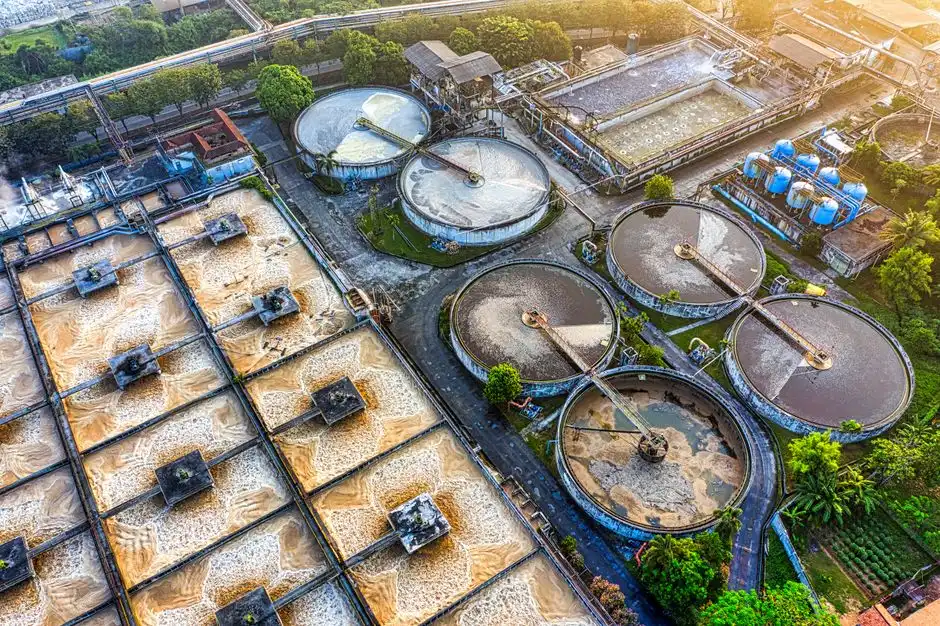
Treatment selection must follow contaminant removal requirements rather than a single semiconductor recipe. Fluoride-bearing scrubber blowdown requires dedicated pretreatment before it enters general wastewater; coagulation or precipitation should proceed only after site testing establishes the chemistry, pH and dose. The supplied guide identifies calcium precipitation for fluoride control, but reagent choice and performance must be demonstrated with representative effluent.
For solids-bearing flows, physical separation comes before biological or membrane duty. DAF pretreatment for solids-bearing fab wastewater is relevant where suspended solids, oil and grease or colloidal material justify dissolved-air flotation. The guide also identifies DAF as appropriate for semiconductor pretreatment only after stream inventory and solids characterization; without representative sludge and emulsion behavior, equipment selection remains premature.
Ammonia routing should follow concentration. In TSMC’s documented system, low-concentration ammonia wastewater is sent to biological treatment, while high-concentration wastewater can use a degassing membrane to convert ammonia nitrogen into ammonium sulfate (TSMC, 2025-06-02). At Fab 20 Phase 1, this diversion system was associated with a 40% reduction in discharged wastewater conductivity and a 30% reduction in chemical-reagent use. Those results are site and corporate precedents, not guaranteed Mexican-site outcomes.
Where near-reuse quality is required, biological solids separation should precede reverse osmosis. An MBR membrane bioreactor for fab water reuse can provide the solids-separation barrier, while RO performance must be sized against the verified reuse specification and concentrate route. Neither unit should be selected from a generic recovery percentage.
| Treatment objective | Applicable equipment | Required sizing or test basis | Primary output |
|---|---|---|---|
| Suspended solids, oil and grease or colloidal separation | DAF, with sludge handling | Representative solids, droplet and emulsion characterization; confirmed sludge properties | Physically separated solids and clarified liquid |
| Fluoride removal | Dedicated precipitation or coagulation followed by solids separation | Fluoride concentration, pH, dosage tests and resulting sludge characteristics | Pretreated fluoride-bearing flow |
| Low-concentration ammonia treatment | Biological treatment | Ammonia load, flow variability, alkalinity and biological operating data | Biological conversion and separated solids |
| High-concentration ammonia recovery | Degassing membrane | Concentration bands, flow, ammonium-sulfate quality and residual discharge duty | Recovered ammonium sulfate and treated liquid |
| Near-reuse polishing | MBR followed by RO | Verified reuse specification, membrane feed quality, recovery and concentrate disposal route | Reuse-grade water and managed concentrate |
| pH and phosphorus control | Automatic chemical dosing | Production and reuse demand, chemical inventory, dose limits and alarm response | Stable treatment chemistry |
Automatic dosing should control pH and phosphorus where production or reuse demand changes. TSMC’s Nanjing operation is cited in the supplied guide as operating to a 3 ppm total-phosphorus corporate benchmark, but that is a corporate target rather than a universal Mexican limit. Confirm both the Mexican requirement and the intended reuse specification before writing a phosphorus guarantee.
Design reuse, sludge and monitoring as one system
Reuse, residue handling and reporting determine the treatment plant’s real scope. Assign each treated stream to discharge, process reuse, cooling reuse or a future reclamation train. Size MBR and RO from the verified end-use specification, not a generic recovery percentage; a stream that meets discharge criteria may still fail process or cooling-water chemistry requirements.
Near-zero liquid discharge should be evaluated as a phased option after establishing the water balance, utilities, concentrate route, economics and expansion schedule. TSMC’s Phoenix reclamation plant is designed for up to 90% recycling and near-zero liquid discharge, according to the supplied guide’s 2025-09-01 reporting. Those Arizona facts demonstrate infrastructure planning ahead of full utilization, but they are not Mexican permit precedent and do not establish the required technology, footprint, energy demand or schedule.
Sludge treatment belongs in the same design. Define dewatering, cake yield, residual characterization, storage, transport and disposal before selecting equipment. A filter press should be evaluated only after representative sludge properties and the acceptance specification for the residue are known; the supplied source identifies plate-and-frame filtration for fab wastewater sludge dewatering as a possible equipment route, not a default selection.
Monitoring should support both regulatory reporting and TSMC audit evidence. Specify sample points, parameter lists, pH and flow instrumentation, calibration, bypass alarms, emergency containment, sampling access, data retention and report exports. The design must show how regulator submissions and corporate supplier reporting are generated from the same validated data rather than maintained as parallel records.
Resource recovery should also be tested at site scale. TSMC reported that, as of October 2026, its waste-etchant reuse technology had been deployed at three advanced backend fabs, avoiding 920 metric tons of outsourced waste-liquid treatment and saving 280 metric tons of purchased chemicals. That precedent supports testing viable reagent-recovery options; it does not prove that the waste etchant stream exists at the Mexican site.
Turn verified data into procurement criteria
Supplier quotations should be tied to verified mass and load data, guaranteed effluent duties, the reuse-water specification, utility availability, residue handling and site-specific performance testing. A guarantee expressed against generic semiconductor limits cannot be tested and should not be accepted. Each supplier must state the data used for sizing, identify assumptions, define performance tests and show how the equipment supports local permit reporting and TSMC audit requirements.
Procurement packages should separate confirmed obligations, corporate precedents and site-specific assumptions. The supplier should identify which instruments it has verified, which facts remain subject to regulator confirmation, and how changes in production, reuse demand or discharge authorization affect the guarantee. Performance tests should use representative influent and address startup, steady operation, upset response and integration with the site’s sampling and data architecture.
| Acceptance criterion | Information required before award | Evidence required from supplier |
|---|---|---|
| Guaranteed treatment performance | Verified influent mass balance, permit limits and reuse specification | Component sizing, guarantee boundaries and site-specific test protocol |
| Reuse readiness | End-use quality requirements and seasonal demand | RO or MBR performance calculation, membrane-fouling basis and concentrate assessment |
| Residue handling | Sludge characteristics, disposal specification and available route | Mass balance, expected cake yield, storage and disposal assumptions |
| Utilities and operability | Available power, water, compressed air, drains and chemicals | Utility demand, operating envelope, redundancy and control narrative |
| Compliance and data | Current permit conditions and reporting format | Sampling arrangement, instrument specifications, calibration, alarms, bypass controls and export method |
| Phased expansion | Production ramp, water balance and expansion schedule | Future tie-ins, retained hydraulic or treatment capacity, and staged commissioning plan |
For process-specific polishing questions, compare the CMP wastewater treatment by ultrafiltration as a technical reference, then require source-specific test results before applying it to the fab. The same rule applies to every train: verify the actual stream before committing process equipment.
Frequently Asked Questions
What treatment performance should a Mexican fab require from equipment suppliers?
Require guarantees based on the verified Mexican influent mass balance, current discharge conditions and verified reuse
Frequently Asked Questions
What treatment train should a TSMC fab use for wastewater in Mexico?
A robust treatment train for a semiconductor facility in Mexico must integrate multi-stage physical-chemical treatment with advanced membrane processes to comply with NOM-001-SEMARNAT-2021. The sequence typically begins with equalization and pH adjustment, followed by coagulation-flocculation and sedimentation to remove heavy metals and suspended solids. This is followed by multi-media filtration and ultrafiltration (UF) as pretreatment for reverse osmosis (RO) units, which are essential for recovering high-purity water and meeting discharge parameters for total dissolved solids (TDS).
For specific streams containing fluorides or ammonia, dedicated precipitation units and biological denitrification stages must be upstream of the main plant. Final polishing via ion exchange or advanced oxidation processes (AOP) may be required depending on the specific receiving water body's local discharge permits and the environmental sensitivity of the region.
How much does a semiconductor fab wastewater treatment plant cost in Mexico?
Capital expenditure (CAPEX) for a semiconductor-grade wastewater treatment facility in Mexico typically ranges between $50 million and $150 million USD, depending on the fab's daily water consumption capacity, which often exceeds 20,000 to 50,000 cubic meters per day. These costs include specialized chemical storage, automation systems, and high-efficiency filtration infrastructure.
Operational expenditure (OPEX) is heavily influenced by local electricity tariffs and the cost of specialized chemical reagents, often ranging from $0.50 to $1.50 USD per cubic meter of treated water. Budgeting must also account for the rigorous analytical testing required to maintain compliance with Mexican federal water quality standards and the potential for high-salinity discharge fees if water recycling rates fall below 80-90%.
Which wastewater streams should be segregated before treatment at a Mexican fab?
Effective management requires the segregation of wastewater into at least five distinct streams to prevent cross-contamination and ensure treatment efficiency: fluoride-bearing wastewater, ammonia-rich streams, CMP (Chemical Mechanical Planarization) slurry waste, solvent-containing waste, and general industrial rinse water. Segregating these streams allows for targeted treatment, such as calcium precipitation for fluorides and air stripping or biological treatment for nitrogen compounds.
Failure to segregate these flows can lead to the formation of hazardous complex compounds, increase chemical consumption, and drastically reduce the lifespan of reverse osmosis membranes. Additionally, acid and base streams should be neutralized at the source to prevent piping corrosion and protect the integrity of the centralized wastewater collection network.
What should I require from a wastewater equipment supplier for a TSMC-related fab?
Suppliers must provide equipment that meets international semiconductor industry standards (such as SEMI S2 and S8) alongside local Mexican certifications, including NOM (Norma Oficial Mexicana) compliance for electrical and mechanical components. You should require detailed mass balance calculations, pilot test results for the specific water chemistry of the local Mexican site, and comprehensive performance guarantees regarding effluent quality metrics like COD, BOD, and heavy metal concentrations.
Furthermore, demand a robust digital integration plan that includes real-time monitoring and SCADA compatibility for remote data logging. Suppliers must also provide a long-term service level agreement (SLA) covering the availability of spare parts and local technical support, as downtime in a semiconductor fab's wastewater system can result in immediate production halts.
Can TSMC's Arizona water-reclamation approach be used as a Mexico design precedent?
While the Arizona model provides a valuable template for high-rate water reclamation and zero-liquid discharge (ZLD) strategies, it cannot be directly imported as a plug-and-play solution due to significant regulatory and environmental differences. Arizona’s regulations are governed by the Clean Water Act and specific state-level aquifer protection permits, whereas Mexican operations must adhere to the Ley de Aguas Nacionales and the specific parameters of NOM-001-SEMARNAT-2021, which may have different discharge thresholds for heavy metals and toxicity.
Design precedents must be adapted to account for Mexico’s unique water scarcity challenges, local energy infrastructure stability, and different climatic conditions that affect evaporation rates in cooling towers and the biological activity in wastewater treatment tanks. Engineering teams must conduct a thorough gap analysis between Arizona’s design specifications and Mexico’s local regulatory and geophysical requirements before final procurement.