Why Cambodia Projects Need a Site-Specific Treatment Strategy
Domestic sewage treatment in Cambodia should usually be planned as a decentralized or packaged system unless a reliable municipal sewer and treatment connection is confirmed. Cambodia’s sewage infrastructure remains limited: a 2019 estimate cited by the Asian Development Bank and reported by Mekong Eye in 2025 put properly treated wastewater at only 9%, while Phnom Penh’s first public sewage plant entered service in December 2023 with 5,000 m³/day capacity. For a new project, confirm current Ministry of Environment discharge requirements, sample the influent, calculate peak and wet-weather flows, and assess flood level and power reliability. WSZ buried A/O package plants suit many communities, while MBR systems are preferable where footprint or reuse-grade effluent is required.
The constraint is not simply the absence of treatment capacity. It is also the absence of a confirmed connection route, an approved discharge point and a receiving environment able to accept the project’s discharge safely. The 2025 Mekong Eye report described untreated wastewater from households, hotels and businesses entering canals and rivers, and noted that Cambodia’s wastewater infrastructure remained among the world’s weakest. The same report recorded 14 wastewater treatment plants under construction nationwide in 2025, but also said implementing guidelines and sub-decrees under the national wastewater law was still in progress. Capacity growth therefore does not establish that a particular development can connect to a public system.
Receiving-water quality also affects process selection. The Journal of Water and Environment Technology study Sewage Water Quality of Phnom Penh City, covering samples collected from December 1997 to September 1999, found that dry-season COD, total nitrogen and total phosphorus in sewage were much higher than in Cambodian surface water, possibly because of domestic wastewater. In rainy season, those concentrations decreased due to rainwater attenuation. The implication is direct: a proposed discharge must be evaluated for its actual receiving water, and infiltration or stormwater entry must be included in the hydraulic and loading calculations.
Before selecting equipment, the project team should obtain written confirmation of sewer availability, the legal discharge route, the sensitivity of the receiving water and any planned network extensions. The industrial wastewater treatment requirements in Phnom Penh provides useful local regulatory context, but it does not replace a project-specific approval from the Ministry of Environment.
Start With Four Inputs That Determine the Correct System
A defensible equipment selection begins with four inputs: wastewater flow, wastewater quality, the receiving-water or reuse objective, and physical site constraints. These are design inputs, not optional background. Without them, a supplier can match a nominal flow to a catalogue model without demonstrating that the package can handle the project’s peak loads, discharge route or operating environment.
First, establish the domestic wastewater design flow from occupancy schedules, fixture counts and the intended operating scenarios. For residential projects, the HydropureWater residential guide dated 2026 gives a preliminary envelope of 150–200 L/person·day and identifies BOD 200–300 mg/L, COD 400–600 mg/L, TSS 200–400 mg/L, NH3-N 20–40 mg/L and fecal coliform 10⁶–10⁷ CFU/100 mL as starting characteristics when site sampling is unavailable. These are screening values under the Sub-Decree on Water Pollution Control framework, not substitutes for project-specific testing. Hotel wastewater, clinic wastewater, food-service effluent and any industrial contribution must be characterized separately rather than assumed to match residential sewage.
Second, calculate both average and peak wet-weather flow. The Phnom Penh academic study noted that rainy-season sewage concentrations fell because of rainwater attenuation, which demonstrates why inflow and infiltration can change both flow and pollutant load. Equalization or inlet attenuation may therefore be needed even when a treatment package handles the average flow.
Third, define the treatment objective before selecting a process train. Is the objective surface-water discharge, landscape irrigation, toilet flushing, cooling-tower makeup or another reuse application? The receiving-water sensitivity, reuse destination and current project permit conditions must define the required effluent quality.
Fourth, document the physical operating constraints: flood level, groundwater level, available footprint, access for sludge removal, power supply and local operator capability. Ask for occupancy schedules, fixture counts, flood records, groundwater observations and electrical capacity data. Finally, require the permit condition to identify the approved discharge point and parameter limits before equipment selection proceeds.
| Required input | Evidence to obtain | Decision affected |
|---|---|---|
| Domestic wastewater design flow | Occupancy, fixtures, average flow, peak factor and wet-weather inflow | Package size, equalization, pumps and treatment loading |
| Wastewater quality | Screening envelope followed by representative site sampling | Biological loading, solids production and pretreatment |
| Receiving-water or reuse objective | Approved discharge point, current permit basis and reuse criteria | Solids separation, nitrogen removal and disinfection |
| Site constraints | Flood and groundwater levels, footprint, access, power and O&M capacity | Burial arrangement, backup power, maintenance and equipment layout |
Compare Package A/O, MBR, and Decentralized Treatment
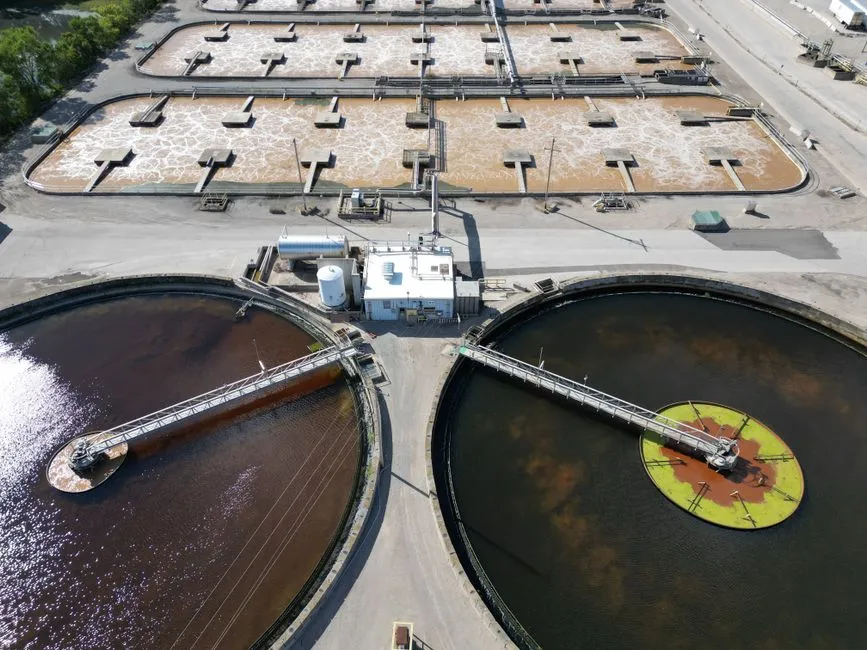
Package A/O, MBR and decentralized treatment solve different combinations of land, flow, effluent-quality and maintenance constraints. The correct comparison starts with process capability, not the supplier’s preferred unit.
The buried WSZ A/O package sewage treatment plant combines anoxic/aerobic biological contact oxidation, sedimentation and disinfection in one buried package. The verified HydropureWater product catalog states a capacity range of 1–80 m³/h and fully automated operation without a resident operator. That range makes the architecture relevant to residential communities and other projects that can concentrate collection and operation at one boundary location. Its performance still depends on the hydraulic and organic loading calculated from the actual site; nominal capacity alone is not an acceptance criterion.
The MBR wastewater treatment system combines activated sludge with submerged PVDF membrane filtration. The HydropureWater residential guide dated 2026 states that it is designed for projects of 10–2,000 m³/day, produces near-reuse-quality effluent and occupies about 60% less space than conventional activated-sludge systems. That makes MBR a candidate where land availability is constrained or reuse is a defined project requirement. The packaged MBR selection guide and MBR sizing and procurement guide provide useful architecture and sizing checks, but the Cambodian designer must apply them to local flows, permits and site conditions.
Decentralized treatment distributes treatment closer to the point of wastewater generation. It can provide coverage independence where a municipal network is incomplete, but it creates multiple equipment interfaces, operating points and sludge-collection routes. For a housing estate or mixed-use masterplan, a hybrid may combine centralized package treatment with smaller decentralized units and a controlled reuse-storage area.
- Provide inlet screening, lifting or flow equalization where required by the design basis.
- Apply biological treatment sized for the tested influent and peak hydraulic loading.
- Separate solids through clarification for package A/O or membrane separation for MBR.
- Disinfect the treated flow using the selected process and dosing arrangement.
- Route effluent to the approved discharge point or reuse storage.
- Provide controlled sludge withdrawal, storage and removal.
| Decision condition | Package A/O | MBR | Distributed decentralized units |
|---|---|---|---|
| Primary fit | Concentrated flows within the stated 1–80 m³/h package range | Projects within the stated 10–2,000 m³/day range requiring a compact installation or reuse-grade effluent | Sites without dependable sewer access where multiple units can be coordinated |
| Land and collection | Buried installation can preserve the surface for landscaping | About 60% smaller footprint than conventional activated sludge, according to the 2026 HydropureWater guide | Units distributed across the development; each point needs access and oversight |
| Main buyer concern | Verify biological and hydraulic loading, sedimentation and disinfection | Verify membrane area, fouling control, aeration, cleaning and replacement provisions | Define ownership, monitoring, maintenance and sludge collection |
Every supplier should demonstrate hydraulic loading, biological loading, peak-flow behavior, sludge production, disinfection and expected effluent quality against the approved design basis. A model unit selected only from nominal flow is not a site-specific proposal.
Design for Monsoon Flooding, Unstable Power, and Local Maintenance
Flood protection must be an enforceable installation requirement, not a note left to the contractor. The HydropureWater residential guide dated 2026 identifies half-buried installation as a common failure mode and requires package plants to be either fully buried, with landscaping above, or raised above the applicable flood level. Require the supplier to review the site’s flood-level evidence, grading plan and groundwater conditions before confirming the installation arrangement.
Electrical resilience also belongs in the technical schedule. The 2026 HydropureWater guide calls for automatic restart after power loss and backup generation or solar buffering sized to cover at least the aeration blower load during a four-hour outage, based on HydropureWater field data. Treat that as a supplier-documentation requirement: ask for the control philosophy, restart sequence, protected loads and backup-power calculation rather than accepting a general promise of automatic operation.
Access for maintenance is equally important. Specify sampling points that an operator can reach safely, sludge withdrawal provisions, an approved sludge-removal route, remote alarms, critical spare-parts availability and a defined local service response. Commissioning should include an operator handover covering routine inspections, aeration control, disinfection, solids handling, alarm response and emergency actions.
Domestic sewage O&M must be budgeted as a lifecycle. The relevant costs include aeration energy, disinfection chemicals, membrane cleaning or media maintenance, inspections, sludge handling and eventual membrane or media replacement. A low purchase price that omits these items can create a more expensive and less reliable asset.
| Project risk | Required supplier information | Buyer acceptance check |
|---|---|---|
| Monsoon flooding | Installation elevation, burial arrangement, flood-level basis and access routes | Drawing identifies the applicable site flood level and protected arrangement |
| Power interruption | Automatic-restart sequence, protected load list and backup-power duty | Backup sizing is supported by the aeration and critical-equipment load schedule |
| Maintenance access | Sample points, sludge withdrawal, spare-parts list and local support arrangements | All routine tasks and sludge removal can be completed without dismantling the process |
| Lifecycle cost | Energy, consumables, maintenance, sludge, replacement and service assumptions | Offer states exclusions and includes a complete O&M cost schedule |
Verify Compliance Before Signing the Equipment Order

The Ministry of Environment should confirm the applicable wastewater-discharge framework and the project-specific permit conditions before the equipment order is signed. The wider Cambodian legal framework includes the Sub-Decree on Water Pollution Control, commonly cited as Sub-Decree No. 27 ANRK.BK, while the 2026 HydropureWater residential guide notes that project requirements and local interpretation can vary. A supplier’s generic “compliance” statement is not an approval.
The same guide gives a residential surface-discharge design reference of BOD ≤30 mg/L, COD ≤120 mg/L, TSS ≤50 mg/L, total nitrogen ≤20 mg/L and fecal coliform ≤200 CFU/100 mL under the Sub-Decree 27 ANRK.BK framework and Ministry of Environment practice for 2024–2025. These values are conditional references, not guaranteed universal legal limits for every 2026 project. Obtain current written requirements and identify the approved discharge point before relying on them in a performance guarantee.
Reuse projects require a different basis. A surface-discharge target does not establish suitability for irrigation, toilet flushing or cooling-tower makeup. The reuse application, exposure pathway, recipient and applicable criteria must be established. Where disinfection is part of the train, equipment sizing and performance should be tied to the design flow and the dose condition; the product reference for a chlorine dioxide generator provides a basis for comparing generator capacity, controls and service scope.
Include enforceable guarantees for design flow, the tested influent basis, effluent BOD, COD, TSS, nitrogen where applicable and disinfection performance. Define test methods, sampling locations, acceptance periods and remedy for non-compliance. These contractual tests matter because a package can be correctly installed and still fail if the influent basis differs from the supplier’s assumptions.
Sludge is part of the compliance scope. The Phnom Penh academic study found that 56% of suspended solids in sewage deposited as sediments in the dry season. Design the package with sufficient withdrawal, storage and removal access, and assign responsibility for final disposal.
| Compliance item | Evidence required before order | Where it should be fixed |
|---|---|---|
| Legal discharge framework | Current written Ministry of Environment requirements and project-specific permit basis | Design basis and purchase order |
| Surface-discharge reference | BOD ≤30, COD ≤120, TSS ≤50, total nitrogen ≤20 mg/L and fecal coliform ≤200 CFU/100 mL as the 2026 guide’s conditional residential reference | Effluent guarantee, subject to confirmed permit conditions |
| Reuse criteria | Application-specific criteria and receiving requirements | Separate reuse design and performance schedule |
| Sludge management | Withdrawal, storage, removal and disposal responsibilities | Scope of supply and O&M schedule |
Use a Vendor-Selection Checklist That Produces Comparable Quotes
Comparable quotations require the same technical boundary, performance basis and lifecycle assumptions from every bidder. Ask each supplier to state design flow, process train, dimensions, burial depth, power load, backup-power duty, effluent guarantee, commissioning scope, O&M requirements, warranty and delivery schedule. If these fields are missing, the bids cannot be compared reliably.
Require exclusions to be explicit. Civil works, inlet works, pumps, electrical upgrades, sludge disposal, permits, sampling and operator training may fall outside the equipment package, but each exclusion still needs an owner and allowance in the project budget. The sewage treatment plant supplier comparison framework can help structure this review, while the technical basis must remain specific to the Cambodian site.
Compare lifecycle factors rather than purchase price alone: energy use, consumables, maintenance frequency, sludge volume, membrane or media life, spare-parts pricing and local technical support. Require a site-specific calculation showing how each process assumption maps to flow, quality, treatment objective and site constraints. A model-unit recommendation based only on nominal flow is not responsive to the design basis.
| Quotation field | Comparable response required |
|---|---|
| Design basis | Average and peak flow, tested influent assumptions, treatment objective and permit reference |
| Equipment and installation | Process train, dimensions, burial or elevation arrangement, power load and backup duty |
| Performance | Effluent guarantees, test methods, acceptance conditions and remedies |
| Delivery and commissioning | Delivery schedule, civil interfaces, testing, training and operator handover |
| Lifecycle scope | Energy, consumables, maintenance, sludge removal, replacement and local support |
| Exclusions | Explicit list with responsibility assigned to supplier or contractor |
Final capacity, performance guarantees, lead time and compliance should be fixed in the purchase order rather than left as general performance language. That gives the project a clear acceptance basis and prevents a model unit from becoming the project by default.
Frequently Asked Questions
What information does a supplier need before selecting sewage treatment equipment in Cambodia?
Provide the domestic wastewater design flow, representative influent characteristics, treatment objective, site constraints and anticipated permit basis. This should include average and peak wet-weather flow, average and peak flow, occupancy and fixture information, flood and groundwater levels, footprint, power conditions and the intended discharge or reuse route. A vendor can then prepare preliminary equipment selection; final design still requires representative sampling and confirmation of current project requirements from the Ministry of Environment.
Should a Cambodian project choose MBR or a package A/O plant?
MBR is normally justified when the project needs a smaller footprint or near-reuse-quality effluent; the 2026 HydropureWater guide states that the MBR architecture covers 10–2,000 m³/day and occupies about 60% less space than conventional activated sludge. A WSZ package is a practical candidate for flows within its stated 1–80 m³/h range when one centralized buried installation suits the site. The deciding check is whether the supplier’s site-specific design demonstrates the required peak-flow performance, effluent quality, flood arrangement and O&M capability.
How should a buyer control the cost of a domestic sewage treatment system?
Request a complete lifecycle-cost schedule, not only the equipment price. Ask the bidder to price electricity for aeration, disinfection, consumables, routine maintenance, sludge removal, membrane or media replacement, spare parts and local service support, and identify every exclusion. Compare quotations using the same flow, effluent guarantee and scope boundary. The research supplied does not provide a reliable project price or quotation range, so a defensible budget cannot be set until the four design inputs, site scope and supplier offers are available.
How should buyers manage compliance risk and supplier selection?
Obtain current written project requirements from the Ministry of Environment before ordering, and state the approved discharge point and performance criteria in the purchase order. The residential surface-discharge values in the 2026 HydropureWater guide—BOD ≤30 mg/L, COD ≤120 mg/L, TSS ≤50 mg/L, total nitrogen ≤20 mg/L and fecal coliform ≤200 CFU/100 mL—are design references, not universal legal limits. Select the bidder that demonstrates project-specific calculations, commissioning tests, enforceable guarantees, local support, spare-parts availability and clearly assigned exclusions.
Related Equipment
- MBR wastewater treatment system — specifications, capacity range, and technical data