
What Wastewater Does an Oklahoma City Data Center Produce?
An Oklahoma City data center needs a segregated treatment plan for cooling-tower or evaporative-cooler blowdown, domestic sewage, glycol-loop wastewater, equipment-cleaning water, generator liquids and emergency wastewater. The appropriate train depends on cooling architecture, source-water chemistry, flow, permit limits and reuse goals. Dry or closed-loop systems reduce cooling-related water demand but do not eliminate domestic wastewater or maintenance liquids. Every stream requires its own characterization and disposal strategy rather than a shared treatment assumption.
Cooling blowdown is the concentrated residual water produced when evaporative cooling evaporates water and concentrates dissolved minerals. A controlled portion of the circulating water must then be removed to limit scale and corrosion. The discharge volume is not fixed: it changes with make-up-water chemistry, evaporation, operating conditions and the selected cycles of concentration.
The Oklahoma Water Resources Board expects statewide demand to grow by 18% over the next 20 years, according to The Oklahoman, published 2026-02-24. The same report says projected demand could exceed available surface water for permitting in some areas, including Oklahoma City, by 2075. That is a long-term planning signal, not proof of an immediate shortage.
The Pryor record supplies regional context only. The Oklahoman reported that the Pryor facility used more than 1.1 billion gallons of water and discharged about 253 million gallons of wastewater from 2024-07-01 through 2025-06-30. Those figures describe a different facility, cooling system, water source and permit boundary; they are not an Oklahoma City sizing basis.
| Stream | Primary concern | Data to collect | Initial treatment decision |
|---|---|---|---|
| Cooling-tower or evaporative-cooler blowdown | Concentrated dissolved minerals, corrosion, scale and permit-relevant constituents | Average and peak flow, cycles of concentration, conductivity, pH, hardness, alkalinity, silica and treatment chemicals | Minimize discharge, then consider controlled pretreatment and sewer, surface-water, off-site or reuse pathways |
| Domestic sewage | Sanitary load and local sewer capacity | Flow, occupancy schedule and utility restrictions | Keep separate from process water; evaluate sanitary collection and treatment |
| Glycol-loop wastewater | Glycol concentration and chemical contamination | Glycol type, concentration, pH, batch volume and upstream contaminants | Characterize and collect separately; do not send to cooling blowdown by default |
| Equipment-cleaning wastewater | Suspended solids, cleaning chemicals and variable composition | Cleaning agent, source equipment, volume, frequency and contaminant profile | Segregate by composition and route through tested pretreatment or approved waste management |
| Generator or maintenance liquids | Possible oil, fuel and regulated constituents | Liquid source, contaminant profile, volume and disposal classification | Keep isolated; obtain waste classification and disposal instructions |
| Emergency wastewater | Uncontrolled release, power loss or high-concentration event | Maximum credible inventory, available storage, response time and backup service | Provide storage, isolation and tested contingency response |
For each stream, document its average and peak flow, operating schedule, chemical additions, upstream contaminants, current disposal route, and contractual or permit constraints. A data-center wastewater and cooling blowdown treatment framework provides a useful comparison point, while this cooling-blowdown treatment planning guide illustrates why local chemistry and disposal rules must drive the design.
Why Oklahoma City Water Conditions Change the Treatment Plan
Oklahoma City’s treatment strategy should plan for long-term water competition without treating projected statewide conditions as a present-day allocation constraint. The Oklahoma Water Resources Board expects statewide demand to grow by 18% over the next 20 years because of population growth and urban expansion, according to The Oklahoman, published 2026-02-24. The agency also projects that, by 2075, demand will exceed available surface water for permitting in some areas, including Oklahoma City.
Those projections make efficiency, reuse and utility coordination part of the facility’s permitting and community-risk analysis. They do not establish that an individual Oklahoma City site lacks water today. The Oklahoman also reported that cities retain enough water for immediate demand. The engineering response is to protect supply availability through source diversification, cooling selection, leak control and water reuse where technically and legally supportable.
Cooling selection establishes the wastewater profile. Valicor reports in its 2026 data-center water-management article that evaporative cooling uses roughly 10% less energy than air-cooled alternatives. The same source explains the other side of the trade: air-cooled systems eliminate most cooling-water consumption but increase electricity demand, while closed-loop systems shift the burden away from water consumption.
That comparison is not a procurement decision by itself. A closed-loop cooling system requires more electrical demand for equivalent cooling, and air-cooled designs create additional noise-management requirements. The Oklahoman, published 2026-02-24, reported that proposed air-cooled Oklahoma projects included enclosing large fans and installing sound dampeners. An Oklahoma City project therefore has to evaluate the full cooling consequence: water, electricity, noise, equipment footprint and operational reliability.
Confirm the actual source, seasonal availability, water chemistry and planned utility expansion with the serving utility. Do not assume that municipal, groundwater and reclaimed water are interchangeable; each introduces different minerals, biological indicators, treatment requirements and permit dependencies. The Stillwater sewer-limit planning example shows why receiving-system requirements must be addressed explicitly rather than assumed.
Build the Treatment Train from Source Water to Final Disposal
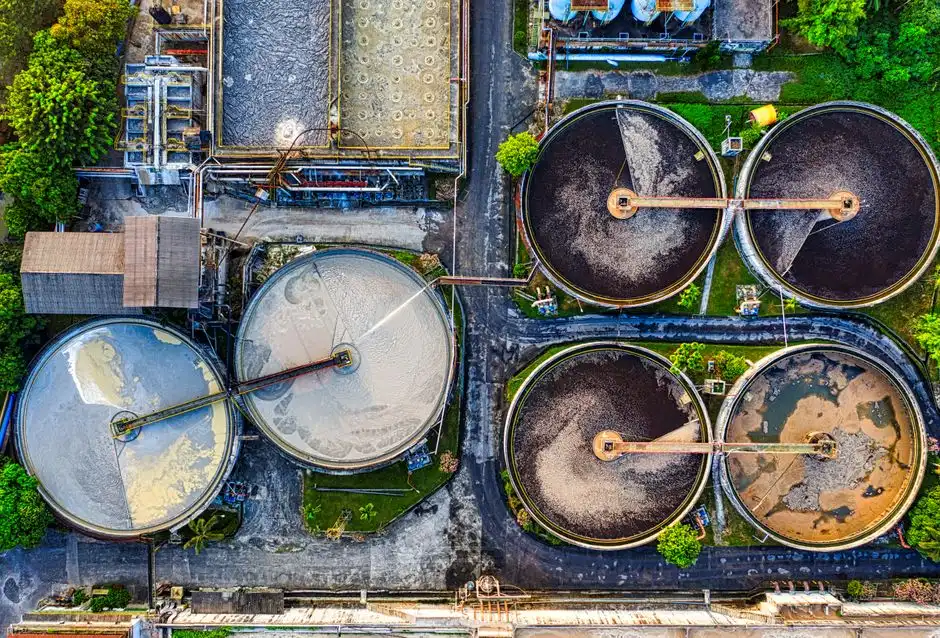
The treatment train should be built in six steps, with each step producing the inputs needed for the next. Source-water chemistry and final disposal constraints determine equipment selection; bypass that sequence and the result is equipment without a defensible design basis.
- Characterize the source water and each waste stream. Request pH, conductivity, total hardness, calcium, alkalinity, silica, suspended solids, chlorides, metals, organics and biological indicators as applicable to the cooling chemistry and permit. Do not limit the investigation to potable-water compliance parameters.
- Define treatment objectives. Establish the permitted cycles of concentration, equipment-protection requirements, receiving-system limits, reuse quality and consequences of an exceedance. Treatment objectives must reflect both equipment reliability and discharge quality.
- Minimize disposal before selecting treatment capacity. Control leakage, segregate incompatible streams, recover water where practical, optimize blowdown and use automatic conductivity-controlled purge where process safety permits. This sequence can reduce the volume that treatment and disposal must handle.
- Apply pretreatment selected by contaminant. Screening, multimedia filtration, ultrafiltration, softening, chemical dosing and dissolved-air flotation may each have a role, but jar or pilot testing should establish applicability before a unit is purchased. Online water-quality monitoring for blowdown control is relevant because treatment objectives must be linked to a measurable control signal.
- Choose the final pathway. Compare authorized sewer discharge, permitted surface-water discharge, off-site treatment and onsite reuse. Obtain written confirmation that the receiving utility or treatment provider will accept the stream, constituent profile and proposed flow.
- Install monitoring and contingency controls. Monitor flow, conductivity, pH and permit-relevant indicators, with defined responses for upset, power loss, chemical-feed loss and high-concentration events. Instrumentation is part of the treatment train, not an accessory.
Source-water chemistry governs more than scaling. Valicor’s 2026 article explains that cycles of concentration—the ratio of dissolved minerals in circulating water to those in make-up water—connect source-water quality to blowdown management and discharge compliance. Municipal, groundwater and surface-water sources have different mineral and biological profiles, so the utility’s water-quality report should be checked against current site conditions.
| Decision point | Required input | Engineering output |
|---|---|---|
| Stream characterization | Site-specific flow, schedule, chemistry and contaminants | Segregated mass balance and peak-load basis |
| Cooling optimization | Make-up-water chemistry, cycles of concentration and operating controls | Target blowdown flow and water-saving opportunities |
| Pretreatment selection | Confirmed contaminant and required effluent quality | Tested process train with equipment sizing basis |
| Disposal selection | Receiving-system acceptance, permit conditions and treatment capacity | Authorized primary and contingency routes |
| Operations and monitoring | Control limits, sampling plan and upset scenarios | Alarm, isolation, storage and response procedures |
For a biological treatment and high-quality reuse application, review the technical limits of MBR advantages and disadvantages before treating MBR as a generic blowdown solution. The proper sequence is source characterization, treatment objective, discharge minimization, pretreatment, pathway selection and monitoring.
Match Equipment to the Wastewater Stream
Treatment equipment should be selected by contaminant and required water quality, not by the assumption that blowdown needs one generic package. Filtration addresses particulates, softening addresses hardness, flotation addresses buoyant and colloidal material, biological treatment addresses biodegradable loads, and filtration equipment handles generated solids.
Multi-media filtration can reduce suspended solids and turbidity when analysis indicates particulate loading and downstream protection is required. An industrial multi-media filtration system should be selected against raw-water characteristics, validated flow and required outlet quality rather than nominal filter capacity alone.
An industrial water softener for cooling-system pretreatment may be justified where hardness and scaling risk warrant it. The KJ-WT product range is rated from 1 to 45 T/h, according to the supplied product information. That is a manufacturer specification, not a recommendation for the Oklahoma City project; the required capacity must be calculated from confirmed makeup-water chemistry and operating flows.
An automatic chemical dosing system can provide controlled pH adjustment, coagulation or scale control. Its feed rate, controls and sequence should follow jar or pilot testing and the cooling chemistry. An automated pump without a validated chemical basis only automates an uncertain dose.
A DAF system for industrial wastewater pretreatment may fit streams carrying oil, grease, suspended solids or colloidal contaminants. The supplied DAF product range is 4 to 300 m³/h; actual selection depends on wastewater analysis, operating flow and required separation.
An MBR integrated wastewater treatment system is appropriate when biological treatment and high-quality reuse are both required. The supplied MBR range is 10 to 2,000 m³/day, with near-reuse-quality effluent below 1 μm filtration. This is a product claim; it does not remove the need to characterize the biological load, reject water, recover solids and prove compliance.
An plate-and-frame filter press can dewater sludge generated by the treatment process. Available filtration areas are 1 m² to 500 m² in the supplied product information. Cake properties, polymer demand, cycle time and disposal route must be included in the solids balance.
Do not default to reverse osmosis for cooling blowdown. It may support high-quality reuse, but recovery, concentrate management, pretreatment, fouling control and energy demand must be evaluated as a complete system. The reverse-osmosis water purification system is one recovery component, not a disposal decision.
Use a Decision Framework for Disposal and Reuse

The best disposal route is the one with verified authorization, dependable capacity and a manageable residual stream. Proximity to a sewer or river does not establish permission to discharge. The receiving authority must confirm acceptance and applicable conditions in writing.
Sewer discharge is appropriate only after the industrial user or POTW confirms that the stream is acceptable, identifies prohibited constituents and establishes any local pretreatment or surcharge requirements. Off-site treatment or hauling can provide contingency for small, variable or chemically complex streams, but the selected service must have compatible treatment capacity, appropriate transport, manifest controls and dependable emergency response.
Surface-water discharge requires the applicable permit, receiving-water analysis and demonstrated compliance. Onsite reuse becomes more attractive when blowdown minimization, recovery equipment, quality monitoring and a committed user align. Evaluate the recovery rate, concentrate disposal and downstream user requirements together; permeate yield alone does not establish a viable reuse system.
| Pathway | Decision condition | Information to obtain | Main risk to resolve |
|---|---|---|---|
| Authorized sewer discharge | POTW accepts the constituent profile and operating flow | Industrial-user requirements, prohibitions, pretreatment requirements, capacity and charges | Exceedance, surcharge or infrastructure-capacity constraints |
| Off-site treatment or hauling | Provider confirms compatible treatment and emergency capacity | Accepted constituents, service territory, response commitments, transport, manifests and disposal route | Service interruption, unavailable capacity or unsuitable waste classification |
| Surface-water discharge | Applicable authorization and receiving-water conditions are demonstrated | Permit, monitoring conditions, receiving-water analysis and operating controls | Noncompliance or inadequate receiving-water capacity |
| Onsite reuse | Water quality, recovery, concentrate handling and user demand align | Reuse specification, whole-system recovery, monitoring, residuals and user commitments | Unusable water quality or residual stream without a disposal route |
Compare each option against permit certainty, uptime, water saved, chemical demand, energy demand, sludge or concentrate disposal, footprint, operating labor and long-term capital cost. The same table structure can be used for bids, but each bidder should populate it with site-specific assumptions and exclusions.
Plan for Permitting, Operations and Supplier Selection
Procurement should begin with a permit and operating-data matrix, not a packaged-plant price. The responsible authorities must determine which approvals and limits apply; a general treatment concept cannot establish site-specific authorization.
Build a matrix covering source-water rights, cooling and wastewater permits, sewer authorization, air and noise obligations, and any discharge-route or reuse approval that applies. For each obligation, identify the responsible party, application timing, monitoring requirement, operating record and renewal owner.
Require bidders to submit a complete process flow, mass balance, sizing basis, chemical and energy consumption, monitoring plan, redundancy strategy, sludge or concentrate plan, O&M assumptions and commissioning acceptance criteria. A price that excludes chemical delivery, waste removal, final disposal, permit support or startup support is not a comparable capital or operating cost.
Evaluate suppliers through demonstrated data-center experience, analytical laboratory support, emergency response, equipment guarantees, local service capacity and references with comparable water chemistry. Ask how the supplier will respond to a chemical-feed loss, high-concentration event, power interruption or permit exceedance. A conductivity-sensor pricing and specification guide can help frame monitoring costs, but it does not replace site-specific instrumentation requirements.
Clarify service boundaries in the contract: equipment supply, installation, commissioning, chemistry, sludge removal, transport, final disposal and permit support should be listed explicitly. Contingency planning should address spills, compressor or power failure, unavailable haul service and temporary high-load startup.
| Procurement package | Minimum information | Acceptance test |
|---|---|---|
| Process basis | Stream segregation, source-water analysis, flow basis, cycles of concentration and receiving-system requirements | Design flow and chemistry match the approved site basis |
| Equipment | Process flow, capacities, materials, controls, redundancy and guarantees | Performance demonstrated under agreed loading |
| Operations | Monitoring, sampling, chemical management, training, O&M and emergency procedures | Operator demonstrates the agreed startup and upset scenarios |
| Residuals | Sludge or concentrate quantity, characterization, transport and final disposal route | No residual stream lacks a documented destination |
| Service and compliance | Response time, laboratory support, permit support and responsibility matrix | Service commitments and responsible parties are contractually defined |
Frequently Asked Questions
What flow and chemistry data are needed to size an Oklahoma City data-center treatment system?
Require average and peak blowdown flow, make-up-water chemistry, cycles of concentration, recovery rate and applicable permit limits. Also obtain domestic, glycol, cleaning, generator and emergency-stream flow data where relevant. The Pryor figures reported by The Oklahoman on 2026-02-24 are not transferable design inputs because the facility, cooling system, source water and permit boundary differ.
What factors should be used to compare treatment-system cost and budget?
Compare site-specific bids using flow and chemistry, treatment level, reuse target, pumping, chemicals, energy, sludge or concentrate disposal and emergency service. Also identify exclusions, escalation assumptions, operator labor, monitoring and disposal charges. Request the same cost boundary from every bidder; the supplied research does not provide a defensible Oklahoma City price, so request an itemized quotation rather than apply an assumed unit rate.
How should an equipment or wastewater-service supplier be selected?
Require demonstrated data-center experience, chemistry and permit support, emergency response, local service capacity and measurable operating guarantees. Check references with comparable water chemistry, define response commitments, and identify who owns installation, commissioning, waste transport, final disposal and permit support. Supplier proximity alone does not establish technical capability or reliable emergency coverage.
Which discharge authorization and limits apply to an Oklahoma City data center?
The responsible authority must determine authorization and applicable limits. For sewer discharge, obtain POTW acceptance and industrial-user requirements; for surface-water discharge, obtain the applicable permit and receiving-water conditions. This article does not assign an Oklahoma City discharge limit because the supplied research does not specify one for the project site. The skid-mounted treatment-plant pricing guide can support bid comparisons, but it cannot substitute for site-specific permits or receiving-system approval.
Can cooling blowdown and other data-center wastewater use one treatment train?
Only after stream segregation and characterization show that the flows are compatible in chemistry, concentration, treatment requirements and disposal authorization. Cooling blowdown may need conductivity, scale-corrosion and reuse controls; glycol, cleaning water and generator liquids may require entirely different handling. A shared final collection system can still be acceptable, but the treatment and disposal decisions should remain traceable to each waste stream.