Map the Wastewater Streams Before Selecting Equipment
An Agege data center needs separate treatment paths for sanitary wastewater, cooling-tower blowdown, and any industrial process wastewater. Cooling blowdown should first be characterized for flow, temperature, pH, conductivity/TDS, silica, calcium, alkalinity, suspended solids, and residual chemicals. A practical treatment train typically uses side-stream solids removal, ultrafiltration, controlled chemical dosing, and brackish-water reverse osmosis where blowdown-to-makeup reuse is justified. Design should target controlled cycles of concentration, with a Lagos reference case proposing 5–6 CoC and LSI between −0.5 and +0.5. Concentrate requires a defined management route, while Nigeria permits and site-specific sampling must determine final discharge requirements.
Begin with four separate flow diagrams rather than one combined wastewater system:
- Cooling-tower blowdown: tower or hybrid-cooler discharge to side-stream filtration, recovery treatment, controlled discharge, or concentrate management.
- Sanitary wastewater: toilet flushing, washroom and staff sewage to the separately selected wastewater treatment or sewer route.
- Industrial process wastewater: any equipment washwater, generator systems, laboratory wastewater or process drains to a dedicated assessment before reuse or discharge is selected.
- Clean-water make-up: municipal, borehole or mixed supply to pretreatment, cooling-tower make-up, and treated-water reuse.
Do not route sanitary sewage through the cooling-blowdown membrane train unless the wastewater network and final reuse route genuinely require it. The treatment objective, receiving water and final reuse quality differ from those for cooling water.
Confirm whether cooling is evaporative, hybrid or once-through. The recoverable stream and its concentration depend on the operating configuration, not only on the data-center IT load.
| Stream | Measure before design | Provisional path | Do not assume |
|---|---|---|---|
| Cooling-tower blowdown | Average and peak flow, temperature, pH, conductivity/TDS, suspended solids, silica, calcium, alkalinity, iron, residual chlorine and treatment chemicals | Side-stream filtration, then cooling reuse, polishing or discharge treatment as approved | That make-up-water chemistry represents blowdown chemistry |
| Sanitary wastewater | Flow, pH, suspended solids, BOD, COD, nutrients, pathogens and collection layout | Separate wastewater treatment, sewer connection or approved reuse train | That cooling-blowdown equipment can accept sewage |
| Industrial process wastewater | Flow, temperature, pH, TDS, metals, oils, solvents, cleaning chemicals and batch profile | Source-specific characterization and treatment | That it is chemically similar to cooling blowdown |
| Clean-water make-up | Flow, pH, conductivity/TDS, silica, hardness, alkalinity, iron, turbidity and microbiology | Filtration, conditioning, softening or RO as required | That one Lagos benchmark applies to every Agege source |
For broader stream-separation examples, see the wastewater and cooling blowdown treatment guide and the data-center treatment approach used in Ribeirão Preto.
Establish the Agege Water and Discharge Basis
The Lagos benchmark identifies brackish feed and concentrated blowdown, but it does not establish Agege site chemistry or permit limits.
HydropureWater’s Lagos reference, dated 2026, reports municipal and borehole feed water at 200–600 mg/L TDS and cooling-tower blowdown at 1,200–6,000 mg/L TDS. These are preliminary Nigerian benchmarks, not Agege design values. Agege could draw from municipal, borehole or mixed supplies, and saline influence, silica, hardness, alkalinity, iron and turbidity must be established through source-specific laboratory testing before membranes, softeners or chemical programs are selected.
The discharge basis is equally site-specific. Identify the authorized discharge point and obtain the current FMEnv, NESREA and applicable state or local permit conditions before defining an effluent target. The HydropureWater Lagos reference identifies FMEnv, NESREA and LASEPA instruments, but it also describes Lagos permit benchmarks rather than an Agege authorization. Do not transfer those benchmark values to the Agege permit without regulator confirmation.
Ask the operator to identify:
- the permit holder and responsible technical operator;
- the owner of the sewer connection and authorized discharge point;
- who installs, calibrates and maintains flow meters and chemistry analysers;
- whether thermal discharge or concentrated blowdown is accepted;
- who owns operating, calibration and compliance records.
Retain flow, temperature, pH, conductivity/TDS and every permit-specified chemistry parameter in an SCADA-exportable record. The data-center blowdown treatment guide for Lusaka provides a comparable framing for a non-Lagos African site, but its local requirements still require separate verification.
| Design basis | Verified benchmark or requirement | Agege action |
|---|---|---|
| Make-up-water chemistry | 200–600 mg/L TDS municipal or borehole feed reported by HydropureWater’s Lagos reference, 2026 | Sample every actual source over operating and seasonal conditions |
| Blowdown chemistry | 1,200–6,000 mg/L TDS reported by HydropureWater’s Lagos reference, 2026 | Measure the actual tower concentration and chemistry |
| Regulatory basis | FMEnv, NESREA and applicable Lagos State or local requirements identified by HydropureWater, 2026 | Obtain current permits and written discharge conditions for the selected outfall |
| Compliance records | Flow, pH, temperature and conductivity logging identified by HydropureWater, 2026 | Define calibrated instruments, export frequency, retention and responsible operator |
Calculate the Treatment Duty from the Cooling Water Balance
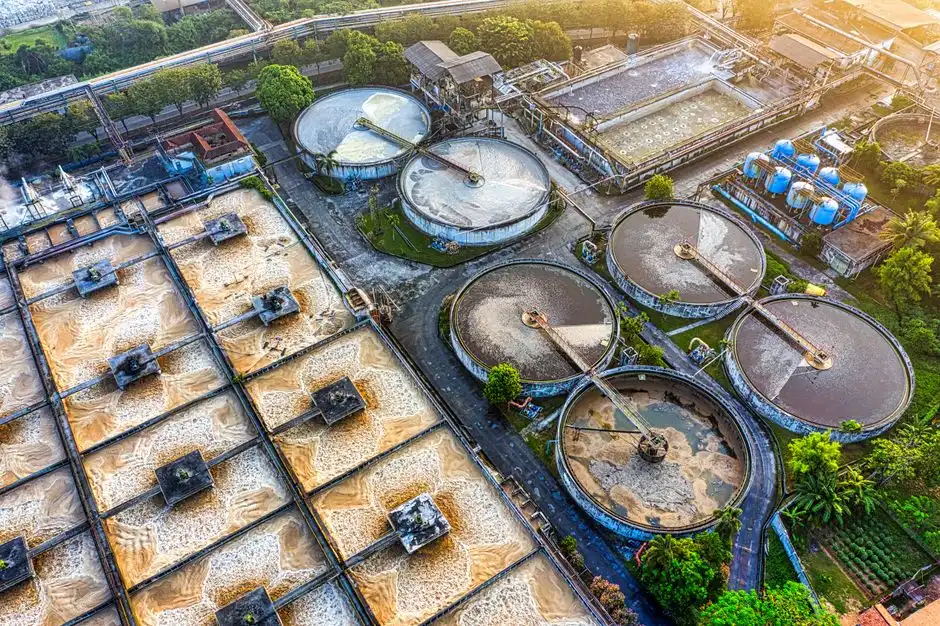
Cooling-blowdown treatment capacity must come from the approved heat-rejection load, cooling configuration and water balance—not a generic data-center flow.
Use the following sequence:
- Determine the facility heat-rejection load and the fraction assigned to each cooling system.
- Calculate tower evaporation from heat rejection and cooling-system efficiency.
- Calculate blowdown as evaporation ÷ (CoC − 1).
- Cross-check evaporation, blowdown and make-up against the site water balance and measured utility consumption.
- Size pretreatment and recovery equipment using both peak blowdown and the duty left during filter cleaning, maintenance or recovery outages.
Genesis Water Technologies’ 2026 relationship gives a theoretical blowdown ratio of 1/(CoC − 1): 25% at 4 CoC and 20% at 6 CoC. Moving from 4 to 6 CoC therefore reduces blowdown by 20%, not 50%.
HydropureWater’s Lagos reference, dated 2026, provides a worked reference rather than an Agege input. At a stated 50 MW heat load and 80% cooling-tower efficiency, it reports approximately 99,537 kg/h evaporation, about 33,000 kg/h blowdown at 4 CoC, and about 19,900 kg/h at 6 CoC.
Do not apply peak-load, fouling, maintenance, simultaneous-tower or outage factors until the client has approved the heat-rejection and cooling configuration. Those factors affect equipment resilience and redundancy, but applying them before the base duty is known can distort both price and capacity.
| Calculation input | Reference value | Status for Agege design |
|---|---|---|
| Reference heat load and tower efficiency | 50 MW and 80% in HydropureWater’s Lagos reference, 2026 | Replace with the approved Agege heat-rejection design |
| Reference evaporation | Approximately 99,537 kg/h | Illustration only; recalculate for Agege |
| Blowdown at 4 CoC | Approximately 33,000 kg/h | Recalculate from approved evaporation |
| Blowdown at 6 CoC | Approximately 19,900 kg/h | Recalculate and confirm scaling and biological control |
| Site water-demand cross-check | 1.14–1.70 million L/day for a 15–20 MW site and up to 2 million L/day for 100 MW, as reported in HydropureWater’s Lagos reference, 2026 | Use to reconcile the water balance, not as equipment sizing |
The multi-media filtration equipment should be selected only after the calculated pretreatment flow, feed chemistry and required solids-removal duty are documented.
Choose the Appropriate Treatment Route
Three treatment routes are defensible for Agege, but the correct route depends on discharge permission, reuse value, concentrate constraints and operator capability.
| Route | Process scope | Best fit | Principal trade-offs |
|---|---|---|---|
| A. Controlled discharge | Chemical control, filtration, monitoring and legally permitted discharge | Receiving system accepts the conditioned stream and reuse savings are limited | Lower treatment complexity, but continued discharge and freshwater demand |
| B. Process-water reuse | Physical separation with targeted polishing for toilet flushing, washing or another approved non-critical use | A defined internal demand exists and discharge restrictions are significant | Reduces blowdown without closing the cooling-water loop; reuse quality must match each destination |
| C. Closed-loop make-up recovery | Multi-media filtration, side-stream solids removal, UF and brackish RO, with concentrate management | Blowdown-to-makeup reuse is approved and technically viable | Higher capital, energy, chemical, cleaning and concentrate-management obligations |
Route A should not be selected merely because it has the shortest equipment list. Confirm that the receiving system legally accepts the conditioned stream and that its thermal and chemical limits can be met. Route B requires demand-side controls, including the sanitary fixture or wash process that will actually consume the recovered water. Genesis Water Technologies identifies irrigation, toilet flushing and equipment washing as reuse pathways, but each requires its own quality and plumbing review.
Route C normally uses a hollow-fiber ultrafiltration system ahead of an industrial reverse osmosis system. HydropureWater’s Lagos reference, 2026, cites 75–85% BWRO recovery and 10–50 mg/L TDS permeate for cooling-tower make-up. IDE Tech reports that conventional BWRO commonly reaches 75–80% before scaling becomes difficult.
For higher recovery, evaluate controlled precipitation or a dedicated brine-desalter route rather than forcing conventional RO beyond its scaling limit. IDE Tech describes an industrial application operating at around 95% recovery, with permeate silica reduced to about 1 mg/L. That is a referenced high-recovery case, not a generic Agege guarantee.
Do not assume RO improves the facility’s climate balance automatically. Open Engineering Inc.’s 2026 life-cycle analysis found the wastewater scenario had approximately twice the GWP of the freshwater case, with treatment energy accounting for roughly 80% of the difference. Compare energy, chemicals, cleaning, sludge, concentrate disposal, redundancy and downtime—not water savings alone.
Protect the Membrane Train and the Cooling Equipment
Reliable UF and RO operation depends on controlling solids, scale, corrosion and biology before the water reaches the membranes.
HydropureWater’s Lagos reference identifies multi-media filtration as the first barrier before side-stream filtration and UF, with the multi-media stage reducing turbidity below 3 NTU. It also identifies self-cleaning 10–25 µm screens handling 1–5% of circulation flow. These values belong to the Lagos reference dated 2026 and must be checked against the selected equipment and Agege feed data.
The hollow-fiber ultrafiltration system uses 0.03 µm PVDF membranes, accepts turbidity up to 300 ppm, and provides automatic backwash and air scour. These specifications identify the stated equipment envelope; they do not remove the need to confirm feed temperature, solids loading, flux, recovery and chemical compatibility.
Use PLC-controlled antiscalant, biocide and pH adjustment where required. HydropureWater’s Lagos reference recommends keeping LSI between −0.5 and +0.5 to protect chillers, heat exchangers and membranes. Control biological growth, corrosion and scaling rather than using chemical additions that unnecessarily raise dissolved solids and worsen downstream RO loading.
Specify automatic monitoring for permeate quality, differential pressure, conductivity and flow, with timestamped data export. The instrument set must match the permit and performance test, not only the control philosophy. The Lagos reference identifies flow metering, pH, temperature and conductivity logging; additional permit chemistry should be added only after the permit conditions are confirmed.
| Protection layer | Design requirement | Evidence required |
|---|---|---|
| Media filtration | Remove suspended solids and turbidity before UF | Feed and filtered-water turbidity, solids and pressure records |
| Side-stream filtration | Control blowdown solids before membrane treatment | Screen differential pressure, solids-removal performance and solids-disposal route |
| UF | Provide membrane-friendly feed with automatic backwash and air scour | Flux, recovery, transmembrane pressure, filtrate quality and cycle records |
| Chemical control | Manage scaling, corrosion, disinfection and pH through interlocks | Dosage rates, tank levels, calibration and alarm history |
| RO | Protect membranes through feed chemistry and operating control | Permeate conductivity, normalized permeate flow, differential pressure and cleaning records |
Automatic chemical dosing should be linked to the PLC-controlled chemical dosing system, while valves and media selection should remain consistent with the available treatment components and service requirements.
Resolve the Concentrate Route Before Buying the Plant
Concentrate management must be contracted and priced before the treatment plant is tendered.
HydropureWater’s Lagos reference, 2026, reports RO concentrate at 5,000–8,000 mg/L TDS and states that it cannot simply be sent to a managed storm drain. That warning is technically relevant to Agege, but the authorized disposal route must be established with the relevant authority rather than inferred from the Lagos example.
Compare at least three routes:
- On-site buffer storage followed by licensed hauling: requires storage capacity, bunding, drainage isolation, truck access, licensed carriers and manifest procedures.
- Further treatment followed by lawful discharge: requires confirmation that the treated concentrate meets the actual permit and receiving-water conditions.
- Evaporation or high-recovery treatment: requires an energy, maintenance, solids-handling and land assessment. It is not automatically justified by a high-recovery objective.
Request a complete mass balance covering recovered water, residual discharge, salt, chemical additions, sludge, precipitated solids and off-site transport. Inherited equipment may change the concentrate chemistry and mass distribution, so the balance must follow the actual process route.
Do not specify zero-liquid-discharge intent until the site, utility connection and transport arrangements have been reviewed. HydropureWater positions ZLD as a higher-cost option in its 2026 Lagos reference; no Agege ZLD price is established by the research.
| Concentrate route | Design scope | Procurement evidence |
|---|---|---|
| Licensed hauling | Buffer vessel, bunding, isolation drainage, loading arrangement and manifests | Carrier credentials, route, waste classification, destination and contracted capacity |
| Further treatment and discharge | Polishing or concentration-reduction unit, sampling and discharge controls | Permit, receiving-point approval and guaranteed final-water chemistry |
| Evaporation or high recovery | Evaporator or brine-desalter route, solids removal, utilities and redundancy | Energy demand, scale formation, waste route, availability and recovery guarantee |
Where solids removal is required, evaluate a plate-and-frame filter press for dewatering and a sedimentation treatment stage for solids capture. Their selection must follow the confirmed solids mass, settling characteristics and destination for the resulting cake or sludge.
Build a Procurement-Ready Equipment and Performance Checklist
A defensible tender starts only after flow, chemistry, heat load, CoC, reuse destination, permit route and concentrate destination are approved.
Issue separate process, electrical, controls, civil, commissioning and environmental scopes. Require suppliers to price the complete duty, including offsite interfaces and utility connections. Do not compare bids on nominal flow alone.
Require contractual guarantees for:
- gross permeate flow and product-water quality;
- system recovery;
- equipment availability and treatment-train availability;
- energy and chemical consumption under the agreed design basis;
- membrane cleaning frequency and expected life;
- concentrate flow and chemistry;
- permeate-quality rejection response and automatic controls;
- documentation, training, warranty exclusions and local service support.
Pre-operation and performance testing should record feedwater, permeate, concentrate, pH, conductivity, flow, temperature and differential pressure. Add silica, calcium, alkalinity, suspended solids, microbial indicators and permit parameters where they are part of the acceptance basis.
Require PLC/SCADA integration, automatic backwash, chemical interlocks, high-pressure protection, leak detection, calibrated instruments, spare parts and documented maintenance routines. The required control architecture can be benchmarked against the PLC control architecture for wastewater treatment.
| Procurement check | Buyer action | Acceptable supplier evidence |
|---|---|---|
| Approved design basis | Freeze site-specific flows, chemistry, heat load, CoC and destinations before tender | Signed design-basis and process-flow drawings |
| Performance guarantee | Define flow, quality, recovery, availability, cleaning, power and chemical guarantees | Signed guarantee schedule with test conditions and remedies |
| Commissioning | Set pre-operation, wet, performance and reliability tests | Raw data, calibration certificates and witnessed test reports |
| Controls and records | Require alarm, interlocks, data export and audit history | SCADA configuration, FAT/SAT records and backup procedure |
| Operations | Require procedures, training, maintenance, membrane plan and warranty exclusions | Manuals, training records, competency assessment and support agreement |
| Total cost | Compare utility water, discharge charges, energy, chemicals, labour, sludge, concentrate transport, downtime and permit risk | Open life-cycle cost model with assumptions and sensitivity cases |
For site-specific automation scope, also compare the municipal wastewater PLC-control engineering guide with the data-center control requirement.
Frequently Asked Questions
How much does cooling-blowdown treatment cost for an Agege data center?
No defensible Agege quotation can be issued without approved flow, chemistry, heat load, CoC, reuse destination and concentrate route. HydropureWater’s 2026 Lagos reference reports $1.2–2.5 million for a full 200–300 m³/day reuse plant, depending on concentrate handling, and identifies ZLD as a higher-cost option. Those are Lagos reference points, not Agege prices. Request an itemized offer covering equipment, pretreatment, membranes, controls, civil works, utilities, commissioning, chemicals, sludge and concentrate transport, plus stated energy and chemical consumption.
What capacity is needed for a 5 MW or 15 MW Agege data center?
Capacity must be calculated from the approved heat load, cooling efficiency, evaporation and target CoC. Genesis Water Technologies’ 2026 example states that a 10 MW evaporative-cooling facility at 4 CoC may have a 25% blowdown ratio, while HydropureWater’s 2026 Lagos reference associates a 15–20 MW site with 1.14–1.70 million L/day of overall demand. Neither value sizes an Agege treatment plant. Request the site water balance, peak duty, redundancy philosophy and measured or warranted blowdown availability before selecting capacity.
Should the project use UF and RO, or can blowdown be reused without RO?
UF and RO are justified when the required reuse destination is cooling-tower make-up and the chemistry permits the specified recovery. Physical separation and targeted polishing may be sufficient for an approved non-critical process use, while controlled discharge may be preferable if the receiving system legally accepts the stream. Genesis Water Technologies identifies filtration followed by targeted treatment for process reuse, and HydropureWater’s 2026 Lagos reference identifies UF as the standard RO-pretreatment barrier. The decision must be based on reuse quality, chemistry, recovery and concentrate fate.
Which Nigerian permits and records are required before commissioning?
Obtain the current discharge authorization for the selected outlet and confirm the applicable FMEnv, NESREA and Lagos State or local requirements. HydropureWater’s 2026 Lagos reference identifies those regulatory layers and site-specific flow, pH, temperature and conductivity logging, but the Agege permit holder and actual limits must be confirmed in writing. The commissioning record should include permit conditions, calibrated instrument certificates, source analyses, operating setpoints, alarm tests, calibration records, training and signed acceptance results.
How should a supplier demonstrate that the plant will meet its performance guarantee?
Require a witnessed test at the agreed design basis using measured feedwater and recorded operating conditions. The test should verify gross permeate flow, product quality, recovery, concentrate flow and chemistry, power consumption, chemical consumption and treatment-train availability. Include membrane cleaning intervals, automatic backwash, interlocks, leak detection, SCADA data export and a documented remedy for failure. A performance test without raw time-series records and calibrated instruments is not sufficient evidence.