Start with the sewer-connection decision
For a Manchester housing development, the first decision is whether United Utilities can provide a hydraulically capable sewer connection; if it can, a package treatment plant may be unnecessary. Where no connection is available, the developer must own the treatment works and the associated Environment Agency discharge-consent risk. Only after that route is defined should buried A/O contact oxidation or packaged MBR be assessed against design flow, consent limits, land availability, reuse and operating responsibility.
United Utilities assesses forecast dry-weather flow, flow-to-full-treatment and final-effluent permit requirements when determining whether wastewater infrastructure can support development. Its 2026 proposal for £309.4m across 34 wastewater treatment works, including sites in Greater Manchester, shows that regional capacity is changing, but it does not establish capacity for an individual plot (United Utilities, 2026).
The practical decision rule is therefore:
- Submit a United Utilities pre-development application with forecast flow, load and development phasing.
- Confirm the connection point, capacity, adoption conditions, connection charge and required upgrade contribution.
- If no feasible connection exists, establish the receiving-water route and engage the Environment Agency before freezing the treatment duty.
- Compare whole-life sewer and on-site alternatives rather than selecting equipment from brochure capacity alone.
| Development route | Developer’s responsibility | Preliminary conclusion |
|---|---|---|
| United Utilities sewer connection | Provide the connection and meet any infrastructure or contribution requirements confirmed by United Utilities | Preferred where hydraulic and load capacity is confirmed |
| No sewer connection | Own treatment, operation, sludge management, monitoring and discharge-consent compliance | Proceed to permit-led process selection |
Related city cases show the same decision structure in the London housing package-plant comparison and Birmingham housing package-plant comparison.
Identify the Manchester consent that drives plant selection
A discharge to the Irwell or Mersey is judged against site-specific environmental consent conditions anchored to the 91/271/EEC envelope. HydropureWater’s Manchester guidance gives 25 mg/L BOD, 125 mg/L COD, 60 mg/L TSS and 2 mg/L total phosphorus for catchments serving more than 100,000 people, with the Irwell/Mersey identified as sensitive (HydropureWater, 2026).
The worked sensitive-catchment example adds 15 mg/L total nitrogen while retaining 2 mg/L total phosphorus. The same guidance notes that phosphorus is often 1 mg/L for new permits, subject to the site-specific consent. Consequently, a process capable of the general urban-wastewater envelope may still be unsuitable if the draft permit imposes tighter nutrient conditions or reuse requirements.
Permit route and process requirements should be considered together. The Manchester guidance states that a discharge exceeding 5 m³/day to surface water or 10 m³/day to ground in the Irwell/Mersey catchment needs a bespoke environmental permit under the Environmental Permitting (England and Wales) Regulations 2016. The design statement should demonstrate performance against applicable consent limits under the applicable 95-percentile rule, rather than relying on an average concentration.
| Consent or design item | Scope | Engineering consequence |
|---|---|---|
| BOD, COD and TSS | 91/271/EEC envelope cited for catchments above 100,000 people | Confirm biological and solids-removal performance |
| Total nitrogen | 15 mg/L in the cited sensitive-catchment example | Assess biological nitrogen removal rather than assuming conventional A/O is sufficient |
| Total phosphorus | 2 mg/L in the cited envelope; 1 mg/L often sought for new permits | Resolve the final limit before process selection |
| Discharge threshold | More than 5 m³/day to surface water or 10 m³/day to ground | Prepare a bespoke permit application in the cited catchment |
| Performance basis | Applicable 95-percentile rule | Size and demonstrate the complete treatment train, not an average effluent result |
Metals and sludge should be planned early. Mass-balance research cited in the Manchester guidance reports that roof and street runoff contributes 50–80% of Cd, Cu, Pb and Zn in the mixed sludge stream (Sustainability, MDPI, 2014). Surface water should therefore be excluded upstream of the package plant, with foul sewage, inlet protection and sludge monitoring included in the consent strategy. The plate-frame filter press and rotary mechanical bar screen may form parts of the wider treatment and sludge train, but neither substitutes for site-specific design.
Turn housing-development data into a design duty

Package capacity becomes defensible only after measured water use, population equivalents, foul-flow peaks and discharge constraints are reconciled. Before selecting equipment, request metered or measured domestic wastewater data, the development phasing schedule, population equivalents, the foul and surface-water split, peak-flow assumptions, groundwater conditions and the intended discharge point. Influent testing is also required because nominal flow alone cannot establish biological loading or treatment reliability.
The supplied residential example uses 200 m³/day and approximately 1,500 PE. These figures describe the same development from different angles, but they must still be reconciled with water-use data and the proposed phasing. For an initial equipment comparison, the duty can be represented as an average daily flow with a separate peak check; for procurement, it should be issued as a complete design basis with the proposed and ultimate development scenarios.
The Manchester-by-the-Sea municipal reference provides an order-of-magnitude comparison rather than a mandatory housing peak factor. It records average daily flow of 1.2 MGD, maximum daily flow of 3.0 MGD and instantaneous flow of 5.0 MGD, corresponding to factors of 2.5× on the daily average and 4.2× on the instantaneous flow (Manchester-by-the-Sea Sewage Treatment, accessed 2026). The project designer must select the final factors from local flow evidence and the wastewater network’s design basis.
| Design input | Evidence to request | Decision affected |
|---|---|---|
| Domestic wastewater design flow | Measured or metered water use and phased occupancy | Hydraulic capacity and redundancy |
| Population equivalent | Occupancy and development schedule reconciled with flow data | Biological loading |
| Peak flow | Site-specific peak-factor assessment | Tank and treatment capacity |
| Influent quality | Sampling and laboratory analysis | Process selection and performance guarantee |
| Surface-water exclusion | Drainage strategy, runoff source control and outfall information | Hydraulics, metals and sludge load |
| Discharge consent | Draft permit, receiving-water constraints and reuse conditions | Effluent targets and treatment train |
Nominal capacity is therefore a screening value, not a performance guarantee. Influent testing, receiving-water constraints, permit limits, peak duty, redundancy and the final equipment proposal must be checked before the duty is frozen.
Compare buried A/O and packaged MBR for housing
The buried A/O option is appropriate where the consent can be met without reuse and a low-maintenance, low-surface-impact solution is preferable. The cited WSZ range is 1–80 m³/h, integrating anoxic/aerobic contact oxidation, sedimentation and disinfection in a fully buried unit described as requiring no operator (HydropureWater verified product catalog, 2026). Its published process envelope is aligned with 25 mg/L BOD, 125 mg/L COD and 60 mg/L TSS, but the actual permit still governs.
A submerged PVDF membrane bioreactor offers more treatment and reuse headroom in a smaller footprint. The cited MBR range is 10–2,000 m³/day, with effluent described as below 1 μm and approximately 60% smaller than a conventional system of equivalent duty (HydropureWater verified product catalog, 2026). That treatment quality can support downstream disinfection and non-potable reuse where consent permits. The additional control is operational: the MBR route requires quarterly membrane clean-in-place and trained-operator oversight, whereas the WSZ is described as running unattended between 12-monthly sludge offloads.
| Decision criterion | Buried WSZ A/O | Packaged MBR |
|---|---|---|
| Cited range | 1–80 m³/h | 10–2,000 m³/day |
| Core process | A/O contact oxidation, sedimentation and disinfection in a buried unit | Activated sludge with submerged PVDF membrane filtration |
| Consent fit | Suited to the cited 25 mg/L BOD, 125 mg/L COD and 60 mg/L TSS envelope where no reuse is needed | More headroom for tighter conditions, nitrogen-sensitive design or reuse |
| Site impact | Typically buried 2–4 m to invert; surface can be landscaped or used for parking | Approximately 60% of conventional footprint, with skid-mounted equipment |
| Operator requirement | No operator; 12-monthly sludge offloads | Quarterly membrane CIP and trained operator |
| Sludge route | Requires a defensible management plan | Requires a defensible management plan |
Land use differs as well as process performance. A WSZ arrangement can return the occupied surface to landscaping or parking, while the MBR’s smaller footprint may be decisive on a constrained urban site. For equipment review, compare the buried WSZ A/O package sewage treatment plant against the packaged MBR wastewater treatment system; module-level information is also available for the DF membrane bioreactor modules.
Sludge remains a consent-critical stream in either case. The supplied sequence thickens sludge to 5% DS and presses it to 18–25% DS before transport or permitted reuse (HydropureWater, 2026). The wider treatment train must therefore address headworks, biological treatment, clarification or membrane filtration, disinfection and sludge handling as one train. A UV disinfection system may be required where the effluent quality and consent support non-potable reuse.
Apply the decision to a 200 m³/day Manchester development
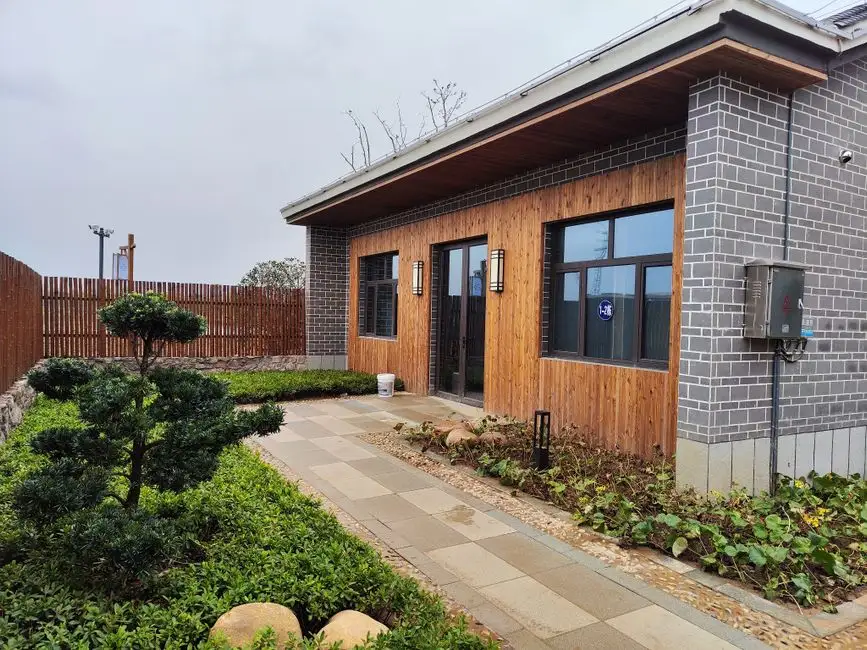
For the illustrative 200 m³/day, approximately 1,500 PE residential case discharging to the Irwell/Mersey catchment under a sensitive-area condition of 15 mg/L total nitrogen and 2 mg/L total phosphorus, the choice depends on effluent headroom and reuse—not simply equipment price.
For standard treatment without reuse, the supplied configuration uses 2 × WSZ-80 units in duty/standby, with combined nominal capacity of 160 m³/h. The units can be buried so that the surface is landscaped or used for parking. This arrangement provides redundancy, but the nitrogen condition must still be demonstrated against the final consent rather than inferred from the general A/O envelope.
Where tighter effluent, nitrogen-sensitive treatment or reuse is required, the supplied configuration uses 2 × DF225 modules, producing up to 270 m³/day combined, with each module rated at 32–135 m³/day and one module available as standby. The <1 μm effluent can feed a UV bank for non-potable reuse under an Environment Agency controlled activity. The trade-off is quarterly membrane CIP, trained-operator input and replacement-spares management.
| Illustrative option | Configuration | Primary justification | Principal risk |
|---|---|---|---|
| Buried A/O | 2 × WSZ-80 in duty/standby; 160 m³/h combined nominal capacity | Standard discharge without reuse; surface returned to development | Limited headroom if consent is tighter than the general envelope |
| MBR | 2 × DF225 modules; up to 270 m³/day combined | Tighter effluent, nitrogen-sensitive design, footprint or reuse | Membrane CIP, operator attendance and replacement spares |
This is an illustrative design from the supplied source, not a universal Manchester sizing rule. Site data, phasing, peak flow, current permit conditions and the final equipment proposal determine the specification.
Build the procurement and consent package
A defensible tender requires a site-specific performance guarantee tied to the applicable effluent limits, not simply a statement that the offered equipment falls within a published flow range. The bid should address average and peak hydraulic duty, duty/standby redundancy, future phasing, inlet works, odour control, controls, power, access, sludge removal, membrane maintenance, critical spares and remote alarms.
- Define the permit basis: issue the draft consent, receiving-water route, numeric limits and monitoring requirements.
- Define the hydraulic and loading basis: provide measured water use, population equivalents, development phasing, peak assumptions and influent test data.
- Require a complete treatment train: identify headworks, biological treatment, clarification or membrane filtration, disinfection and sludge handling without leaving permit-critical interfaces implicit.
- Control runoff at source: exclude roof and street runoff from the foul treatment stream because the cited mass-balance evidence identifies runoff as a major contributor to metals in mixed sludge.
- Require demonstrable compliance: state the applicable 95-percentile performance basis and identify every assumption still subject to the current permit or final proposal.
- Close the operating handover: include commissioning tests, operator training, monitoring support, sludge-removal arrangements, maintenance schedules and critical spares.
Relevant civil and equipment interfaces can be specified through the rotary mechanical bar screen, high-efficiency sedimentation tank and chlorine dioxide generator. Each remains subject to the complete process design; inclusion of an item in a bid is not evidence that it is required at the site.
Before award, check that the supplier has used current permits, influent testing and the final proposal—not generic catalogue assumptions—to establish the duty. Any value that remains unresolved should be listed as a design assumption, with the consent or test needed to close it.
Frequently Asked Questions
Does a United Utilities sewer connection make a package treatment plant unnecessary?
Usually, yes. A hydraulically capable connection avoids the developer owning treatment, sludge management and discharge-consent risk. United Utilities assesses dry-weather flow, flow-to-full-treatment and final-effluent requirements, so the connection must be confirmed through a pre-development application rather than assumed from proximity to a sewer.
How should a Manchester housing development be sized?
Start with measured or metered water use, then reconcile it with population equivalents, development phasing, average and peak flows, influent testing, surface-water separation and the discharge permit. The final duty should cover duty/standby arrangements and the proposed and ultimate development scenarios rather than rely on nominal package capacity.
Is MBR worth the additional cost for housing?
Only where its additional capability has a defined project value, such as tighter effluent conditions, nitrogen-sensitive design, a constrained footprint or non-potable reuse. Require a whole-life comparison of equipment, civils, utilities, operator hours, membrane cleaning, replacement spares and sludge handling. The supplied research does not provide a Manchester quotation, so request a site-specific price and lifecycle-cost schedule from bidders.
What should a supplier quotation include for Manchester consent and delivery?
Require a performance guarantee against the site-specific limits, peak duty, redundancy, civil interfaces, controls, installation, commissioning, operator training, O&M, sludge handling, spares and monitoring support. Also request the proposed permit conditions, delivery schedule, utility requirements and any assumptions still requiring Environment Agency or United Utilities confirmation. For sludge-handling design, the sludge dewatering equipment guide provides relevant equipment context, but the Manchester design must use its own flow and solids data.
What can delay a Manchester discharge consent?
Common causes are uncertainty over the receiving water, incomplete flow and load evidence, unconfirmed permit conditions, and insufficient provision for metals and sludge monitoring. A robust application should also show that surface water is separated from foul sewage upstream of the package plant. The consent application and planning design statement should use the same process train, assumptions and monitoring basis.