Choose the discharge route before choosing the equipment
No packaged sewage treatment plant should be shortlisted for a London housing development until the discharge route and receiving authority are confirmed. A public sewer connection, a ground discharge under standard rules and a surface-water discharge are separate consent routes with different design consequences. The London domestic sewage treatment compliance guide identifies Section 106 connection with the local sewerage company—normally Thames Water in London—as the route for a new public-sewer connection.
For a qualifying, purely domestic packaged plant discharging to ground at no more than 5 m³/day, the same 2026 guide identifies SR2015 No1 as the applicable standard-rules permit. Above that flow, or for a surface-water discharge within the scope described by the guide, a bespoke Environmental Permit is required. HydropureWater’s 2026 guide states that permit determination typically takes 8–13 weeks after a complete application, so this route must be programmed before selecting equipment.
Do not assume that connecting to a public sewer removes the need to assess a separate on-site discharge. Also confirm whether the drainage contains trade effluent rather than only domestic sewage: the 2026 guide states that commercial-process wastewater is regulated through the sewerage company’s trade-effluent regime. That classification can change both the consent route and the pretreatment required.
| Discharge route | Indicative threshold or condition | Consent action before equipment selection |
|---|---|---|
| Public sewer | New connection to a public sewer | Section 106 application to the relevant sewerage company; normally Thames Water in London |
| Ground discharge | Qualifying domestic plant up to 5 m³/day | Confirm SR2015 No1 applies to the proposed discharge |
| Bespoke environmental permit | Above 5 m³/day or a surface-water discharge within the guide’s scope | Complete the application and environmental assessment; HydropureWater’s 2026 guide gives a typical 8–13-week determination period after a complete application |
| Private sewer serving multiple plots | Connection or adoption proposed | Assess Section 104 adoption requirements with the relevant sewerage company |
Build the London approval checklist
Planning, Building Control, environmental permitting and sewer adoption are separate approvals and must be coordinated rather than treated as one consent. HydropureWater’s 2026 guide states that conservation areas, Green Belt and Article 4 directions can tighten planning rules for buried tanks and kiosks; the practical first step is a planning pre-application check. Record whether the plant and access works need full planning permission rather than relying on the general permitted-development position.
- Confirm planning status. Identify the site constraints and obtain a pre-application view before fixing the plant location.
- Develop the Building Regulations design. The 2026 guide states that Approved Document H addresses venting, siting and ground-discharge suitability, including a percolation test where discharge is to ground. Building Control approval does not replace environmental discharge consent.
- Resolve the discharge permit. Confirm whether the route is SR2015 No1, a bespoke Environmental Permit or a sewer connection.
- Establish sewer adoption duties. Determine whether Thames Water or another relevant sewerage company must approve the connection, and whether a new private sewer serving multiple plots must be offered for adoption under Section 104.
The supplier’s submission should be an integrated package with one PLC covering biological treatment, disinfection and sludge handling—not disconnected equipment lists. This makes the control philosophy, alarms, maintenance access and operating responsibility auditable before construction.
Size the plant on flow and load
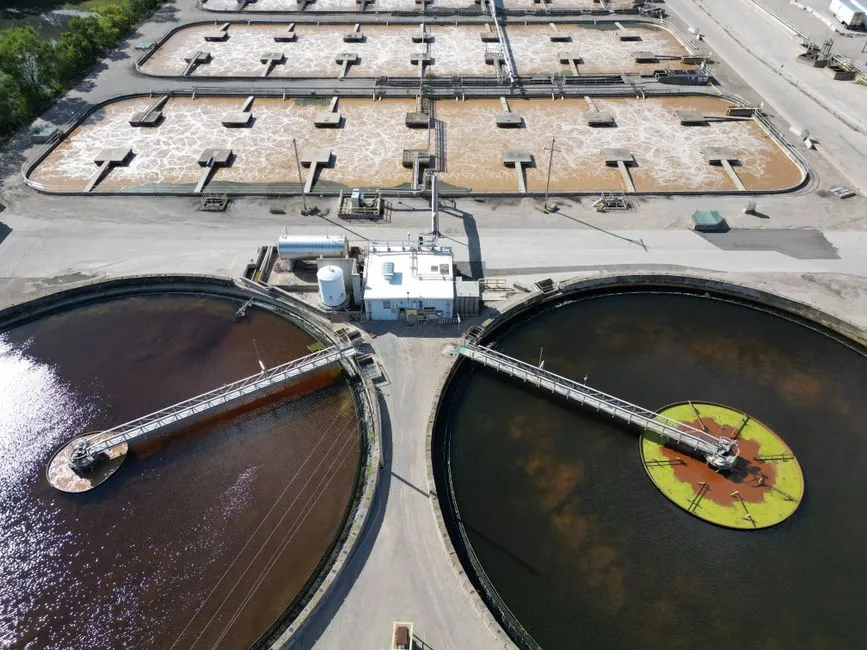
A London housing plant must be sized on both hydraulic flow and contaminant load. HydropureWater’s 2026 sizing practice uses 150 L/head/day for residential flows and 200–250 L/head/day for hotels. It applies a 2.5× peaking factor for steady residential occupancy and 3.5–4× for transient occupancies such as hotels, student housing and short-let blocks.
For the supplied 80-unit residential example, 80 units multiplied by 2.5 occupants and 150 L/head/day gives approximately 30 m³/day mean flow. Applying the 2.5× residential peak factor gives approximately 75 m³/day peak flow. This establishes a preliminary hydraulic envelope; the final selection still requires site-specific hydraulic review.
Flow alone does not size the biological stage. HydropureWater’s 2026 guide places domestic sewage at 200–400 mg/L BOD, 250–450 mg/L COD and 40–60 mg/L ammonia. Convert the selected flow into kg BOD/day and check it against the biological loading rate. The same guide specifies a typical food-to-microorganism ratio of 0.05–0.15 kg BOD/kg MLSS/day for A/O contact oxidation and 0.03–0.08 for MBR.
For mixed-use developments, the 2026 guide advises adding 10–20% to flow. Route trade effluent through appropriate pretreatment, such as a grease trap or the linked dissolved-air flotation unit, rather than allowing it to enter the domestic biological stage untreated.
| Design input | Supported basis | Procurement or design check |
|---|---|---|
| Residential flow | 150 L/head/day | Confirm occupancy and any mixed-use allowance |
| Residential peak | 2.5× mean flow | Confirm hydraulic profile, storage and equalisation requirements |
| Transient occupancy | 3.5–4× mean flow | Use only where the occupancy pattern supports it |
| Domestic load envelope | 200–400 mg/L BOD; 250–450 mg/L COD; 40–60 mg/L ammonia | Obtain site-specific influent evidence where available |
| A/O biological loading | 0.05–0.15 kg BOD/kg MLSS/day | Check tank volume against the selected load |
| MBR biological loading | 0.03–0.08 kg BOD/kg MLSS/day | Check membrane and biological sizing separately |
Compare A/O, MBR and MBR plus UF
Process selection follows the discharge route, flow and load, footprint, consent sensitivity and reuse requirement. A/O is normally the first candidate for a conventional development with space, modest loading and no reuse duty. MBR becomes more defensible where land is constrained or the discharge requires additional treatment confidence. MBR plus UF should follow a defined reuse specification, not a general desire for the most advanced equipment.
HydropureWater’s 2026 guide describes its buried A/O package treatment plant as combining anoxic and aerobic contact oxidation, sedimentation and disinfection in one automated buried unit, with capacity from 1–80 m³/h. Its integrated MBR wastewater treatment system covers 10–2,000 m³/day, provides filtration below 1 μm and occupies approximately 60% less footprint than a conventional activated-sludge plant, according to the 2026 guide.
Where toilet flushing, irrigation or laundry reuse is specified, the guide identifies MBR plus UF as the appropriate process. The UF polishing system for treated wastewater reuse adds a 0.03 μm stage. HydropureWater’s 2026 guide states that reuse in England requires a separate water-quality permit and a site-specific wastewater reuse risk assessment; SR2015 No1 does not cover reuse.
The cost comparison also needs a reason. The 2026 guide places A/O at 1.0× baseline CAPEX and MBR at 1.4–1.8× that baseline. These are relative screening benchmarks, not project prices. MBR also requires scheduled membrane cleaning every 6–12 months, while either process needs a practical sludge-removal and maintenance-access strategy.
| Decision factor | Buried A/O | MBR | MBR plus UF |
|---|---|---|---|
| Preferred application | Conventional development with available footprint and no reuse requirement | Constrained site or discharge requiring additional treatment confidence | Defined water-reuse application |
| Stated capacity | 1–80 m³/h | 10–2,000 m³/day | MBR capacity with downstream UF polishing |
| Footprint | Buried package with landscaping over the unit | Approximately 60% smaller than conventional activated sludge, according to the 2026 guide | Requires additional UF footprint and access |
| Relative CAPEX | 1.0× baseline | 1.4–1.8× baseline | Obtain a site-specific quotation |
| Key operating issue | Sludge storage and removal | Membrane cleaning every 6–12 months and sludge dewatering | MBR membrane maintenance plus UF and reuse controls |
| Consent issue | Standard rules may apply to qualifying ground discharges | Check the application-specific permit | Separate water-quality permit and site-specific reuse risk assessment |
Specify pretreatment, disinfection and sludge handling

The biological package is not a complete wastewater installation. Headworks, disinfection and sludge handling must be specified with it because they determine reliability, maintenance access and the ability to meet the discharge consent. HydropureWater’s 2026 guide identifies a GX rotary mechanical bar screen to remove rags, wipes and fibrous material before it reaches the anoxic zone and downstream equipment.
Disinfection follows adequately sized biological treatment. The 2026 guide identifies chlorine dioxide where measurable residual control is required and UV-C as a chemical-free option effective against chlorine-resistant Cryptosporidium and Giardia. The relevant equipment is the linked chlorine dioxide generator or UV sterilizer. For a discharge to ground, confirm the actual permit conditions before selecting a disinfection train.
Sludge is a separate design stream. HydropureWater’s 2026 guide states that a buried A/O unit typically requires sludge removal every 6–12 months, depending on loading. For MBR, include a dewatering route: the guide describes a sludge dewatering filter press with filtration areas from 1–500 m² and 22–28% dry-solids cake.
Disinfection cannot compensate for an undersized biological stage. The 2026 guide states that it controls microbiological indicators but does not produce the required BOD or ammonia removal.
| Process element | Design purpose | Information to request from the supplier |
|---|---|---|
| Pretreatment | Remove rags, wipes and fibrous material before biological treatment | Screen type, duty, dimensions, bypass arrangement and installation interface |
| Disinfection | Control microbiological indicators after biological treatment | Method, hydraulic duty, control arrangement, residual strategy and permit interface |
| A/O sludge line | Provide storage, access and removal | Storage arrangement, expected removal interval and removal-access route |
| MBR sludge line | Dewater sludge for off-site handling | Filtration area, cake-solids duty, containerisation and maintenance access |
Test affordability, phased growth and supplier offers
Use CAPEX only as the first commercial screen. HydropureWater’s 2026 benchmarks place A/O at 1.0× baseline and MBR at 1.4–1.8×, but neither represents total project cost. Request itemised prices for civil works, installation, electrical supply, controls, commissioning, permits, sludge removal, maintenance and membrane replacement.
Each supplier’s offer should state the guaranteed design flow, peak-flow basis, loading envelope, duty point, effluent guarantees, installation assumptions, controls scope and sludge-disposal obligations. These are not optional clarifications: they make otherwise non-equivalent bids comparable.
For phased developments, require evidence of operation at low load and define the expansion provision. Marlowe Environmental Services states in its supplier article that its systems can operate at loadings as low as 10% of design capacity and are supported by a 25-year tank warranty; verify both statements in the quotation and contract. The same article reports that, where an existing plant remains structurally sound and reliable, tertiary-treatment upgrades can improve effluent quality and accommodate future growth without replacing the whole asset. That is a supplier-specific position, not a general replacement-cost rule.
A useful shortlist therefore records each package against the discharge route, hydraulic and load calculations, biological loading rate, auxiliary treatment, controls architecture, maintenance access and consent programme. The packaged sewage treatment plant comparison for housing provides a related supplier-selection framework for a non-London market, but its values and approvals must not be transferred directly to a London site.
Frequently Asked Questions
What flow and load data should be used for preliminary London housing-plant sizing?
Use 150 L/head/day for residential flow, the applicable occupancy-based peak factor and the stated domestic envelope of 200–400 mg/L BOD, 250–450 mg/L COD and 40–60 mg/L ammonia. These figures provide a preliminary design basis under HydropureWater’s 2026 guide; require site-specific hydraulic and load checks before ordering.
How should the buyer compare the cost of A/O and MBR systems?
Use the 2026 relative benchmarks—A/O at 1.0× and MBR at 1.4–1.8×—only for initial screening. Request itemised quotations covering civil works, installation, controls, consents, commissioning, sludge removal and maintenance, then compare whole-life obligations against the site constraints that justify MBR.
Which process should be shortlisted for a London housing development?
Shortlist A/O for a conventional development with available space, no reuse requirement and a compatible discharge route. Consider MBR where footprint or discharge sensitivity supports its premium. Add UF only where reuse has been formally defined and the separate water-quality permit and site-specific reuse risk assessment identified by HydropureWater’s 2026 guide can be addressed.
What should be checked before ordering and what should the operating budget include?
Confirm current SR2015 No1 conditions, planning constraints, Building Regulations requirements and sewer-adoption duties with the relevant authorities. For operations, include membrane cleaning every 6–12 months for MBR and the applicable 6–12-month sludge-removal interval for a correctly sized buried A/O unit, together with access, power, chemicals, monitoring and waste-removal costs.