What Makes Domestic Sewage Treatment in Hanoi Different?
Domestic sewage treatment in Hanoi must address low-strength wastewater with a comparatively meaningful nitrogen load, incomplete sewer coverage and extensive reliance on septic tanks. The Journal of Vietnamese Environment reported Hanoi domestic wastewater with COD of 120-200 mg/L and total nitrogen of 10-40 mg/L. A technology selected only for BOD or COD removal may therefore leave an unresolved nutrient-control requirement when the receiving environment or reuse scheme calls for it.
Collection conditions also affect process selection. WEPA-DB reported that approximately 92% of urban wastewater collection in Vietnam used combined systems in its 2013 policy brief. Combined sewers can dilute wastewater and introduce substantial flow variability, so hydraulic and load data must be separated before biological capacity is fixed.
A sewered development and a stand-alone septic-tank installation are not equivalent collection problems. For the latter, the technical scope must identify how septic residuals are emptied, transported, received, treated and finally disposed of. A treatment unit cannot resolve an undefined septage pathway.
Hanoi Influent and Effluent Evidence to Use in Design
The Hanoi A/O-MBR trial provides a useful local reference, but its laboratory results must not be converted into full-scale guarantees. The Journal of Vietnamese Environment operated an anoxic-oxic system coupled to a hollow-fiber membrane bioreactor at 5-10 L/h for 150 days, with different sludge recirculation rates. The reported effluent remained relatively stable during that operating period.
| Parameter | Reported condition or result | Evidence boundary |
|---|---|---|
| Influent COD | 120-200 mg/L | Characterization reported for Hanoi domestic wastewater in the Journal of Vietnamese Environment study |
| Influent total nitrogen | 10-40 mg/L | Study characterization; project design still requires current site sampling |
| Treated COD | Around 20 mg/L | Observed after 150 days of laboratory operation |
| Treated NH4-N | Below 1 mg/L | Observed under the reported laboratory conditions |
| Treated NO3-N | Below 5 mg/L | Observed under the reported laboratory conditions |
| Operating flow | 5-10 L/h | Laboratory scale; not a commercial sizing rule |
| External additions | No external carbon source or coagulants | Finding of the reported 150-day laboratory test |
The study reported stable organic-matter and nitrogen removal without external carbon or coagulants, and identified potential use where land is limited and for high-quality reuse. For design, use current site-specific sampling and the applicable permit or reuse specification in force at the discharge location. This evidence supports technology assessment; it does not establish that every commercial configuration will reproduce the reported effluent or comply with a particular reuse scheme.
Collection Networks and Septage Can Define the Real Capacity
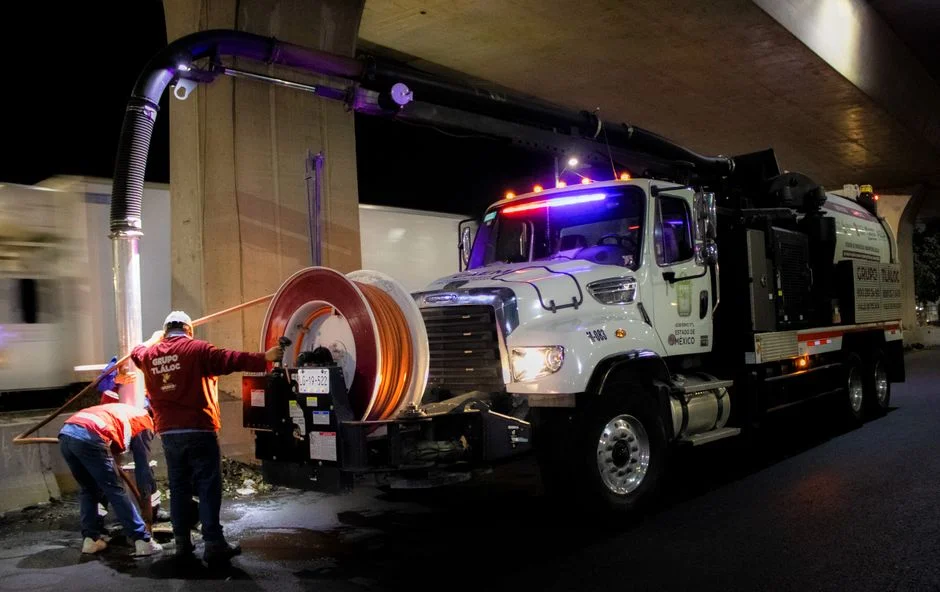
Treatment capacity is only useful when wastewater reaches the plant. The 2013 WEPA-DB policy brief reported that North Thang Long-Van Tri WWTP was designed for 42,000 m³/day but operated at 7,000 m³/day because surrounding residential wastewater was not connected through adequate sewer coverage. The gap was collection infrastructure, not the nominal treatment capacity alone.
The same source reported that less than 4% of generated septage was collected and treated properly in its cited national assessment. A project relying on septic residuals should therefore document tank-emptying frequency, transport route, receiving facility, accepted residual characteristics and the point at which septage enters the treatment train. If residuals are excluded from the design flow, that exclusion and its disposal pathway need to remain explicit throughout procurement.
Buyers should require the supplier to state the design-flow basis, peak factor and equalization requirements. The supplier must also identify whether the assumed inflow includes stormwater, groundwater infiltration, industrial discharges or other non-domestic sources. Each inclusion changes both hydraulic loading and the treatment objectives.
For a stand-alone site, survey the collection route rather than assuming that a private sewer will connect reliably to public infrastructure. The assessment should cover septic access, vehicle turning and discharge points, temporary holding capacity and who is responsible when a truck cannot remove residuals during the required interval.
Compare A/O, MBR and Low-Impact Treatment for Hanoi Sites
The correct architecture follows the weakest link between effluent quality, land, collection reliability and operating responsibility. A/O biological contact oxidation offers an established biological route for low-strength sewage, while integrated MBR adds membrane solids separation and can suit land-constrained or reuse-focused applications. Constructed wetlands provide a low-energy biological route but depend on land availability, hydraulic distribution and long-term solids and vegetation management.
The strongest Hanoi-specific quantitative evidence supplied is the Journal of Vietnamese Environment A/O-MBR trial: after 150 days at 5-10 L/h, treated COD was around 20 mg/L, NH4-N was below 1 mg/L and NO3-N was below 5 mg/L. The study reported stable performance without external carbon source or coagulants and identified potential application in places with limited land and for high-quality treated-water reuse. Those findings support further evaluation of A/O-MBR, but they remain laboratory observations.
IntechOpen also describes vermifiltration as a decentralized process that requires less expertise and reports its application to domestic septic-tank sewage. It should be treated as a separate residual-management option unless project testing demonstrates its compatibility with the complete treatment train. It does not automatically replace the biological and solids-separation stages required for a sewered residential or institutional site.
| Decision factor | A/O biological contact oxidation | Integrated MBR | Constructed wetland or vermifiltration option |
|---|---|---|---|
| Required effluent quality | Must be demonstrated for the applicable permit or reuse specification | Laboratory evidence supports potential for high-quality reuse; site performance requires verification | Site-specific |
| Available footprint | Can be packaged, but civil and access requirements remain site-specific | Potential advantage where land is limited | Land availability is generally a defining constraint |
| Wastewater source | Sewed domestic wastewater or managed inflows | Domestic sewage and reuse projects are suitable candidate applications | Constructed wetlands address wastewater; vermifiltration was applied to septic-tank sewage |
| Septic residuals | Include only when the design basis and pretreatment route are defined | Include only with confirmed hydraulic, loading and membrane-protection conditions | Vermifiltration may be considered as a separate septage treatment option |
| Solids handling | Clarifier and sludge-removal provision required | Membrane separation requires an explicit cleaning and solids-disposal plan | Accumulated solids require regular removal and maintenance |
| Automation and operator attention | Package systems may automate routine operation, but controls and servicing remain required | Higher instrumentation and membrane-maintenance demands must be included in O&M planning | Lower process-energy demand does not eliminate routine operational work |
| Reuse objective | Define intended use and quality criteria before selection | Promising candidate where clarified effluent is required, subject to site verification | Site-specific |
Reuse planning is also an institutional issue. A 2014 Loughborough University paper identified inadequate financing and policy mismatch as barriers to planned wastewater reuse in Hanoi. Equipment should therefore be selected with a defined receiving use, responsible operator, testing regime and fallback discharge route rather than an informal reuse assumption.
Design the Treatment Train Around the Discharge or Reuse Route
A complete domestic sewage treatment train starts with source characterization and a flow-and-collection survey, then proceeds through headworks, equalization, biological treatment, clarification or membrane separation, disinfection, solids handling, discharge or reuse, and monitoring and maintenance. Each stage needs a design basis; a packaged biological unit does not remove the need to manage incoming solids, equalize flow, remove residuals or handle the final effluent route.
For low-strength, nitrogen-bearing sewage, A/O biological contact oxidation provides an anoxic-aerobic sequence that should be evaluated against the required nutrient outcome. MBR is the stronger candidate where a smaller footprint or highly clarified effluent is required, provided membrane fouling, cleaning, solids removal and electrical reliability are included in the design. The Hanoi trial supports this comparison but does not establish a universal performance guarantee.
A buried underground A/O package sewage treatment plant is a candidate arrangement where A/O biological contact oxidation, sedimentation and disinfection are integrated in one unit. Its verified product catalogue states a flow range of 1-80 m³/h and fully automated operation. The integrated MBR membrane bioreactor is a candidate for municipal sewage and reuse projects; its catalogue lists treatment capacity from 10-2,000 m³/day and filtration below 1 micrometre. These are catalogue configuration figures, not guaranteed performance for a Hanoi site.
| Decision step | Required design action | Information to obtain before ordering |
|---|---|---|
| Source characterization | Determine COD, nitrogen fractions, solids and any non-domestic inputs | Current site sampling and land-use information |
| Collection survey | Map sewered connections, septic flows, stormwater influence and infiltration | Survey records, flow measurements and septic-service data |
| Headworks and equalization | Remove material that would overload or damage the selected process | Screen and grit requirements, detention basis and bypass controls |
| Biological treatment | Select A/O, MBR or another route against organic and nutrient objectives | Process calculations, loading basis and applicable performance criteria |
| Solids separation | Define clarification or membrane separation and residual-solids removal | Sludge volume, dewatering or disposal route and maintenance access |
| Disinfection and final route | Match treatment to discharge or reuse conditions | Current permit, receiving use, fallback route and monitoring responsibility |
The 2014 Hanoi reuse-policy findings make the receiving pathway a procurement requirement. Name the intended use, applicable quality criteria, party responsible for testing and fallback arrangement before accepting a reuse claim.
Turn the Equipment Choice into a Procurement Scope
A defensible procurement package starts with an auditable flow-and-load schedule. It should cover average and peak domestic flow, current and future occupancy, process wastewater, infiltration, stormwater and septage where applicable. The laboratory flow of 5-10 L/h reported in the Hanoi study must not be used to size commercial equipment; it establishes test conditions only.
Require a process guarantee with named sampling points, parameters and test conditions. Final guaranteed values should be established from the current Hanoi permit applicable to the discharge point and from the intended reuse specification. Ask for the design calculations, hydraulic assumptions, process diagrams, controls narrative and O&M manuals to be submitted with the offer.
| Procurement item | Information or deliverable to require | Buyer check |
|---|---|---|
| Flow and load basis | Average, peak, future development, infiltration and septage assumptions | Every included and excluded flow has a documented source |
| Performance guarantee | Named parameters, test points, frequency and acceptance conditions | Guarantee matches the current permit and reuse requirement |
| Civil and installation scope | Tank or plant foundations, piping, controls, access and commissioning work | Interfaces with the sewer, receiving point and reuse system are defined |
| Utilities and site conditions | Power, drainage, odor control, groundwater, flood level and lifting plan | Installation assumptions are confirmed by site investigation |
| O&M and disposables | Sludge removal, membrane cleaning, spare parts, training and annual service | Each service item is separately priced and assigned |
| Responsibilities | Who owns sewer, septic, electrical, civil, monitoring and disposal tasks | No gap remains between package supply and site operation |
For buried equipment, confirm access for maintenance and tank lifting, groundwater and flood levels, power availability, odor control and the responsible party for sewer and septic works. Treat catalogue capacity only as a candidate configuration. Award should depend on project-specific sizing, civil design, documented guarantees and a complete O&M responsibility schedule.
Frequently Asked Questions
How much does domestic sewage treatment in Hanoi cost?
The supplied research provides no project quotation for domestic sewage treatment in Hanoi. Request a cost breakdown separating equipment, civil works, installation, utilities, controls, commissioning, training, sludge removal, membrane cleaning, spare parts and annual service. The buyer should also identify whether septic residuals, sewer extensions and reuse equipment are inside or outside the supplier’s scope.
How should treatment capacity be sized for a building or decentralized site?
Begin with domestic flow, wastewater characteristics and collection arrangements, then apply the selected process’s loading and hydraulic criteria. The Hanoi A/O-MBR study’s 5-10 L/h operating condition was laboratory scale, not a commercial sizing rule. Obtain an auditable schedule showing average and peak flow, occupancy assumptions, infiltration, process wastewater and any septage included in the design.
Does the Hanoi study prove that A/O-MBR equipment will meet the current discharge permit?
No. The Journal of Vietnamese Environment reported COD around 20 mg/L, NH4-N below 1 mg/L and NO3-N below 5 mg/L after 150 days of laboratory operation at 5-10 L/h. Those results support technology assessment but do not constitute a site-specific permit or reuse guarantee. Verify the requirement applicable to the discharge point or reuse scheme and match it to guaranteed test parameters.
How should a wastewater-treatment supplier be selected in Hanoi?
Request documented process data, an auditable sizing basis, project-specific guarantees, construction scope and O&M support. Ask who will remove sludge, clean membranes, maintain controls and manage septage, and at what price. A generic catalogue capacity or an automated-operation claim should not replace evidence, installation details and named responsibilities.