What Makes a Packaged STP Fit a Rotterdam Housing Development?
The best packaged sewage treatment plant for a Rotterdam housing development is selected from verified average and peak wastewater flows, organic loading, required effluent quality, available footprint and future occupancy—not from the number of homes alone. A buried A/O package may suit a compact site with suitable treatment requirements, while an MBR may justify added membrane maintenance where tighter solids separation, reuse potential or a smaller footprint is required. The supplier must also demonstrate Dutch water-board approval, sewer or surface-water acceptance, sludge handling, odour control and phased installation. Rotterdam’s wider city region has about 1.2 million inhabitants, but the supplied evidence provides no site-specific Rotterdam discharge specification.
A packaged STP is a factory-built or prefabricated system in which major treatment stages are integrated before installation. Compactness is therefore a physical property, not proof of technical suitability. The selection must pass four gates: hydraulic capacity, wastewater characteristics, receiving location and effluent quality, and site logistics, future growth and operations.
The HydropureWater 2026 Netherlands resource identifies the Urban Waste Water Treatment Directive, BBL 4.153 and water-board permits as project-level checks. These references do not establish the complete Rotterdam permit condition; that must come from the relevant authority for the proposed discharge route. The Rotterdam city region, comprising Rotterdam and neighbouring municipalities, has about 1.2 million inhabitants according to Socio-Environmental Systems Modeling (2015). That regional scale cannot substitute for a site hydraulic model or receiving-water assessment.
The required process flow is:
inlet and screening → flow equalisation → biological treatment → solids separation → disinfection → controlled discharge or reuse.
For broader background, see packaged sewage treatment options for housing developments and A/O, MBR and packaged treatment comparison for housing. The technical decision still has to be made against Rotterdam-specific discharge, sewer and site conditions.
Establish the Design Flow Before Choosing a Plant
The design flow and organic load must be established before equipment selection because neither catalogue capacity nor the number of homes demonstrates treatment capability at the required peak duty.
Request the developer’s occupancy schedule, average daily wastewater flow, morning and evening peak factors, seasonal assumptions, stormwater-ingress allowance and water-saving assumptions. Obtain representative wastewater characterization for BOD, COD, suspended solids, nutrients where relevant, pH and any household or commercial contaminants. A project-specific package, MBR and decentralized sewage treatment comparison illustrates why flow and quality must be evaluated together.
The following is a project-specific Arklow housing example from Butler Manufacturing Services, not a Rotterdam design standard:
| Arklow example | Project-specific basis |
|---|---|
| Population-equivalent basis | 200 litres per person per day; 60 g BOD, 60 g suspended solids and 180 g COD per person per day |
| Phase 1 hydraulic and organic load | 136 PE and 27,200 litres per day |
| Phase 2 hydraulic and organic load | 240 PE and 48,000 litres per day |
| Phase 3 hydraulic and organic load | 788 PE and 109,600 litres per day |
The progression shows why hydraulic and organic growth must be evaluated together: occupancy rises and the plant must remain capable of handling both flow and pollutant load. Butler Manufacturing Services reports that the Arklow project had an average occupancy of four people per house and an outlet specification of BOD 20 mg/L, suspended solids 30 mg/L and COD 125 mg/L. These values belong to that Irish project and cannot be transferred to a Rotterdam discharge permit.
Require the designer to state explicitly whether the selected package is sized for average flow, peak flow, equalisation storage or a combination. Do not infer this from nominal daily throughput. The supplier should provide a written duty curve covering minimum, average and peak operating conditions, including how the biological process responds during sudden residential peaks.
- Fix the occupancy and water-use assumptions for each development phase.
- Calculate daily flow and pollutant loading from a consistent population-equivalent basis.
- Apply measured or justified peak factors and identify the design peak.
- Allocate equalisation, biological and solids-separation capacity against that duty.
- Confirm the treatment train still meets the permitted outlet requirement at every phase.
Compare A/O, MBR and Conventional Packaged Treatment

The treatment process must be selected from the verified duty and outlet requirement because no packaged technology is automatically superior across flow, solids separation, maintenance and future expansion.
The buried A/O packaged sewage treatment plant is described by the HydropureWater product catalogue as a WSZ system combining anoxic/aerobic A/O contact oxidation, sedimentation and disinfection. Its stated duty is 1–80 m³/h, and the catalogue states that no operator is required. The containerized MBR sewage treatment system is described as integrated activated sludge with submerged PVDF membrane filtration. The catalogue states a duty of 10–2,000 m³/day and a footprint 60% smaller than conventional systems.
The Ion Exchange NGPSTP provides another packaged reference: an all-in-one combination of lamella clarification and aeration, available from 10 to 100 m³/day. Ion Exchange reports that the primary clarification stage reduces suspended solids by 75% and BOD by 25%; these are supplier-reported stage-performance claims, not a complete effluent guarantee.
| Decision factor | A/O packaged treatment | MBR | Conventional or alternative packaged treatment |
|---|---|---|---|
| Biological treatment | Integrated A/O contact oxidation | Integrated activated sludge with submerged PVDF membranes | For example, NGPSTP combines lamella clarification with a fixed-film aeration bio-zone |
| Solids separation | Package includes sedimentation | Filtration provides the principal solids barrier | NGPSTP includes lamella clarification and final settlement |
| Footprint | Buried configuration may suit constrained plots; verify the proposed installation | Supplier states 60% smaller footprint than conventional systems | NGPSTP is described as compact, but hydraulic and O&M space still require checking |
| Mechanical complexity | Lower membrane-related maintenance burden, with aeration and solids handling still required | Requires membrane cleaning, inspection and eventual replacement planning | NGPSTP requires aeration, sludge removal and periodic maintenance |
| Why select it | A simpler integrated process fits the footprint, loading and discharge route | Tighter solids separation, reuse potential, footprint constraint or expansion strategy justifies membranes | Its process train fits the project duty and outlet conditions |
Compare biological removal, solids separation, footprint, mechanical complexity, sludge handling, odour, energy demand, access, redundancy and future expansion. MBR should not be treated as the default. A/O remains attractive where a simpler integrated process and buried installation fit the available area and duty range, subject to verification against the actual outlet route and peak hydraulic load.
Design for Rotterdam Site Conditions and Permitting
A Rotterdam package plant is not approvable until the discharge route, authority jurisdiction and project-specific site constraints are documented.
The approval checklist should cover sewer availability and connection conditions, water-board jurisdiction, receiving water, permitted discharge route, sampling and monitoring, sludge disposal, electrical supply, odour control and maintenance access. The HydropureWater 2026 Netherlands guide identifies UWWTD, BBL 4.153 and water-board permits, but the supplied research does not contain a complete numerical Rotterdam discharge specification.
| Information to obtain | Decision supported |
|---|---|
| Sewer capacity confirmation and connection conditions | Whether off-site treatment is required and whether pretreated discharge may enter the sewer |
| Water-board pre-application comments | Jurisdiction, discharge route and information needed for the application |
| Groundwater and soil information | Excavation, infiltration and installation constraints |
| Flood-risk and protected-landscape constraints | Plant location, access and site development restrictions |
| Confirmed outlet quality | Whether disinfection, nutrient control or further reuse treatment is required |
Request sewer-capacity confirmation, water-board pre-application comments, the permit-application requirements, groundwater and soil information, flood-risk constraints and protected-landscape requirements from the developer and relevant authorities. Confirm whether the treated flow will enter a sewer, discharge to surface water or feed a planned reuse point.
Separate permanent infrastructure from temporary pretreatment in the written scope. In the Butler Manufacturing Services Arklow housing case, an on-site package provided pretreatment until the municipal system was upgraded. The authority required pretreatment because the municipal plant could not accept additional organic load. That example demonstrates why the regulatory purpose must be defined; it does not establish the acceptance conditions for a Rotterdam development.
Plan Installation, Phasing and Lifecycle Costs
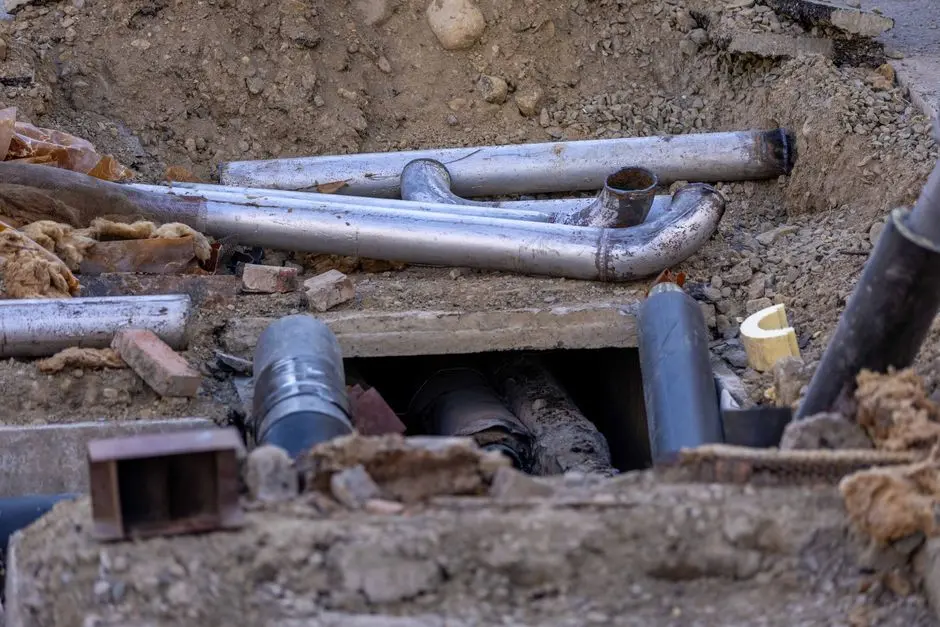
Phased housing delivery requires a plant arrangement that follows verified occupancy growth while preserving equal hydraulic treatment of every parallel module.
Specify civil works, inlet and outlet pumping or gravity requirements, electrical supply, controls, access, odour control, sludge removal, sampling, commissioning and operator training as separate scope items. The supplier should not hide site interfaces or long-term obligations inside a unit price.
Butler Manufacturing Services reports that four BMS BL2000 units were installed across three phases between 2019 and 2021 in the Arklow housing development. Flow was split evenly so that equal-size units could operate in parallel as organic load increased. That configuration illustrates the value of pre-installing civil interfaces where phased modules are expected.
The same BMS source states BL2000 dimensions of 7.6 m × 2.3 m × 2.25 m to deck level, with placement above or below ground and at least three months of sludge storage. These are model-specific facts, not generic Rotterdam dimensions.
| Cost or schedule item | Information required from each bidder |
|---|---|
| Initial equipment and civil works | Supply price, foundations, excavation, piping, access and electrical works |
| Installation and commissioning | Delivery, erection, testing, sampling and operator training |
| Operating resources | Energy, chemicals, inspections and operator support |
| Renewal and waste | Membrane or media replacement, sludge removal and transport |
| Future growth | Module cost, additional civil works, connection works and downtime |
Compare initial equipment and civil works, installation, energy, chemicals, membrane or media replacement, inspections, sludge transport, operator support and planned expansion. Require every bid to state exclusions and assumptions. This makes lifecycle differences visible instead of allowing a low capital price to conceal site works, maintenance or future expansion.
A Decision Framework for Approving a Rotterdam Supplier
A Rotterdam supplier should not be approved until its bid closes the discharge-route, authority, wastewater-basis and footprint gaps in an auditable project record.
First screen for completeness. The bid should identify the treatment train, duty curve, effluent guarantee, civil interface, controls, sludge route, commissioning evidence and total-cost schedule. A catalogue capacity alone does not establish that the package can perform at the project’s average and peak conditions.
Next require a project-specific process basis. The supplier should explain how average and peak flow, BOD, COD, suspended solids and outlet requirements lead to the selected configuration. Ask for reference evidence from comparable housing or residential schemes and verify that the proposed capacities and performance are not merely catalogue values.
| Approval gate | Required evidence |
|---|---|
| Discharge route | Written sewer, surface-water or reuse destination and the applicable authority |
| Verified wastewater basis | Average and peak flow, pollutant loading, occupancy phases and discharge target |
| Available footprint | Arrangement showing treatment, access, sludge handling, utilities and future modules |
| Supplier performance | Process calculations, duty curve, effluent guarantee and comparable references |
| Commercial completeness | Whole-life schedule, exclusions, permit dependencies and expansion assumptions |
The supplier must identify design exclusions, permit dependencies, utility requirements, maintenance tasks and the conditions that could reduce performance. No selection should proceed before the discharge route, authority contact, verified wastewater basis and available footprint are documented.
The final recommendation should therefore be a project-specific compliance and delivery record, not a brand ranking. It should state why the selected process fits the verified duty, what remains subject to authority approval, which civil interfaces are excluded, how occupancy growth is accommodated and how lifecycle costs change between phases.
Frequently Asked Questions
What does a packaged sewage treatment plant for a Rotterdam housing development cost?
The supplied research contains no Rotterdam residential package-plant price. Require each bidder to provide a site-specific total-cost schedule covering equipment, civil works, utilities, energy, chemicals, sludge removal and transport, maintenance, consumables or membrane replacement, operator support and planned expansion. Ask the bidder to list exclusions and assumptions so the schedules use the same scope. A capital price alone is not a comparable bid.
How should a Rotterdam housing wastewater plant be sized?
Size it from verified average and peak flow, organic loading and the occupancy schedule for each phase. Document the wastewater basis, including BOD, COD, suspended solids, nutrients where relevant, stormwater ingress and water-saving assumptions. Do not convert the number of homes directly into a plant size or treat nominal daily throughput as proof of peak-duty capability. Require a written minimum, average and peak duty curve and clarification of how equalisation is included.
Which supplier credentials matter when selecting a packaged sewage treatment plant?
Require a compliant duty curve, project-specific process calculations, effluent guarantee, commissioning evidence, comparable reference installations and transparent exclusions. Check that the supplier has defined the civil interface, utility requirements, sludge route, maintenance tasks, permit dependencies and future expansion method. A catalogue capacity or reference installation should not be accepted as a substitute for demonstrating the proposed configuration at this development’s verified load.
Does a water-board permit confirm that a packaged STP is compliant?
No. General references to the Urban Waste Water Treatment Directive, BBL 4.153 and water-board permits identify issues for review; they do not replace the project-specific discharge permission issued for the actual outlet. The buyer needs written confirmation of the discharge route, competent authority, application requirements, outlet conditions, sampling and monitoring, and sludge-disposal obligations before representing the plant as permitted.
How should the treatment plant be phased as housing occupancy grows?
Match modules to verified occupancy and load stages while maintaining balanced treatment across all units in service. The BMS Arklow example used four equal BL2000 units installed in three phases between 2019 and 2021, with flow split evenly and the units operating in parallel. For Rotterdam, establish whether future modules can connect to pre-installed splitting, piping and power without excessive shutdown or civil disruption, and include the expansion works in the lifecycle-cost comparison.