
Why Yangon Housing Developments Need a Decentralized Treatment Decision
For a Yangon housing development, a decentralized packaged sewage treatment plant is credible where a reliable municipal sewer connection is unavailable. A 2023 Yangon study found that the YCDC centralized system handles 7% of city wastewater, while 10% of households in cities use DEWATS. It also reported acceptable effluent and stable DEWATS performance over a 10-day sampling period at YCDC Officer Housing Estates. A buried A/O package or MBR may fit, but the choice depends on verified flow, land, treatment targets and the disposal route.
That infrastructure gap is separate from the equipment decision. The Yangon study reports that the YCDC centralized wastewater treatment system serves seven townships—Dagon, Latha, Lanmadaw, Pabedan, Pazundaung, Botahtaung and Kyauktada—yet it handles only 7% of the city’s wastewater. The same 2023 study reports that 10% of households in cities use decentralized wastewater treatment systems, including community systems based on membrane bioreactors for a community or housing estate.
The Greater Yangon Project aims to construct sewage facilities serving 49% of the population, while the city has an objective of 80% service coverage by 2040, according to the 2023 study. Those are planning targets, not assurance that every development will receive a connection within its construction programme.
For a developer, the practical question is therefore whether a domestic sewage package plant can provide a controlled treatment route without waiting for a central sewer extension. A decentralized option should still be assessed as an infrastructure alternative—not automatically as cheaper or as an already approved discharge solution. The packaged sewage plant comparison for housing developments provides a useful cross-market structure, but Yangon-specific evidence and site conditions must determine the final decision.
What Local Yangon Evidence Says About Package Plants
The 2023 Yangon study provides direct but limited evidence for DEWATS in a housing-estate setting. DEWATS samples were taken at YCDC Officer Housing Estates, while comparison samples came from the centralized wastewater treatment plant in Botahtaung township. Over the reported 10-day period, DEWATS effluent consistently met acceptable standards, with effective pollutant removal and stable performance.
That finding supports technical feasibility, but it does not establish a performance guarantee for a new housing development. The observation window covered 10 days and did not establish performance across seasonal rainfall, changing occupancy, wet-weather inflows, long-term sludge accumulation or the full operating cycle of a proposed package plant.
The receiving environment also matters. The study describes discharge from the centralized facility into the Yangon River and notes that effluent is regularly monitored in an on-site laboratory against the Myanmar National Environment Quality Guidelines (NEQEG). A proposed development using irrigation reuse or another discharge route must establish the relevant criteria separately rather than transferring the centralized plant’s monitoring result to a different context.
Several project-specific checks remain necessary: characterize the incoming sewage; confirm the feed after household septic tanks and pumping; verify seasonal conditions; establish the receiving-water or reuse requirements; and test whether the proposed package has sufficient hydraulic and process margin. The 2023 study identifies decentralized management as contributing to social well-being and development in Yangon, but those wider benefits do not remove the need for technical verification and regulatory confirmation.
Compare A/O, MBR and Conventional Package Plant Options
Process selection should follow the required effluent duty and installation constraints, not the broadest capacity statement. The MBBR process and equipment selection guide is useful background, but housing developers need a direct comparison of candidate package architectures.
| Option | Treatment configuration | Selection considerations |
|---|---|---|
| Buried A/O package | Underground integrated plant using anoxic/aerobic biological contact oxidation, sedimentation and disinfection; stated capacity is 1–80 m³/h. | Consider where a fully buried, integrated arrangement and conventional process architecture are priorities. See the buried A/O package sewage treatment plant. |
| MBR package | Activated-sludge treatment with submerged PVDF membrane filtration below 1 μm; stated capacity is 10–2,000 m³/day. | Consider where compact treatment and high-quality solids separation justify membrane-specific operation and maintenance. See the integrated MBR sewage treatment system. |
| Conventional activated sludge | Biological treatment with conventional solids separation. | Retain for comparison where established operating experience and a suitable civil arrangement outweigh compactness or process integration. |
| SBR | Cyclic biological treatment and settling. | Assess where cyclic operation and its associated civil arrangement suit the development. Review the SBR engineering buyer guide. |
MBR is the clearer candidate when a very small footprint or high-quality solids separation is necessary. A/O is the clearer candidate when a fully buried integrated package and conventional treatment architecture are priorities. SBR remains relevant when its cyclic operation and civil arrangement create a better operational or phased-development case.
Do not select from the process label alone. Influent characteristics, required effluent quality, intended reuse or discharge route, land availability, utilities, sludge handling and maintenance access must be confirmed first.
Size the Plant From Verified Development Inputs
Average daily wastewater flow divided by 24 gives the average hourly flow; the design flow must also reflect the project’s agreed peaking and seasonal factors. The research does not provide a defensible peak factor for this housing development, so the designer must establish it from the development brief rather than insert an unsupported number.
The quotation package should include:
- Number of housing units or the occupancy basis used to forecast flow.
- Wastewater contribution per unit or resident.
- Commercial and mixed-use allowances.
- Groundwater infiltration, stormwater ingress and collection losses.
- The approved discharge or reuse rate.
- Average and design flow expressed in one consistent flow unit.
Influent quality needs particular attention. The 2023 Yangon study states that, to comply with the Myanmar National Building Code 2020, almost all households install at least one septic tank. The developer and designer must therefore establish whether those tanks will be retained, pumped, bypassed or replaced, because each arrangement changes the solids, organic load and flow delivered to the package plant.
| Design input | What the supplier must receive | Procurement check |
|---|---|---|
| Hydraulic duty | Average daily flow, design flow and development phasing | Convert to m³/h for A/O comparison and m³/day for MBR comparison. |
| Influent duty | Project-specific organics, suspended solids and expected septic-tank effects | Do not substitute generic loading values for verified project data. |
| Effluent duty | Stated discharge or reuse specification and applicable criteria | Confirm treatment stages, disinfection and solids separation. |
| Residual handling | Sludge quantity, condition, storage and removal route | Include residual handling in the total scope. |
The WSZ range of 1–80 m³/h and the MBR range of 10–2,000 m³/day are not directly interchangeable ratings. Ask each bidder to demonstrate coverage of the entire verified duty. The selected process must also be checked for organics, suspended solids, solids retention, disinfection and the required effluent performance; project-specific loading values are not supplied in the research.
Plan Collection, Site Constraints and Pretreatment
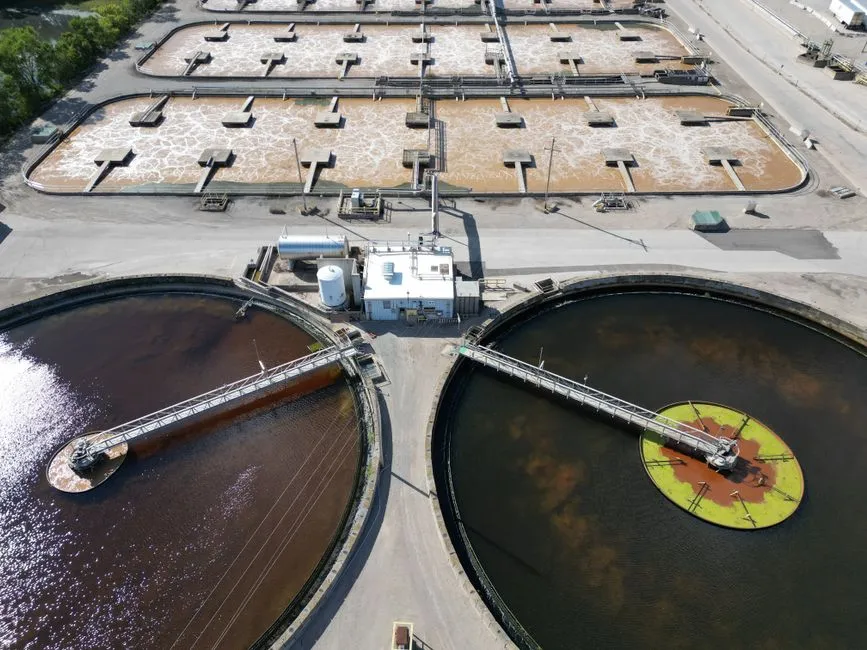
The treatment package does not remove the need to collect the development’s sewage. Residential solutions guidance distinguishes cluster systems serving small groups of homes from community systems that collect each home’s wastewater by gravity or pumping to a central package plant, according to Anua International’s residential wastewater solutions overview. That collection arrangement affects sewer network cost, civil works and operating energy.
Land application and beneficial reuse are not interchangeable. Reuse for irrigation of community green spaces may reduce the discharge burden, but it should be counted only after confirming its legal route, hydraulic demand, seasonal variability and required treatment quality.
| Site or collection issue | Decision required before purchase |
|---|---|
| Collection route | Confirm gravity or pumped conveyance, alignment, pumping stations and connection points. |
| Pretreatment | Assess screening and solids removal for suspended solids, rags, plastics and fibrous debris. The product portfolio includes a rotary mechanical bar screen for this duty. |
| Installation | Assess excavation, groundwater, access, burial depth, odor control and power availability. |
| Residuals | Define sludge removal, storage and disposal arrangements. |
| Disposal or reuse | Confirm the receiving route, applicable criteria and seasonal operating plan. |
The package unit is only one part of the installation. Quotation and design deliverables should distinguish equipment supply from collection pipes, pumping, excavation, electrical works, controls, commissioning, training and residual management. Failing to resolve these interfaces can leave a technically suitable package unable to receive the wastewater it was sized for.
Confirm Effluent, Monitoring and Discharge Risk
A monitoring plan should be built before the supplier’s performance guarantee is accepted. The 2023 Yangon study describes regular on-site laboratory monitoring at the centralized facility and comparison of effluent with the Myanmar National Environment Quality Guidelines (NEQEG). That is a useful model for defining an evidence-based monitoring regime, not proof that a decentralized package will meet the same criteria at a different site.
Separate the approval checks for each route. A discharge to the Yangon River, irrigation reuse and another disposal route involve different evidence requirements. For each route, require the supplier to state:
- The intended discharge or reuse standard.
- The test parameters and test methods.
- The monitoring frequency and sampling locations.
- Who owns sampling, analysis, interpretation and reporting.
- What corrective action applies when a result is outside the agreed criteria.
The 10-day DEWATS result from YCDC Officer Housing Estates should be treated as evidence of performance under the conditions studied. It does not establish compliance for a new discharge point, reuse scheme, influent profile or full operating year.
Where the required standard or receiving condition remains uncertain, obtain confirmation from the relevant Yangon authority and a local environmental professional before ordering. This step should follow the UV disinfection equipment specification review: disinfection equipment does not remove the need to define the legal effluent duty, validation method and monitoring responsibility.
Build the Supplier Comparison and Procurement Checklist
A comparable quotation requires one common design basis. The 2023 Yangon study reports that a centralized sewer network may cost five times as much as the sewage treatment plant. That comparison explains why collection infrastructure can dominate the project, but it also shows why treatment-plant price alone cannot measure the decentralized solution.
| Bid document | Required supplier response |
|---|---|
| Common design basis | Average and design flow, influent duty, process type, treatment stages, effluent duty, installation basis, utilities, commissioning tests and warranty scope. |
| Priced schedule | Separate package equipment, excavation, collection pipes, pump stations, electrical works, commissioning, training, chemicals, sludge handling and replacement parts. |
| Technical substantiation | Process guarantees, controls, commissioning evidence, local spare-parts support, maintenance access and the definition of performance failure. |
| Operational evidence | Sludge handling, effluent monitoring, operator competence requirements and ongoing service support. |
| Phasing | Confirm that the proposed equipment covers verified duty and any future occupancy or phased-development scenario included in the brief. |
Check flow units carefully: m³/h and m³/day describe different comparison bases, and a supplier must demonstrate that the proposed equipment covers the complete duty rather than a selected rating. Require the sludge dewatering equipment scope to match the selected residual-handling route. Likewise, identify the valves, filters and consumable parts included in the price, including local availability.
Do not accept a process guarantee without its test conditions, sample points, acceptance criteria and remedy. Likewise, confirm that training, maintenance access, monitoring ownership and replacement-part support are contractual rather than assumed.
Make a Conditional Plant Selection for Your Yangon Site
The provisional selection follows directly from the verified development inputs:
- Choose a buried integrated A/O package when a fully integrated unit with anoxic/aerobic treatment, sedimentation and disinfection is the priority and the verified design flow falls within the WSZ range of 1–80 m³/h.
- Choose MBR when compact treatment and membrane solids separation below 1 μm are required and the verified duty falls within the 10–2,000 m³/day range.
- Retain conventional activated sludge or SBR for comparison when operating experience, phased deployment or a different civil arrangement materially changes the commercial case.
Do not approve a process from hydraulic capacity alone. The final selection must resolve pretreatment, effluent route, monitoring, sludge, maintenance, utilities, collection interfaces and local approval. The buried A/O package option and integrated MBR option should therefore be evaluated against the same verified brief rather than against headline capacity.
Yangon has direct academic support for DEWATS in a housing estate, so a package plant is technically credible. There is no universal model or capacity recommendation for every Yangon development: the defensible choice follows the development’s flow, wastewater characteristics, land, reuse or discharge route and monitoring obligations.
Frequently Asked Questions
What size packaged sewage treatment plant does a Yangon housing development need?
Use the verified average daily wastewater flow, divide it by 24 to obtain average m³/h, and then apply the project’s agreed peak, infiltration and seasonal allowances. Compare the resulting duty with 1–80 m³/h for the WSZ A/O option or 10–2,000 m³/day for MBR. The supplier must confirm that its selected configuration covers the complete verified duty and phased-development assumptions.
How should a developer select a sewage package plant supplier?
Ask every bidder to quote the same design basis and provide a common schedule covering guaranteed process duty, effluent obligations, total installed scope, controls, commissioning evidence, training, maintenance support and locally available spare parts. Define what constitutes a performance failure and require the proposed test conditions, acceptance criteria and remedy in the contract rather than relying on a general performance statement.
How much should the buyer budget for a decentralized sewage treatment system?
Request an itemized quotation rather than a package-plant price alone. Excavation, collection pipes, pump stations, electrical works, commissioning, operator training, chemicals, sludge handling and replacement parts remain part of the decentralized-project scope. The 2023 Yangon study notes that a centralized sewer network may cost five times as much as the sewage treatment plant, so each bidder should separately price the treatment package and the infrastructure needed to connect the development.
Does the 10-day Yangon DEWATS result guarantee compliance for a new housing estate?
No. The 2023 Yangon study reports acceptable effluent and stable performance over a 10-day sampling period at YCDC Officer Housing Estates, but that observation does not replace project-specific wastewater testing, full-cycle assessment or confirmation of the applicable discharge or reuse criteria. The 2023 study also documents regular centralized-plant monitoring against the Myanmar National Environment Quality Guidelines (NEQEG), providing a basis for defining monitoring requirements.
What should the buyer confirm before choosing a discharge or reuse route?
Ask for the exact reuse or discharge route, applicable standard, monitoring parameters, test methods, frequency and reporting responsibility. A Yangon River discharge, irrigation reuse and another disposal route require separate approval and performance checks. If the route or criteria remain uncertain, obtain written confirmation from the relevant Yangon authority and a local environmental professional before ordering the plant.