
Choose from the wastewater profile, not the factory category
A Frankfurt factory should select an industrial ETP or DAF system from its wastewater profile, not from flow alone. Dissolved air flotation is the strongest fit when the priority is removing suspended solids, FOG, oil, grease, and colloidal material before biological treatment. It works by releasing 10–100 micron micro-bubbles that lift separated material to the surface for skimming. A complete ETP is more appropriate when the wastewater also requires biological treatment and final polishing. The correct Frankfurt scope must be selected using representative wastewater tests, peak flow, discharge requirements, and the required treatment-train balance.
The first decision is not whether the plant is in Frankfurt; it is what the wastewater must become. Establish average and peak flow, operating hours, production and cleaning schedules, pH, suspended solids, FOG or oil and grease, colloid content, biodegradability, temperature, and the final discharge or reuse destination. The supplied research contains no Frankfurt-specific wastewater or discharge figures, so no local flow, contaminant concentration, removal target, or compliance limit should be assumed.
A standalone DAF scope is appropriate when physical separation is the principal objective and the downstream process can accept the clarified result. A broader ETP is needed when the train must include primary treatment, secondary biological treatment, tertiary polishing, or any combination of these. Quora’s ETP explanation, accessed July 2025, describes primary treatment as physical and chemical treatment, secondary treatment as biological treatment under aerobic or anaerobic conditions, and tertiary treatment as the final cleaning stage.
Sampling must cover production, cleaning, shutdown, and dump periods. Otherwise, a supplier may size the equipment around diluted routine effluent and miss the batch load that determines equalization, treatment, and sludge handling. Use the industrial DAF system for factory wastewater as a starting point for technical comparison, but require the final selection to follow site characterization.
| Decision input | Evidence required | Equipment implication |
|---|---|---|
| Flow and operating schedule | Average flow, peak flow, batch-discharge duration, operating hours | Equalization, hydraulic capacity, transfer pumps, controls |
| Physical contaminants | Suspended solids, FOG, free and emulsified oil, colloids | DAF, chemical conditioning, skimming, sludge withdrawal |
| Chemical condition | pH, temperature, biodegradability and treatment compatibility | pH control, biological stage or process-specific pretreatment |
| Destination | Discharge route, receiving requirements or reuse specification | Tertiary treatment, disinfection or polishing where required |
Map factory conditions to the required treatment train
High FOG, free oil, suspended solids, or colloidal material should trigger an immediate DAF assessment. OpenBlueprint identifies these pollutants as targets for the micro-bubble flotation step in its Quora answer, dated July 2025. The flotation step does not remove the need to characterize the entire stream: emulsified oil, chemical demand, biological toxicity, and batch shocks determine what must precede and follow it.
Where emulsified oil could reach biological treatment, place chemical conditioning and DAF upstream of the biology. OpenBlueprint warns that oil films can reduce bacterial oxygen transfer and damage the microbial colony. If coagulant or flocculant is required, the train must include metering, mixing, dose control, and chemical storage rather than treating DAF as a stand-alone package. A PLC-controlled chemical dosing skid is one catalog option for this function.
Where soluble organic pollution remains after physical separation, include secondary biological treatment. A complete ETP must then balance primary, biological, and tertiary stages rather than merely placing a DAF vessel ahead of an underspecified biological reactor. Tertiary treatment should be added when the discharge or reuse specification requires further solids, nutrient, pathogen, or dissolved-solids control. The supplied research does not identify the applicable Frankfurt requirement, so the required endpoint must come from the specific receiving authority and intended reuse.
Clarification is not automatically part of the DAF package. HydropureWater’s lamella clarifier catalog specifies surface loading rates of 20–40 m/h and chemical consumption up to 30% lower; these are product-catalog values, not design values for a Frankfurt installation. For sludge from DAF or chemical treatment, include dewatering in the project scope. The plate-and-frame filter press range is offered from 1 m² to 500 m² filtration area in manual, hydraulic, and fully automatic PLC-controlled configurations.
| Factory condition | Required treatment function | Indicative train extension |
|---|---|---|
| High FOG, free oil, suspended solids, or colloids | Physical separation by flotation | DAF with skimming and sludge withdrawal |
| Emulsified oil approaching biological treatment | Destabilization followed by physical removal | Chemical conditioning before DAF |
| Soluble biodegradable organics remain | Biological degradation | Secondary aerobic or anaerobic stage |
| Final quality requires additional control | Tertiary separation or polishing | Clarification, filtration, MBR, or another justified stage |
| DAF or chemical sludge accumulates | Sludge concentration and removal | Holding, withdrawal, and plate-and-frame dewatering |
Understand what the DAF unit actually removes
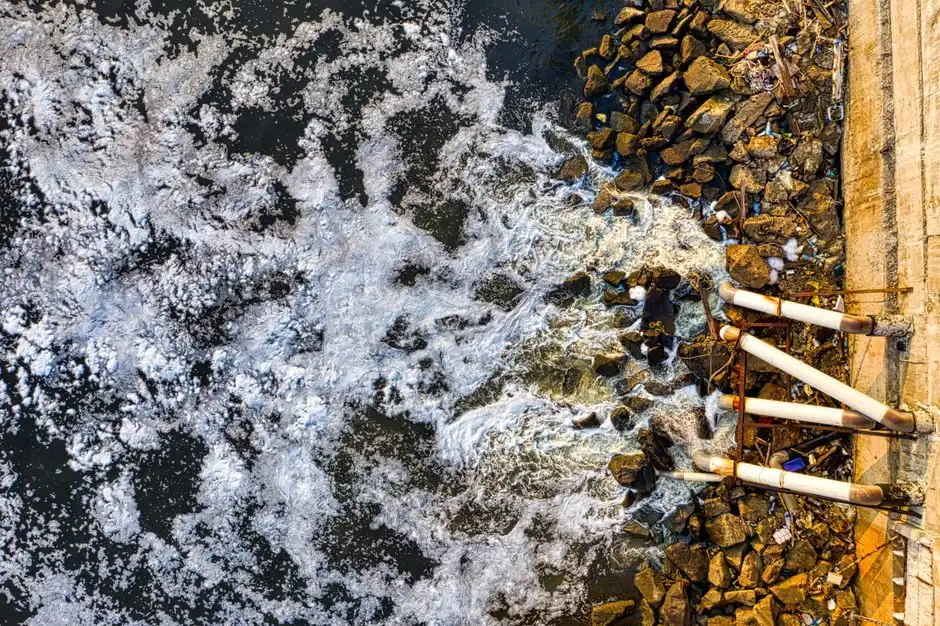
DAF separates material by attaching air bubbles to particles that would otherwise remain suspended. According to OpenBlueprint’s Quora answer, dated July 2025, a portion of clarified liquid is recycled, pressurized, and saturated with air in a dedicated drum. It returns to the flotation tank, where the pressure drop releases the air as micro-bubbles usually measuring between 10 and 100 microns in diameter.
The bubbles attach to suspended solids and tiny oil droplets, reducing their effective density and accelerating their rise. Solids and separated oil accumulate as froth, which a mechanical skimmer removes to a sludge holding tank. Clarified water leaves beneath an overflow weir. This mechanism makes DAF relevant to suspended solids treatment, FOG removal, and recovery of oil and grease, including fine material that can be difficult to separate by gravity alone.
The process boundary matters. OpenBlueprint describes DAF as a secondary clarifier within a refinery ETP: it follows an initial API separator used to remove large free-floating oil and heavy sediment, and it protects downstream biological treatment from emulsified oil and fine solids. DAF therefore does not replace initial gravity oil removal where free oil is present, and it does not replace biological treatment where soluble organic load remains.
HydropureWater’s DAF catalog covers suspended solids, FOG, oil and grease, and colloidal matter across 4–300 m³/h and 13 standard models. These are catalog limits, not proof that any model is suitable for a Frankfurt factory. Selection still depends on the measured flow and contaminant loads, the required removal performance, the operating envelope, and the available installation footprint. For a fuller process review, see how industrial DAF systems work.
Size the DAF and ETP around peak flow and pollutant loading
Size the treatment train around peak hydraulic flow and batch discharges, not only the daily average. The DAF catalog’s 4–300 m³/h range identifies available standard capacities; it does not establish the correct capacity for any factory. A short, high-volume dump can control equalization, pump selection, and peak solids loading even when average flow appears modest.
Require each bidder to base its selection on representative flow duration, wastewater characteristics, required contaminant removal, operating hours, and available footprint. For a DAF-led train, verify solids loading, FOG loading, recycle arrangement, pH-control needs, chemical compatibility, sludge withdrawal, skimming access, and maintenance access. These inputs determine whether the tank, recycle pump, air system, and sludge-handling equipment work as one process.
For a complete ETP, ask how primary, biological, and tertiary stages are balanced. Require the mass balance to track water, removed solids, and generated sludge through every stage. Do not accept a single removal percentage or design loading as universal. The supplied research establishes no Frankfurt-specific performance guarantee, so performance criteria should be tied to representative influent data and a stated test method.
An MBR may be proposed as a biological or polishing architecture, not as a default replacement for DAF. HydropureWater’s MBR catalog states filtration below 1 μm and a capacity range of 10–2,000 m³/day. Those are product specifications; the final architecture still has to follow the wastewater characterization and receiving requirement. The 2026 DAF unit selection and decision framework provides a useful basis for structuring supplier questions.
| Sizing question | Information the buyer must provide | Decision consequence |
|---|---|---|
| What is the controlling flow? | Average flow, peak flow, batch volume and discharge duration | Sets hydraulic capacity and equalization duty |
| What is the controlling load? | Suspended solids, FOG, colloid and required removal performance | Sets DAF loading, chemical demand and solids handling |
| Can downstream biology be protected? | Oil form, emulsification, pH and biological compatibility | Determines need for conditioning and upstream DAF |
| Does the ETP balance all stages? | Primary, biological and tertiary duties with a solids balance | Determines whether a broader ETP is required |
Build a procurement-ready scope for a Frankfurt project
A technically defensible Frankfurt tender starts with a wastewater characterization report and a process narrative that names every treatment stage, its duty, and the contaminants it is expected to remove. Include the sampling plan, analytical methods, representative operating conditions, and the applicable discharge, sewer-pretreatment, or reuse requirement. The receiving authority and destination must be confirmed for the specific site; the supplied research does not establish a universal Frankfurt limit.
Require each proposal to state design and peak flow, equipment dimensions, materials of construction, available utilities, controls, skid or civil-works boundaries, installation access, and local service support. The quotation should also provide a complete mass and solids balance covering separated sludge and wastewater, rather than only equipment throughput and nominal performance.
Include chemical dosing where the process requires coagulant, flocculant, or pH control. HydropureWater describes its automatic chemical dosing systems as PLC-controlled, skid-mounted, pre-wired, and factory-tested. This is a catalog description, not evidence of compatibility with a particular Frankfurt wastewater; the bidder must confirm chemical selection, storage requirements, duty, and control logic.
Separate the quotation into equipment, installation, civil works, chemicals, power, sludge handling, commissioning, training, spare parts, and maintenance. This lets procurement compare complete scopes rather than one equipment price against another supplier’s incomplete offer. For the physical-treatment side of the tender, use the DAF package for factory effluent treatment to define the equipment boundary, then require each bidder to fill in the process, controls, utilities, and performance data.
| Quotation package | Required information | Procurement check |
|---|---|---|
| Process basis | Characterization, sampling, destination, applicable requirements | Do not compare proposals using different wastewater bases |
| Equipment | Flow, duty, dimensions, materials, utilities, controls, installation boundary | Confirm every stage and accessory is included |
| Performance | Duty-specific guarantees, test methods, acceptance sampling | Tie guarantees to representative influent data |
| Solids and cost | Mass balance, sludge handling, itemized equipment and lifecycle costs | Exclude no disposal or civil-work consequence |
Frequently Asked Questions
What budget should a Frankfurt factory allocate for an industrial DAF or ETP?
No defensible project price can be calculated from the supplied research because flow, wastewater characteristics, civil works, and treatment scope are unspecified. Request a design based on representative samples and an itemized quotation covering equipment, installation, civil works, chemicals, power, sludge handling, commissioning, training, spares, and maintenance. The 2026 DAF unit selection and decision framework can structure that cost request.
How should a DAF system be sized when the factory has batch discharges?
Size it from peak flow and the duration of each batch, together with FOG, suspended solids, colloid, pH, and required removal performance. An average daily discharge is insufficient because a concentrated dump can determine the required equalization, hydraulic capacity
Frequently Asked Questions
How much does an industrial ETP or DAF system cost for a factory in Frankfurt?
For a standard industrial DAF unit in the Frankfurt region, capital expenditure typically ranges from €45,000 to €150,000 depending on throughput capacity and materials of construction, such as 316L stainless steel. A complete industrial ETP, including biological treatment stages and sludge dewatering, can range from €250,000 to over €1,000,000 based on the complexity of the influent profile and the required final effluent quality.
Operational costs should be calculated based on local energy prices and chemical consumption, typically adding 10% to 20% of the initial capital cost annually. These estimates must account for German installation standards (DIN/VDE) and the specific logistical challenges of urban industrial sites in Hesse.
What flow rate and wastewater tests are needed to size a DAF system?
To accurately size a DAF system, you must determine your peak hourly flow rate (m³/h) and the average daily volume (m³/d), ensuring the system can handle hydraulic surges without exceeding surface loading rates of 5 to 10 m/h. Bench-scale "jar testing" is mandatory to determine the optimal coagulant and flocculant dosage, as well as the required air-to-solids (A/S) ratio for effective flotation.
Essential wastewater parameters for sizing include Chemical Oxygen Demand (COD), Total Suspended Solids (TSS), Oil and Grease (FOG) content, pH levels, and temperature. These values should be based on 24-hour flow-proportional composite samples to account for production variability in the factory.
How do I compare DAF suppliers for a German factory wastewater project?
When evaluating suppliers, prioritize those with proven compliance records under the German Wastewater Ordinance (Abwasserverordnung - AbwV). Verify their ability to provide CE-marked equipment and documentation compliant with the Machinery Directive 2006/42/EC, which is critical for legal operation in Hesse.
Compare suppliers based on the specific air-saturation technology used, such as dissolved air flotation with micro-bubble generators, and request references for similar industrial sectors. Ensure the proposal includes a detailed Service Level Agreement (SLA) covering the availability of spare parts and the response time for technical support within the Frankfurt metropolitan area.
Does our factory need a DAF system or a complete industrial ETP?
A DAF system is primarily a primary treatment step designed to remove suspended solids, fats, oils, and grease from industrial effluent. If your factory’s wastewater exceeds local municipal discharge limits for COD, BOD, or heavy metals after physical separation, a DAF alone will be insufficient and you will require a complete ETP that includes secondary biological treatment (e.g., MBBR or MBR) and tertiary polishing.
Consult the local Frankfurt sewer statutes (Abwassersatzung) to determine if your effluent meets the requirements for direct discharge into the municipal sewer system. If the influent is high in dissolved organics or nitrogen, a DAF should be viewed only as a pretreatment component to reduce the load on a downstream biological system.
What compliance risks should be checked before ordering wastewater treatment equipment in Frankfurt?
Before procurement, conduct a formal review of the "Indirekteinleitergenehmigung" (indirect discharge permit) issued by the relevant Frankfurt water authority. Ensure that the proposed equipment can consistently meet the specific concentration limits for heavy metals, hydrocarbons, and AOX (adsorbable organic halogens) mandated for your specific industry category under the AbwV.
Failure to comply with these local regulations can result in significant fines or a total revocation of discharge rights. Additionally, ensure the equipment design satisfies the "Stand der Technik" (Best Available Technique - BAT) requirements as defined by the Federal Environment Agency (UBA), which is a prerequisite for environmental permitting in Germany.