Confirm the process category and discharge route for a Hanceville mining or metals site
Begin with the actual mineral or metal process, all wastewater streams and each outfall. Part 436 is Mineral Mining and Processing, not the federal floor for every U. S. mine. Part 440 covers Ore Mining and Dressing,434 Coal Mining, and 437 covered Centralized Waste Treatment (CWT) of off-site wastes. For metal operations,433 is Metal Finishing,467 Aluminum Forming and 468 Copper Forming, subject to each scope and exclusion.
| Site activity | Category to verify | Required decision |
|---|---|---|
| Covered mineral mining/processing | 436 | Mineral, subcategory and wastewater type |
| Ore or coal mining | 440 or 434 | Actual covered extraction/processing operation |
| Off-site waste treatment | 437 CWT where applicable | Waste receipts, treatment operation and exclusions |
| Metal finishing or forming | 433 /467 /468 as applicable | Actual finishing/forming process, not the word “metals” alone |
Read the actual 436 subpart without transferring direct limits to the sewer
Distinguish a direct discharge authorized under an NPDES permit from an indirect industrial discharge to a POTW. A 436 BPT limit in a mine’s direct-discharge permit does not automatically become a categorical sewer limit. For an indirect stream, determine whether any categorical PSES/PSNS actually applies, then meet Part 403 prohibitions and the actual receiving authority’s conditions.
| 436 subpart | Actual subject | How to read it |
|---|---|---|
| A | Dimension Stone | Reserved |
| B | Crushed Stone | Read 436.20 onward for the actual covered stream |
| C | Construction Sand and Gravel | Read 436.30 onward |
| D | Industrial Sand | Read 436.40 onward |
| H | Lightweight Aggregates | Reserved |
| J | Barite | Read 436.100 onward; not sand/gravel |
| AD /AG | Shale and Common Clay /Kaolin | Reserved |
“Reserved” means that this particular subpart itself has no promulgated categorical numerical provisions. It does not establish absence of all federal or state obligations, a permit exemption, or local limits as the only possible enforceable layer. Identify other applicable law and the actual direct or sewer authorization. Construction aggregate is not uniformly reserved: construction sand/gravel C differs from dimension stone A or lightweight aggregates H.
Use the actual local conditions and an evidenced MAHL/MAIL basis
Part 403.5 general and specific prohibitions protect the POTW, including against pass-through and interference. 403.8(a) defines which POTWs must have a pretreatment program; 403.5(c) identifies local-limit duties. Local conditions may be numerical or narrative BMPs. Do not assume every POTW uses the same numerical table or that the Hanceville receiving authority has adopted a particular allocation without obtaining its documents.
EPA’s Local Limits Development Guidance provides a framework for selecting pollutants of concern, collecting data, calculating allowable headworks/industrial loads and implementing local controls. It is not proof of a mandatory identical five-step calculation at every POTW. Where MAHL/MAIL is used, request the actual pollutant basis, data period, uncontrolled loads, safety/expansion allowances and allocation method. The controlling criterion may depend on receiving water, inhibition, sludge or other site factors; no “metals always sludge-driven” assumption replaces those data.
Before the RFQ, make one matrix linking each applicable standard or local condition to pollutant fraction, units, averaging period, sampling point, method and response/reporting requirement. Provide the supplier peak/average flow, batch timing, water analyses and sludge constraints. Select the treatment stages by tests against this matrix; the six-step discussion below is an engineering option, not a regulatory prescription.
A defensible six-step basis of design for 2026 sewer-quality discharge
A defensible unit-operation sequence for a Hanceville-area mineral mining or aggregate operation in 2026 has six steps, and each one maps to a specific unit operation. The literature and the established mining flow sheets point to the same order: pH correction first, then coagulation, then solids separation, then multimedia filtration, then a membrane polish when salts or trace metals persist, with monitoring and reporting on the back end. Specifying each step independently is what gives the operator a defensible scope they can hand to multiple suppliers and compare on equal terms.
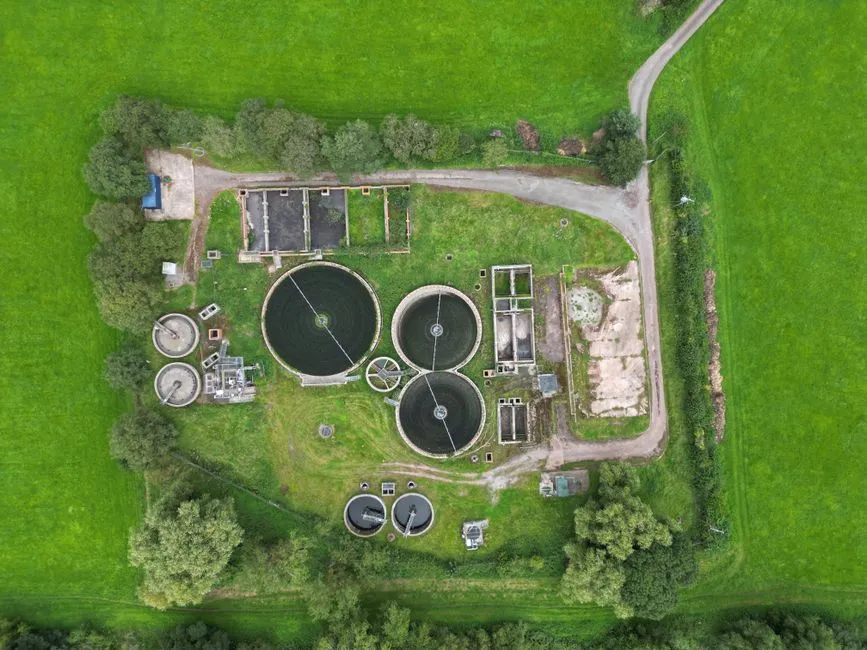
Step 1 is pH correction. Raise pH so dissolved metals precipitate as hydroxides, and drop out gypsum; lime raise to pH greater than 10 is the standard practice before thickening. The lime dose is the single biggest operating cost driver in the train, so the automatic chemical dosing skid for lime, coagulant, and flocculant belongs on the P&ID from day one. Step 2 is coagulation and flocculation — dose coagulant and flocculant matched to the floc density required by the downstream clarifier; selection is driven by the next step, not by chemistry preference. Step 3 is solids separation, where the choice is between a DAF system for mining wastewater solids separation for buoyant floc or streams carrying oils and fines, and a lamella clarifier for metal hydroxide sludge where sludge volume and footprint drive the decision (Genesis Water Technologies, 2025-11). The full DAF vs clarifier decision guide for mining wastewater is published separately.
Step 4 is multimedia filtration. Specify target SDI after the filter, not just inlet turbidity, because SDI is the parameter that protects the downstream membrane. A multi-media filter for RO pretreatment is the workhorse unit. Step 5 is membrane polish — UF for fine colloids and RO for dissolved salts and metals. RO is rated at greater than 99% rejection of dissolved metals and salts (AMPAC USA, 2025-09), with 50–70% recovery on AMD feed and 70–85% as the RO stage of a zero-liquid-discharge train. Step 6 is self-monitoring and reporting — a PLC/HMI with continuous pH, flow, and conductivity plus POTW self-monitoring records, framed as the audit-trail layer the sewer authority will require (LiqTech, 2025-08). The supplied research does not publish flow ranges for Hanceville-area operations, so throughput bands have to be framed qualitatively: a single dimension-stone or sand-and-gravel site typically runs in the low-to-mid two-digit m³/h range, while a process plant with heap leach or milling sits an order of magnitude higher.
| Step | Unit operation | Key specification | Evidence / source |
|---|---|---|---|
| 1 — pH correction | Lime/caustic dosing, equalization | Raise pH greater than 10 before thickening | PMC review, 2024-02 (as cited in S5) |
| 2 — Coagulation/flocculation | Chemical dosing, flash mix, floc basin | Coagulant and flocculant matched to downstream floc density | Genesis Water Technologies, 2025-11 |
| 3 — Solids separation | DAF (buoyant floc, oils/fines) or lamella (heavy floc, footprint) | Selection driven by floc buoyancy and oil loading | Genesis Water Technologies, 2025-11 |
| 4 — Multimedia filtration | Multi-media filter | Target SDI after the filter, not inlet turbidity | LiqTech, 2025-08 (as cited in S5) |
| 5 — Membrane polish | UF (colloids) + RO (dissolved salts/metals) | RO greater than 99% rejection; 50–70% recovery on AMD feed, 70–85% on ZLD RO stage | AMPAC USA, 2025-09 (as cited in S5) |
| 6 — Self-monitoring and reporting | PLC/HMI, continuous pH/flow/conductivity, POTW records | Audit-trail layer the sewer authority will require | LiqTech, 2025-08 (as cited in S5) |
What goes into a defensible vendor RFQ (and what the operator must provide)
Provide the measured flow profile, peak and average flow, batch volumes and representative pH/metals analyses. Obtain the actual receiving authority’s applicable numerical limits or narrative/BMP conditions and record each relevant parameter, fraction, method, point and period in the RFQ. Do not assume every Hanceville site has one common metals/pH/TSS numerical table or a categorical pollutant list identical to another facility.
The desired RO recovery percentage and any reuse scope belong in the RFQ, because reuse changes the RO sizing and the economics. Sludge-handling expectation is the last input: chemical precipitation generates metal-hydroxide sludge that has to be dewatered, and a plate-and-frame filter press for mining sludge dewatering is the standard fit. The cake dryness target and cycle time belong in the RFQ, and they go in alongside the chemistry and flow data — not as a separate purchase order six months later, because the upstream chemistry decisions determine the cake volume and the press sizing.
Reuse economics: turning the compliance spend into a payback lever
Internal water reuse enabled by RO treatment can reduce freshwater consumption 40–60% compared to once-through mining operations (AMPAC USA, 2025-09). For zero-liquid-discharge sites, RO handles 70–85% of the bulk water recovery before the more energy-intensive thermal stages concentrate the remaining brine. Operators should request a recovery curve, not just a nameplate figure, because recovery drives both effluent quality and energy cost. A complementary industrial wastewater management solutions provider selection process and a peer-region compliance approach for mining plants both support the same conclusion.
The sizing logic is reuse as much as economics allow, then polish the rest to sewer quality. The compliance investment pays back on the reuse side and the discharge side simultaneously, and a defensible industrial RO system for mining wastewater is the unit operation that makes the economics work.
Frequently Asked Questions
If our mineral falls under a reserved 40 CFR Part 436 subpart, do we still have to meet federal limits?
A reserved 436 subpart itself has no issued categorical numerical provisions. Other applicable federal/state requirements and the actual direct or sewer authorization still need review. For a POTW discharge,403 prohibitions and actual local conditions remain relevant; do not assume that a direct BPT number applies or that local limits are the only possible obligations.
What budget range should we expect for a six-step pretreatment train in 2026?
The supplied research does not publish price points for a complete pretreatment train, so a buyer has to request a quotation against their own basis of design rather than rely on a published range. The inputs a vendor needs to price the scope are peak and average flow, influent pH and metal profile, the actual applicable control conditions, numerical or narrative/BMP, and desired RO recovery if reuse is in scope. Without those numbers, any price a vendor gives is a placeholder, not a basis-of-design quote.
What should we look for when selecting a pretreatment supplier for a Hanceville-area operation?
Request comparable inlet/outlet analyses, operating conditions and test records for the actual treatment duties. Specify necessary equipment and integration, operator training, spares and response support rather than requiring every vendor to supply UF/RO regardless of need. Tie guarantees and acceptance tests to the verified limits and feed envelope; company claims alone do not establish compliance or delivery certainty.
What is the biggest compliance risk we should plan around for 2026?
The critical risk is mixing process categories or direct-discharge numbers with sewer requirements, and treating a reserved subpart as exemption from other obligations. Confirm process and route, obtain actual applicable standards and control conditions, then use one documented parameter/period/method matrix for design and acceptance. Request an MAHL/MAIL allocation only where the actual authority uses that basis.