
Why Meerut Needs a Reuse-First, Two-Stream Design in 2026
India has no national data-centre water-efficiency standard, and only five of fifteen state data-centre policies carry explicit sustainability provisions (Earth5r, 2025). For a 5–30 MW facility in Meerut that means the Uttar Pradesh Pollution Control Board (UPPCB) consent is the binding instrument, and a single combined wastewater train will not pass it. Two segregated trains — physico-chemical plus UF/RO for cooling tower blowdown (CTBD) and a biological plant for staff sewage — are the only defensible layout.
Meerut's climate drives the cooling load hard. CEEW data, cited by Earth5r (2025), puts 57% of Indian districts in the high to very high heat-risk band, which keeps the cooling tower working for more of the year and pushes per-MW on-site water use toward the upper end of the 0.8–2 million L/day band cited for a 100 MW facility. Average rack density has migrated from 1–3 kW historically to roughly 8 kW today (Earth5r, 2025), so each MW of IT load carries more cooling duty than older Indian designs assume. Meerut also sits inside the upper Ganga plain drainage, which is a regulatory sensitivity for the UPPCB consent note rather than a cost figure. The submission should flag basin sensitivity explicitly, even if the consent does not name it.
The Two Wastewater Streams a Meerut Data Center Must Treat Separately
Stream one is CTBD. At 4 cycles of concentration, TDS sits at 1,200–6,000 mg/L (4–8× the makeup), with 10–50 mg/L suspended solids and an accumulated load of biocides, corrosion and scale inhibitors, and dispersants; legacy chromate and high-phosphate chemistries complicate any reuse or discharge path (Genesis Water Tech). At 4 cycles of concentration, 25–30% of makeup water leaves as blowdown (Genesis Water Tech) — a predictable, on-site, recoverable stream rather than waste. Stream two is staff and cafeteria sewage: lower in flow but high in BOD, sized against the CPHEEO urban norm of 135 L/person/day and the 6,000–15,000-person equivalent domestic demand cited for a 100 MW site (Earth5r).
Routing sewage into the blowdown RO train is the most common Meerut proposal error. It fouls membranes, swings RO feed TDS, and breaches the separate UPPCB consent line. The two streams must stay segregated. Blowdown discharge itself is consent-controlled: some jurisdictions cap blowdown TDS below 1,500 mg/L (Genesis Water Tech), so the consent TDS ceiling is the binding number when the engineer selects the train. The 0.01–0.1 µm UF guard for the CTBD RO train is the membrane that protects the brackish-water RO behind it.
| Parameter | Stream 1 — CTBD | Stream 2 — Staff sewage |
|---|---|---|
| Flow basis | 20–30% of makeup water | 135 L/person/day (CPHEEO) |
| TDS | 1,200–6,000 mg/L at 4 cycles | Low (municipal-grade) |
| Suspended solids | 10–50 mg/L | High BOD/COD |
| Key contaminants | Biocides, inhibitors, chromate/phosphate legacy | BOD, pathogens, nutrients |
| UPPCB consent line | Separate, TDS-capped (some jurisdictions <1,500 mg/L) | Separate, BOD/COD-capped |
| Train | Physico-chemical + UF/RO reuse | Biological (WSZ or MBR) |
Reference Flow Sizing for a 10–20 MW Meerut Site
Order-of-magnitude sizing for a Meerut campus starts with per-MW on-site cooling water use in the 8,000–20,000 L/day band, applied at the upper end for summer peaks, and a 20–30% blowdown fraction of makeup water (Genesis Water Tech). For a 10 MW site, that gives a daily makeup envelope in the low hundreds of kL and a daily CTBD envelope in the tens of kL; for a 20 MW site, double it. The engineer must collect the contracted IT load, design PUE, target WUE in L/kWh, cycles of concentration, the makeup source mix (Meerut Municipal Corporation vs borewell vs recycled sewage), and the Meerut-specific wet-bulb/dry-bulb design conditions before locking any of these numbers.
Free-cooling hours drop sharply between April and June, so blowdown generation is seasonal rather than flat. Equalisation or storage upstream of the RO train is required to ride out the peak-month swing without throttling recovery. Per-MW figures and daily totals are order-of-magnitude envelopes only; final sizing has to come from the project PUE, the target WUE, and the Meerut wet/dry-bulb envelope.
| Input | Working band | Source |
|---|---|---|
| Per-MW on-site cooling water use | 8,000–20,000 L/day (upper end for Meerut peak summer) | Earth5r / CEEW, 2025 |
| Cycles of concentration | 4 (working assumption) | Genesis Water Tech |
| CTBD fraction of makeup | 20–30% | Genesis Water Tech |
| 10 MW daily makeup envelope | Order-of-magnitude only | Derived envelope |
| 10 MW daily CTBD envelope | Order-of-magnitude only | Derived envelope |
Reuse-First Treatment Train: Side-Stream Filtration → UF → RO
Side-stream filtration is sized at 1–5% of total circulation flow, with capex of US$50,000–200,000 for typical data-center installations (Genesis Water Tech). It drops suspended solids ahead of the RO and lets the cooling tower run more cycles, which is the whole point. A multi-media filter ahead of the UF stage handles the bulk solids cut.
UF at 0.01–0.1 µm pore size acts as the RO guard: 90–95% recovery, low-pressure 10–30 psi operation, removes bacteria and colloids that would otherwise foul the RO (Genesis Water Tech). Brackish-water RO is the workhorse — permeate at 10–50 mg/L TDS, recovery 50–85% on CTBD limited by calcium, magnesium and silica scaling, pressure 150–400 psi, with PLC-controlled antiscalant and biocide dosing to push recovery higher (Genesis Water Tech). The brackish-water RO train for cooling-tower blowdown is the workhorse that returns high-quality permeate to the makeup stream. Conventional BWRO is limited to 75–80% recovery on CTBD; high-recovery designs with controlled silica and calcium precipitation can reach about 95% recovery but add complexity (IDE Tech).
Capex for a 50,000 GPD RO train is US$250,000–500,000, with opex of US$1.50–3.00 per 1,000 gallons treated (Genesis Water Tech). Request vendor bands in ₹-crore against this envelope before binding. Permeate is blended back into the cooling-tower makeup stream, raising cycles of concentration and cutting both freshwater intake and discharge volume. Spare spare RO and UF membrane elements should be on the spares list from day one.
Campus Sewage Train: Packaged A/O (WSZ) or MBR
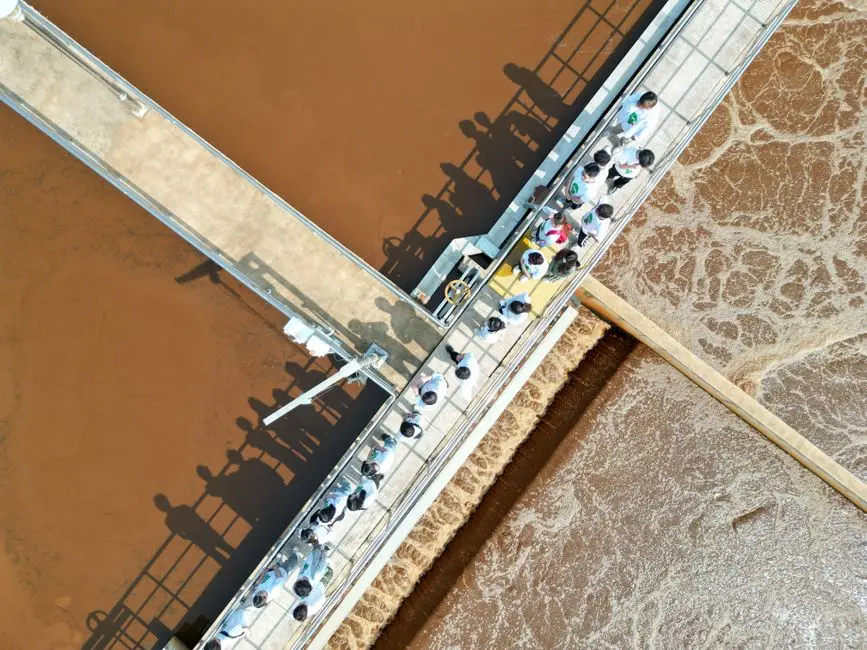
For staff and cafeteria sewage, pick a buried WSZ packaged A/O plant for staff sewage when land is at a premium, the treated stream goes to land irrigation or a soak pit, and no operator is available — the unit is fully automated and buried. The WSZ range covers 1–80 m³/h, which fits a 5–30 MW campus. Pick an MBR option for the campus sewage line (10–2,000 m³/day, sub-micron filtrate) when the operator wants treated sewage for toilet flushing or landscaping and needs a smaller footprint than conventional activated sludge. Trailer mounting is available for phased build-out, which suits a Meerut campus that adds capacity in stages.
Reagent choice matters: a ClO₂ generator belongs on the CTBD and cooling-loop side for biocide control, not on the sewage side, where it interacts negatively with downstream membranes. Both trains must run on separate UPPCB consent lines, and a single-train proposal that mixes CTBD and domestic sewage is a consent risk and a membrane-life risk at the same time.
| Parameter | WSZ packaged A/O | MBR |
|---|---|---|
| Flow range | 1–80 m³/h | 10–2,000 m³/day |
| Filtrate quality | Conventional activated-sludge effluent | Sub-micron (<1 µm) filtrate |
| Footprint | Buried, very compact | Compact vs conventional AS |
| Reuse outlet | Land irrigation / soak pit | Toilet flushing, landscaping |
| Operator need | Low (fully automated) | Moderate |
| Trailer mount | Yes | Case-by-case |
Reuse vs Partial ZLD vs Full ZLD: When Meerut Needs the Upgrade
Reuse-only is the 2026 default for Meerut: side-stream filter plus UF plus RO, with permeate returned to the cooling-tower makeup stream. Partial ZLD layers RO at 70–80% recovery with MVC at around 95% recovery of the RO concentrate, capturing most of the volume benefit at lower cost than full crystallisation; MVC distillate comes in below 10 mg/L TDS and is usable as high-quality cooling-tower makeup (Genesis Water Tech). Full ZLD stacks RO, evaporative concentration, and a crystalliser to hit 95–99% overall recovery and pushes capex to US$3–8M with opex of US$5–15 per 1,000 gallons (Genesis Water Tech) — justify only when discharge is prohibited or freshwater cost spikes.
The trigger to escalate from reuse to partial or full ZLD is a UPPCB consent revision that caps blowdown TDS below 1,500 mg/L (Genesis Water Tech), a Meerut Municipal Corporation supply interruption that turns the MVC distillate line into a buffer, or a corporate BRSR Principle 6 disclosure target. ZLD remains a future-proofing option, not the 2026 default.
| Option | Architecture | Capex envelope | Opex envelope | When to choose |
|---|---|---|---|---|
| Reuse only (2026 default) | Side-stream filter + UF + RO | US$250,000–500,000 per 50,000 GPD RO | US$1.50–3.00 / 1,000 gal | Standard UPPCB consent, no ZLD requirement |
| Partial ZLD | RO (70–80%) → MVC (~95%) | US$1–3M for 10,000–30,000 GPD MVC stage | 15–25 kWh per 1,000 gal distillate | Consent tightens, MMC supply risk |
| Full ZLD | RO + brine concentrator + crystalliser | US$3–8M | US$5–15 / 1,000 gal | Discharge prohibited, very high freshwater cost |
What to Ask a Vendor Before Signing the Meerut Proposal
Demand two separate UPPCB consent lines and two physically segregated trains — reject any single-train proposal that mixes CTBD and domestic sewage. Ask for hyperscale precedents analogous to AWS (20 sites on purified wastewater by 2023) and Google (reclaimed water at over 25% of campuses), and evidence that the train meets BRSR Principle 6 disclosure (Earth5r / KETOS, 2026).
Ask the vendor to band their capex against the Genesis Water Tech envelope — US$250,000–500,000 for 50,000 GPD RO and US$3–8M for full ZLD — and to scope a reuse-only train for the 10–30 MW Meerut envelope before binding to a single number. Operating cost is US$1.50–3.00 per 1,000 gallons treated for RO and US$5–15 per 1,000 gallons for ZLD (Genesis Water Tech). For the RO specification framework for data-center CTBD and the high-TDS treatment options for CTBD, request side-by-side quotes against the same envelope. For the sewage side, the packaged STP cost and compliance in India reference sets the floor.
Request site-specific influent testing, current UPPCB consent terms, and the wet-bulb/dry-bulb envelope — order-of-magnitude figures in this guide are not a substitute for these documents. Confirm antiscalant chemistry and the cleaning regime, and ask whether the control philosophy is conservative-recovery RO (lower membrane risk) or high-recovery brine management (IDE-style, around 95%) — both are defensible, but the operating-cost story differs.
Frequently Asked Questions
Does cooling tower blowdown discharge need UPPCB consent, and what TDS ceiling applies?
Yes. Blowdown discharge falls under UPPCB consent, and the engineer must confirm the consent terms before sizing the train. Some jurisdictions cap blowdown TDS below 1,500 mg/L for discharge (Genesis Water Tech), so the consent TDS limit is the binding number for train selection — request the current consent text from the developer or consultant before locking any equipment list.
Is reuse now the default for a Meerut data center in 2026?
Yes. Reuse — side-stream filtration plus UF plus RO, with permeate returned to the cooling-tower makeup stream — is the 2026 default. ZLD remains a future-proofing option that the engineer escalates to only if UPPCB tightens the consent TDS ceiling, Meerut Municipal Corporation supply becomes unreliable, or a corporate BRSR Principle 6 disclosure target demands it (Earth5r / KETOS, 2026).
What capex band should a 10–30 MW Meerut site expect for a reuse-only train?
Capex is project-specific. Ask suppliers to band their quote against the Genesis Water Tech envelope of US$250,000–500,000 for a 50,000 GPD RO train and US$3–8M for a full ZLD train, and to scope a reuse-only train for the 10–30 MW Meerut envelope before binding to a single number. Operating cost is US$1.50–3.00 per 1,000 gallons treated for RO and US$5–15 per 1,000 gallons for ZLD (Genesis Water Tech). The buyer must request vendor-specific ₹-crore and ₹/kL bands against this envelope.
Can cooling tower blowdown and staff sewage share a single train?
No. The two streams must stay on separate UPPCB consent lines and separate trains. Routing sewage into the blowdown RO train fouls membranes, swings RO feed TDS, and breaches the separate consent line — reject any single-train proposal that mixes CTBD and domestic sewage, because it is a consent risk and a membrane-life risk at the same time.