
What an industrial ETP for a Sydney factory actually has to do in 2026
A factory in Sydney, Australia discharges either to sewer under a Sydney Water trade waste customer charter or to the environment under the NSW Protection of the Environment Operations (POEO) Act, and in both cases the licence envelope, not the influent strength, sets the design. Sydney Water trade waste licences for industrial sites typically cap BOD, suspended solids, oil and grease, pH and often ammonia, nitrogen and phosphorus, mirroring the licence envelope documented in the GHD case study of a Central Coast NSW food plant, where the trade waste agreement set BOD <300 mg/L, SS <300 mg/L, oil/grease <50 mg/L and pH 7–9 with a maximum daily discharge of 80 m³/d (instantaneous rate <2.2 L/s) (Laginestra, GHD, Wst Aspire 07, 2025-09 reprint of 2006 case study).
Industrial ETPs treat three classes of contaminant step by step. Primary treatment removes settleable solids and free oil through physical and chemical means — screening, grit removal, grease traps, flow equalisation and a DAF. Secondary treatment removes dissolved organics through biological action, either aerobic (continuous aeration, SBR, MBR) or anaerobic. Tertiary treatment strips residual inorganics, pathogens and colour through filtration, disinfection (chlorine, chlorine dioxide, UV) and, where water reuse is required, reverse osmosis. A DAF alone is therefore rarely the answer for a Sydney factory: it is the core solids-and-FOG removal step in a multistage train.
The reader's first decision is whether they need to meet sewer discharge, water-recycling, or zero-discharge requirements, because this single choice drives whether a DAF and biological pair is sufficient or whether MBR/RO polishing is required downstream. For the 2026 framework discussed in this guide, the targets align with the 2026 industrial effluent discharge limits and compliance guide, which any Sydney project engineer should review before specifying equipment.
The DAF-first process train used by NSW food and industrial plants
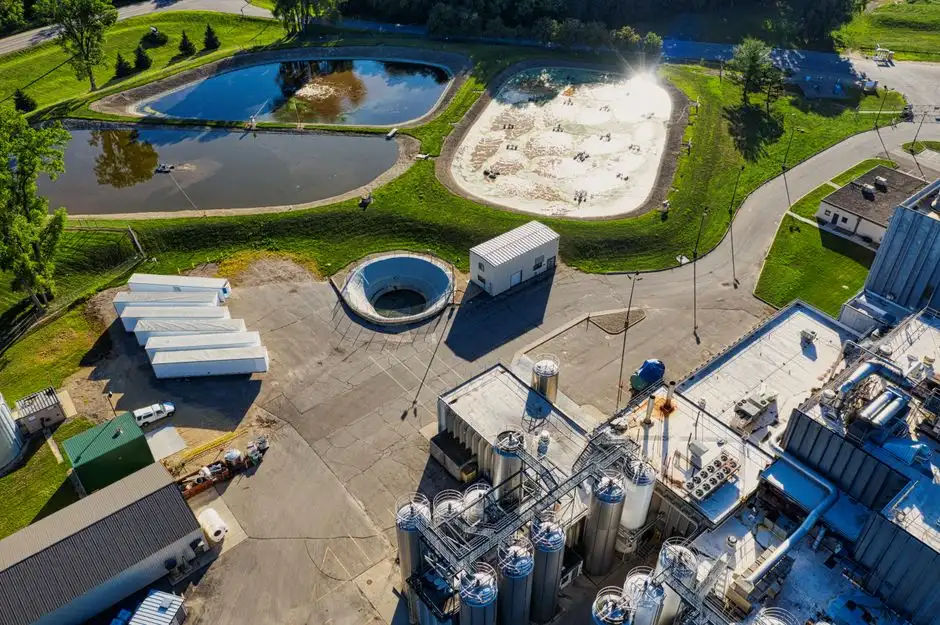
The reference NSW food plant, as documented in the GHD case study, runs as: grease trap → 25 m³ above-ground equalising tank (level-controlled) → transfer pumps (two duty, low and high flow) → DAF with chemical conditioning (ferric chloride solution and polymer) and pH adjustment (caustic soda) → DAF effluent storage → two continuously aerated bioreactors in series → sequencing batch reactor (SBR) with a 4-hour aeration / 1-hour settle / 1-hour decant cycle → floating decanter to treated effluent storage → sewer transfer pumps, with DAF float and waste activated sludge combined in a 15 kL holding tank, supernatant returned to the equalising tank, and combined sludge tankered off-site (Laginestra, GHD, 2025-09 reprint).
A DAF works by pressurising a sidestream of clarified effluent with air in a dedicated saturation drum, then releasing it into the flotation tank at atmospheric pressure, where the pressure drop generates micro-bubbles that attach to oil droplets and suspended solids and float them to the surface for skimming. Per the Quora refinery explainer, these bubbles typically measure 10–100 microns in diameter and the accumulated froth is scraped off by a mechanical skimmer into a sludge trough, leaving clarified water to flow out under an overflow weir (OpenBlueprint, Quora, undated).
In refinery and similar oily applications, the DAF sits between an API gravity separator and the biological stage, acting as the secondary clarifier that protects bacteria from suffocating under emulsified oil films. The Quora source is explicit on this point: if significant quantities of emulsified oil reach the biological stage, the oil coats the bacteria in a suffocating film, preventing oxygen transfer and destroying the entire microbial colony (OpenBlueprint, Quora, undated). For a Sydney food plant the protection function is identical, because the influent oil/grease documented in the GHD case averaged 19,600 mg/L with a range up to 49 mg/L in the effluent — far above what activated sludge can tolerate without DAF protection upstream.
Two design details from the GHD case deserve to be flagged for any 2026 specifier. First, the equalisation tank ran at 16.8 hours of detention versus a typical 18–24 hours and was identified as marginally undersized, which is why the upgrade added a 75 m³ balance tank extension to the existing 25 m³ tank. Second, the DAF in the same case operated at a hydraulic loading of 0.7 m³/m²·h against a typical 2–4 m³/m²·h, and still achieved 97% grease reduction (Laginestra, GHD, 2025-09 reprint). That last data point is important: even a hydraulically overloaded DAF can carry the FOG load if chemical conditioning is right, which is why suppliers should be asked for guaranteed FOG removal under documented peak flow, not just nominal hydraulic loading. The unit class specified for an equivalent Sydney food site is an industrial DAF system for Sydney factories, matched to the site's peak flow rather than its average.
Matching the DAF and biological stage to Sydney factory wastewater
DAF sizing must be driven by peak flow and hydraulic loading rate (m³/m²·h), not by average daily flow. The GHD case study is explicit that the DAF was "not performing optimally due to peak flows (when 2 feed pumps operate together, which is necessary because of the lack of capacity of the equalising tank)" — a direct line from the operator's review (Laginestra, GHD, 2025-09 reprint). For 2026 designs, the project engineer must collect a peak-vs-average flow profile from the site before sizing the flotation cell, and a variable-speed feed pump paced against equalisation tank level is now standard practice rather than an upgrade option.
Biological stage sizing should be based on BOD loading, target F:M ratio and MLSS band, not on tank volume alone. The GHD case ran the bioreactors at 2,800–3,500 mg/L MLSS, 0.6 mg/L dissolved oxygen and 0.12 kg BOD/kg MLVSS·d with a 14-day detention time, against a typical design of 2,500–4,500 mg/L MLSS, 1–2 mg/L DO and 0.1–0.2 kg BOD/kg MLSS·d at 3–5 days detention (Laginestra, GHD, 2025-09 reprint). The site moved toward a tighter 3–5 day SBR-only detention after the upgrade.
Dissolved oxygen is the single biggest operational risk after the DAF. The GHD case ran the aeration tanks at 0.6 mg/L DO against a design target of 1–2 mg/L, and the operator's review attributes the periodic BOD and SS licence breaches directly to low DO and nutrient imbalance (Laginestra, GHD, 2025-09 reprint). Specifiers should therefore require the aeration system to be sized for peak BOD load, not average, and should demand continuous DO monitoring with a high-DO alarm tied to the PLC.
Plastic, rag and fibrous debris from food and packaging lines is a recurrent cause of blockage in NSW plants, which is why the GHD upgrade explicitly added an inlet screen to remove coarse solids prior to the DAF (Laginestra, GHD, 2025-09 reprint). For a Sydney factory the screen sits between the grease trap and the equalisation tank, and the standard equipment is a rotary bar screen for headworks protection.
| Process unit | Parameter | GHD case actual | Typical design band |
|---|---|---|---|
| Equalisation tank | Detention time | 16.8 h | 18–24 h |
| Grease trap | Detention / SS reduction / grease reduction | 4.8 h / 15% / 99% | 0.5–1 h / 10% / 80% |
| DAF | Hydraulic loading / SS reduction / BOD reduction / grease reduction | 0.7 m³/m²·h / 61% / 35% / 97% | 2–4 m³/m²·h / 70% / 35% / 95% |
| Bioreactors (incl. SBR) | MLSS / DO / F:M / Detention / SS+BOD reduction | 2,800–3,500 mg/L / 0.6 mg/L / 0.12 kg BOD/kg MLVSS·d / 14 d / 0% + 83% | 2,500–4,500 mg/L / 1–2 mg/L / 0.1–0.2 kg BOD/kg MLSS·d / 3–5 d / 80–95% |
Sources: Laginestra, GHD, Wst Aspire 07 (2025-09 reprint of 2006 case study); the table transcribes the operator's documented plant values against typical design parameters. Numerical bands in the right-hand column are reproduced from the same case study's "typical design" column, not invented.
Chemical conditioning, sludge handling and recycling — the parts engineers forget
DAF performance depends on chemical conditioning with coagulant, flocculant polymer and pH adjustment, all dosed upstream of the flotation cell. The GHD case used ferric chloride solution as coagulant, polymer as flocculant, and caustic soda for pH correction, with precipitation and coagulation of solids in the pipework before the DAF cell (Laginestra, GHD, 2025-09 reprint). For a 2026 Sydney specifier the chemistry is the same family, but the dosing should be PLC-controlled chemical dosing for DAF conditioning with flow-pacing, because manual nutrient dosing of urea and phosphate was a documented source of process instability in the GHD case (Laginestra, GHD, 2025-09 reprint).
The DAF float sludge and the waste activated sludge from the biological stage are usually combined in a sludge holding tank, dewatered, and sent off-site. The GHD case used a 15 kL sludge holding tank with supernatant returned to the equalising tank and combined sludge tankered off-site weekly. The operator's review explicitly noted that "sludge thickening and dewatering will reduce handling costs significantly for the site" (Laginestra, GHD, 2025-09 reprint). For Sydney factories the workhorse dewatering option is a plate-and-frame filter press for sludge volume reduction, paired with a sludge feed pump and polymer make-up unit.
If the site targets water recycling (for washdown, CIP, irrigation or cooling-tower make-up), disinfection with chlorine dioxide or UV must be added after the biological stage, and the SBR/DAF effluent must be polished through filtration. The GHD upgrade included disinfection specifically "to enable recycling of effluent for a number of applications" (Laginestra, GHD, 2025-09 reprint). When recycling is the target, the biological stage is typically replaced or followed by an MBR system for water-recycling ETPs, with RO downstream where dissolved solids or specific ions must be removed.
2026 selection framework: which DAF and ETP configuration fits your Sydney site
The first variable is flow band. Sydney food prep, light manufacturing and small metal-finishing sites in the 4–20 m³/h range typically select a single small DAF skid, a packaged equalisation tank, a packaged biological unit (WSZ or MBR), and skid-mounted chemical dosing. The Central Coast food plant benchmark of 46 m³/d average (range 33–84 m³/d) and 80 m³/d licence maximum falls in the 20–80 m³/h band, where a mid-size DAF with a 60–100 m³ equalisation tank, separate bioreactors and SBR, plus a filter press for sludge, is the proven configuration (Laginestra, GHD, 2025-09 reprint). Sites in the 80–300 m³/h range — large beverage, dairy, metal finishing, pulp and paper — require a multi-unit DAF train, dedicated screening, MBR or activated sludge with clarified sludge recirculation, and a full chemical dosing skid.
The second variable is discharge target. Sewer discharge alone is satisfied by DAF + biological + sludge dewatering, sized against the trade waste licence envelope (BOD <300 mg/L, SS <300 mg/L, oil/grease <50 mg/L, pH 7–9 in the GHD case). Water reuse adds disinfection and filtration, and zero liquid discharge adds RO plus brine management — neither is a standard DAF scope.
For 2026 selections, the project engineer should always ask suppliers for the same data the GHD upgrade demanded: influent variability range, peak vs. average flow, DAF hydraulic loading in m³/m²·h, MLSS and DO targets, sludge production rate, and a documented upgrade path to a future flow 1.5–2× the current average (Laginestra, GHD, 2025-09 reprint). Hydraulic loading against peak flow is the single number that determines whether the DAF will pass the Sydney Water trade waste audit on day one, and the only way to verify it is to ask for the guaranteed FOG and SS removal at the documented peak flow, not the nominal flow. For a deeper cost-and-spec comparison of DAF models, refer to the best DAF unit for industrial wastewater 2026 benchmark, and for a process-level contrast with sedimentation refer to the DAF vs sedimentation 2026 comparison.
| Flow band | Typical Sydney site | DAF configuration | Equalisation | Biological stage | Sludge handling |
|---|---|---|---|---|---|
| 4–20 m³/h | Small food prep, light manufacturing | Single small DAF skid | Packaged tank | Packaged WSZ or MBR | Bag dewatering or small filter press |
| 20–80 m³/h | Central Coast food plant benchmark (46 m³/d, 80 m³/d licence) | Mid-size DAF with chemical conditioning | 60–100 m³, level-controlled | Separate bioreactors + SBR or MBR | Plate-and-frame filter press, 15 kL sludge holding |
| 80–300 m³/h | Large beverage, dairy, metal finishing, pulp and paper | Multi-unit DAF train with dedicated screening | 100 m³+ balance tank with VSD feed pumps | MBR or activated sludge with RAS | Filter press plus sludge thickener |
Source for the 20–80 m³/h benchmark row: Laginestra, GHD, Wst Aspire 07 (2025-09 reprint of 2006 case study). The 4–20 m³/h and 80–300 m³/h rows describe the configuration classes implied by the same case study's process units and the 100 m³/d future design flow adopted in the upgrade.
Frequently Asked Questions
What budget should a Sydney factory plan for an industrial ETP with DAF in 2026?
The supplied research documents the process configuration and the licence envelope (BOD <300 mg/L, SS <300 mg/L, oil/grease <50 mg/L, pH 7–9, 80 m³/d maximum) for the GHD Central Coast food plant, but does not publish a capital or operating cost figure (Laginestra, GHD, 2025-09 reprint). A buyer should therefore request a written quote from each shortlisted supplier that breaks out the DAF unit, the equalisation tank extension, the bioreactor and SBR upgrade, the chemical dosing skid, the sludge dewatering press and the PLC/instrumentation scope separately, and then compare those line items against the GHD process unit list as a check that no scope item has been omitted.
How do I select a DAF and ETP supplier in Sydney without getting locked into the wrong configuration?
Ask each supplier to guarantee, in writing, the FOG and SS removal at the documented peak flow (not the nominal flow), the DAF hydraulic loading rate in m³/m²·h at that peak, the MLSS and DO targets for the biological stage, and the upgrade path to 1.5–2× current average flow (Laginestra, GHD, 2025-09 reprint). A supplier that quotes only nominal flow and nominal loading cannot be compared against the GHD benchmark of 0.7 m³/m²·h actual versus 2–4 m³/m²·h typical, and should be asked to re-quote against peak flow before any order is placed.
What is the typical lead time for a DAF and ETP upgrade in NSW?
The GHD case study records that the design for the Central Coast food plant upgrade was completed in mid 2006 and "fast track installation took place in late 2006" (Laginestra, GHD, 2025-09 reprint). The supplied research does not state a 2026 lead time in weeks or months, so a buyer must request a project schedule from each shortlisted supplier that covers design, equipment fabrication, site installation, commissioning and the Sydney Water trade waste compliance sampling window before signing.
Which licence limits actually drive ETP design for a Sydney factory in 2026?
The trade waste licence envelope in the GHD case study sets BOD <300 mg/L, SS <300 mg/L, oil/grease <50 mg/L, pH 7–9, with a maximum daily discharge of 80 m³/d and instantaneous rate <2.2 L/s (Laginestra, GHD, 2025-09 reprint). For any 2026 Sydney project, the actual licence limits must be obtained from Sydney Water before equipment is sized, because the licence envelope — not the influent strength — is what determines DAF sizing, biological stage capacity and sludge dewatering choice.