
Why the Baton Rouge pretreatment stack has three layers
Baton Rouge chemical plants sit inside a three-layer regulatory stack: the federal National Pretreatment Program and the categorical effluent guideline under 40 CFR Part 414 for organic chemicals, the EPA's National Pollutant Discharge Elimination System (NPDES) framework, and the local City-Parish of East Baton Rouge Industrial Pretreatment Program (C-P IPP). The national pretreatment program requires nondomestic dischargers that introduce pollutants to POTWs to comply with pretreatment standards to prevent pass-through, interference, and sludge contamination, and those standards apply whether or not the POTW has an approved pretreatment program and whether or not the industrial user has been issued a permit (dober.com). The C-P IPP is the local mechanism that delivers those requirements: it ensures wastewater discharged to the City of Baton Rouge / Parish of East Baton Rouge collection system meets local, state, and federal water quality regulations (brla.gov, Industrial Pretreatment Program page).
EPA has issued Effluent Guidelines for 59 industrial categories, applying to approximately 40,000 facilities discharging directly to U.S. waters and 129,000 facilities discharging to municipal sewage treatment plants (dober.com). For organic chemicals, the applicable categorical standard is 40 CFR Part 414. A critical point often missed on the plant floor: effluent guidelines are technology-based, not water-quality-based, so site-specific POTW limits and local ordinance limits can be more stringent than the ELG floor (dober.com). A chemical plant's permit is therefore facility- and location-specific, and the C-P IPP's review of pretreatment designs, inspections, sampling, and self-monitoring reports enforces that specificity (brla.gov).
Inside the C-P Industrial Pretreatment Program: permits, SIU vs NSIU, and inspections
The C-P IPP paperwork starts with an Environmental Recommendation / Pretreatment Approval, which is required as part of the initial permitting process for commercial improvements and is submitted along with a copy of the plumbing layout to [email protected] (brla.gov). Industrial facilities and commercial facilities planning to discharge industrial waste to the C-P sanitary sewer system may be required to obtain an Industrial Wastewater Permit; the program defines Industrial Waste as "all water-borne solids, liquids, or gaseous substances resulting from any process of industry, manufacturing, trade, business, food processing operation or any mixture of the waste with water or normal wastewater, or any waste which is distinct from normal domestic wastewater" (brla.gov). Pretreatment is the reduction of the amount of pollutants, the elimination of pollutants, or the alteration of the nature of pollutant properties in wastewater to a less harmful state prior to discharging into a POTW, obtained by physical, chemical, or biological processes or process changes (brla.gov).
Under the C-P IPP, Industrial Users are categorized as either Significant Industrial Users (SIU) or Non-Significant Industrial Users (NSIU) depending on the type and quantity of wastewater routed to the collection system. The C-P's major program elements include reviewing pretreatment designs, issuing permits, performing inspections, collecting samples, reviewing self-monitoring reports, and enforcing state and federal regulations and local ordinances (brla.gov). For a chemical plant, this means the SIU/NSIU determination changes the inspection frequency, the self-monitoring schedule, and the parameter list the plant must report against. The C-P Environmental Division is the program contact, reachable at [email protected] (brla.gov, Environmental Division page).
The chemical-plant pretreatment train from equalization to monitoring

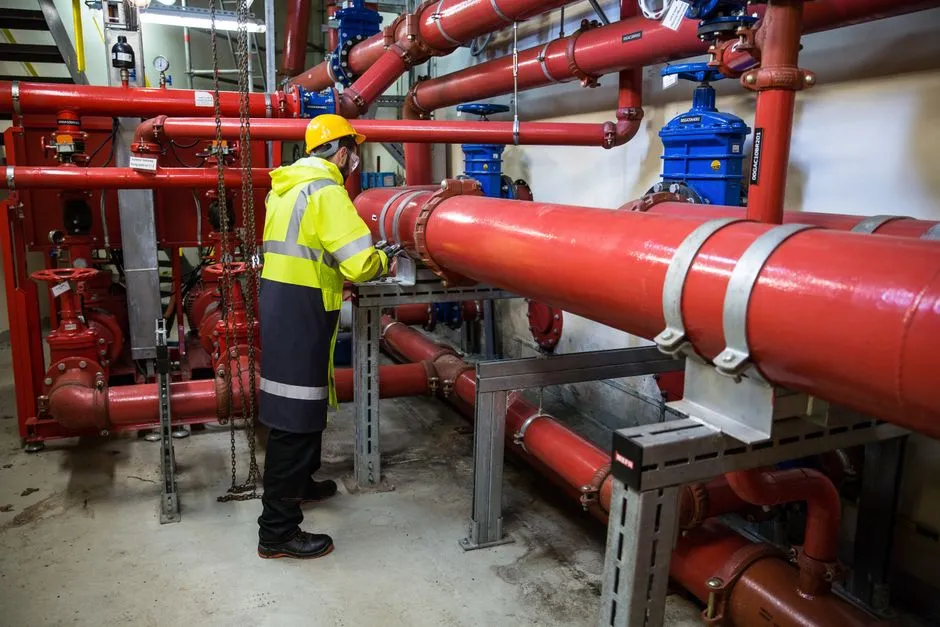
Chemical treatment programs must be designed around the specific numeric limits in the facility's NPDES permit rather than industry averages, as permits are facility- and location-specific (dober.com). Coagulants, pH adjusters, and other treatment chemicals used upstream of a POTW connection must produce an effluent that will not interfere with municipal treatment plant operations or violate the POTW's own NPDES permit (dober.com). The most common chemical pretreatment train for organic-chemical plants discharging to a POTW combines flow and load equalization, pH adjustment, coagulation and flocculation, dissolved air flotation or lamella clarification for oil/grease and colloidal solids, biological treatment (typically activated sludge or MBR) for COD/BOD reduction, and final polishing/clarification, with continuous online pH and flow monitoring plus composite sampling for self-monitoring reports.
Coagulation and flocculation chemistries use either inorganic or organic (carbon-based) chemicals, each with characteristic environmental and economic trade-offs (dober.com). Synthetic polymers used in solid–liquid separation include polyacrylates, polyacrylamide, polyamines, poly DADMAACs, and poly(ethylene oxides); natural polymers include lignin, tannins, and polysaccharides such as chitosan and starch (dober.com). The choice is driven by the specific pollutant profile and the discharge limits in the permit. Self-monitoring reports and POTW sampling are the proof artifacts: the C-P IPP reviews self-monitoring reports alongside its own sampling, so data integrity and chain of custody are mandatory (brla.gov). A typical unit-operation map for an organic-chemical SIU is summarized below.
| Stage | Unit operation | Primary purpose | Typical monitoring |
|---|---|---|---|
| Headworks | Rotary bar screen / grit removal | Protect downstream units from rags and coarse debris | Visual inspection, differential pressure |
| Equalization | Surge/equalization basin with mixing | Dampen flow and load swings | Level, online pH |
| pH adjustment | Acid/ caustic dosing via PLC-controlled chemical dosing system | Bring pH into the band required for coagulation and biology | Online pH, flow-paced dosing |
| Coagulation / flocculation | Flash mix and floc basin with polymer feed | Destabilize colloids and grow settleable floe | Jar tests, streaming current |
| Primary separation | DAF system for chemical plant wastewater or lamella clarifier for chemical pretreatment | Remove oil/grease and floated/settled solids | TSS, O&G, scum blanket |
| Biological / polishing | Activated sludge or MBR, plus activated carbon if needed | COD/BOD reduction; adsorb residual organics | COD, BOD, MLSS, dissolved oxygen |
| Final monitoring | Effluent sampling station with flow meter and online pH | Generate the data for self-monitoring reports | Composite sampling, online pH/flow, C-P grab cross-check |
2026 PFAS and stormwater exposure for chemical plants on the C-P system
The EPA has developed Method 1633, capable of measuring 40 different PFAS compounds in wastewater, while industry-specific wastewater standards for PFAS-manufacturing facilities are under development with a proposed rulemaking anticipated in 2026 per the September 2025 Unified Agenda (dober.com). Maryland's Protecting State Waters from PFAS Pollution Act, enacted in May 2024, charges the state environmental agency with setting PFAS action levels and monitoring requirements for significant industrial users operating under pretreatment permits (dober.com) — a state-level precedent for what an SIU permit could look like once a federal PFAS ELG lands.
EPA's proposed 2026 Multi-Sector General Permit for industrial stormwater discharges would replace the 2021 permit, requiring quarterly monitoring for 40 PFAS compounds across 23 industrial sectors — a new compliance burden for chemical sites (dober.com). Stormwater contamination pathways on a chemical site — treatment chemical storage areas, loading docks, and outdoor process equipment — must be addressed inside the same chemical program as process wastewater (dober.com). For a Baton Rouge SIU, the practical move is to install a rotary bar screen for headworks protection on the process wastewater side and to bring outdoor chemical and loading areas under a single inspection and sampling discipline.
Enforcement reality: why a defensible pretreatment program matters in Region Six
EPA's compliance assurance program evaluates state agencies on four interdependent elements: appropriate identification of violations, timely issuance of enforcement actions, escalation of enforcement actions when violations continue, and the ability to assess and collect penalties (LSU Master's Theses 1073, 2003). A successful program depends on the regulated community perceiving a high likelihood of being inspected and a high likelihood of receiving enforcement orders and penalties (LSU Master's Theses 1073, 2003). Deterrence is a function of perception, which is built by the regulated community's experience with actual inspections and enforcement orders.
For a Baton Rouge chemical plant, the C-P Environmental Division's inspection, sampling, and self-monitoring review functions are not paperwork theater (brla.gov). Permit violations, missed sampling, or pH excursions documented in C-P records can escalate into formal enforcement. Operators should treat self-monitoring data quality, on-site calibration of pH/flow meters, and timely Discharge Monitoring Reports as the first line of defense. A defensible file — identification records, enforcement correspondence, escalation history, and penalty exposure notes — aligned with the four EPA compliance assurance elements is the audit-ready posture that survives a Region Six inspection.
A 2026 pretreatment compliance checklist for chemical plants near Baton Rouge
The checklist below maps directly to the C-P IPP paperwork, the categorical standard, and the 2026 federal watchlist. Use it to score your facility before the next C-P inspection cycle.
| Area | Verification step | Reference |
|---|---|---|
| Permit status | Confirm current Industrial Wastewater Permit is on file with the C-P; confirm SIU/NSIU classification; confirm Environmental Recommendation / Pretreatment Approval is current for any process or plumbing change. | brla.gov |
| Sampling and reporting | Verify sampling points, composite vs. grab protocols, and that self-monitoring reports match the schedule and parameter list in the permit; C-P reviews these reports alongside its own sampling. | brla.gov |
| Unit operations audit | Walk equalization, pH adjustment, coagulation/flocculation, flotation/clarification, biological or carbon polishing, and final monitoring; confirm each stage is sized for the permit's numeric limits. | dober.com |
| Chemical program | Confirm a PLC-controlled chemical dosing system with flow-paced control on acid/caustic and coagulant/polymer, and a primary separator (a DAF system for chemical plant wastewater or lamella clarifier) sized for the design flow. | dober.com; brla.gov |
| 2026 watchlist | Track the proposed 2026 Multi-Sector General Permit (quarterly PFAS monitoring across 23 sectors), the PFAS-manufacturing ELG rulemaking anticipated in 2026, and EPA Method 1633 readiness. | dober.com |
| Documentation | Maintain a four-element compliance file — identification records, enforcement correspondence, escalation history, and penalty exposure notes — aligned with the EPA compliance assurance program elements. | LSU Master's Theses 1073, 2003 |
Frequently Asked Questions
Who regulates chemical plant sewer discharge in the Baton Rouge area?
Discharges to the C-P sanitary sewer are regulated by the City-Parish of East Baton Rouge Industrial Pretreatment Program alongside federal categorical standards such as 40 CFR Part 414 for organic chemicals, and the EPA's National Pretreatment Program and NPDES framework (brla.gov; dober.com). The C-P issues Industrial Wastewater Permits, performs inspections, collects samples, and reviews self-monitoring reports (brla.gov).
How do I choose between a DAF and a lamella clarifier for chemical plant pretreatment?
The choice is driven by the specific pollutant profile and the discharge limits in the permit. DAF is typically selected when oil and grease, emulsified loads, or floated colloids dominate; a lamella clarifier is selected when settleable solids dominate and footprint is constrained. Coagulants, pH adjusters, and other treatment chemicals used upstream of a POTW connection must produce an effluent that will not interfere with municipal treatment plant operations or violate the POTW's own NPDES permit (dober.com). Request from the supplier the specific removal guarantee, footprint, polymer consumption, and reference list for chemical SIU applications, and a side-by-side DAF vs clarifier factory guide is a useful starting point.