What a Multiple Effect Evaporator Is and Why Design Parameters Matter
A multiple effect evaporator (MEE) is a series of evaporator vessels ("effects") in which vapor generated in one effect condenses inside the heat exchanger of the next, so each kilogram of primary steam is reused across stages rather than vented after a single evaporation. The design payoff is that adding effects reduces specific steam consumption but increases capital cost, so the engineer's exercise is a parameter trade-off, not a single optimum (Chantasiriwan, MDPI 2020; CondorChem, "Multiple effect evaporators for high volumes of wastewater").
The five parameter families that drive that trade-off are: number of effects, feed arrangement (forward, backward or parallel), vacuum and pressure profile, evaporation temperature (and its associated boiling-point elevation), and the distribution of heating-surface area across effects. These families interact, so changing one — for example, deepening the vacuum on the last effect — shifts the saturation temperature, which shifts the available log-mean temperature difference (LMTD) and therefore the heating area in every other effect. The rest of this article walks through each family, anchors the range with a sourced value, and closes with a consolidated parameter table drawn from a real commercial product line.
Number of Effects and Steam Economy
Commercial wastewater MEE units are sold in 1, 2 and 3 effects, with the CondorChem Envidest DPM and Envidest MFE product lines offered in all three stage counts ("Multiple effect evaporators for high volumes of wastewater", condorchem.com). Academic models, by contrast, often go to 4 effects — Chantasiriwan (MDPI, published 2020-03-16) builds his comparison around a 4-effect sugar MEE. Steam economy in a multiple effect evaporator scales roughly with the number of effects: CondorChem states that a 3-effect system can produce approximately three times more distillate than a single-effect system for the same primary steam input, which is the working definition of "≈3 kg distillate per kg steam" for a balanced 3-effect unit. Beyond 4–5 effects, marginal steam-economy gain drops while capital cost and pressure-drop control get harder, and the literature notes that MVR or TVC boosting is then the usual next step rather than simply adding more bodies (qualitative consequence discussed in Chantasiriwan, MDPI 2020). The number of effects decision must be made jointly with the available waste-heat or steam source temperature, because each effect needs a usable temperature drop from the previous one, and that drop shrinks as more effects are stacked.
Feed Arrangement: Forward, Backward and Parallel Flow
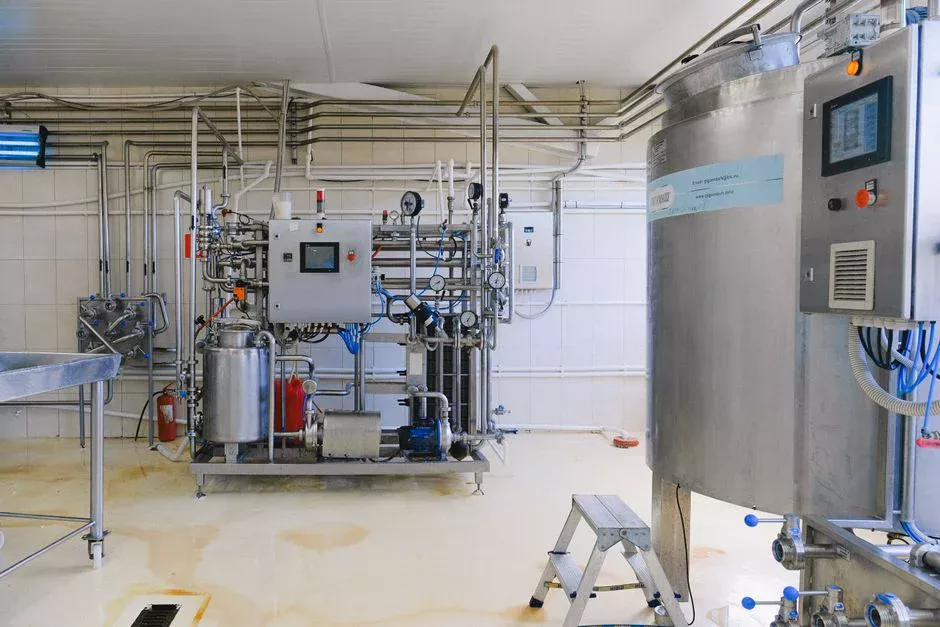
Forward-feed (co-current) keeps steam and liquid moving in the same direction; the most concentrated juice is exposed to the lowest saturated vapor temperature in the last effect, flashing between effects assists circulation, and the pressure profile does not require inter-effect pumps, which is why it dominates sugar evaporators (Chantasiriwan, MDPI 2020). Backward-feed (counter-current) moves the liquid opposite to the vapor; Chantasiriwan's mathematical comparison shows that if the hot and cold fluid inlet temperatures in a counter-flow heat exchanger and a parallel-flow heat exchanger are identical, the log-mean temperature difference is larger in the counter-flow exchanger. Because heat transfer between the hot and cold fluids is proportional to the LMTD, a counter-flow (backward-feed) MEE transfers more heat than a parallel-flow (forward-feed) MEE at the same heating surface area, which is the energy-efficiency advantage Chantasiriwan attributes to backward-feed in his 4-effect sugar model. The trade-off is that backward-feed needs a pump on the concentrated-liquid line because liquid flows from the lowest to the highest pressure, and cold dilute feed meets the coolest effect, which is a problem when the most concentrated stream is also the most viscous. Parallel-feed is used when the feed saturation temperature is above the first effect or when very small volumes of dilute feed are mixed in; it is a side option the engineer should know exists, not a default. Choose forward-feed when concentration and viscosity rise sharply with solids; choose backward-feed when residence time at the highest temperature must be minimized and the feed is not highly viscous.
| Parameter | Forward-feed (co-current) | Backward-feed (counter-current) | Parallel-feed |
|---|---|---|---|
| Steam / liquid direction | Same direction across all effects | Opposite direction (liquid low → high pressure) | Feed split across effects at saturation |
| LMTD at fixed heating area (S1, MDPI 2020) | Lower than counter-current | Higher than parallel-flow at equal area | Case-dependent |
| Inter-effect pumping | Not required (pressure profile drives flow) | Required on the concentrated-liquid line | Not required |
| Concentrate temperature exposure | Most concentrated liquid meets coolest effect | Most concentrated liquid meets hottest effect | Each feed split sees its own effect temperature |
| Best-fit duty | High-solids feeds where viscosity rises sharply with concentration | Low-to-moderate viscosity feeds where residence time at Tmax must be minimized | Small-volume dilute feeds or feeds already above first-effect saturation |
| Industrial example | Sugar industry, multiple-effect evaporators operating in forward-feed (S1) | Several industries, including sugar and selected chemical duties (S1, citing Bhargawa et al.) | Side option for mixed-saturation feeds (S1 framing of flow taxonomy) |
Vacuum and Pressure Profile Across Effects
Each subsequent effect in a multiple effect evaporator operates at a lower temperature and pressure than the previous one, and the pressure differential between effects drives condensation in the next stage (CondorChem, "Multiple effect evaporators for high volumes of wastewater"). For a commercial 1–3 effect wastewater MEE the vacuum setpoints are approximately 310/200/125 mbar across effects 1, 2 and 3, with a dedicated vacuum system on the last effect to condense the final vapor and remove non-condensable gases (CondorChem Envidest DPM and Envidest MFE product lines). Chantasiriwan's 4-effect sugar MEE model uses the first effect at 112.7 kPa with a juice heater saturation temperature of Th,0 = 103 °C, and the last effect at atmospheric pressure 101.3 kPa as the reference pressures (Chantasiriwan, MDPI 2020; scope: sugar case study). Deeper vacuum lowers the boiling temperature and reduces fouling or scaling risk for heat-sensitive or scaling feeds, but it also raises the specific volume of vapor and therefore the vapor-line and condenser diameter — a qualitative trade-off the engineer must carry into equipment sizing.
Evaporation Temperature and Boiling-Point Elevation
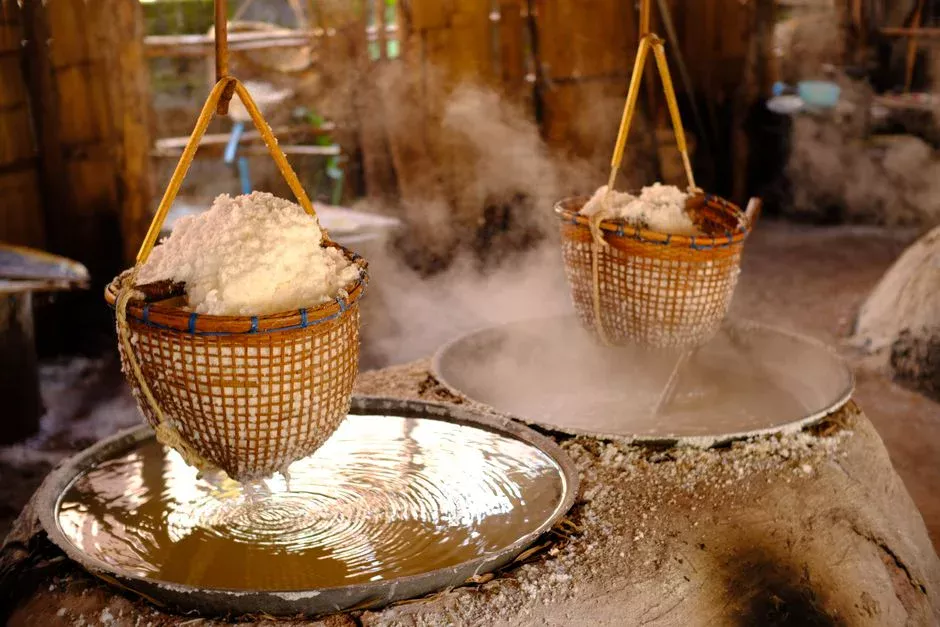
A 3-effect commercial wastewater MEE operates at evaporation temperatures of approximately 70/60/50 °C across effects 1, 2 and 3 (CondorChem Envidest DPM/MFE), which lines up directly with the ≈310/200/125 mbar vacuum profile on the same product line. Real industrial feed is not pure water; it carries dissolved solids, so the actual boiling temperature is higher than that of pure water at the same pressure, and this offset is the boiling-point elevation (BPE). BPE must be added to the saturation temperature of water when sizing each effect, because the temperature driving force in the heat-transfer equation is the difference between the condensing vapor side and the actual juice or wastewater boiling side (Chantasiriwan, MDPI 2020). Chantasiriwan uses the BPE relation Tf = -227.03 + 3816.44/[18.3036 - ln(7.5(p + ρgH/2000))] + 2x/(100-x) with H = 0.3 m as the assumed liquid level in the evaporator vessels, where x is the concentration of dissolved solids in sugar juice, g is gravitational acceleration and ρ is juice density (S1; scope: sugar juice model). The practical consequence is that BPE eats into the available temperature driving force in each effect, and for high-solids feeds BPE — not the achievable vacuum — is often the real cap on how many effects can be added before the required heat-transfer area explodes. The same logic is why an MEE sitting ahead of a zero liquid discharge process guide duty must be sized with the downstream crystallizer's BPE budget in mind, not just pure-water saturation tables.
Heating Surface Area, Heat-Loss and Steam Economy Trade-offs
Each kilogram of primary steam is reused across effects, so both the total heating surface and how that area is distributed across effects control specific steam consumption (Chantasiriwan, MDPI 2020). Chantasiriwan uses a heat-loss coefficient ε = 0.015 in his 4-effect sugar model, a constant that should be carried into any first-pass MEE design and then tuned against real plant heat-loss measurements once the unit is running. Sample heat-transfer correlations are scope-specific to the sugar case: Hugot gives Uh,i = 0.007 Ti (u/1.8)0.8 with juice velocity u = 2.0 m/s for juice heaters, and Wright gives Ui = 0.000049 (110 - xi)1.1616 Tf,i for the Robert evaporator body (Chantasiriwan, MDPI 2020). These are reported as example correlations, not as universal values for any industrial feed, and the engineer should request feed-specific U from the vendor. Earlier work by Chantasiriwan demonstrates that an optimum distribution of heating surface areas across effects exists that minimizes steam consumption, which means an equal-area design across all effects is rarely the lowest-steam option. On a wider thermodynamic view, Ramanathan and Rakshit (IOP Conf. Ser. Mater. Sci. Eng. 556, 2019) show that mass flow rate of steam and wastewater chiefly drive heat transfer and entropy generation in a solar-assisted MEE, while feed concentration and solar-side optical efficiency only matter once heat transfer and thermodynamic performance are optimized jointly. In a wastewater concentration duty, the practical analogue is that a pre-concentration step with an industrial RO system upstream of the MEE can shift the feed-concentration operating point and therefore the heat-transfer balance in the first effect.
Putting It Together: MEE Design Parameter Reference
The single most useful thing a process engineer can bring into a vendor meeting is one consolidated parameter sheet. The only commercial parameter ranges supplied in the research anchor to the CondorChem Envidest DPM and Envidest MFE product lines, both of which share the 1–3 effect envelope, the ≈310/200/125 mbar vacuum setpoints, and the ≈70/60/50 °C evaporation temperatures across effects 1, 2 and 3 (CondorChem, condorchem.com). Chantasiriwan (MDPI 2020) shows backward-feed raises energy efficiency on a 4-effect sugar MEE; the engineer should ask any vendor to quote both forward and backward configurations when feed viscosity allows, because the LMTD advantage does not transfer to all feeds. No CAPEX or OPEX numbers are included in the research, so CAPEX must be requested separately for each configuration, and the engineer should bundle that request with the duty, steam source pressure, feed composition and target discharge specification rather than rely on catalogue pricing. Where the MEE sits ahead of a solids-handling step, the same envelope sets the feed condition for downstream equipment such as a plate and frame filter press for sludge dewatering, so the design parameters of the evaporator and the dewatering line should be developed together rather than in isolation. A reader building a plant-wide water loop can also reference high water volume management best practices and data center cooling water reuse options for the wider reuse and discharge framing.
| Parameter | Envidest DPM (thermal) | Envidest MFE (forced circulation, thermal) |
|---|---|---|
| Technology | Evaporation with thermal energy | Evaporation with thermal energy, forced circulation (FC) |
| Number of effects | 1, 2 or 3 | 1, 2 or 3 |
| Capacity (L/day) | 4,000 to 30,000 | 20,000 to 200,000 |
| Electricity consumption per 1 m³ distillate | 4 to 12 kWh/m³ | 20 to 110 kWh/m³ |
| Thermal energy for evaporation | 130 to 315 kWht | 630 to 2,100 kWht |
| Thermal energy for condensation | 130 to 315 kWht | 630 to 2,100 kWht |
| Vacuum (1st / 2nd / 3rd effect) | ≈ 310 / 200 / 125 mbar | ≈ 310 / 200 / 125 mbar |
| Evaporation temperature (1st / 2nd / 3rd effect) | ≈ 70 / 60 / 50 °C | ≈ 70 / 60 / 50 °C |
Frequently Asked Questions
What capacity range should I expect from a 1–3 effect MEE, and how does it drive equipment sizing?
The CondorChem Envidest product lines anchor commercial 1–3 effect MEE capacity at 4,000–30,000 L/day for the DPM (thermal) unit and 20,000–200,000 L/day for the MFE (forced circulation, thermal) unit, with shared 1–3 effect counts and ≈310/200/125 mbar vacuum setpoints (CondorChem, condorchem.com). The action for the buyer is to request a feed-specific mass and energy balance at your target turndown and peak flow rather than accept a catalogue headline number, because the same envelope handles very different throughputs depending on feed composition and number of effects selected.
How do I choose between a forward-feed and backward-feed MEE when I ask suppliers to quote?
Chantasiriwan (MDPI 2020) demonstrates that backward-feed MEE yields a higher log-mean temperature difference than forward-feed at equal heating surface area, and transfers more heat per unit area in his 4-effect sugar model. The action for the buyer is to ask every vendor to quote both forward and backward configurations on the same heating-area and pressure envelope, and to provide your feed viscosity curve so the vendor can justify the inter-effect pump and viscous-stream penalty that backward-feed imposes on highly concentrated streams.
What vacuum and evaporation temperature setpoints should a 3-effect MEE be designed around?
A commercial 3-effect wastewater MEE is specified at approximately 310/200/125 mbar vacuum and approximately 70/60/50 °C evaporation temperature across effects 1, 2 and 3 (CondorChem Envidest DPM and MFE product lines). The action for the buyer is to confirm that your vendor's last-effect vacuum is sized for your feed's non-condensable gas load, because vacuum stability drives the actual saturation temperature and therefore the heat-transfer area in every effect.
How should I evaluate a supplier's MEE proposal, and what compliance or operating risks should I flag before signing?
CondorChem notes that multi-stage evaporators are "specially recommended for industries with continuous operation or available waste heat, where operating cost savings outweigh higher initial investment", which frames the supplier-selection trade-off as a CAPEX-vs-OPEX decision rather than a single-price comparison. The action for the buyer is to require the vendor to disclose the heat-loss coefficient (ε) used in their model, the assumed BPE for your feed at each effect, and the steam-source pressure and temperature contract, because all three of these inputs set the real operating steam economy and the achievable distillate rate. No cost figures were supplied in the research, so the engineer must request vendor-specific CAPEX, steam and electricity OPEX, and any discharge permit constraints as separate line items rather than accept a single bundled price.