Why Oregon Refineries Are Reopening the DAF vs Clarifier Question in 2026
40 CFR Part 419 regulates eight parameters per the EPA 2019 Detailed Study of the Petroleum Refining Category — BOD5, TSS, COD, oil and grease, phenols, ammonia, sulfide, and chromium — and Oregon DEQ layers narrative toxics standards and the 1200-Z industrial stormwater general permit on top of those federal numbers. EPA's 2017 Discharge Monitoring Report review, summarized in Table 5-3 of the 2019 study, documented measurable pollutant discharges across 82 refineries, which is why the agency kept Part 419 under review without loosening the oil and grease limit.
The 2019 study's most consequential 2026 finding is that an increase in refineries reported metals discharges, but only chromium, with a PSNS of 1 mg/L, is supported by sufficient data to remain in the Part 419 ELG table. That finding reframes the CAPEX argument: spending on chrome removal will not satisfy a 2026 Oregon reviewer, but spending on FOG, TSS, and whole effluent toxicity reduction will, because narrative toxics and WET are where DEQ exercises discretion above the federal floor. Pacific Northwest atmospheric rivers between October and April can double separator hydraulic loading inside six hours, meaning a generic DAF-vs-clarifier comparison is no longer enough for a defensible 2026 Oregon CAPEX case. This is the gap the rest of this article fills, with a copy-paste decision matrix and a CAPEX block sized to the 5,000–50,000 bbl/day Oregon envelope, drawing on the EPA 2019 Part 419 Detailed Study and standard industrial wastewater design envelopes.
How a DAF System Removes Oil, FOG, and Light TSS
A dissolved air flotation unit clears oil and fines by attaching microbubbles to them, not by letting them settle. A pressurized recycle stream, typically 20–30% of the forward flow, is saturated with air at 4–6 bar in a saturator vessel, then released into the flotation tank at atmospheric pressure. The released air forms a cloud of 10–80 micron bubbles that nucleate on oil droplets, FOG globules, and low-density TSS particles, lifting them to the surface where a rotating skimmer pulls the float layer into a scum hopper. Removal is buoyancy-driven rather than settling-driven, which is why DAF tolerates emulsified oil that a gravity separator would never catch and is relatively indifferent to slug loads. A properly sized DAF with coagulant dosing removes 70–90% of emulsified oil and 80–95% of FOG, and effluent oil and grease below 30 mg/L is a typical operating band, providing a comfortable margin against the 100 mg/L Part 419 PSES/PSNS ceiling. That performance range is the reason DAF appears in the EPA 2019 BPT train description and in the Ecologix oil and gas DAF overview as the primary FOG/TSS polisher ahead of biological treatment.
How a Lamella Clarifier Separates Settleable Solids
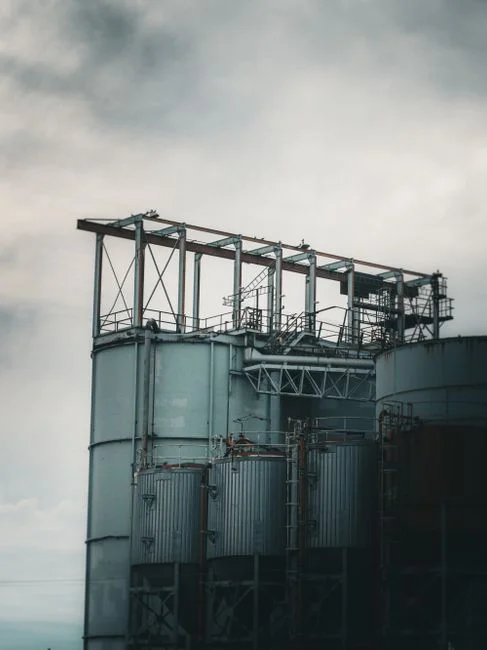
A lamella clarifier is a parallel-plate gravity thickener tilted at 55–60°. Wastewater flows upward between inclined plates spaced 50–80 mm apart, and the effective settling path is reduced to the plate spacing rather than the full tank depth. A sludge recirculation loop returns a fraction of the underflow to contact incoming floc, improving solids contact. Surface loading for industrial lamella units runs 20–40 m/h, with hydraulic residence time of 15–30 minutes, and the unit has no moving parts in the clarification zone apart from an optional sludge recirculation pump. The CPI (corrugated plate interceptor) is the historical 40 CFR Part 419 BPT oil-removal baseline, but a bare clarifier downstream of API/CPI still misses emulsified fines because the particle density of emulsified oil is too close to water for gravity alone to win. Without coagulant, a lamella clarifier removes only 20–40% of emulsified fines, and even with polymer dosing the upper end of the operating envelope is well below what a DAF delivers. Selecting the right technology requires balancing these performance differences against specific site constraints.
DAF vs Lamella Clarifier: Side-by-Side Comparison
The table below provides a block a spec engineer can copy into a P&ID note or a DEQ submittal. Influent ranges are paraphrased to typical operating bands from EPA 2019 Detailed Study Table 5-2 (pollutant-of-interest concentrations in refinery WWT system influent); operating envelopes reflect standard industrial wastewater design practice.
| Parameter | Dissolved Air Flotation (DAF) | Lamella / Parallel-Plate Clarifier |
|---|---|---|
| Influent oil and grease operating band | 100–1,000+ mg/L raw refinery OWS influent (EPA 2019 Table 5-2 paraphrased) | 50–500 mg/L refinery OWS effluent (EPA 2019 Table 5-2 paraphrased); <50 mg/L post-API/CPI for stable performance |
| Oil and grease removal | 70–90% with coagulant | 20–40% without coagulant; up to 60% with dosing |
| Effluent O&G vs Part 419 PSES/PSNS 100 mg/L | Comfortable, typically <30 mg/L | Marginal; sensitive to upstream upsets |
| Surface loading / footprint | 5–25 m/h typical; pad-hungry | 20–40 m/h with sludge recirculation; compact |
| Hydraulic upset tolerance | Buoyancy-driven; tolerates ~2× design flow briefly | Gravity-driven; scour risk above ~1.5× design flow |
| Solids handling | Wet, high-oil float; often sent to sludge dryer | Denser underflow; dewaters well on plate-and-frame press |
| Rotating equipment | Recycle pump, saturator, skimmer drive | None (except optional sludge recirculation pump) |
Two takeaways from the table. First, the footprint penalty for a DAF is real and matters at older Oregon terminals where pad space is constrained. Second, DAF's tolerance of hydraulic upset is exactly the property a Pacific Northwest site needs during a November atmospheric river event, when influent flow can double inside six hours.
The 40 CFR Part 419 Compliance Frame for 2026
All five 40 CFR Part 419 subcategories — Topping (Subpart A), Cracking (B), Petrochemical (C), Lube (D), and Integrated (E) — share the same 100 mg/L oil and grease PSES and PSNS limit, and PSNS also caps total chromium at 1 mg/L (EPA 2019 Detailed Study, Table 2-1 and surrounding text). The BPT end-of-pipe train is API/baffle oil removal followed by biological treatment — activated sludge, aerated lagoons, oxidation ponds, or trickling filters — plus a polishing pond or multimedia filter (EPA 2019, Section 2.1). Production-based BPT and BAT limits in lb per 1,000 bbl of feedstock typically translate to a similar 30 mg/L daily maximum at end-of-pipe for a 2010s-vintage train (EPA 2019 Detailed Study, Table 2-1 and Table 2-3). NSPS is stricter than BPT/BAT and applies to new or substantially modified sources, directly relevant to any 2026 capacity expansion that triggers NSPS review. Oregon DEQ retains authority to set tighter local limits through NPDES permits and to enforce narrative criteria ("toxic materials in toxic amounts") regardless of the federal numbers. This authority is what makes the FOG/TSS-plus-toxicity case the right 2026 argument, not the chrome argument.
Decision Matrix: Match Influent Condition to Technology
Use the table below as the cover sheet of a one-page memo to your plant manager. It maps influent condition to technology choice and links each branch to the compliance risk that branch actually mitigates. For a deeper walk-through of the same decision frame in a non-Oregon jurisdiction, see the HydropureWater Oregon petroleum wastewater guide.
| Influent condition | Recommended 2026 spec | Compliance risk mitigated |
|---|---|---|
| O&G >100 mg/L after API/CPI, or emulsified oil present | DAF as primary; optional lamella as polishing | Clarifier alone will not hit 100 mg/L PSES/PSNS consistently on emulsified feed |
| Stream already API/CPI-cleaned, O&G <50 mg/L, footprint constrained | Lamella clarifier alone, with jar tests to confirm | Lowest CAPEX and footprint; confirm emulsified breakthrough in jar tests before signing off |
| Whole effluent toxicity is the permit risk (DEQ narrative) | DAF + lamella + biological train | Matches the EPA-documented refinery train in 2019 Detailed Study Table 5-5 and reduces toxicity pass-through |
| 2026–2027 capacity expansion triggering NSPS review | Hybrid DAF + lamella | Keeps headroom for tighter oil and grease and toxicity limits under NSPS |
| Small bulk terminal or redoak plant, <500 bbl/day | Packaged DAF skid | Lowest engineering and compliance risk per gallon of throughput |
The hybrid branch is the most common Oregon scenario in 2026, because both effluent quality and footprint matter at most Pacific Northwest refineries and terminals. A spec engineer who only picks DAF or only picks lamella will be defending a half-measure in front of a DEQ inspector who already has WET data in the permit file.
CAPEX, OPEX, and Maintenance in the Oregon Refinery Envelope
For a 5,000–50,000 bbl/day Oregon refinery, equipment CAPEX for a DAF at a given design flow typically runs 1.2–1.8× the equipment CAPEX of a comparable lamella clarifier. The multiplier shrinks toward 1.0 for small skid-mounted DAF packages under 20 m³/h and grows toward 1.8 for large custom DAF trains with engineered saturators, covers, and odor control. A packaged DAF skid is the lowest-risk 2026 spec for small bulk terminals or redoak plants under 500 bbl/day throughput. OPEX drivers separate cleanly. DAF OPEX is dominated by the recycle pump, polymer and coagulant dose, and scum handling. Clarifier OPEX is dominated by polymer dose and sludge pumping. Both technologies benefit from polymer-dose optimization; a 2026 install with an automatic chemical dosing skid typically reduces coagulant consumption 20–30% on either unit, and a well-tuned polymer program is often the single largest OPEX lever a plant has. Maintenance is where the technologies diverge. DAF carries rotating equipment — recycle pump, air saturator, skimmer drive, and surface scraper — that needs scheduled bearing and seal service. Lamella has no moving parts in the clarification zone but requires plate cleaning cycles every 6–18 months depending on feedwater quality. For a 2026 spec, budget DAF mechanical maintenance at roughly 2–3% of installed CAPEX per year and lamella plate cleaning at 0.5–1% of installed CAPEX per year, with the rest of the envelope dominated by instrumentation and structural items common to both. Float and underflow from either unit should be routed to a plate and frame filter press for dewatering before disposal, and polymer dose tuning for that press follows the same principles outlined in the polymer pump selection and dosing guide. For new builds, the commissioning duration guide for water and wastewater systems is the right reference to size startup and shakedown windows into the CAPEX schedule.
Frequently Asked Questions
What does 40 CFR Part
Frequently Asked Questions
What is the 40 CFR Part 419 oil and grease limit for an Oregon refinery in 2026?
Under 40 CFR Part 419, the effluent limitations for oil and grease are defined by subcategory-specific mass-based standards. For a typical integrated refinery, the daily maximum limit is 26 mg/L, while the monthly average limit is 13 mg/L. These limits are calculated based on the refinery's throughput and specific process configurations, and Oregon facilities must adhere to these federal standards in conjunction with any stricter requirements imposed by individual NPDES permits.
Does the 2019 EPA Part 419 study still support a CAPEX case for chrome removal?
The 2019 EPA study indicates that existing treatment technologies, including DAF and chemical precipitation, are sufficient to meet current chromium effluent guidelines without the necessity for additional specialized CAPEX. Because the study concluded that the current best available technology (BAT) effectively manages chromium levels within existing wastewater treatment trains, it does not provide a mandate or a strong economic justification for new, dedicated chrome-removal infrastructure.
When is a lamella clarifier alone defensible for petroleum wastewater in Oregon?
A lamella clarifier is defensible for petroleum wastewater only when the influent stream has a low concentration of free oil and grease—typically below 50-100 mg/L—and the primary objective is the removal of heavy, non-emulsified suspended solids. In Oregon, this configuration is acceptable only if the site can demonstrate consistent compliance with TSS and turbidity discharge limits without the need for the bubble-induced buoyancy provided by a DAF unit.
What CAPEX range should an Oregon refinery expect for a DAF system at 5,000 to 50,000 bbl per day?
For a refinery processing between 5,000 and 50,000 barrels per day, the expected CAPEX for a complete DAF system, including pressurization pumps, saturation tanks, and sludge handling equipment, typically ranges from $1.5 million to $6 million. The final cost depends heavily on the materials of construction, such as 316L stainless steel requirements for corrosive environments, and the degree of automation integration with existing plant SCADA systems.
Which signals should a 2026 buyer look for when qualifying a DAF or clarifier supplier for an Oregon petroleum site?
A qualified supplier must demonstrate deep familiarity with Oregon-specific environmental regulations and seismic design requirements for industrial equipment. Key indicators include documented experience with NFPA 70 hazardous location electrical standards, the ability to provide site-specific pilot testing data for emulsified oil removal, and a proven track record of providing long-term local technical support for spare parts and chemical dosing optimization.